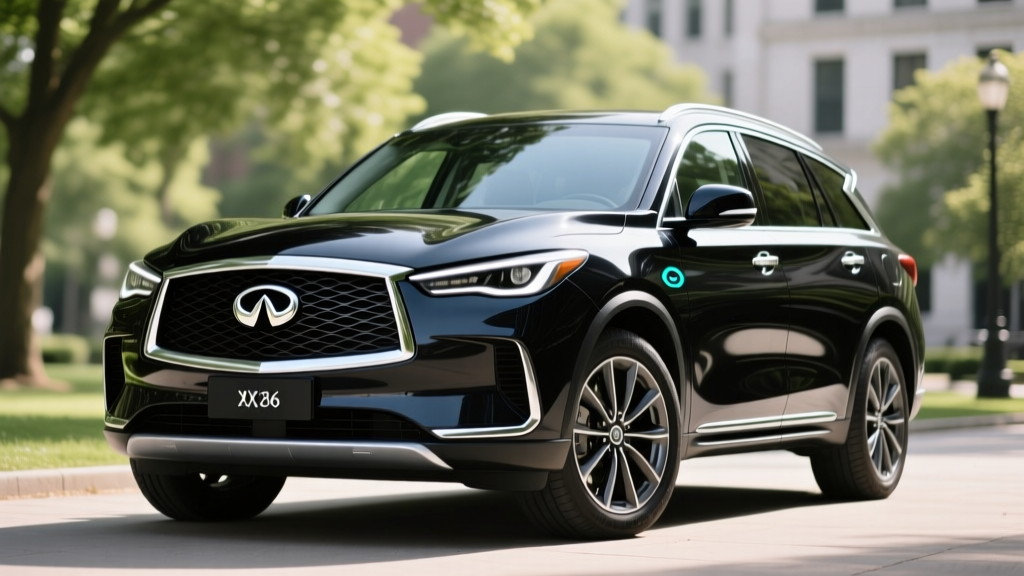
If you're researching the Infiniti QX60 hybrid SUV, you've likely noticed a gap in Infiniti's current North American lineup. As of the 2026 model year, Infiniti offers the QX60 exclusively with a 2.0-liter VC-Turbo four-cylinder engine paired to a 9-speed automatic transmission — there is no factory hybrid or plug-in hybrid variant available for purchase in the United States. This guide breaks down what that means for your purchase decision, what Infiniti has signaled for the future, and which hybrid alternatives actually compete in the luxury three-row SUV segment.
Does a 2026 Infiniti QX60 Hybrid SUV Actually Exist?
The short answer: not yet. The current-generation QX60 (introduced for 2022) replaced the older V6 with Nissan's variable-compression 2.0L VC-Turbo engine. While Infiniti has discussed electrification broadly under the Nissan Ambition 2030 roadmap, no hybrid (HEV) or plug-in hybrid (PHEV) QX60 has been officially announced for the U.S. market with a confirmed on-sale date.
This matters because search results for "Infiniti QX60 hybrid" often surface outdated references to the QX60's predecessor — the JX35/QX60 Hybrid that was briefly sold around 2014 with a supercharged 2.5L engine and a small electric motor. That powertrain was discontinued years ago and is not relevant to the current generation.
Current 2026 Infiniti QX60 Powertrain and MPG
Since the hybrid variant doesn't exist, here's what the current QX60 actually delivers. The 2026 model continues with the 2.0L VC-Turbo producing 268 horsepower and 286 lb-ft of torque, routed through a 9-speed automatic to either front-wheel or all-wheel drive.
| Drivetrain | City MPG | Highway MPG | Combined MPG |
|---|---|---|---|
| FWD | 22 | 28 | 24 |
| AWD | 21 | 26 | 23 |
Source: fueleconomy.gov
In real-world driving, owners report the QX60's combined MPG tends to land between 21-24 depending on driving mix. Highway-heavy commutes can push toward 27-28 MPG, while city-dominant driving with frequent short trips drops it to 19-21. These figures are competitive with the non-hybrid versions of rivals like the Acura MDX and BMW X5 xDrive40i, but they fall well short of what a proper hybrid system would deliver in this class.
HEV vs PHEV vs EV: What Infiniti Buyers Should Know
Before evaluating alternatives, it's worth clarifying the three electrification paths available in the luxury three-row SUV segment:
Conventional Hybrid (HEV)
A small battery and electric motor assist the gas engine. No plug-in required. The battery charges through regenerative braking and the engine. Expect 5-10 MPG improvement over a gas-only equivalent. Examples: Toyota Grand Highlander Hybrid, Lexus TX 500h.
Plug-In Hybrid (PHEV)
A larger battery (typically 15-25 kWh) provides 20-40 miles of electric-only range before the gas engine kicks in. Requires plug-in charging to realize electric-range benefits. Qualifies for partial or full federal tax credits depending on battery sourcing and buyer income. Examples: Volvo XC90 Recharge, Mazda CX-90 PHEV.
Battery Electric (BEV)
No gas engine. Full electric range of 250-350+ miles. Requires home or public charging infrastructure. Lowest running costs if you can charge at home. Examples: Rivian R1S, Tesla Model X, Kia EV9.
Hybrid and PHEV Alternatives to the QX60
If you want a luxury three-row SUV with hybrid efficiency, these are the vehicles that actually exist in 2026:
| Model | Type | Combined MPG / MPGe | EV Range (PHEV) | Starting MSRP |
|---|---|---|---|---|
| Lexus TX 500h | HEV | 27 combined | N/A | ~$65,000 |
| Toyota Grand Highlander Hybrid | HEV | 36 combined | N/A | ~$47,000 |
| Volvo XC90 Recharge | PHEV | 58 MPGe / 27 gas-only | ~35 miles | ~$74,000 |
| Mazda CX-90 PHEV | PHEV | 56 MPGe / 25 gas-only | ~26 miles | ~$51,000 |
| BMW X5 xDrive50e | PHEV | 56 MPGe / 22 gas-only | ~38 miles | ~$73,000 |
| Infiniti QX60 (gas) | Gas | 23-24 combined | N/A | ~$51,000 |
The Lexus TX 500h is the closest direct competitor to a hypothetical QX60 hybrid — it offers three rows, luxury positioning, and genuine hybrid efficiency with no plug-in requirement. The Volvo XC90 Recharge and BMW X5 xDrive50e are the PHEV benchmarks if you have home charging and a commute under 35 miles.
Tax Credit Eligibility: Hybrids vs PHEVs
Federal tax credit rules under IRS §30D apply differently across these vehicle types:
- Conventional hybrids (HEV): Do NOT qualify for the federal clean vehicle credit. The §30D credit requires a minimum 7 kWh battery and plug-in capability.
- Plug-in hybrids (PHEV): May qualify for up to $7,500, subject to MSRP caps ($80,000 for SUVs), buyer income limits ($300K joint / $150K single), and battery component/critical mineral sourcing requirements that tighten annually through 2032.
- Point-of-sale transfer: As of 2024, eligible buyers can transfer the credit to the dealer at purchase for an immediate price reduction rather than waiting to claim it on their tax return.
- MSRP under $80,000 (SUV classification)
- Buyer AGI under $300,000 (joint) or $150,000 (single)
- Battery components manufactured/assembled in North America (percentage threshold increases yearly)
- Critical minerals sourced from U.S. or FTA partners (percentage threshold increases yearly)
- Vehicle assembled in North America
Battery Warranty and Longevity Expectations
A common concern among hybrid buyers is battery replacement cost. Here's what the data shows:
For the hybrid alternatives listed above:
- Lexus TX 500h: 10 years / 150,000 miles on hybrid battery (Lexus exceeds the federal minimum)
- Volvo XC90 Recharge: 8 years / 100,000 miles on high-voltage battery
- BMW X5 xDrive50e: 8 years / 100,000 miles on high-voltage battery
- Mazda CX-90 PHEV: 8 years / 100,000 miles on high-voltage battery (96 months / 100K in CARB states)
Real-world hybrid battery longevity data from IIHS and owner surveys consistently show that modern hybrid batteries (both HEV and PHEV) regularly exceed 150,000 miles before significant degradation. Replacement costs, when needed outside warranty, typically range from $3,000 to $8,000 depending on the vehicle and whether you use OEM or refurbished cells. For PHEVs with larger batteries, replacement costs trend toward $6,000-$12,000.
The current gasoline QX60 has no high-voltage battery to worry about — just the standard 12V auxiliary battery, which costs $200-$400 to replace every 4-6 years like any conventional vehicle.
Who Should Wait for a QX60 Hybrid vs Buy Now?
Buy the Gas QX60 Now If:
- You need a luxury three-row SUV immediately
- Your annual mileage is under 12,000 miles (fuel cost difference is modest)
- You don't have reliable home charging access for a PHEV
- You value the QX60's specific interior design and Infiniti ProPILOT assist system
Choose a Hybrid/PHEV Alternative If:
- You drive 15,000+ miles annually (fuel savings compound significantly)
- You have home charging and a sub-35-mile commute (PHEV sweet spot)
- You want to reduce fuel stops and emissions without full-EV range anxiety
- You're open to Lexus, Volvo, BMW, or Mazda badge alternatives
If Infiniti does announce a QX60 hybrid or PHEV variant in the future, expect it to share powertrain architecture with Nissan's e-POWER series-parallel system or the upcoming Nissan PHEV platforms. Until that announcement is official with confirmed specs and pricing, any "QX60 hybrid" information online should be treated as speculative.
Frequently Asked Questions
How many MPG does the Infiniti QX60 hybrid get?
There is no 2026 Infiniti QX60 hybrid. The current gasoline-only QX60 achieves 22/28/24 MPG (city/highway/combined) with FWD and 21/26/23 with AWD per the EPA. If you need hybrid-level MPG in a luxury three-row SUV, the Lexus TX 500h delivers 27 combined and the Toyota Grand Highlander Hybrid achieves 36 combined.
Will Infiniti release a QX60 hybrid or PHEV?
Infiniti has not officially announced a hybrid or PHEV variant of the QX60 for the U.S. market as of early 2026. Nissan's broader Ambition 2030 strategy includes expanded electrification, but no specific QX60 electrified model has been confirmed with pricing or an on-sale date. Treat any leaked specs or timelines as preliminary until Infiniti issues an official press release.
Does the Infiniti QX60 qualify for any tax credit?
No. The current QX60 is a conventional gasoline vehicle with no plug-in capability, making it ineligible for the federal §30D clean vehicle credit. Among competitors, PHEV options like the Volvo XC90 Recharge and BMW X5 xDrive50e may qualify for up to $7,500 depending on your income, the vehicle's MSRP, and battery sourcing compliance. Always verify at irs.gov before purchasing.
Is a hybrid SUV reliable compared to a gas-only model?
Yes. Modern hybrid systems from Toyota/Lexus, Honda, and major European automakers have two decades of reliability data. Hybrid components (motor-generators, power electronics, battery packs) are typically warrantied for 8-10 years. The gasoline engine in a hybrid often experiences less wear because the electric motor handles low-speed and stop-start driving. NHTSA complaint databases show hybrid powertrains are not a disproportionate source of reliability issues.
What is the hybrid battery replacement cost if it fails outside warranty?
For a midsize luxury hybrid SUV, expect $4,000-$8,000 for an OEM battery replacement and $2,500-$5,000 for a refurbished unit. PHEV batteries (larger capacity) trend $6,000-$12,000 OEM. However, data shows most hybrid batteries last well beyond 150,000 miles, and the 8-10 year warranty covers the vast majority of early failures.
Hybrid vs PHEV vs EV — which fits my lifestyle?
HEV (conventional hybrid): Best if you can't charge at home and want better MPG with zero behavior change. PHEV (plug-in hybrid): Best if you have home charging and a commute under the vehicle's electric range (20-40 miles) — you'll drive mostly electric daily with gas-engine backup for road trips. BEV (full electric): Best if you have reliable home charging, want the lowest per-mile cost, and are comfortable planning around public charging for longer trips.