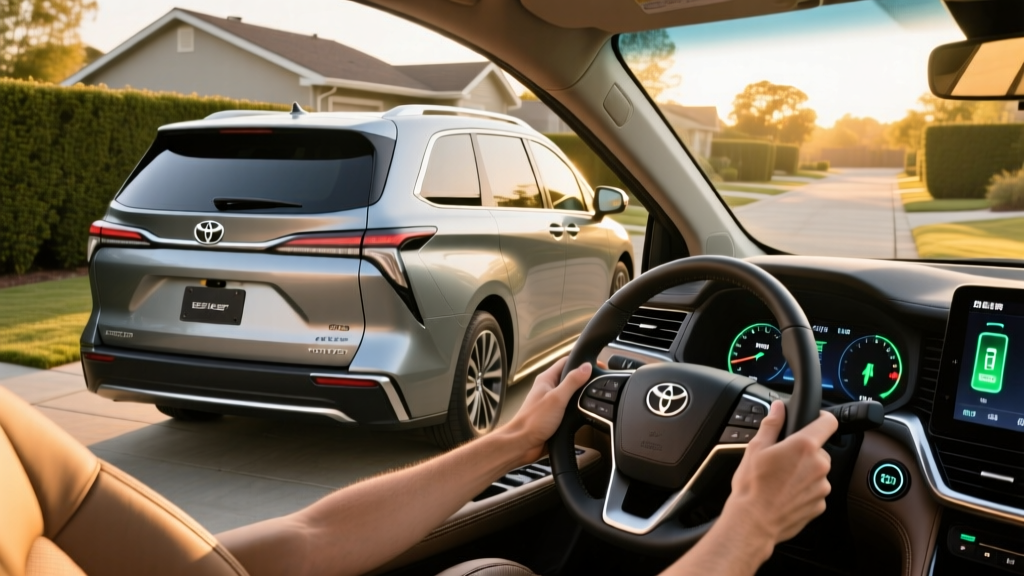
The 2022 Toyota Sienna XLE Hybrid occupies a rare position in the minivan segment: it's a full hybrid electric vehicle (HEV) that requires no plug, no behavior change, and no range anxiety — yet delivers fuel economy that embarrasses most compact sedans. For families evaluating whether a hybrid minivan, a plug-in hybrid (PHEV), or a full battery-electric vehicle (BEV) makes the most financial sense, the Sienna XLE provides a compelling data point. Here's the complete ownership picture, from EPA numbers to long-term battery reliability.
HEV vs PHEV vs BEV: Where the Sienna XLE Fits
Before examining specs, it's critical to distinguish the three electrification paths available to minivan buyers. The 2022 Sienna is a conventional hybrid (HEV) — it generates all its electricity onboard through regenerative braking and its gasoline engine. There is no plug, no electric-only driving mode of meaningful distance, and no home charger requirement.
| Feature | HEV (Sienna) | PHEV (e.g., Chrysler Pacifica Hybrid) | BEV (e.g., Kia EV9) |
|---|---|---|---|
| Plug-in required? | No | Yes (Level 2 recommended) | Yes (Level 2 essential) |
| Electric-only range | ~1 mile at low speed | 32 miles (EPA) | 230-300+ miles (EPA) |
| Home charger needed? | No | Recommended | Required |
| Federal tax credit (§30D) | Not eligible | Up to $7,500 (sourcing rules apply) | Up to $7,500 (sourcing rules apply) |
| Best for | No garage/outlet access | Short commutes + road trips | Home charging + daily driving |
The Chrysler Pacifica Hybrid is the Sienna's only PHEV minivan rival, offering 32 miles of electric-only range before the gas engine engages. If you have garage access with a 240V outlet and a commute under 30 miles, the Pacifica PHEV can run almost entirely on electricity on weekdays while retaining gas-engine flexibility for road trips. But if you lack charging access — apartment dwellers, street parkers, or those who simply don't want to think about plugging in — the Sienna HEV delivers most of the fuel savings with zero infrastructure demands.
Fuel Economy: EPA Ratings and Real-World MPG
The 2022 Toyota Sienna XLE is available in both front-wheel drive (FWD) and all-wheel drive (AWD). The FWD variant carries slightly higher EPA ratings, while AWD adds an independent rear electric motor for traction at the cost of roughly 1 MPG combined.
| Drivetrain | City (EPA) | Combined (EPA) | Fuel Tank | Total Range | |
|---|---|---|---|---|---|
| FWD | 36 MPG | 36 MPG | 36 MPG | 14.5 gal | ~522 miles |
| AWD (XLE) | 35 MPG | 36 MPG | 35 MPG | 14.5 gal | ~508 miles |
Source: EPA Fuel Economy
Real-World MPG: What Owners Actually See
Toyota's hybrid synergy drive system excels in stop-and-go traffic, where regenerative braking recovers kinetic energy and the electric motor handles low-speed propulsion. In city driving, many Sienna owners report exceeding the EPA city estimate, with 38-42 MPG achievable in moderate-temperature urban conditions. This is the opposite of conventional gas vehicles, which suffer their worst efficiency in city traffic.
Highway driving tells a different story. At sustained 75-80 MPH speeds, the aerodynamic drag of a minivan body works against the hybrid system's advantages. Expect 30-33 MPG on the highway in real-world conditions — below the EPA sticker. Cold weather (below 35°F) further reduces efficiency by 10-15% as the engine runs more frequently to provide cabin heat and maintain battery temperature.
For a family driving 15,000 miles per year with a 60/40 city/highway split, the AWD Sienna XLE will consume roughly 430 gallons of fuel annually. At $3.40/gallon (national average), that's approximately $1,462 per year in fuel costs — roughly $800 less than a non-hybrid minivan rated at 22 MPG combined.
Powertrain Specs: Engine, Motors, and Combined Output
| Specification | 2022 Sienna XLE Hybrid |
|---|---|
| Engine | 2.5L 4-cylinder Atkinson cycle |
| Engine output | 189 HP / 176 lb-ft torque |
| Front electric motor | 134 HP / 199 lb-ft |
| Rear electric motor (AWD only) | 54 HP / 89 lb-ft |
| Combined system horsepower | 245 HP (FWD & AWD) |
| Transmission | eCVT (electronically controlled) |
| 0-60 MPH | ~7.1 seconds (FWD) |
| Towing capacity | 3,500 lbs |
| Hybrid battery | 1.9 kWh NiMH (sealed, non-plug-in) |
The Sienna's 245 combined horsepower is delivered through Toyota's fourth-generation hybrid system. The 2.5-liter Atkinson-cycle engine prioritizes thermal efficiency over peak power, while the front electric motor provides instant torque from a standstill. AWD models add a separate rear-axle electric motor that engages automatically during acceleration or low-traction conditions — there is no mechanical driveshaft connecting the front and rear axles.
The 1.9 kWh nickel-metal hydride (NiMH) traction battery is compact, mounted under the second-row seats. Unlike PHEV or BEV batteries measured in tens or hundreds of kWh, this small buffer exists solely to capture regenerative braking energy and provide short bursts of electric assist. It never depletes to zero or charges to 100% — the hybrid system maintains a narrow state-of-charge window (roughly 40-80%) to maximize longevity.
Pricing and Tax Credit Eligibility
The 2022 Toyota Sienna XLE originally carried an MSRP of $41,160 for FWD and $41,910 for AWD, including destination charges. As a 2022 model year vehicle, it is now available only on the used market, where clean examples typically trade between $32,000 and $38,000 depending on mileage and condition.
Federal tax credit status: The Sienna Hybrid is a conventional HEV, not a plug-in vehicle. Under IRS §30D Clean Vehicle Credit rules, only plug-in electric vehicles (PHEVs and BEVs) with sufficient battery capacity qualify for the up-to-$7,500 federal credit. The Sienna Hybrid does not qualify for any federal EV tax credit.
Some states offer their own hybrid or clean-vehicle rebates that may include HEVs, but these vary by jurisdiction and change frequently. Check your state's energy or environmental agency for current programs.
Battery Warranty, Reliability, and Replacement Costs
Hybrid battery longevity is consistently the top concern among first-time hybrid buyers. Toyota addresses this with one of the strongest hybrid battery warranties in the industry.
2022 Sienna Hybrid Battery Warranty
- Hybrid battery coverage: 10 years / 150,000 miles (whichever comes first)
- Hybrid system components: 8 years / 100,000 miles
- Capacity retention threshold: Toyota covers the battery if it fails to hold sufficient charge to operate the hybrid system normally
- Transferable: Yes — warranty transfers to subsequent owners automatically
Toyota's hybrid battery track record is among the best in the industry. The Prius, which has used a similar NiMH chemistry since 2001, routinely sees original batteries lasting 200,000+ miles. The Sienna's hybrid system is less stressed than a PHEV or BEV battery because it operates in a narrow state-of-charge band, avoiding the deep discharge cycles that accelerate degradation in larger batteries.
If a hybrid battery replacement is needed out of warranty, expect to pay $2,500 to $4,000 for a new OEM battery pack at a Toyota dealer, or $1,500 to $2,500 for a refurbished unit from a third-party hybrid specialist. Individual module replacement (replacing only the degraded cells within the pack) can reduce costs further to $500-$1,200 at independent hybrid repair shops.
According to IIHS, the 2022 Sienna earned a Top Safety Pick+ rating with Good scores across all crashworthiness tests, reinforcing Toyota's reputation for building durable family vehicles.
Sienna XLE Hybrid vs PHEV vs Full EV: Which Should You Choose?
Choose the Sienna HEV If:
- You lack home charging access (apartment, street parking, no 240V outlet)
- You want zero behavior change — no plugging in, no route planning
- You frequently take long road trips where charging infrastructure is sparse
- You want proven reliability with a 10-year hybrid battery warranty
- Your priority is reducing fuel costs without upfront EV premium
Consider a PHEV or BEV Instead If:
- You have garage/outlet access and a commute under 30 miles (PHEV sweet spot)
- You want to maximize electric-only driving and minimize gasoline use
- You qualify for the $7,500 federal tax credit (income + sourcing requirements)
- You want the quietest, smoothest driving experience (BEV advantage)
- You're willing to plan charging stops on road trips (BEV trade-off)
The math often favors the Sienna HEV for families who drive 12,000-18,000 miles per year with mixed city/highway use. At 35 MPG combined and current fuel prices, annual fuel costs run $1,400-$1,500. A comparable gas-only minivan at 22 MPG would cost $2,300-$2,400 annually — a roughly $900/year savings for the hybrid with no charging infrastructure investment.
A PHEV minivan like the Pacifica Hybrid can reduce fuel costs further if most weekday driving stays within its 32-mile electric range, but the higher purchase price and home charger installation ($500-$2,000) offset savings for many buyers. A full-electric three-row SUV like the Kia EV9 eliminates gasoline entirely but starts above $54,000 and requires reliable home or workplace charging.
Frequently Asked Questions
How many MPG does the 2022 Toyota Sienna XLE Hybrid actually get?
The EPA rates the FWD Sienna XLE at 36 MPG city/highway/combined, and AWD at 35/36/35. In real-world city driving, owners frequently see 38-42 MPG thanks to regenerative braking. Highway driving at 75+ MPH typically yields 30-33 MPG. Cold weather reduces these figures by 10-15%.
Does the Sienna Hybrid need to be plugged in?
No. The Sienna is a conventional hybrid (HEV), not a plug-in hybrid (PHEV). It charges its small 1.9 kWh battery entirely through regenerative braking and the gasoline engine. You fuel it like any other vehicle at a gas station.
How long will the hybrid battery last, and what does replacement cost?
Toyota covers the hybrid battery for 10 years/150,000 miles. Based on Toyota's track record with NiMH hybrid batteries (Prius, Camry Hybrid), original batteries commonly last 200,000+ miles. If replacement is needed out of warranty, expect $2,500-$4,000 for a new OEM pack or $1,500-$2,500 for a refurbished unit.
Does the 2022 Sienna Hybrid qualify for any federal tax credit?
No. The IRS §30D Clean Vehicle Credit applies only to plug-in vehicles (PHEVs and BEVs) meeting battery sourcing, MSRP, and buyer income requirements. The Sienna HEV has no plug and does not qualify. Some state-level incentives may include conventional hybrids — check your state's energy agency.
Is the AWD system always active?
No. The AWD Sienna's rear electric motor engages on-demand during hard acceleration, slippery conditions, or when the system detects front-wheel slip. During steady-state cruising on dry pavement, the Sienna AWD operates primarily as a front-wheel-drive vehicle, which is why the fuel economy penalty versus FWD is only 1 MPG.
How does the Sienna Hybrid compare to the Chrysler Pacifica Hybrid?
The Pacifica Hybrid is a PHEV with 32 miles of electric-only range and a combined 30 MPG once the battery is depleted. It qualifies for the $7,500 federal credit (subject to current sourcing rules) and is ideal for families with home charging and short commutes. The Sienna HEV offers better fuel economy once a PHEV's electric range is exhausted (35-36 vs 30 MPG), requires no plug, and has a lower starting price — but no electric-only driving and no federal tax credit.