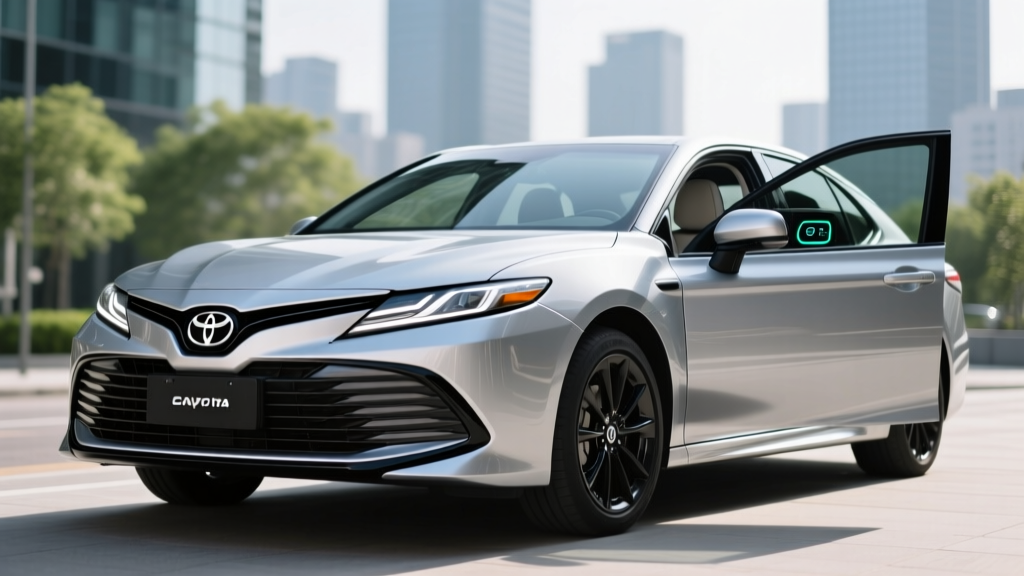
The 2025 Toyota Camry entered its ninth generation with a bold move: every single Camry is now a hybrid. Toyota dropped the gas-only four-cylinder entirely, making the Hybrid MAX powertrain standard across all trims. For buyers specifically searching for all-wheel drive, the 2025 Camry Hybrid AWD is available on every trim level — LE, SE, XLE, and XSE — with no package restrictions. That's a significant shift from previous generations where AWD was limited or required specific configurations.
If you're researching 2025 Toyota Camry Hybrid AWD availability, here's the short answer: it's broadly available at dealers nationwide, but high-demand trims (particularly the SE AWD and XSE AWD) may carry wait times of 2–6 weeks depending on your region. Let's break down exactly what's offered, what it costs, and whether this hybrid sedan fits your driving needs.
2025 Camry Hybrid AWD: Trim Availability and Pricing
Toyota simplified the Camry lineup for 2025. The hybrid system is standard, and AWD is a straightforward $1,500 add across all four trims. Here's the complete MSRP breakdown before destination charges:
| Trim | FWD MSRP | AWD MSRP | Combined HP | Key Features |
|---|---|---|---|---|
| LE AWD | $28,400 | $29,900 | 232 hp | 8" touchscreen, TSS 3.0, 16" alloy wheels |
| SE AWD | $30,700 | $32,200 | 232 hp | Sport-tuned suspension, 18" wheels, paddle shifters |
| XLE AWD | $33,400 | $34,900 | 232 hp | Leather-trimmed seats, 12.3" display, ambient lighting |
| XSE AWD | $34,900 | $36,400 | 232 hp | Sport seats, dual exhaust tips, 19" wheels, JBL audio avail. |
Destination charge: $1,135 (adds to all trims). Prices reflect base MSRP before dealer markups or incentives.
The AWD system on the 2025 Camry Hybrid uses a dedicated rear-mounted electric motor rather than a mechanical driveshaft from the engine. This means there's no transmission tunnel intrusion, no drivetrain lag when the rear wheels engage, and minimal weight penalty — roughly 110 lbs over the FWD version. Toyota calls this an electronic on-demand AWD system, and it's the same architecture proven in the RAV4 Hybrid AWD and Prius AWD.
Fuel Economy: EPA Ratings and Real-World MPG
One of the strongest selling points for the Camry Hybrid AWD is that adding all-wheel drive costs you almost nothing at the pump. Here's the full EPA breakdown according to fueleconomy.gov:
| Trim | City MPG | Highway MPG | Combined MPG | Fuel Tank | Total Range |
|---|---|---|---|---|---|
| LE AWD | 51 | 49 | 50 | 13.2 gal | ~660 mi |
| SE AWD | 44 | 43 | 44 | 13.2 gal | ~581 mi |
| XLE AWD | 44 | 43 | 44 | 13.2 gal | ~581 mi |
| XSE AWD | 44 | 43 | 44 | 13.2 gal | ~581 mi |
The LE trim achieves its class-leading 50 combined MPG thanks to 16-inch low-rolling-resistance tires and a lighter curb weight. The SE, XLE, and XSE trims step up to 18- or 19-inch wheels with stickier rubber and carry additional equipment weight, dropping combined MPG to 44 — still exceptional for an AWD midsize sedan.
Powertrain: How the Hybrid AWD System Works
The 2025 Camry Hybrid pairs a 2.5-liter Dynamic Force four-cylinder engine with Toyota's fifth-generation hybrid transaxle. Here's the hardware breakdown:
- Gas engine: 2.5L inline-4, 184 hp / 163 lb-ft torque (Atkinson cycle)
- Front electric motor: Integrated into hybrid transaxle, 134 hp
- Rear electric motor (AWD only): 40 hp, independent rear axle unit
- Combined system output: 232 hp (AWD models)
- Hybrid battery: 1.1 kWh lithium-ion (bipolar NiMH on prior gen replaced by Li-ion for 2025)
- 0–60 mph: ~7.1 seconds (AWD)
Important distinction: this is a conventional hybrid (HEV), not a plug-in hybrid (PHEV). You never plug it in. The 1.1 kWh battery recharges through regenerative braking and the gas engine. It provides brief electric-only motoring at low speeds (typically under 25 mph for short distances), but the system's primary function is to assist the gas engine and recapture braking energy — not to drive on electricity alone for meaningful distances.
HEV vs. PHEV: What's the Difference?
Conventional Hybrid (HEV) — Camry Hybrid: No plug. Small battery (~1 kWh). Regenerative braking + engine recharges it. 40–50 MPG. No electric-only highway driving.
Plug-in Hybrid (PHEV) — e.g., RAV4 Prime, Prius Prime: Plugs in. Larger battery (~13–19 kWh). 25–44 miles electric-only range before the gas engine starts. Requires charging access to maximize value.
Battery Electric (BEV) — e.g., Tesla Model 3, Hyundai Ioniq 6: No gas engine. 250–360+ miles of range. Requires regular charging. Zero tailpipe emissions.
If you're cross-shopping the Camry Hybrid against a PHEV, the trade-off is clear: PHEVs offer electric-only commuting but cost $5,000–$10,000 more upfront, carry heavier battery packs, and require access to charging infrastructure. The Camry Hybrid delivers outstanding efficiency with zero lifestyle change — just fill up with gas less often.
Does the 2025 Camry Hybrid Qualify for a Tax Credit?
No. The 2025 Toyota Camry Hybrid does not qualify for the federal §30D clean vehicle tax credit. Under current IRS rules, the §30D credit applies only to plug-in electric vehicles (BEVs and PHEVs) with battery capacities of at least 7 kWh that meet critical mineral and battery component sourcing requirements. Conventional hybrids like the Camry Hybrid — with their 1.1 kWh batteries — fall well below this threshold.
Some states offer their own incentives for hybrid purchases, but these vary widely and change frequently. Check your state's energy or environmental agency website for current programs. A handful of states (notably Colorado) have offered modest hybrid rebates in recent years, but most state incentive budgets prioritize full EVs and PHEVs.
The financial case for the Camry Hybrid rests on fuel savings, not tax incentives. At $3.40/gallon and 12,000 miles/year, a Camry Hybrid AWD LE (50 MPG combined) costs roughly $816/year in fuel versus ~$1,360/year for a comparable gas-only midsize sedan averaging 30 MPG — a savings of approximately $544 annually, or $2,720 over five years.
Battery Warranty, Reliability, and Replacement Cost
Hybrid battery longevity remains the top concern for buyers new to the technology. Toyota addresses this with one of the strongest warranty packages in the industry:
- Hybrid battery: 10 years / 150,000 miles (whichever comes first)
- Hybrid system components: 8 years / 100,000 miles (inverter, transaxle, control module)
- Basic vehicle warranty: 3 years / 36,000 miles
- Powertrain warranty: 5 years / 60,000 miles
The hybrid battery warranty is transferable to subsequent owners, which supports resale value.
Toyota's hybrid battery track record is exceptional. The Prius, now in its 25th year of production, has demonstrated that nickel-metal hydride and lithium-ion hybrid batteries routinely last 150,000–200,000+ miles with minimal degradation. The Camry Hybrid's battery is small (1.1 kWh) and operates within a conservative state-of-charge window (roughly 40–80%), which dramatically reduces cell stress compared to a full EV battery that cycles through deeper discharge ranges.
If a hybrid battery does require replacement outside warranty, expect a cost of $2,500–$4,000 for a new OEM unit at a Toyota dealer, or $1,500–$2,500 for a refurbished/remanufactured unit from a specialist. Given the 10-year/150,000-mile warranty coverage and Toyota's reliability history, unplanned battery replacement is rare for first owners.
According to IIHS, the 2025 Camry carries top safety ratings, and Toyota's Safety Sense 3.0 suite is standard on every trim — including pre-collision with pedestrian detection, lane departure alert with steering assist, full-speed-range adaptive cruise control, and automatic high beams.
Who Should Buy the Camry Hybrid AWD?
Pros
- 50 MPG combined (LE AWD) — best-in-class for AWD sedans
- AWD available on every trim, no package restrictions
- 232 hp provides confident highway merging
- 10-year/150k-mile hybrid battery warranty
- Standard Toyota Safety Sense 3.0
- ~660 miles total range on a single tank
- No charging infrastructure needed
- Strong resale value (Toyota brand + hybrid demand)
Cons
- No federal tax credit eligibility
- AWD adds $1,500 and drops MPG to 44 (SE/XLE/XSE trims)
- CVT-like driving feel lacks engagement for enthusiasts
- 1.1 kWh battery means virtually no electric-only driving
- No PHEV variant offered (if you want plug-in, look at Prius Prime)
- Dealer markups possible on high-demand AWD trims
- Rear seat headroom slightly reduced vs. prior generation
Decision Framework: Camry Hybrid AWD vs. Alternatives
Choose the Camry Hybrid AWD if: You want 44–50 MPG with AWD, drive 10,000–15,000 miles/year, don't have reliable home charging access for a PHEV or EV, and want a proven midsize sedan with minimal ownership risk.
Choose a PHEV (e.g., Prius Prime) if: You have home Level 2 charging, your commute is under 40 miles round-trip, and you want to drive mostly on electricity while keeping a gas engine for road trips.
Choose a full EV (e.g., Tesla Model 3, Hyundai Ioniq 6) if: You have home charging, drive under 250 miles/day, want the lowest per-mile fuel cost, qualify for the $7,500 federal tax credit (subject to income and sourcing rules), and are ready to plan around public charging for road trips.
Real-World Availability: What to Expect at Dealers
As of early 2026, the 2025 Camry Hybrid AWD is in full production at Toyota's Georgetown, Kentucky plant. Dealer inventory varies by region:
- Snow-belt states (Northeast, Midwest, Mountain West): AWD trims are in high demand. Expect 2–6 week waits for specific color/trim combinations, particularly the SE AWD and XSE AWD. Some dealers may have units in transit.
- Sun Belt states (South, Southwest): FWD trims tend to be more plentiful, but AWD configurations are increasingly ordered by buyers who travel to mountainous areas. Moderate inventory with shorter waits.
- West Coast: Strong hybrid demand overall. Inventory improving but popular combinations (XLE AWD in white or black) may require dealer trades or factory orders.
If you're flexible on color and options, you can often find a Camry Hybrid AWD on a dealer lot or in transit. If you want a specific configuration — particularly the XSE AWD with available packages (premium audio, panoramic roof, head-up display) — plan for a factory order with a 4–8 week lead time.
One practical tip: Toyota's online Build & Price tool shows estimated availability windows. Cross-reference with Toyota's dealer inventory search to find units already on lots within a broader radius. Many buyers find their exact configuration 100–200 miles away and arrange delivery.
Frequently Asked Questions
How many MPG does the 2025 Camry Hybrid AWD get?
The LE AWD achieves 51 city / 49 highway / 50 combined MPG. The SE, XLE, and XSE AWD trims achieve 44 city / 43 highway / 44 combined. Real-world results often exceed EPA city estimates in stop-and-go driving but may fall 1–3 MPG short on sustained highway trips at 75+ MPH.
Is the Camry Hybrid a plug-in hybrid?
No. The 2025 Camry Hybrid is a conventional hybrid (HEV). You never plug it in. The small 1.1 kWh lithium-ion battery recharges through regenerative braking and the gas engine. If you want a Toyota with plug-in capability, look at the Prius Prime (up to 44 miles electric-only) or RAV4 Prime (up to 42 miles electric-only).
How far can the Camry Hybrid drive on electric power alone?
Only very short distances at low speeds — typically under 1 mile at speeds below 25 mph, such as creeping through a parking lot or in heavy stop-and-go traffic. The system is not designed for meaningful electric-only driving. Its purpose is to supplement the gas engine for maximum fuel efficiency, not to replace it.
Is the hybrid battery reliable and what does replacement cost?
Toyota hybrid batteries have an outstanding reliability record, routinely lasting 150,000–200,000+ miles. The 2025 Camry Hybrid battery is covered by a 10-year/150,000-mile warranty. Out-of-pocket replacement costs $2,500–$4,000 for an OEM unit or $1,500–$2,500 for a refurbished unit, though most first owners will never face this expense.
Does the 2025 Camry Hybrid qualify for any tax credit?
No federal tax credit is available. The §30D clean vehicle credit requires a plug-in vehicle with at least 7 kWh of battery capacity. The Camry Hybrid's 1.1 kWh battery does not qualify. Some states may offer modest hybrid incentives — check your state's energy agency for current programs.
How does the AWD system work on the Camry Hybrid?
The Camry Hybrid AWD uses a separate 40 hp electric motor mounted on the rear axle. There is no mechanical driveshaft connecting the engine to the rear wheels. The system engages the rear motor automatically when it detects front-wheel slip (wet roads, snow, hard acceleration) and disengages during steady-state cruising to minimize energy loss. It's an on-demand system — you'll never feel it engage or need to activate it manually.
Camry Hybrid AWD vs. RAV4 Hybrid AWD — which is more efficient?
The Camry Hybrid LE AWD (50 MPG combined) significantly outperforms the RAV4 Hybrid AWD (approximately 39–41 MPG combined). The sedan's lower weight, better aerodynamics, and smaller frontal area give it a decisive efficiency advantage. However, the RAV4 offers substantially more cargo space (37.6 cu ft vs. 15.1 cu ft trunk) and a higher seating position. Choose based on your cargo and passenger needs, not efficiency alone.