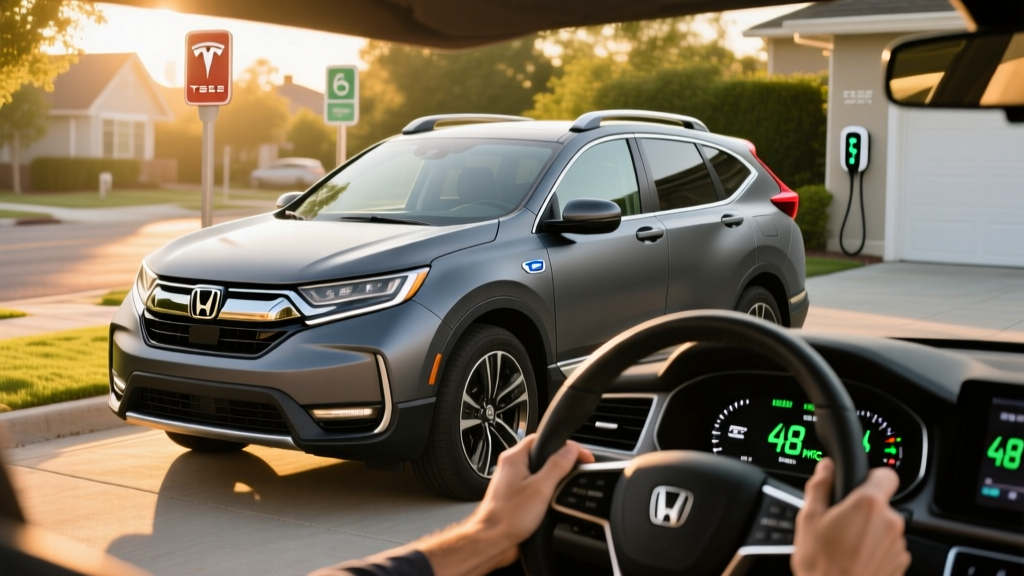
The 2021 Honda CR-V Hybrid pairs a 2.0-liter Atkinson-cycle engine with a two-motor system to deliver 212 horsepower and an EPA-estimated 40 MPG combined. Honda discontinued the CR-V Hybrid after the 2022 model year (replacing it with a new-generation hybrid for 2023+), which makes the 2021 model a high-value target on the used market in 2026. This guide breaks down exact efficiency numbers, real-world fuel economy, battery longevity, and whether this conventional hybrid (HEV) still makes sense compared to modern PHEVs and full EVs.
HEV vs PHEV: The 2021 CR-V Hybrid Is a Conventional Hybrid
Before examining specs, it's critical to understand what the 2021 CR-V Hybrid is not: it is not a plug-in hybrid (PHEV). There is no charging port, no electric-only driving mode, and no federal tax credit eligibility. It operates exactly like a gas car — you fill it at the pump — but its hybrid system recovers braking energy and optimizes engine operation to cut fuel consumption roughly 30% compared to the gas-only CR-V.
| Feature | HEV (2021 CR-V Hybrid) | PHEV (e.g., Toyota RAV4 Prime) | BEV (e.g., Tesla Model Y) |
|---|---|---|---|
| Plug-in charging required? | No | Yes (Level 1/2) | Yes (Level 1/2/DC) |
| Electric-only range | 0 miles (motor assists engine) | 25–42 miles typical | 250–330+ miles |
| Fuel source | Gasoline only | Gasoline + electricity | Electricity only |
| Federal tax credit (§30D) | Not eligible | Up to $7,500 (if eligible) | Up to $7,500 (if eligible) |
| Home charging install needed? | No | Recommended (Level 2) | Essential (Level 2) |
If you were hoping for electric-only commuting, the 2021 CR-V Hybrid won't deliver that. Its electric motors assist the gas engine and enable brief low-speed EV-mode coasting, but the 1.3 kWh battery is far too small for meaningful electric-only driving. If plug-in capability is your goal, look at the Toyota RAV4 Prime PHEV or a 2023+ Honda CR-V e:PHEV (sold outside the US) instead.
EPA Fuel Economy and Real-World MPG
| Metric | EPA Estimate | Real-World Expectation |
|---|---|---|
| City MPG | 40 MPG | 38–43 MPG (hybrids often beat EPA in city) |
| Highway MPG | 35 MPG | 32–36 MPG |
| Combined MPG | 38 MPG (AWD) / 40 MPG (FWD)* | 35–40 MPG combined |
| Fuel tank capacity | 14.0 gallons | — |
| Total driving range | ~532 miles (AWD) | ~490–560 miles |
*Note: The 2021 CR-V Hybrid was sold exclusively with AWD in the US market. The EPA combined rating for the AWD model is 38 MPG. Some sources cite 40 MPG for the FWD variant sold in other markets.
Source: fueleconomy.gov — 2021 Honda CR-V Hybrid AWD
Why Hybrids Often Exceed EPA City Estimates
The two-motor hybrid system in the CR-V operates primarily as a series hybrid at low speeds: the gas engine generates electricity, and the drive motor propels the wheels. This means stop-and-go city driving — where a conventional gas car is least efficient — is where the CR-V Hybrid shines. In real-world city driving, many owners report 40–43 MPG, particularly in moderate temperatures (50–80°F).
Highway efficiency is the relative weak point. At sustained 70+ MPH speeds, the engine must work harder against aerodynamic drag, and the hybrid system's advantage narrows. Expect 32–35 MPG on long highway trips, especially with roof cargo or in headwinds. Cold weather (below 30°F) can reduce combined MPG by 5–10% as the engine runs more frequently to provide cabin heat and maintain battery temperature.
Powertrain Specs: 212 HP Two-Motor Hybrid System
| Specification | 2021 Honda CR-V Hybrid |
|---|---|
| Engine | 2.0L DOHC Atkinson-cycle 4-cylinder |
| Engine output | 143 hp @ 6,200 rpm / 129 lb-ft torque |
| Electric motors | Two-motor i-MMD system |
| Drive motor output | 181 hp / 232 lb-ft torque |
| Combined system output | 212 hp |
| Drivetrain | AWD (standard, electronic) |
| Transmission | Single-speed direct drive (e-CVT) |
| 0–60 MPH | ~7.5 seconds (est.) |
| Hybrid battery capacity | ~1.3 kWh (lithium-ion) |
| Towing capacity | 1,500 lbs |
| Cargo volume (behind rear seats) | 33.2 cu ft |
Honda's i-MMD (Intelligent Multi-Mode Drive) system is fundamentally different from the planetary-gear hybrid systems used by Toyota. The CR-V Hybrid operates in three modes:
- EV Drive: Battery powers the drive motor alone (brief, low-speed only — typically under 1 mile)
- Hybrid Drive: Engine spins a generator motor to produce electricity for the drive motor (series hybrid — most city driving)
- Engine Drive: Engine connects directly to wheels via a lock-up clutch (highway cruising only)
The result is seamless, responsive acceleration with the instant torque of the 181-hp drive motor. The e-CVT has no rubber-band effect common in older Toyota hybrids. The AWD system uses a rear-mounted electric motor rather than a mechanical driveshaft, engaging only when traction demands it.
Battery Warranty, Longevity, and Replacement Cost
Honda Hybrid Battery Warranty
- Coverage: 8 years / 100,000 miles (10 years / 150,000 miles in CARB states including CA, NY, MA, and others)
- What's covered: Hybrid battery pack and hybrid system components
- Capacity threshold: Honda does not publish a specific degradation percentage trigger, but significant capacity loss affecting drivability qualifies
How Long Will the 2021 CR-V Hybrid Battery Last?
The 1.3 kWh lithium-ion hybrid battery in the CR-V is small and operates within a narrow state-of-charge window (roughly 40–60% SoC), which dramatically reduces degradation stress compared to full EV batteries that cycle from 10–90%+ daily. Honda's hybrid battery track record is strong: the Insight and Accord Hybrid platforms using similar i-MMD architecture have shown minimal capacity loss at 150,000+ miles in fleet data.
For a 2021 model purchased used in 2026, you're looking at a vehicle that is 5 years old. If the odometer reads under 100,000 miles, the hybrid battery warranty likely still has 3 years of coverage remaining. In CARB states, that extends to 5 more years.
Battery Replacement Cost
If the hybrid battery fails outside warranty, replacement costs typically range from $2,000 to $4,000 for parts and labor at a Honda dealer. Independent hybrid specialists may offer refurbished packs for $1,500–$2,500. Given the small battery size and conservative charge management, complete hybrid battery failure before 200,000 miles is uncommon in Honda's i-MMD systems.
The 12V auxiliary battery (a separate, conventional battery that powers electronics) may need replacement every 4–6 years at a cost of $150–$250 — standard for any vehicle.
2021 CR-V Hybrid Trims and Used Market Pricing
The 2021 CR-V Hybrid was offered in three trims, all with AWD standard:
| Trim | Original MSRP (2021) | Estimated Used Price (2026) | Key Features |
|---|---|---|---|
| EX | $31,110 | $19,000–$23,000 | 18" wheels, Honda Sensing suite, 7" touchscreen, heated front seats |
| EX-L | $33,710 | $21,000–$26,000 | Leather seats, power liftgate, auto-dimming mirror, heated steering wheel |
| Touring | $37,310 | $24,000–$29,000 | 19" wheels, navigation, premium audio, wireless charging, hands-free liftgate |
Used prices vary significantly by mileage, condition, and region. Hybrid trims typically command a $1,500–$3,000 premium over equivalent gas-only CR-V models on the used market, reflecting sustained demand for fuel-efficient SUVs.
Does the 2021 CR-V Hybrid Qualify for a Tax Credit?
No. The 2021 Honda CR-V Hybrid is a conventional hybrid (HEV), not a plug-in hybrid or battery electric vehicle. It does not qualify for the federal §30D Clean Vehicle Credit (up to $7,500), which is reserved for PHEVs and BEVs meeting battery sourcing, MSRP, and buyer income requirements per current IRS rules.
Some states offer modest incentives for conventional hybrids, but these are rare and typically small ($250–$500 rebates). Check your state's energy office for current programs. The used EV credit (§25E, up to $4,000) also does not apply, as it covers only BEVs and PHEVs.
CR-V Hybrid vs RAV4 Hybrid vs Full EV: Which Fits You?
Choose the 2021 CR-V Hybrid If:
- You want 38+ MPG without any charging infrastructure or behavior change
- You drive a mix of city and highway and want strong city efficiency
- You want AWD standard with no mechanical complexity penalty
- You prefer a smooth, responsive two-motor system over traditional CVT feel
- Your budget is $20,000–$28,000 for a reliable used compact SUV
Consider a PHEV or Full EV Instead If:
- You have home charging access and want electric-only daily commuting (PHEV: 25–42 mi; BEV: 250+ mi)
- You want to qualify for the $7,500 federal tax credit on a new vehicle purchase
- You drive mostly in the city and want near-zero fuel costs (BEV at ~$0.04/mile vs hybrid at ~$0.10/mile)
- You want the latest generation tech (the 2023+ CR-V Hybrid is substantially updated)
- You want one-pedal driving and full regenerative braking capability
Competitor Comparison: CR-V Hybrid vs RAV4 Hybrid
| Spec | 2021 Honda CR-V Hybrid AWD | 2021 Toyota RAV4 Hybrid AWD |
|---|---|---|
| EPA Combined MPG | 38 MPG | 40 MPG |
| Combined Horsepower | 212 hp | 219 hp |
| 0–60 MPH | ~7.5 sec | ~7.4 sec |
| Cargo (rear seats up) | 33.2 cu ft | 37.6 cu ft |
| Hybrid System Type | Series-parallel (i-MMD) | Series-parallel (THS II) |
| AWD System | Electric rear motor | Electric rear motor |
The RAV4 Hybrid edges out the CR-V Hybrid by 2 MPG combined and offers more cargo space. The CR-V counters with a more refined driving experience and a stronger drive motor for responsive acceleration. Both have excellent reliability records and similar battery warranty terms.
Reliability, Safety, and Ownership Costs
The 2021 CR-V Hybrid earned a 5-Star Overall Safety Rating from NHTSA and was an IIHS Top Safety Pick when equipped with Honda Sensing (standard on all trims). The Honda Sensing suite includes:
- Collision Mitigation Braking System (CMBS)
- Road Departure Mitigation (RDM)
- Adaptive Cruise Control (ACC) with Low-Speed Follow
- Lane Keeping Assist System (LKAS)
- Traffic Sign Recognition
Note: Honda Sensing is an SAE Level 2 driver-assistance system — it requires active driver supervision at all times and is not a self-driving system.
5-Year Ownership Cost Estimate (Used Purchase in 2026)
| Cost Category | 5-Year Estimate | Notes |
|---|---|---|
| Purchase price (EX-L, ~45k mi) | $23,500 | Mid-range used market |
| Fuel (15,000 mi/yr, $3.40/gal) | $6,375 | At 38 MPG combined |
| Insurance | $7,500 | ~$1,500/yr average |
| Maintenance | $2,500 | Oil, tires, brakes (regen reduces brake wear) |
| Total 5-year cost | ~$39,875 | Excludes depreciation |
Compared to a gas-only 2021 CR-V AWD (EPA 29 MPG combined), the Hybrid saves approximately $2,200 in fuel over 5 years at 15,000 miles/year and $3.40/gallon — enough to offset the typical used-market hybrid premium.
Frequently Asked Questions
How many MPG does the 2021 Honda CR-V Hybrid get?
The EPA rates the 2021 CR-V Hybrid AWD at 40 MPG city, 35 MPG highway, and 38 MPG combined. In real-world driving, owners commonly see 38–43 MPG in mixed and city driving, with highway-only trips yielding 32–36 MPG. Cold weather can reduce these figures by 5–10%.
Can the 2021 CR-V Hybrid be plugged in to charge?
No. The 2021 CR-V Hybrid is a conventional hybrid (HEV), not a plug-in hybrid. It has no charging port. The small 1.3 kWh hybrid battery charges exclusively through regenerative braking and the gasoline engine. You fuel it at a gas station like any conventional vehicle.
Is the 2021 CR-V Hybrid reliable?
Yes. Honda's i-MMD hybrid system has proven durable, with few widespread failure modes reported. The hybrid battery operates in a conservative charge window that minimizes degradation. The CR-V platform has strong reliability scores from major evaluators. Regular maintenance (oil changes every 7,500–10,000 miles) keeps the system running well past 200,000 miles.
What is the hybrid battery replacement cost?
Out-of-warranty hybrid battery replacement runs $2,000–$4,000 at a Honda dealer, or $1,500–$2,500 through independent hybrid specialists. However, the battery is covered under Honda's 8-year/100,000-mile hybrid warranty (10 years/150,000 miles in CARB states), and actual failures before 200,000 miles are uncommon.
Does the 2021 CR-V Hybrid qualify for any tax credit?
No. As a conventional hybrid (HEV), the 2021 CR-V Hybrid is not eligible for the federal §30D Clean Vehicle Credit or the §25E Used Clean Vehicle Credit. These credits apply only to plug-in hybrids (PHEVs) and battery electric vehicles (BEVs) meeting specific battery sourcing, MSRP, and buyer income thresholds. Check IRS.gov for current credit rules.
How does the CR-V Hybrid compare to a full EV for daily commuting?
If you commute 30–40 miles round trip with home charging access, a full EV like a used Tesla Model Y or Chevrolet Bolt EUV will cost roughly $0.04/mile in electricity vs $0.10/mile in gas for the CR-V Hybrid — saving about $900/year in fuel. However, the EV requires home charging installation ($500–$2,000), has a higher upfront cost, and demands route planning for longer trips. The CR-V Hybrid offers zero-compromise fueling flexibility with strong city MPG.
What is the towing capacity of the 2021 CR-V Hybrid?
The 2021 CR-V Hybrid is rated to tow 1,500 pounds — adequate for a small utility trailer or a pair of dirt bikes but not sufficient for a boat or camping trailer. The gas-only CR-V AWD shares this 1,500-lb rating.