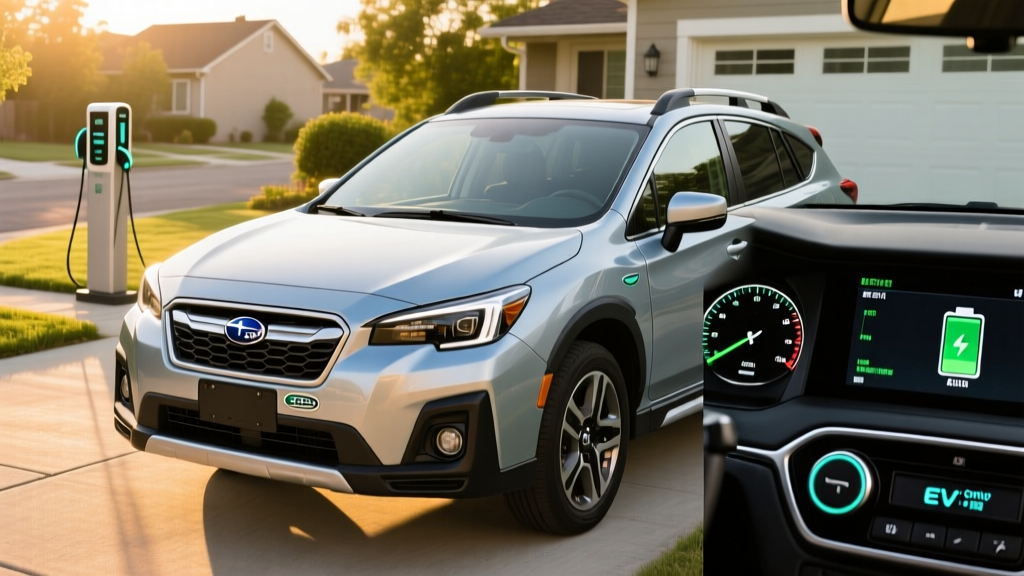
The 2019 Subaru Crosstrek Hybrid was Subaru's first plug-in hybrid (PHEV) sold in the United States, and it arrived with a specific mission: deliver short-range electric commuting wrapped in Subaru's trademark all-wheel-drive, 8.7-inch ground-clearance package. Based on the Toyota Prius Prime's powertrain architecture, this compact crossover offered something no other PHEV on the market at the time could — genuine off-road capability with an electric-only commute option.
Now in 2026, the Crosstrek Hybrid is only available on the used market (Subaru discontinued the PHEV variant after the 2023 model year). But for buyers considering a pre-owned example, the question remains: does this plug-in hybrid still make sense? We break down every spec, real-world efficiency figure, and ownership cost you need to know.
PHEV, Not HEV: What the Crosstrek Hybrid Actually Is
Despite the "Hybrid" badge, the 2019 Crosstrek Hybrid is a plug-in hybrid electric vehicle (PHEV), not a conventional hybrid (HEV). This distinction matters enormously for ownership expectations:
HEV vs PHEV — Key Differences
| Feature | Conventional Hybrid (HEV) | Plug-In Hybrid (PHEV) |
|---|---|---|
| Plugs in to charge? | No — charges via engine and regen | Yes — Level 1 or Level 2 |
| Electric-only range | ~1 mile or less at low speed | 10–40+ miles depending on model |
| Battery size | 0.5–1.5 kWh | 8–20+ kWh |
| Tax credit eligible (new)? | No | Was eligible under prior rules |
The 2019 Crosstrek Hybrid falls squarely in the PHEV column. You plug it in, get electric-only miles, and the gasoline engine kicks in once the battery depletes.
Powertrain and Performance Specs
The 2019 Crosstrek Hybrid pairs a 2.0-liter flat-four (Boxer) engine with two electric motor-generators and an 8.8 kWh lithium-ion battery pack. The system is essentially Subaru's adaptation of Toyota's Hybrid Synergy Drive, tuned for Subaru's symmetrical all-wheel-drive system.
| Specification | 2019 Subaru Crosstrek Hybrid |
|---|---|
| Combined system horsepower | 148 hp |
| Gasoline engine | 2.0L Boxer-4, 137 hp |
| Electric motors | MG1 (generator) + MG2 (drive), 118 hp (MG2) |
| Battery capacity | 8.8 kWh (lithium-ion) |
| Drivetrain | Symmetrical AWD (e-AWD via rear motor assist) |
| Transmission | e-CVT (planetary gearset) |
| 0–60 mph | ~8.5 seconds |
| Ground clearance | 8.7 inches |
| Cargo volume (rear seats up) | 15.9 cu ft |
| Original MSRP (2019) | $34,995 (single trim) |
One thing to note: the battery pack sits beneath the cargo floor, which reduces rear cargo volume by about 4 cubic feet compared to the gas-only Crosstrek. That's a meaningful trade-off if you regularly haul gear.
Fuel Economy: EPA Ratings and Real-World MPG
The EPA rates the 2019 Crosstrek Hybrid in two modes — electric (MPGe) and gasoline (MPG). Here is the full breakdown according to fueleconomy.gov:
| Mode | City | Highway | Combined |
|---|---|---|---|
| Electric (MPGe) | 105 | 82 | 90 MPGe |
| Gasoline only (MPG) | 35 | 34 | 35 MPG |
Real-World MPG vs EPA Sticker
In real-world driving, the 2019 Crosstrek Hybrid tends to meet or slightly exceed its EPA combined rating in city-heavy commuting, where regenerative braking recovers energy at every stop. Owners on forums and tracking apps like Fuelly commonly report 36–39 MPG in mixed city driving once the battery is depleted.
Highway driving at 70+ mph is a different story. The Boxer engine and AWD system create more rolling and aerodynamic drag than a Prius, so expect 30–33 MPG on the highway when running on gasoline alone. In cold weather (below 30°F), the gasoline engine fires up more frequently to heat the cabin, which can drop electric-only range by 20–30% and reduce overall efficiency to 28–31 MPG in winter conditions.
Electric-Only Range and Charging
The EPA rates the 2019 Crosstrek Hybrid at 17 miles of electric-only range. That's modest compared to newer PHEVs (the 2025 Toyota RAV4 Prime delivers 42 miles), but it covers many short commutes.
| Charging Spec | Detail |
|---|---|
| EPA electric-only range | 17 miles |
| Total combined range (EV + gas) | ~480 miles |
| Battery capacity | 8.8 kWh (usable ~6.0 kWh) |
| Level 1 charging (120V) | ~5 hours (0–100%) |
| Level 2 charging (240V, 3.3 kW) | ~2 hours (0–100%) |
| DC fast charging | Not supported |
| Charge port | J1772 (Level 1/Level 2) |
The onboard charger maxes out at 3.3 kW, meaning even if you plug into a 7.2 kW or 11.5 kW Level 2 station, the car will only accept 3.3 kW. There is no DC fast charging capability — this is strictly a home-and-destination charging vehicle. For overnight top-ups, that's perfectly fine. A standard 120V outlet will fully recharge the pack in about five hours.
Battery Warranty, Reliability, and Replacement Cost
Subaru warranted the 2019 Crosstrek Hybrid's lithium-ion battery pack for 8 years or 100,000 miles (10 years/150,000 miles in California Air Resources Board states, which include CA, CO, CT, MA, MD, ME, NJ, NY, OR, RI, VT, and WA). The warranty covers defects and capacity loss below approximately 60% of original capacity.
Hybrid Battery Longevity: What to Expect
Because the 2019 Crosstrek Hybrid uses Toyota-derived hybrid components, the battery and powertrain have a strong reliability pedigree. The Prius Prime shares essentially the same system, and real-world data shows these packs commonly last 150,000–200,000+ miles before significant degradation. Toyota and Subaru hybrid battery replacement costs for this platform typically run $2,500–$4,000 at a dealership, with aftermarket refurbished units available for $1,500–$2,500.
For a 2019 model, the original 8-year/100,000-mile battery warranty expires in 2027, so most examples still carry at least partial coverage. Always verify warranty status by VIN with a Subaru dealer before purchasing.
Overall reliability ratings for the 2019 Crosstrek Hybrid are strong. IIHS named it a Top Safety Pick when equipped with EyeSight, and the hybrid powertrain's Toyota lineage gives it one of the lowest failure rates in the PHEV segment.
Tax Credit Eligibility (New and Used)
When sold new, the 2019 Subaru Crosstrek Hybrid qualified for a $4,502 federal tax credit under the pre-2023 IRS §30D rules (the credit amount was based on battery capacity — 8.8 kWh yielded $4,502). Subaru never hit the 200,000-vehicle cap that eliminated credits for GM and Toyota during that era, so every new buyer received the credit.
Now on the used market, here's what applies in 2026:
- Used EV / PHEV credit (§25E): Up to $4,000 or 30% of the sale price (whichever is less) when purchased from a dealer.
- Sale price cap: The used vehicle must sell for $25,000 or less to qualify.
- Income limits: Adjusted gross income must not exceed $75,000 (single), $112,500 (head of household), or $150,000 (joint).
- Dealer requirement: Must be purchased from a licensed dealer who reports the sale to the IRS.
- Age requirement: Vehicle must be at least 2 model years old (2019 qualifies in 2026).
Most 2019 Crosstrek Hybrids on the used market in 2026 sell for $18,000–$24,000 depending on mileage and condition, meaning many examples will fall under the $25,000 cap and qualify for the used PHEV credit — provided the buyer meets income requirements. Always confirm current eligibility at irs.gov and consult a tax professional.
2019 Crosstrek Hybrid vs Alternatives
Pros
- Standard AWD — unique among 2019-era PHEVs
- 8.7 inches of ground clearance for dirt roads and snow
- Toyota-derived hybrid reliability
- 35 MPG combined after battery depletion
- Eligible for used PHEV tax credit (up to $4,000)
- X-MODE for traction management on slippery surfaces
Cons
- Only 17 miles of electric range
- Slow 3.3 kW Level 2 charging; no DC fast charge
- Reduced cargo space (15.9 cu ft) vs gas Crosstrek
- Firm ride quality on rough pavement
- CVT drone under hard acceleration
- EyeSight disables in heavy rain or direct sun glare
If you're cross-shopping, here's how the Crosstrek Hybrid stacks up against common alternatives from the same era:
| Spec | 2019 Crosstrek Hybrid | 2019 Prius Prime | 2019 Mitsubishi Outlander PHEV |
|---|---|---|---|
| EV range | 17 mi | 25 mi | 22 mi |
| Combined MPG (gas) | 35 | 54 | 25 |
| AWD? | Yes | No | Yes |
| Ground clearance | 8.7 in | 5.3 in | 7.3 in |
| DC fast charge? | No | No | Yes (CHAdeMO) |
| Used price range (2026) | $18K–$24K | $16K–$22K | $17K–$23K |
Who Should Buy the 2019 Crosstrek Hybrid?
Decision Framework
Choose the 2019 Crosstrek Hybrid if:
- You need AWD and ground clearance for snow, dirt roads, or light trails
- Your commute is under 17 miles and you can charge at home overnight
- You want PHEV efficiency but aren't ready to commit to a full EV
- You value Toyota-hybrid reliability in a Subaru package
Choose a full EV (e.g., used Chevy Bolt, Hyundai Kona Electric) if:
- Your daily driving exceeds 17 miles and you want zero gasoline use
- You have reliable home charging and access to DC fast chargers for road trips
- You want lower ongoing maintenance (no oil changes, no gasoline engine)
Choose the gas-only Crosstrek if:
- You can't charge at home or work
- You regularly drive in extreme cold where PHEV electric range drops sharply
- You want maximum cargo space and a lower purchase price
Frequently Asked Questions
How many MPG does the 2019 Subaru Crosstrek Hybrid get?
The EPA rates it at 35 MPG combined (35 city / 34 highway) when running on gasoline after the battery is depleted. In real-world city driving, many owners report 36–39 MPG thanks to regenerative braking. Highway driving at 75+ mph drops to roughly 30–33 MPG. In electric mode, it earns 90 MPGe combined.
How far can the 2019 Crosstrek Hybrid go on electric only?
The EPA rates it at 17 miles of electric-only range. In mild weather at city speeds, you may stretch that to 19–20 miles. In cold weather or at highway speeds, expect 12–14 miles before the gasoline engine engages. Total combined range (electric + gasoline) is approximately 480 miles.
Is the 2019 Crosstrek Hybrid reliable and what does battery replacement cost?
Yes — the Toyota-derived hybrid system is one of the most proven PHEV powertrains in existence. The hybrid battery is warranted for 8 years/100,000 miles (10 years/150,000 miles in CARB states). Real-world data shows these packs commonly last 150,000–200,000+ miles. If replacement is needed, expect $2,500–$4,000 at a dealer or $1,500–$2,500 for an aftermarket refurbished unit.
Does the 2019 Crosstrek Hybrid qualify for a tax credit in 2026?
Not as a new vehicle (it's no longer sold new). However, it may qualify for the Used Clean Vehicle Credit (§25E) — up to $4,000 or 30% of the sale price, whichever is less. The vehicle must sell for $25,000 or less, the buyer must meet income caps ($75K single / $150K joint), and the purchase must be through a licensed dealer. Verify current rules at irs.gov.
Can the 2019 Crosstrek Hybrid DC fast charge?
No. It only supports Level 1 (120V, ~5 hours) and Level 2 (240V at 3.3 kW, ~2 hours). There is no DC fast charging port. This is typical for PHEVs of this era — the small battery doesn't require rapid charging for daily use.
Hybrid vs PHEV vs EV — which fits me?
If you can charge at home and your commute is under 20 miles, a PHEV like the Crosstrek Hybrid gives you electric commuting with gasoline backup for road trips. If your commute is longer and you have reliable charging, a full EV eliminates gasoline entirely. If you can't charge at home at all, a conventional HEV (like the Toyota RAV4 Hybrid) offers better MPG without any plug-in requirement.