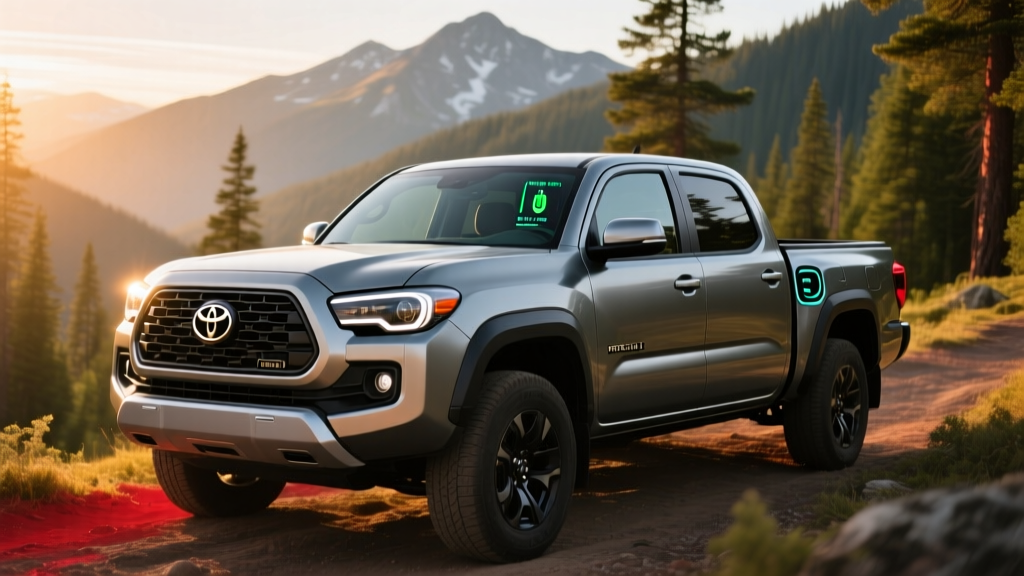
The Toyota Tacoma i-FORCE MAX powertrain — sometimes referred to colloquially as the "Wolf Hybrid" in enthusiast forums due to its aggressive turbocharged delivery — is Toyota's answer to the midsize pickup buyer who wants hybrid efficiency without sacrificing towing or off-road capability. If you've been searching for how much is a Wolf Hybrid, the short answer is that the 2026 Tacoma i-FORCE MAX starts at $40,990 (TRD Off-Road trim) and climbs to over $57,000 fully loaded in Trailhunter or TRD Pro guise. But price is only part of the equation. This guide breaks down the real-world fuel economy, powertrain specs, hybrid battery longevity, and whether this conventional hybrid (HEV) — not a plug-in — is the right truck for your driveway.
What Exactly Is the Tacoma i-FORCE MAX Hybrid?
The i-FORCE MAX is Toyota's turbocharged 2.4-liter inline-four paired with a 48-horsepower electric motor integrated into the eight-speed automatic transmission housing. This is a conventional hybrid (HEV), meaning it does not plug in. The system recovers energy through regenerative braking and uses a small 1.87 kWh nickel-metal hydride (NiMH) battery pack to assist the gasoline engine during acceleration, low-speed crawling, and start-stop events. You will never need to search for a charging station — the truck fuels exclusively at the pump.
HEV vs PHEV: Where the Tacoma Fits
| Feature | Tacoma i-FORCE MAX (HEV) | Plug-In Hybrid (PHEV) Example |
|---|---|---|
| Plugs in to charge? | No — self-charging via regen | Yes — Level 1 or Level 2 |
| Electric-only driving | Minimal (low-speed assist only) | 25–45 miles typical |
| Battery size | 1.87 kWh (NiMH) | 13–20 kWh (NMC lithium-ion) |
| Federal tax credit (§30D) | Not eligible | Up to $7,500 if eligible |
| Best for | Towing, off-road, no charger access | Short commutes + weekend road trips |
2026 Tacoma i-FORCE MAX Pricing by Trim
The i-FORCE MAX powertrain is not available on the base SR or SR5 trims — Toyota reserves it for the more capable, higher-trim models. Here is the 2026 MSRP breakdown (destination charge of $1,495 included):
| Trim | MSRP (4x4) | i-FORCE MAX Standard? |
|---|---|---|
| TRD Off-Road | $40,990 | Optional ($1,750 package) |
| Limited | $48,890 | Standard |
| TRD Pro | $57,290 | Standard |
| Trailhunter | $54,390 | Standard |
At these price points, the Tacoma i-FORCE MAX competes directly with the Ford Maverick Hybrid (starting ~$29,495, but smaller and unibody) and the Chevrolet Colorado (no hybrid option). If you need a body-on-frame midsize truck with hybrid powertrain, the Tacoma is currently the only game in town.
Fuel Economy: EPA MPG and Real-World Expectations
The EPA rates the 2026 Tacoma i-FORCE MAX 4x4 at 23 city / 27 highway / 25 combined MPG (source: fueleconomy.gov). That is a meaningful improvement over the non-hybrid turbocharged 2.4L i-FORCE, which returns 20/26/22 MPG in 4x4 configuration — roughly a 14% combined gain.
| Configuration | City MPG | Highway MPG | Combined MPG |
|---|---|---|---|
| i-FORCE MAX 4x4 (HEV) | 23 | 27 | 25 |
| i-FORCE 4x4 (non-hybrid) | 20 | 26 | 22 |
| Ford Maverick Hybrid FWD | 42 | 33 | 37 |
Real-World MPG: What Owners Actually See
Conventional hybrids often exceed their EPA city estimate because regenerative braking recovers more energy in stop-and-go traffic. Tacoma i-FORCE MAX owners reporting on fuel-tracking apps typically log 24–27 MPG combined in mixed suburban driving. However, highway-dominant commutes at 75+ mph may dip to 22–23 MPG, as the turbocharged engine works harder at sustained speed and the electric motor contributes less at cruising velocity. Towing a 4,000-pound trailer drops observed economy to roughly 15–17 MPG — an honest figure for any midsize truck under load.
Powertrain Specs: Torque, Towing, and the Electric Assist
The i-FORCE MAX produces a combined 326 horsepower and 465 lb-ft of torque. The electric motor fills the torque curve's low end, delivering peak twist from just 1,700 RPM — critical for off-road rock crawling and trailer launches. The 0–60 mph time clocks in at approximately 6.5 seconds, quick for a 4,700-pound body-on-frame truck.
| Specification | Value |
|---|---|
| Engine | 2.4L turbocharged inline-4 |
| Electric motor | 48 hp / 184 lb-ft (integrated in transmission) |
| Combined output | 326 hp / 465 lb-ft |
| Transmission | 8-speed automatic |
| Battery | 1.87 kWh NiMH |
| Max towing capacity | 6,000 lbs |
| Payload capacity | 1,685 lbs (varies by trim) |
| 0–60 mph | ~6.5 seconds |
| Drivetrain | 4WD with part-time transfer case |
For context, the non-hybrid i-FORCE makes 278 hp and 317 lb-ft. The hybrid's 148 additional lb-ft of torque is the real differentiator — you feel it merging onto highways and climbing grades with a bed full of lumber.
Hybrid Battery Warranty, Lifespan, and Replacement Cost
Toyota's hybrid battery warranty covers the i-FORCE MAX pack for 10 years or 150,000 miles (whichever comes first) across all 50 states. This is an improvement from the older 8-year/100,000-mile standard and reflects Toyota's confidence in its NiMH technology, which has proven durable across millions of Prius, Camry Hybrid, and RAV4 Hybrid units on the road.
Battery Longevity: What to Expect
Warranty: 10 years / 150,000 miles
Chemistry: Nickel-metal hydride (NiMH) — proven, thermally stable, no active cooling required
Expected lifespan: Most Toyota hybrid batteries outlast 150,000 miles; many Prius packs reach 200,000+ miles before significant degradation
Replacement cost (out of warranty): Approximately $2,500–$3,800 for the battery module, plus ~$500 labor
The 1.87 kWh pack is small by EV standards, which actually works in its favor: shallow charge/discharge cycles cause less stress on NiMH cells. Unlike a full EV battery, you are not cycling this pack from 0–100% — it operates in a narrow state-of-charge window (roughly 40–60%), managed by the hybrid control system. This is why Toyota hybrid batteries routinely exceed a decade without issue.
Tax Credit Eligibility: Does the Tacoma Hybrid Qualify?
No. The Tacoma i-FORCE MAX is a conventional hybrid (HEV), and the federal §30D Clean Vehicle Credit applies only to plug-in electric vehicles (BEVs and PHEVs) with a minimum battery capacity of 7 kWh (source: IRS.gov). The Tacoma's 1.87 kWh pack falls well below that threshold.
If tax credit eligibility is a priority, consider these PHEV alternatives in the truck/SUV space:
- Ford F-150 Lightning (full BEV) — up to $7,500 credit if income and sourcing requirements are met
- Jeep Wrangler 4xe (PHEV) — 17 kWh battery, 22 miles electric-only, potentially credit-eligible (verify current battery sourcing compliance)
- Toyota RAV4 Prime (PHEV) — 18.1 kWh, 42 miles electric-only, though credit eligibility has lapsed due to the manufacturer sales cap (check current IRS guidance)
Some states offer their own hybrid rebates or HOV lane access for HEVs — California's Clean Air Decal program, for instance, has historically included certain low-emission hybrids. Check your state's energy office for current programs.
Who Should Buy the Tacoma i-FORCE MAX — and Who Shouldn't
Choose the Tacoma i-FORCE MAX If:
- You need a body-on-frame midsize truck for towing (up to 6,000 lbs) or off-road trails
- You lack home charging access and don't want to rely on public infrastructure
- You want better fuel economy than a gas-only truck without range compromise
- You value Toyota's long-term reliability reputation and 10-year hybrid warranty
- Low-end torque for rock crawling or boat launches matters to you
Look at a PHEV or Full EV If:
- Your daily commute is under 35 miles and you have home Level 2 charging
- You want to drive on electricity alone for most daily trips (zero tailpipe emissions in EV mode)
- Federal tax credit eligibility ($3,500–$7,500) significantly affects your budget
- You prioritize fuel cost savings over towing and payload capability
- A unibody truck like the Ford Maverick Hybrid (37 MPG combined, ~$29,495) meets your needs
Hybrid vs PHEV vs Full EV: Which Powertrain Fits Your Truck Needs?
| Factor | HEV (Tacoma i-FORCE MAX) | PHEV (e.g., Wrangler 4xe) | Full EV (e.g., F-150 Lightning) |
|---|---|---|---|
| Plugs in? | No | Yes | Yes |
| Electric-only range | N/A | 20–25 miles | 230–320 miles |
| Combined MPG / MPGe | 25 MPG | 20 MPG + 49 MPGe | 70–78 MPGe |
| Towing capacity | 6,000 lbs | 3,500 lbs | 7,700–10,000 lbs |
| Fuel cost per mile | ~$0.17 | ~$0.09 (electric) / $0.20 (gas) | ~$0.05 (electric) |
| Federal tax credit | None | Up to $7,500* | Up to $7,500* |
| Best use case | Towing + no charger | Short commute + weekend trips | Daily driver + home charger |
*§30D credit eligibility depends on buyer income, vehicle MSRP caps, battery sourcing, and point-of-sale transfer rules. Verify at IRS.gov.
Frequently Asked Questions
How many MPG does the Tacoma i-FORCE MAX hybrid get?
The EPA rates it at 23 city / 27 highway / 25 combined MPG. Real-world owners typically report 24–27 MPG in mixed suburban driving, with highway-only trips at 75+ mph yielding around 22–23 MPG. Towing drops economy to roughly 15–17 MPG.
Does the Tacoma hybrid plug in or charge on electric only?
No. The Tacoma i-FORCE MAX is a conventional hybrid (HEV). It charges its 1.87 kWh battery through regenerative braking and engine power. There is no plug, no electric-only driving range, and no need for any charging infrastructure.
Is the Tacoma i-FORCE MAX reliable? What about battery replacement cost?
Toyota's hybrid systems have an outstanding reliability track record across millions of vehicles. The NiMH battery is covered for 10 years / 150,000 miles. Out-of-warranty replacement runs approximately $2,500–$3,800 for the module plus labor — far less than a full EV battery replacement.
Does the Tacoma hybrid qualify for the $7,500 federal tax credit?
No. The §30D Clean Vehicle Credit requires a minimum 7 kWh battery and plug-in capability. The Tacoma's 1.87 kWh NiMH pack does not qualify. Check your state for any local hybrid incentives or HOV lane programs.
How much is a fully loaded Tacoma i-FORCE MAX in 2026?
The TRD Pro with i-FORCE MAX starts at $57,290. The Trailhunter, aimed at overlanders, starts at $54,390. Adding packages and accessories can push the out-the-door price past $62,000.
Is the "Wolf Hybrid" an official Toyota name?
No. "Wolf Hybrid" is an enthusiast nickname that has circulated in Tacoma forums and social media. Toyota's official powertrain branding is i-FORCE MAX. If a dealer uses "Wolf Hybrid" in advertising, ask them to confirm they are referencing the i-FORCE MAX to avoid confusion with other products.