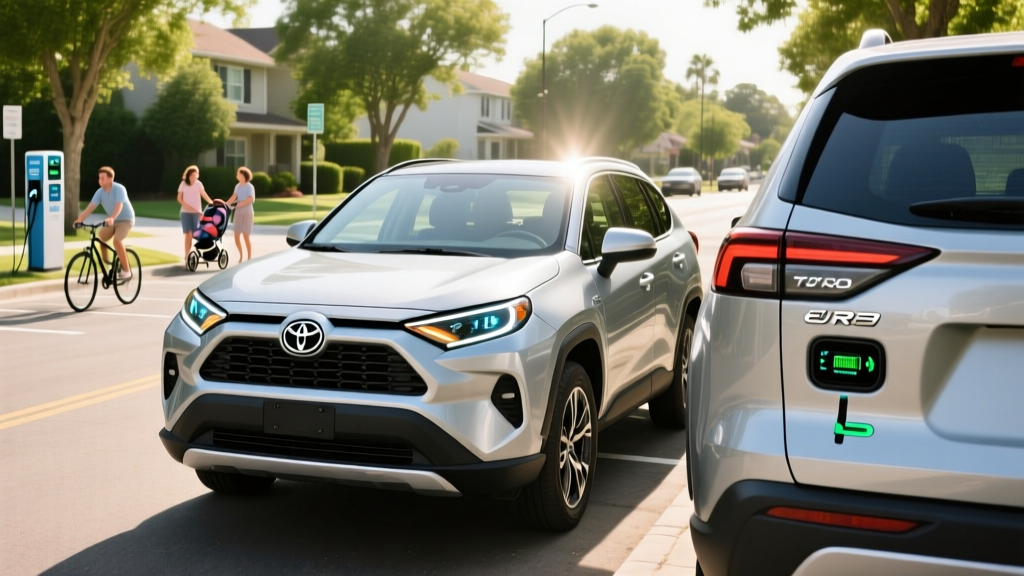
The 2018 Toyota RAV4 Hybrid AWD remains one of the most searched used compact SUVs among buyers who want all-wheel-drive traction without the fuel penalty of a conventional gas model. With an EPA-rated 32 MPG combined and Toyota's proven hybrid synergy drive, it occupies a specific niche: electrified efficiency with zero plug-in requirements. This guide covers everything a 2026 used-car shopper needs to know — real-world MPG, battery longevity, ownership costs, and how it stacks up against plug-in hybrids and full EVs.
HEV vs PHEV vs EV: Where the 2018 RAV4 Hybrid Fits
Before diving into specs, it's essential to distinguish the three electrified powertrains available in the compact SUV segment. The 2018 RAV4 Hybrid is a conventional hybrid electric vehicle (HEV) — it generates all its electricity internally through regenerative braking and the gasoline engine. There is no plug, no charging cable, and no electric-only driving mode of meaningful distance.
| Feature | HEV (2018 RAV4 Hybrid) | PHEV (e.g., RAV4 Prime) | BEV (e.g., Tesla Model Y) |
|---|---|---|---|
| Plug-in Required? | No | Yes (Level 1/2) | Yes (Level 1/2/DC) |
| Electric-Only Range | <1 mile at low speed | 42 miles (RAV4 Prime) | 260-330 miles |
| Gasoline Engine | 2.5L 4-cyl + motors | 2.5L 4-cyl + motors | None |
| Battery Capacity | ~1.6 kWh (NiMH) | 18.1 kWh (Li-ion) | 60-82 kWh (Li-ion) |
| Federal Tax Credit (New) | None | Up to $7,500 (§30D) | Up to $7,500 (§30D) |
| Used EV Credit (§25E) | Not eligible | Up to $4,000 | Up to $4,000 |
The RAV4 Prime (PHEV) didn't arrive until the 2021 model year, so if you're shopping the 2018 generation, you're choosing between the conventional RAV4 Hybrid and the gas-only RAV4 — or looking at a completely different model for plug-in capability.
Fuel Economy: EPA Ratings and Real-World MPG
The 2018 RAV4 Hybrid AWD carries an EPA rating of 34 MPG city / 30 MPG highway / 32 MPG combined. For a compact AWD SUV, that was class-leading in 2018 and remains competitive against newer models today.
| Driving Condition | EPA Rating | Real-World Expectation |
|---|---|---|
| City | 34 MPG | 35-38 MPG (hybrids excel in stop-and-go) |
| Highway (65-75 mph) | 30 MPG | 28-31 MPG |
| Combined | 32 MPG | 31-35 MPG depending on driving mix |
| Cold Weather (below 30°F) | — | 27-30 MPG (engine runs more for cabin heat) |
Why hybrids often beat EPA in the city: Regenerative braking recovers kinetic energy during deceleration, and the engine shuts off at stops. The more stoplights and traffic you encounter, the more the electric motor does the work. Highway driving is the opposite — the gasoline engine carries the sustained load, and aerodynamic drag dominates.
For comparison, the 2018 gas-only RAV4 AWD is rated at 22 city / 28 highway / 25 combined. The hybrid saves roughly 7 MPG combined, which translates to approximately 100-120 fewer gallons per year for a driver covering 15,000 miles annually — about $350-$450 in fuel savings at $3.50/gallon.
Powertrain Specs: Engine, Motors, and Combined Output
| Specification | 2018 RAV4 Hybrid AWD |
|---|---|
| Engine | 2.5L Atkinson-cycle 4-cylinder |
| Engine Output | 150 hp / 136 lb-ft torque |
| Front Electric Motor | 105 kW (141 hp) |
| Rear Electric Motor (AWD) | 50 kW (67 hp) |
| Net Combined System Power | 194 hp |
| Transmission | eCVT (planetary gearset, not a belt CVT) |
| 0-60 mph | ~7.8 seconds |
| Drivetrain | Electronic on-demand AWD (rear motor) |
| Hybrid Battery | ~1.6 kWh Nickel-Metal Hydride (NiMH) |
| Curb Weight | ~3,950 lbs |
The AWD system in the 2018 RAV4 Hybrid is worth explaining: there is no mechanical driveshaft connecting the front and rear axles. Instead, the rear electric motor engages independently when the system detects front-wheel slip or when acceleration demands extra traction. This "e-AWD" approach means the rear motor is inactive during steady-state cruising, reducing parasitic losses and preserving fuel economy. The trade-off is that the rear motor provides limited torque at very low speeds compared to a mechanical AWD system — adequate for snow and rain, but not for serious off-roading.
Hybrid Battery Warranty, Lifespan, and Replacement Cost
Original Warranty: Toyota warranted the 2018 RAV4 Hybrid battery for 8 years / 100,000 miles (10 years / 150,000 miles in California and states adopting CARB emissions standards). As of 2026, the original factory warranty has expired for most vehicles unless the car was purchased late in 2018 and has remained under 100,000 miles.
Expected Lifespan: Toyota's NiMH hybrid batteries have a strong track record of lasting 150,000-200,000+ miles with gradual capacity loss. Unlike full EV batteries, the hybrid battery is small and rarely cycles deeply — the system keeps it between roughly 40-80% state of charge, which minimizes degradation.
Battery replacement cost: If the hybrid battery does fail outside warranty, expect to pay:
- New OEM battery (Toyota dealer): $3,000-$4,500 installed
- Refurbished/remanufactured battery: $1,500-$2,500 installed
- Individual module replacement: $500-$1,000 (a hybrid specialist can replace only the failed cells within the pack)
The good news is that NiMH hybrid battery failures on the 2018 RAV4 Hybrid remain uncommon at current mileages. The far more typical hybrid maintenance item is the hybrid battery cooling fan filter, located behind the rear seat — it should be cleaned or replaced every 30,000 miles to prevent overheating. Neglecting this can shorten battery life.
2026 Used Pricing and Tax Credit Eligibility
As of early 2026, the 2018 Toyota RAV4 Hybrid AWD trades in the used market at approximately:
- 70,000-90,000 miles: $17,000-$21,000
- 90,000-120,000 miles: $14,000-$17,000
- 120,000+ miles: $11,000-$14,000
Federal tax credit status: The 2018 RAV4 Hybrid is a conventional HEV and does not qualify for the IRS §30D new clean vehicle credit or the §25E used clean vehicle credit. Both credits require plug-in capability — either a PHEV with at least 7 kWh of battery capacity or a full BEV. The RAV4 Hybrid's ~1.6 kWh NiMH pack falls far short of this threshold.
Some states offer separate incentives for used hybrids, but these vary by jurisdiction and change frequently. Check your state's energy office or department of revenue for current programs.
Reliability and Ownership Costs
The 2018 RAV4 Hybrid benefits from Toyota's long-running Hybrid Synergy Drive architecture, which has been in continuous production since the 2004 Prius. The eCVT transmission uses a planetary gearset with no belts, clutches, or bands to wear — it is widely regarded as one of the most durable transmissions in the industry.
Key reliability considerations for a 2026 buyer:
- Hybrid system: Excellent track record. Inverter and motor failures are rare.
- Brakes: Regenerative braking reduces pad wear significantly. Many owners report 80,000-100,000 miles on original brake pads.
- 12V auxiliary battery: Like all modern vehicles, the 12V battery (under the hood) will need replacement every 4-6 years. This is a standard automotive battery, not the hybrid traction battery.
- Water pump: The engine coolant pump is electric and can fail around 100,000-130,000 miles ($400-$600 repair).
- Tires: The added weight of the hybrid system (~150 lbs over the gas model) can accelerate tire wear slightly. Expect 40,000-50,000 miles on a set of all-season tires.
According to IIHS, the 2018 RAV4 earned a Top Safety Pick designation with Good ratings in all crashworthiness tests. The NHTSA awarded it 5 stars overall.
Who Should Choose the 2018 RAV4 Hybrid vs a PHEV or EV
Choose the 2018 RAV4 Hybrid AWD If:
- You cannot charge at home (apartment, street parking, no garage outlet)
- You want AWD capability without a fuel-economy penalty
- Your budget is $14,000-$21,000 for a used compact SUV
- You drive a mix of city and highway and want consistent MPG without behavior changes
- You want proven Toyota reliability with minimal hybrid-specific maintenance
- You take frequent road trips where DC fast-charging infrastructure is sparse
Look at a PHEV or Full EV Instead If:
- You have Level 2 home charging and a short commute (PHEV covers it on electricity)
- You want federal tax credits — the used §25E credit offers up to $4,000 on qualifying PHEVs/BEVs under $25,000
- You want to minimize or eliminate gasoline purchases
- You need 30+ miles of electric-only range for daily driving
- You're willing to spend $22,000-$30,000+ for a used RAV4 Prime or Model Y
The bottom line: The 2018 RAV4 Hybrid AWD is the optimal choice for buyers who want electrified efficiency without any change in fueling habits. You gas up at any station, never think about charging, and still get 32 MPG combined in an AWD SUV. If you have reliable home charging and a commute under 40 miles, a used RAV4 Prime (PHEV) or a BEV like the Chevrolet Bolt EUV will deliver lower running costs — but at a higher purchase price and with charging logistics to manage.
Frequently Asked Questions
How many MPG does the 2018 Toyota RAV4 Hybrid AWD actually get?
The EPA rates it at 34 city / 30 highway / 32 combined. In real-world driving, most owners report 31-35 MPG combined, with city driving sometimes exceeding 36 MPG thanks to regenerative braking. Cold weather and sustained highway speeds above 70 mph will push it toward 27-29 MPG.
Does the 2018 RAV4 Hybrid need to be plugged in?
No. The 2018 RAV4 Hybrid is a conventional HEV. It charges its small NiMH battery through regenerative braking and the gasoline engine. There is no charging port and no plug-in capability. If you want plug-in electric range, look at the 2021+ RAV4 Prime (PHEV).
How far can the 2018 RAV4 Hybrid drive on electric power alone?
Less than one mile at very low speeds (under 25 mph) in EV mode. The electric motors assist the gasoline engine during acceleration and can power the car solo at low speeds for brief distances, but the 1.6 kWh battery is not designed for meaningful electric-only driving.
Is the hybrid battery reliable, and what does it cost to replace?
Toyota's NiMH hybrid batteries are among the most reliable in the industry, commonly lasting 150,000-200,000+ miles. Replacement costs range from $500 (individual module repair) to $4,500 (new OEM pack at a dealer). The original 8-year/100,000-mile warranty has likely expired by 2026, so budget accordingly when buying used.
Does the 2018 RAV4 Hybrid qualify for any federal tax credit?
No. Federal clean vehicle credits (§30D for new, §25E for used) require plug-in capability and a minimum battery capacity of 7 kWh. The RAV4 Hybrid's ~1.6 kWh NiMH battery does not meet these thresholds. Only PHEVs and BEVs qualify.
Is the AWD system in the RAV4 Hybrid good in snow?
The electronic on-demand AWD (rear electric motor) provides adequate traction for snow and icy roads during normal commuting. It engages the rear wheels automatically when front slip is detected. However, it is not a substitute for dedicated winter tires, and it does not provide the low-speed torque distribution of a mechanical AWD system for deep snow or off-road conditions.
What's the difference between the 2018 RAV4 Hybrid and the 2019+ redesign?
The 2019 RAV4 moved to Toyota's TNGA-K platform with a more powerful hybrid system (219 hp combined vs 194 hp), improved rear AWD motor, updated infotainment, and slightly better fuel economy (41/38/40 MPG for the 2019 Hybrid XLE AWD). If budget allows, the 2019+ generation is a meaningful upgrade, but the 2018 remains a solid, proven vehicle at a lower used price.