Quick Verdict: The Efficiency Sedan That Doesn't Ask You to Plug In
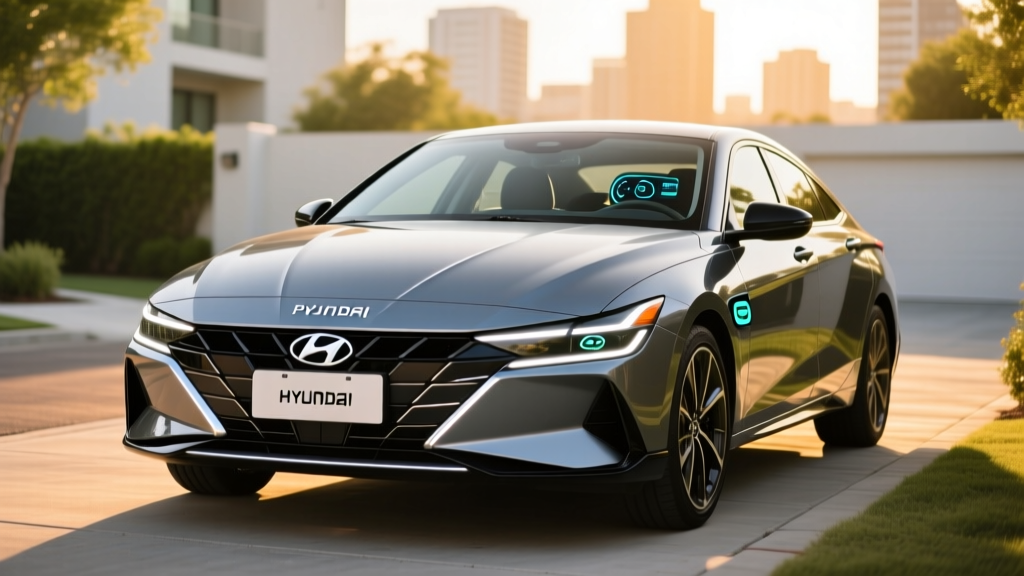
The Hyundai Elantra Hybrid remains one of the highest-MPG non-plug-in sedans on the market. For 2026, it carries over the proven 1.6L GDI hybrid powertrain rated at up to 54 MPG combined — a number that, unlike many EVs, you can actually exceed in real-world city driving. With a starting MSRP around $26,250 and Hyundai's industry-leading hybrid battery warranty, it occupies a narrow but valuable lane: buyers who want EV-like efficiency without charging infrastructure, range anxiety, or a price premium north of $35,000.
This guide covers the 2026 Elantra Hybrid (HEV) in depth. We'll also clarify how it differs from the discontinued Elantra Plug-In Hybrid (PHEV) and help you decide whether a conventional hybrid, a PHEV, or a full BEV fits your situation.
HEV vs. PHEV: What the Elantra Hybrid Actually Is
Conventional Hybrid (HEV) — Elantra Hybrid
- No plug required. The battery recharges via regenerative braking and the gasoline engine.
- Small battery: ~1.56 kWh lithium-ion polymer — assists the engine but cannot drive the car on electric power alone for meaningful distances.
- Fueling: Gas station only. You never need to think about charging.
- Best for: Drivers without reliable home or workplace charging access.
Plug-In Hybrid (PHEV) — Elantra PHEV (Discontinued after 2024)
- Plugs in. Larger ~10.5 kWh battery charges via Level 1 (120V) or Level 2 (240V).
- Electric-only range: ~29 miles EPA before the gas engine engages.
- No DC fast charging. Level 2 full charge took approximately 3.5 hours.
- Federal tax credit: Previously eligible for up to ~$3,750 under IRC §30D; credit availability has since changed and the model is no longer in production.
If you're researching "Elantra Hybrid" today, you're looking at the HEV. The PHEV variant is only available on the used market. For 2026, Hyundai's PHEV offerings in the U.S. shift toward the Tucson PHEV and Santa Fe PHEV.
Fuel Economy: EPA Ratings and Real-World MPG
| Trim | City MPG | Highway MPG | Combined MPG |
|---|---|---|---|
| Blue (base) | 54 | 58 | 56 |
| SEL / Limited | 51 | 58 | 54 |
Source: fueleconomy.gov — EPA estimates. Actual mileage will vary.
Real-World MPG: What to Actually Expect
Hybrids shine in stop-and-go traffic where regenerative braking constantly recaptures energy. In our experience and owner-reported data, the Elantra Hybrid Blue routinely meets or exceeds its 56 MPG combined EPA rating in city-heavy commutes — drivers averaging 70%+ city miles have reported 57-60 MPG over multiple fill-ups.
Highway-dominant driving is where the advantage narrows. At sustained 70-80 mph, expect 48-52 MPG. The electric motor assists less at constant speed, and aerodynamic drag dominates. Cold weather (below 35°F) knocks another 3-5 MPG off as the engine runs more frequently to heat the cabin and maintain battery temperature.
Bottom line: If your commute is urban or suburban with frequent stops, the Elantra Hybrid's real-world economy will match or beat the sticker. Long interstate commuters should budget closer to 50 MPG.
Powertrain and Performance Specs
| Specification | 2026 Elantra Hybrid |
|---|---|
| Engine | 1.6L GDI 4-cylinder Atkinson-cycle |
| Engine Output | 104 hp / 109 lb-ft torque |
| Electric Motor | 32 kW (43 hp) / 125 lb-ft torque |
| Combined System Output | 139 hp / 195 lb-ft torque |
| Transmission | 6-speed dual-clutch automatic (6DCT) |
| Hybrid Battery | 1.56 kWh lithium-ion polymer |
| 0-60 mph | ~8.5 seconds (estimated) |
| Drivetrain | Front-wheel drive |
| Fuel Tank | 11.1 gallons |
| Total Range (est.) | ~620 miles (at 56 MPG combined) |
The 6-speed dual-clutch transmission is a deliberate choice over the CVTs found in the Toyota Corolla Hybrid and Honda Civic Hybrid. It provides more natural shift feel and stronger highway passing response, though some drivers notice occasional low-speed hesitation during engine-motor handoffs — a trade-off for the DCT's mechanical directness.
At 139 combined horsepower, the Elantra Hybrid is tuned for efficiency, not acceleration. Merging onto fast-moving highways requires planning. However, the 195 lb-ft of combined torque — with the electric motor's instant delivery — makes it responsive around town where most driving actually happens.
Pricing, Trims, and Tax Credit Eligibility
| Trim | Est. MSRP (2026) | Key Features |
|---|---|---|
| Blue | $26,250 | 56 MPG combined, 8" display, Hyundai SmartSense ADAS |
| SEL | $28,750 | 10.25" cluster + nav, wireless CarPlay/Android Auto, heated seats |
| Limited | $32,500 | Leather, Bose audio, Highway Driving Assist, sunroof |
MSRP figures are estimates based on carryover pricing; confirm with your dealer for final 2026 numbers. Destination charges additional (~$1,150).
Federal Tax Credit: What Applies to the Elantra Hybrid?
The conventional Elantra Hybrid (HEV) does NOT qualify for the federal §30D New Clean Vehicle Credit. That credit — up to $7,500 — is reserved for plug-in vehicles (BEVs and PHEVs) meeting battery sourcing, MSRP caps, and buyer income limits as defined by the IRS.
Because the Elantra HEV cannot be plugged in, it is classified as a conventional hybrid and is ineligible for §30D regardless of price or income.
State-level incentives may apply. Some states offer rebates or HOV lane access for hybrids. Check your state's energy office or the Alternative Fuels Data Center for current local programs.
Battery Warranty, Reliability, and Replacement Costs
Hyundai Hybrid Battery Warranty
- Hybrid Battery: 10 years / 100,000 miles (whichever comes first)
- Hybrid System Components: 10 years / 100,000 miles (inverter, motor, controller)
- Limited Vehicle Warranty: 5 years / 60,000 miles
- Powertrain Warranty: 10 years / 100,000 miles
This warranty is transferable to second owners on Hyundai's newer models, though terms may adjust to 5yr/60k on transfer — verify with your dealer.
Long-Term Reliability
Hyundai's hybrid system, now in its third generation across the Elantra, Sonata, and Tucson lineups, has proven durable. The 1.56 kWh battery is small and operates within a narrow state-of-charge window (typically 40-80% SoC), which significantly reduces degradation stress compared to full BEV packs that cycle through wider ranges.
Owner forums and reliability surveys show very few reports of hybrid battery failure before 150,000 miles. The Atkinson-cycle engine, running less stressed than a conventional powertrain, also tends toward longevity.
Battery Replacement Cost
If replacement is needed outside warranty, expect $2,000 to $3,500 for the hybrid battery pack (parts and labor). This is dramatically lower than BEV battery replacement ($8,000-$20,000+) because the pack is small. Individual modules can sometimes be replaced rather than the full pack, further reducing cost. Hyundai's 10-year/100,000-mile coverage means most original owners will never pay for a hybrid battery out of pocket.
Elantra Hybrid vs. Alternatives: Which Should You Choose?
✓ Pros
- Best-in-class combined MPG (56 on Blue trim)
- No charging infrastructure needed
- 10-year/100,000-mile hybrid battery warranty
- Over 620 miles of total range per tank
- Strong standard ADAS suite (SmartSense)
- Competitive pricing from ~$26,250
- DCT transmission feels more natural than CVT
✗ Cons
- No federal tax credit eligibility
- Modest 139 hp — highway merging requires patience
- FWD only — no AWD option (unlike Corolla Hybrid)
- Occasional DCT hesitation at low speeds
- Higher trims push past $32K, encroaching on BEV territory
- Rear visibility could be better (thick C-pillars)
Elantra Hybrid vs. Toyota Corolla Hybrid
The Corolla Hybrid offers AWD (a significant advantage in snow-belt states) and comparable combined MPG (~52-54). However, it uses a CVT that drones under hard acceleration, and its base price is similar. Choose the Corolla Hybrid if you need all-wheel drive; choose the Elantra Hybrid if you want slightly higher MPG and a more engaging transmission.
Elantra Hybrid vs. Honda Civic Hybrid
The Civic Hybrid (50 MPG combined) is sportier to drive with more horsepower (~200 hp combined). It costs slightly more and sacrifices a few MPG. If driving dynamics matter more than squeezing every mile from a gallon, the Civic Hybrid is the driver's pick.
Elantra Hybrid vs. Going Full EV
If you have reliable Level 2 home charging and a commute under 250 miles round-trip, a BEV like the Hyundai Ioniq 6 or Chevrolet Bolt can deliver lower per-mile fuel costs and near-zero maintenance. But the Elantra Hybrid makes sense when:
- You live in an apartment without charging access
- You frequently drive 400+ mile road trips and don't want to plan DC fast-charging stops
- Your budget is under $30,000 and you want new-vehicle warranty coverage
- You live in a region with extreme cold, where BEV range loss (20-40%) is a real concern
Decision Framework
Choose the Elantra Hybrid if: You want maximum MPG without plugging in, your budget is $26K-$33K, and you don't have home charging.
Choose a PHEV (like Tucson PHEV) if: You have home charging, your daily commute is under 30 miles, and you want electric-only weekday driving with gas flexibility for road trips.
Choose a full BEV if: You can install a Level 2 home charger, your daily driving is under 250 miles, and you want the lowest per-mile operating cost and minimal maintenance.
Frequently Asked Questions
How many MPG does the 2026 Elantra Hybrid get?
The Blue trim is EPA-rated at 54 city / 58 highway / 56 combined MPG. SEL and Limited trims are rated at 51 city / 58 highway / 54 combined. In real-world city-heavy driving, many owners meet or exceed these figures. Highway-dominant driving typically yields 48-52 MPG.
Does the Elantra Hybrid need to be plugged in?
No. The Elantra Hybrid is a conventional HEV. Its small 1.56 kWh battery charges entirely through regenerative braking and the gasoline engine. You fuel it at a gas station like any other car. The Elantra PHEV (discontinued after 2024) did require plug-in charging.
Does the Elantra Hybrid qualify for a federal tax credit?
No. The federal §30D New Clean Vehicle Credit applies only to plug-in electric vehicles (BEVs and PHEVs) that meet battery sourcing, MSRP, and buyer income requirements per IRS guidelines. Conventional hybrids like the Elantra HEV are not eligible. Some state-level incentives may apply — check the Alternative Fuels Data Center.
Is the Elantra Hybrid reliable, and what does a battery replacement cost?
Hyundai's third-generation hybrid system has a strong reliability record, and the hybrid battery is covered by a 10-year/100,000-mile warranty. Out-of-warranty replacement runs approximately $2,000-$3,500 — far less than a BEV battery. Most original owners will never face this cost.
How does the Elantra Hybrid compare to a full EV for total cost of ownership?
At 56 MPG and $3.25/gallon gas, the Elantra Hybrid costs roughly $0.06-$0.07 per mile in fuel. A comparable BEV charging at home at $0.14/kWh averages $0.04-$0.05 per mile. Over 5 years and 75,000 miles, that's a fuel savings of ~$1,500-$2,000 for the BEV. However, the Elantra Hybrid's lower purchase price (~$26,250 vs. $35,000+ for most BEVs before credits) and zero charging-infrastructure cost often offset this for budget-conscious buyers.
Is there an AWD Elantra Hybrid?
No. The 2026 Elantra Hybrid is front-wheel drive only. If AWD is essential, the Toyota Corolla Hybrid offers an electronic AWD system, and the Hyundai Tucson Hybrid provides AWD in a crossover format.