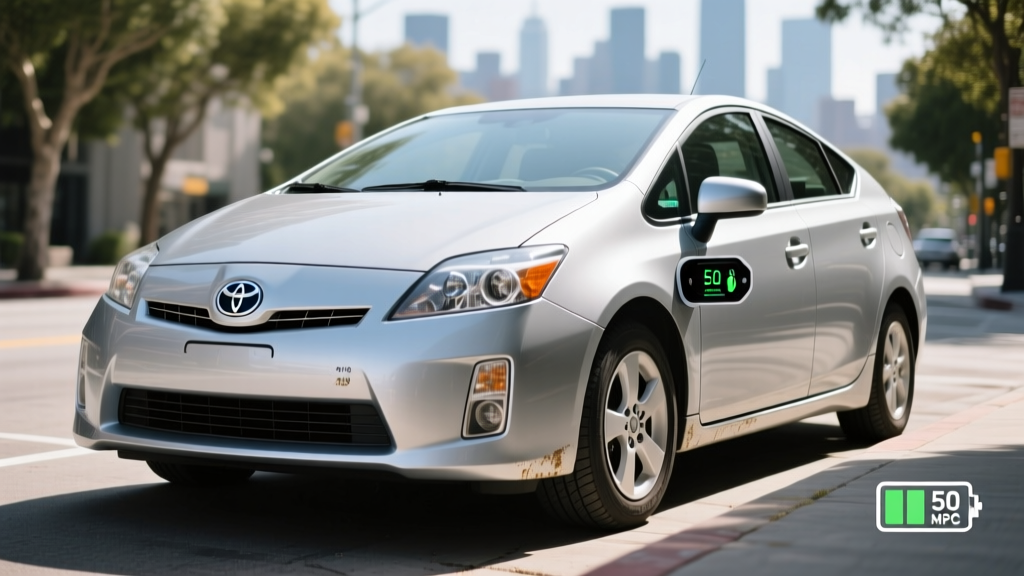
The 2018 Toyota Prius hybrid car remains one of the most fuel-efficient vehicles ever sold in the United States, and in the used-car market of 2026, it represents a compelling entry point for buyers who want hybrid efficiency without the complexity of plug-in charging. Whether you are cross-shopping it against newer hybrids, plug-in hybrids, or full battery-electric vehicles, this guide gives you the exact numbers you need to make an informed decision.
2018 Toyota Prius Powertrain and Efficiency Specs
The fourth-generation Prius (XW50) sold for the 2018 model year pairs a 1.8-liter Atkinson-cycle four-cylinder gasoline engine with Toyota's Hybrid Synergy Drive system. Here are the core specifications:
| Specification | 2018 Toyota Prius |
|---|---|
| Gasoline Engine | 1.8L 4-cylinder Atkinson-cycle, 95 hp |
| Electric Motor | Permanent-magnet synchronous, 71 hp |
| Net Combined Horsepower | 121 hp |
| Hybrid Battery | 0.75 kWh (NiMH) or 0.95 kWh (Li-ion, Eco trims) |
| Transmission | Continuously Variable (eCVT / planetary gearset) |
| Drivetrain | Front-wheel drive (AWD-e not available until 2019) |
| 0–60 mph | ~10.5 seconds |
| Curb Weight | ~3,000–3,050 lbs |
The 2018 Prius is a conventional hybrid electric vehicle (HEV). It does not plug in. The hybrid battery charges exclusively through regenerative braking and the gasoline engine. This is a fundamental distinction from the Prius Prime, which is a plug-in hybrid (PHEV) with a larger battery and external charging capability.
EPA Fuel Economy: City, Highway, and Combined MPG
The 2018 Prius was offered in several trims, and fuel economy varies slightly depending on wheel size and battery chemistry. According to fueleconomy.gov, here are the official EPA ratings:
| Trim / Configuration | City MPG | Highway MPG | Combined MPG |
|---|---|---|---|
| Prius Two / Two Eco (Li-ion battery, 15" wheels) | 58 | 53 | 56 |
| Prius Three / Four / Touring (NiMH battery, 17" wheels) | 54 | 50 | 52 |
The Eco trims achieve their higher city rating partly due to the lighter lithium-ion hybrid battery and low-rolling-resistance 15-inch tires. The difference is meaningful: over 15,000 miles per year at $3.50/gallon, the 56-MPG combined trim saves roughly $140 annually versus the 52-MPG version.
Real-World MPG vs. EPA Sticker
One of the Prius's strengths is that real-world fuel economy often meets or exceeds the EPA estimate in city and suburban driving. The hybrid system recovers kinetic energy during deceleration, meaning stop-and-go traffic actually improves efficiency relative to the highway cycle. Owners on fueleconomy.gov's My MPG tracker commonly report 50–58 MPG combined in mixed driving.
However, there are scenarios where real-world numbers dip:
- Sustained highway driving above 70 mph: Aerodynamic drag reduces efficiency. Expect 45–48 MPG at 75–80 mph on the interstate.
- Cold weather (below 30°F): The engine runs more frequently to maintain cabin heat and battery temperature. Expect a 10–15% reduction, bringing combined MPG to roughly 44–50.
- Heavy cargo or mountain grades: The 121-hp powertrain works harder under load, reducing efficiency to the low-to-mid 40s.
HEV vs. PHEV: Understanding the Prius Lineup
The 2018 model year offered two distinct Prius vehicles. Understanding the difference is essential before you shop:
| Feature | 2018 Prius (HEV) | 2018 Prius Prime (PHEV) |
|---|---|---|
| Plug-in Charging | No — self-charging hybrid | Yes — Level 1 (120V) and Level 2 (240V) |
| Hybrid Battery Capacity | 0.75–0.95 kWh | 8.8 kWh (Li-ion) |
| Electric-Only Range | ~1 mile at low speed | 25 miles (EPA) |
| Combined MPG (after EV range) | 52–56 MPG | 54 MPG |
| MPGe (electric mode) | N/A | 133 MPGe |
| Total Range | ~620 miles | ~640 miles (EV + gas) |
| DC Fast Charging | No | No (Level 2 max, ~5.5 hours from empty) |
| Federal Tax Credit (original purchase) | None | Up to $4,502 (now expired for new purchases) |
The 2018 Prius Prime (PHEV) is the plug-in variant. It offers 25 miles of EPA-rated electric-only range, enough for many daily commutes without using gasoline. After the battery depletes, it operates as a conventional hybrid at 54 MPG combined. Charging takes approximately 5.5 hours on a standard 120V outlet (Level 1) or about 2 hours on a 240V Level 2 charger. The Prius Prime does not support DC fast charging.
The standard 2018 Prius (HEV) requires zero plug-in infrastructure. You fuel it like any gasoline car, and the hybrid system handles the rest. This is the simpler choice for buyers without access to home or workplace charging.
Hybrid Battery Longevity, Warranty, and Replacement Cost
Toyota Hybrid Battery Warranty (2018 Model Year): 8 years / 100,000 miles (10 years / 150,000 miles in California and states that adopted CARB emissions standards: CT, ME, MD, MA, NJ, NY, OR, RI, VT, WA, plus others that have since adopted).
This is the single most important ownership question for used hybrid buyers, and the data is reassuring. Toyota's nickel-metal hydride (NiMH) and lithium-ion (Li-ion) hybrid batteries in the fourth-generation Prius have demonstrated exceptional longevity. Based on fleet data and owner reports compiled by sources including Consumer Reports, the vast majority of Prius hybrid batteries last well beyond 150,000 miles with minimal capacity loss.
Unlike a full EV battery, the Prius hybrid battery is small (under 1 kWh) and operates within a narrow state-of-charge window — typically between 40% and 80%. Toyota's battery management system never allows full discharge or full charge, which dramatically reduces degradation stress. This is why Prius batteries routinely reach 200,000+ miles.
What Does Hybrid Battery Replacement Cost?
If the battery does eventually fail outside of warranty coverage, replacement options in 2026 include:
- New OEM battery from Toyota: Approximately $2,000–$2,500 (parts only, installed at a dealer typically runs $2,500–$3,500 total).
- Refurbished/remanufactured battery: $1,000–$1,800 from reputable suppliers, with 1–3 year warranties.
- Individual module replacement: Some independent hybrid specialists can replace only the failed cells within the battery pack for $500–$900.
For context, a $2,500 battery replacement at 180,000 miles, spread across the vehicle's remaining life, adds roughly 1–2 cents per mile — far less than the cumulative fuel savings the hybrid system has already delivered.
Used 2018 Prius Pricing in 2026
As of early 2026, the 2018 Toyota Prius trades in the used market at the following approximate ranges, depending on mileage, condition, and trim:
| Trim Level | Mileage Range | Approximate Used Price (2026) |
|---|---|---|
| Prius Two | 70,000–100,000 mi | $14,000–$16,500 |
| Prius Two Eco | 70,000–100,000 mi | $14,500–$17,000 |
| Prius Three | 70,000–100,000 mi | $15,500–$18,000 |
| Prius Four / Four Touring | 70,000–100,000 mi | $16,500–$19,500 |
The original MSRP for the 2018 Prius ranged from approximately $23,475 (Two trim) to $28,965 (Four Touring). Depreciation has been moderate — the Prius holds value well relative to conventional sedans, thanks to strong demand from rideshare drivers and fuel-conscious commuters.
Tax Credit Eligibility for Used Hybrid Purchases
The 2018 Toyota Prius (HEV) did not qualify for the federal §30D new-vehicle tax credit when new, and it does not qualify for the Used Clean Vehicle Credit (§25E) today. The §25E credit of up to $4,000 applies only to used plug-in electric vehicles and fuel-cell vehicles — conventional hybrids are excluded.
The 2018 Prius Prime (PHEV) may qualify for the §25E used-EV credit if all conditions are met:
- Sale price must be $25,000 or less
- Buyer's adjusted gross income must not exceed $75,000 (single) / $112,500 (head of household) / $150,000 (joint)
- Vehicle must be at least 2 model years old (2018 qualifies in 2026)
- Must be purchased from a licensed dealer
- Buyer must not have claimed the used-EV credit in the prior 3 years
- Credit equals 30% of sale price, capped at $4,000
Always verify current eligibility with a tax professional and the IRS §25E page, as rules and qualifying vehicle lists are subject to change.
2018 Prius Pros and Cons
Pros
- Exceptional real-world fuel economy: 50–58 MPG combined
- Proven hybrid battery longevity (200,000+ miles common)
- Low annual fuel cost (~$900–$1,100 at 15,000 mi/yr)
- No plug-in charging required — zero infrastructure dependency
- Spacious hatchback cargo area (21.6 cu ft rear seats up, 50.7 cu ft folded)
- Strong reliability record; low maintenance costs
- IIHS Top Safety Pick (when equipped with Toyota Safety Sense P)
Cons
- Modest 121 hp — acceleration is adequate, not quick (0–60 in ~10.5 sec)
- Road noise and ride firmness noticeable on rough pavement
- Infotainment system feels dated by 2026 standards (no Apple CarPlay in 2018)
- Rear-seat headroom tight for taller passengers due to sloping roofline
- AWD not available (AWD-e introduced for 2019 model year)
- Used prices remain elevated relative to conventional sedans
Who Should Choose the 2018 Prius vs. a PHEV or Full EV?
The 2018 Prius occupies a specific niche in the electrified-vehicle spectrum. Here is a practical decision framework:
Choose the 2018 Prius (HEV) if:
- You lack access to home or workplace charging (apartment, street parking, no garage)
- You want maximum simplicity — no cables, no charging apps, no plug-in logistics
- Your budget is $14,000–$19,000 for a reliable, efficient daily driver
- You drive 12,000–20,000 miles/year and want to minimize fuel spend without a high upfront cost
- You frequently take long road trips and want zero range-planning anxiety
Choose a PHEV (like the Prius Prime or newer RAV4 Prime) if:
- You have home Level 2 charging and a commute under 25–40 miles
- You want to drive most weekdays on electricity but keep gasoline for road trips
- You are willing to pay a premium for electric-mode driving and lower per-mile energy cost
Choose a full BEV (like a used Chevrolet Bolt, Tesla Model 3, or Hyundai Kona Electric) if:
- You have reliable home charging and your daily driving is under 200 miles
- You want zero tailpipe emissions, minimal maintenance (no oil changes, no engine), and the lowest per-mile energy cost
- You qualify for the §25E used-EV credit ($4,000), which can bring a used Bolt EV close to Prius pricing
For buyers who drive over 15,000 miles annually and cannot charge at home, the 2018 Prius HEV remains arguably the most cost-effective vehicle choice available. At 54 MPG combined and $3.50/gallon, annual fuel cost is approximately $972 — roughly half what a 27-MPG conventional sedan would require.
Frequently Asked Questions
How many MPG does the 2018 Toyota Prius get?
The 2018 Prius achieves 54–58 MPG combined depending on trim. The Two Eco trim rates at 58 city / 53 highway / 56 combined. The Three, Four, and Touring trims rate at 54 city / 50 highway / 52 combined. Real-world results commonly match or exceed these figures in city driving but may drop to 44–48 MPG in cold weather or sustained high-speed highway driving.
Does the 2018 Prius need to be plugged in?
No. The standard 2018 Prius is a conventional hybrid (HEV). It charges its small hybrid battery through regenerative braking and the gasoline engine. You never plug it in. The 2018 Prius Prime is a different model — a plug-in hybrid (PHEV) that does require external charging to access its 25-mile electric-only range.
How far can the 2018 Prius Prime go on electric only?
The 2018 Prius Prime (PHEV) has an EPA-rated electric-only range of 25 miles. After the battery depletes, it operates as a conventional hybrid at 54 MPG combined. Total range with a full charge and full tank is approximately 640 miles. The standard 2018 Prius HEV can travel roughly 1 mile at very low speed on battery alone but is not designed for meaningful electric-only driving.
Is the 2018 Prius hybrid battery reliable and what does replacement cost?
Yes — Toyota's hybrid batteries in the fourth-generation Prius have an excellent reliability record, routinely lasting 150,000–200,000+ miles. The original warranty covers 8 years/100,000 miles (10 years/150,000 miles in CARB states). If replacement is needed out of warranty, expect $2,500–$3,500 for a new OEM battery installed at a dealer, or $1,000–$1,800 for a refurbished unit from an independent hybrid specialist.
Does the 2018 Prius qualify for any tax credit?
The standard 2018 Prius (HEV) does not qualify for any federal tax credit — neither the new-vehicle §30D credit nor the used-vehicle §25E credit. The 2018 Prius Prime (PHEV) may qualify for the §25E used clean vehicle credit of up to $4,000 if purchased from a dealer for $25,000 or less and the buyer meets IRS income limits. Always confirm eligibility with a tax professional and the current IRS guidelines.
How does the 2018 Prius compare to newer hybrids?
The 2018 Prius's 52–56 MPG remains competitive even against 2025–2026 hybrids. The current-generation Prius (2023+) achieves 57 MPG combined and offers 194 hp — a meaningful performance upgrade — but used prices for newer models are significantly higher. The 2018 model trades acceleration and modern infotainment for a substantially lower entry price while delivering nearly identical efficiency.
What should I check when buying a used 2018 Prius?
Prioritize: (1) hybrid battery health — ask for a diagnostic report from a Toyota dealer or hybrid specialist showing internal resistance values; (2) maintenance history — the gasoline engine still requires regular oil changes and coolant service; (3) brake actuator recalls — verify any open recalls have been addressed via the NHTSA recall lookup; (4) tire condition — low-rolling-resistance tires affect MPG, so confirm replacements match OEM specifications.