The third-generation Toyota Prius (model year 2010) remains one of the most fuel-efficient vehicles ever sold in the United States. If you're researching the 2010 Toyota Prius hybrid MPG as a used-car buyer in 2026, you're looking at a proven platform with exceptional city efficiency, low running costs, and a hybrid battery system that — with proper care — can outlast the car itself. This guide covers the exact EPA numbers, real-world expectations, battery longevity data, and how this 16-year-old HEV stacks up against modern hybrids, PHEVs, and full EVs.
2010 Toyota Prius Hybrid MPG: EPA Ratings and Real-World Data
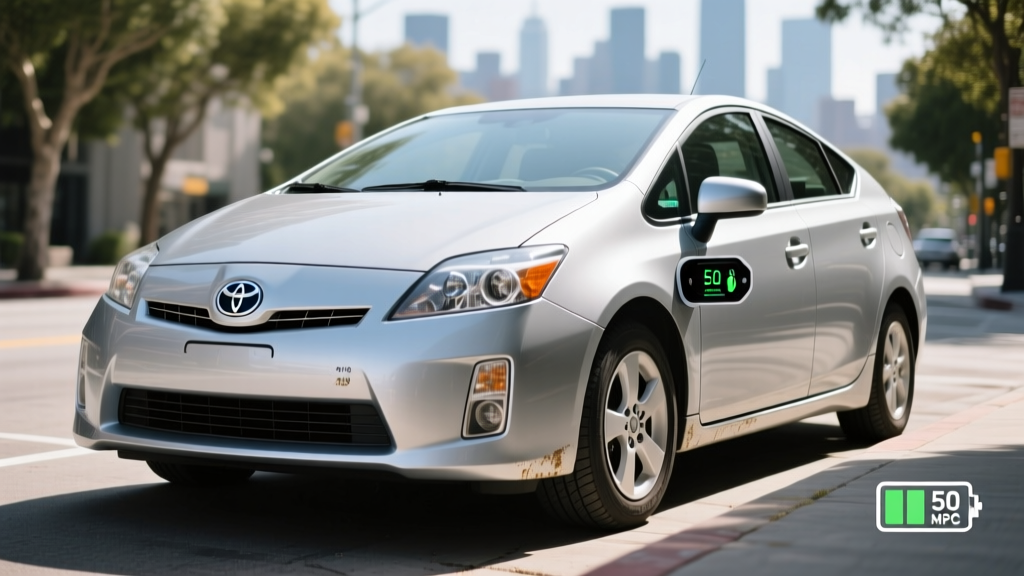
The 2010 Prius carries an EPA-estimated 51 city / 48 highway / 50 combined MPG. At launch, this was the highest combined rating of any mass-market vehicle sold in America. The secret to its city-dominant profile is Toyota's Hybrid Synergy Drive: the 1.8-liter Atkinson-cycle four-cylinder engine shuts off at stops and low speeds, letting the electric motor handle propulsion while regenerative braking recaptures energy that a conventional car would waste as heat.
| Metric | EPA Estimate | Real-World Expectation (2026) |
|---|---|---|
| City MPG | 51 | 48–54 (hybrids often exceed EPA in stop-and-go) |
| Highway MPG | 48 | 43–47 (aerodynamic drag and sustained ICE use) |
| Combined MPG | 50 | 46–50 depending on driving mix |
| Fuel tank capacity | 11.9 gallons | ~540–595 miles per tank |
| Annual fuel cost* | ~$900 | Based on 15,000 mi/yr at $3.50/gal |
*Source: fueleconomy.gov — actual costs vary with local fuel prices and driving habits.
Why real-world city MPG can exceed the EPA sticker: Hybrids benefit disproportionately from regenerative braking and engine-off coasting in traffic. Owners who drive primarily in urban environments frequently report 52–55 MPG. Conversely, sustained highway driving at 75+ MPH pushes the gasoline engine into higher-load operation, dropping efficiency to the low-to-mid 40s. Cold weather also reduces MPG by 5–10% as the engine runs longer to maintain cabin heat and battery temperature.
Powertrain Specs: What's Under the Hood of the 2010 Prius
The 2010 model year marked the debut of Toyota's third-generation Prius (XW30 platform), which introduced a larger 1.8-liter 2ZR-FXE engine replacing the prior 1.5-liter. Combined output rose significantly, giving this generation noticeably better highway passing power than its predecessor.
| Specification | 2010 Toyota Prius |
|---|---|
| Engine | 1.8L Atkinson-cycle 4-cylinder (98 hp) |
| Electric motor | Permanent-magnet AC synchronous (80 hp / 60 kW) |
| Net combined system output | 134 hp |
| Transmission | Planetary eCVT (no traditional gears) |
| 0–60 mph | ~9.8 seconds |
| Drivetrain | Front-wheel drive |
| Curb weight | ~3,042 lbs |
| Hybrid battery | 1.3 kWh nickel-metal hydride (NiMH) |
| Drive modes | Normal, Eco, Power, EV (short low-speed electric-only) |
The eCVT is not a belt-and-pulley CVT like those in some Nissan or Subaru models. It uses a planetary gearset to blend engine and motor power with no friction surfaces to wear — a major reason the Prius drivetrain is among the most durable in the industry.
HEV vs PHEV vs EV: Where Does the 2010 Prius Fit?
The 2010 Prius is a conventional hybrid electric vehicle (HEV). It does not plug in. It cannot be charged from a wall outlet or public charger. Its small 1.3 kWh NiMH battery is recharged exclusively through regenerative braking and the gasoline engine. This is fundamentally different from a plug-in hybrid (PHEV) or a battery electric vehicle (BEV).
| Feature | 2010 Prius (HEV) | Modern PHEV (e.g., Prius Prime) | Full EV (e.g., Tesla Model 3) |
|---|---|---|---|
| Plugs in? | No | Yes (Level 1/2) | Yes (Level 1/2/DC fast) |
| Electric-only range | ~1 mile at low speed (EV mode) | 25–44 miles (EPA) | 250–360+ miles (EPA) |
| Gasoline engine? | Yes (primary propulsion) | Yes (backup/extended range) | No |
| Home charging needed? | No | Recommended for max benefit | Required |
| Federal tax credit (§30D)? | No | Up to $7,500 (if eligible) | Up to $7,500 (if eligible) |
| Best for | No-plug buyers, city commuters | Home chargers wanting EV + road-trip flexibility | Home chargers ready for full electric |
The 2010 Prius's EV mode allows electric-only propulsion for roughly one mile at speeds under 25 mph — useful for creeping through a parking garage, but not a meaningful zero-emission commute solution. If you want substantial electric-only driving, you'd need to look at a current-generation Prius Prime PHEV or a full BEV.
Hybrid Battery Longevity, Warranty, and Replacement Cost
Original battery warranty: Toyota covered the 2010 Prius hybrid battery for 8 years / 100,000 miles (10 years / 150,000 miles in California Air Resources Board states). That factory coverage has now expired for all 2010 examples.
Battery chemistry: Nickel-metal hydride (NiMH) — a mature, well-understood technology with excellent cycle-life characteristics but lower energy density than modern lithium-ion packs.
How long do 2010 Prius hybrid batteries actually last? NiMH packs in the Gen 3 Prius commonly reach 150,000–200,000+ miles before significant degradation. The key failure mode is not sudden death but gradual capacity loss — the battery holds less charge, the engine kicks on more frequently, and MPG drops from 50 to perhaps 42–45. Many 2010 Prius examples on the road in 2026 are still running their original battery packs.
Replacement cost breakdown (2026 market):
- New OEM Toyota battery: $2,000–$2,500 installed at a dealership
- Refurbished/remanufactured battery: $800–$1,500 installed at an independent hybrid specialist
- Individual module replacement: $200–$500 if only a few cells have failed (requires diagnostic testing)
- Used battery from a salvage yard: $400–$800, but remaining lifespan is uncertain
A failing hybrid battery triggers a check-engine light with codes like P0A80 (replace hybrid battery pack). Before committing to a full replacement, ask a hybrid-experienced technician to perform a module-level balance test — sometimes a $300 individual cell swap restores the pack to functional health.
2010 Prius Ownership Costs in 2026: Price, Insurance, and Tax Credits
Used market pricing (2026): A 2010 Toyota Prius typically sells for $4,500–$8,500 depending on mileage, condition, and battery health. Examples under 100,000 miles with documented battery health command the top of that range. High-mileage examples (180,000+) with an original battery sell toward the lower end.
Tax credit eligibility: The 2010 Prius does not qualify for the federal §30D new clean vehicle credit — that credit applies only to new vehicle purchases, and the Prius HEV never qualified even when new (the credit requires plug-in capability with a minimum battery capacity). It also does not qualify for the used EV credit (IRC §25E), which requires the vehicle to be a plug-in electric vehicle or fuel cell vehicle. There is no federal tax incentive for purchasing a conventional hybrid.
Insurance: The 2010 Prius is among the cheapest vehicles to insure in its age bracket. National average premiums run approximately $80–$120/month depending on driver profile and state — lower than comparable-age Corollas in many markets because Prius drivers statistically file fewer claims.
Total annual running cost estimate (2026):
- Fuel (15,000 mi at 48 real-world MPG, $3.50/gal): ~$1,094
- Insurance: ~$1,200
- Maintenance (oil changes, tires, brakes): ~$400–$600
- Total: ~$2,700–$2,900/year — roughly $0.18–$0.19/mile all-in
For comparison, a 2010-era conventional sedan averaging 25 MPG would cost approximately $2,100/year in fuel alone.
Reliability, Common Issues, and What to Inspect Before Buying
The third-generation Prius has an outstanding reliability record, but at 16 years old, specific wear items deserve scrutiny:
- Hybrid battery health: Request a "battery health report" from a Toyota dealer or hybrid specialist. Look for less than 15% capacity loss and balanced module voltages.
- Inverter coolant pump: A known wear item on Gen 3 models. Replacement runs $200–$400. Check for coolant leaks near the inverter.
- EGR (exhaust gas recirculation) system: The EGR valve and cooler can clog with carbon deposits above 120,000 miles, causing rough idle or head-gasket stress. A $200–$350 EGR cleaning is recommended preventive maintenance.
- Brake actuator: The regenerative braking system uses an electro-hydraulic actuator that can fail on high-mileage examples. Replacement is $1,200–$1,800 at a dealer. Test for smooth, consistent brake feel and listen for unusual pump cycling.
- 12V auxiliary battery: Located in the rear cargo area, this small AGM battery powers electronics when the hybrid system is off. It typically lasts 4–6 years and costs $150–$250 to replace.
- Head gasket: Less common than internet forums suggest, but EGR clogging (above) increases head-gasket risk. Ensure the EGR system has been serviced.
Pros
- 50 MPG combined — still among the highest of any non-plug-in vehicle
- Extremely low cost of ownership (~$0.18/mile all-in)
- No plug-in infrastructure required
- Proven 200,000+ mile durability with basic maintenance
- Strong parts availability and independent repair network
- Hatchback cargo versatility (39.6 cu ft rear seats folded)
Cons
- 9.8-second 0–60 time — underpowered for highway merging
- No meaningful electric-only range (EV mode is ~1 mile)
- Original hybrid battery warranty has expired on all examples
- Dated infotainment — no Apple CarPlay, Android Auto, or Bluetooth audio streaming
- No modern ADAS — lacks automatic emergency braking, lane-keeping assist
- Road noise and ride quality lag behind modern compact cars
Who Should Buy the 2010 Prius — And Who Should Look Elsewhere?
Choose the 2010 Prius if:
- You want the lowest possible fuel cost without installing a home charger
- Your commute is primarily city/suburban stop-and-go driving (where hybrid efficiency peaks)
- You need a sub-$8,000 vehicle with predictable, low maintenance costs
- You drive 15,000+ miles per year and fuel cost is a primary concern
- You value hatchback utility over driving dynamics or tech features
Consider a modern PHEV or full EV instead if:
- You have home charging access and want electric-only daily commuting (a Prius Prime delivers 44 EPA electric miles for ~$33,000 new, with potential §30D tax credit eligibility)
- You want modern safety features — automatic emergency braking, blind-spot monitoring, lane-centering assist are standard on current vehicles
- You prioritize acceleration and highway refinement
- You want to reduce tailpipe emissions substantially, not just fuel consumption
The 2010 Prius occupies a specific niche in 2026: it's the cheapest-per-mile vehicle you can buy if you lack charging access. For buyers who can charge at home, even a modest-range PHEV will deliver lower per-mile energy costs on daily commutes while retaining gas-engine flexibility for road trips.
Frequently Asked Questions
How many MPG does the 2010 Toyota Prius hybrid get?
The EPA rates the 2010 Prius at 51 city / 48 highway / 50 combined MPG. Real-world results typically fall between 46 and 54 MPG depending on driving mix, weather, and battery condition. City-heavy drivers often exceed the EPA combined estimate thanks to regenerative braking.
Does the 2010 Prius need to be plugged in?
No. The 2010 Prius is a conventional hybrid (HEV), not a plug-in hybrid (PHEV). Its battery recharges through regenerative braking and the gasoline engine. There is no charging port and no need for home or public charging infrastructure.
How far can the 2010 Prius drive on electric only?
Approximately one mile at speeds under 25 MPH using EV mode. This is not a practical electric-commuting solution — it's designed for low-speed maneuvering in parking structures or residential driveways. For meaningful electric-only range, you need a PHEV (25–44 miles) or a full BEV (250+ miles).
How much does it cost to replace the hybrid battery in a 2010 Prius?
A new OEM battery from Toyota costs approximately $2,000–$2,500 installed. Refurbished batteries from independent hybrid specialists run $800–$1,500 installed. In some cases, individual module replacement ($200–$500) can restore a partially degraded pack without a full swap.
Does the 2010 Toyota Prius qualify for any tax credit?
No. The federal §30D new vehicle credit and §25E used vehicle credit both require plug-in electric capability. The 2010 Prius is a conventional hybrid with no plug and does not qualify for any federal EV tax incentive. Some states historically offered hybrid rebates, but most have expired or shifted to plug-in vehicles only. Check IRS.gov for current federal credit rules.
Is a 2010 Prius with 200,000 miles a good buy?
It can be — if the hybrid battery has been tested and shows acceptable health, the EGR system has been cleaned, and the brake actuator functions smoothly. The eCVT planetary gearset and Atkinson-cycle engine are inherently low-wear components. Many Gen 3 Prius examples reach 250,000+ miles with basic maintenance. Budget $1,000–$2,000 for potential hybrid battery work if the original pack is still in place.
How does the 2010 Prius MPG compare to a modern Prius?
The 2025 Toyota Prius LE is EPA-rated at 57 city / 56 highway / 57 combined — roughly 14% more efficient than the 2010 model, with significantly more power (194 hp combined) and modern safety technology. If your budget allows $28,000+, a new Prius is a substantial upgrade in every measurable metric.