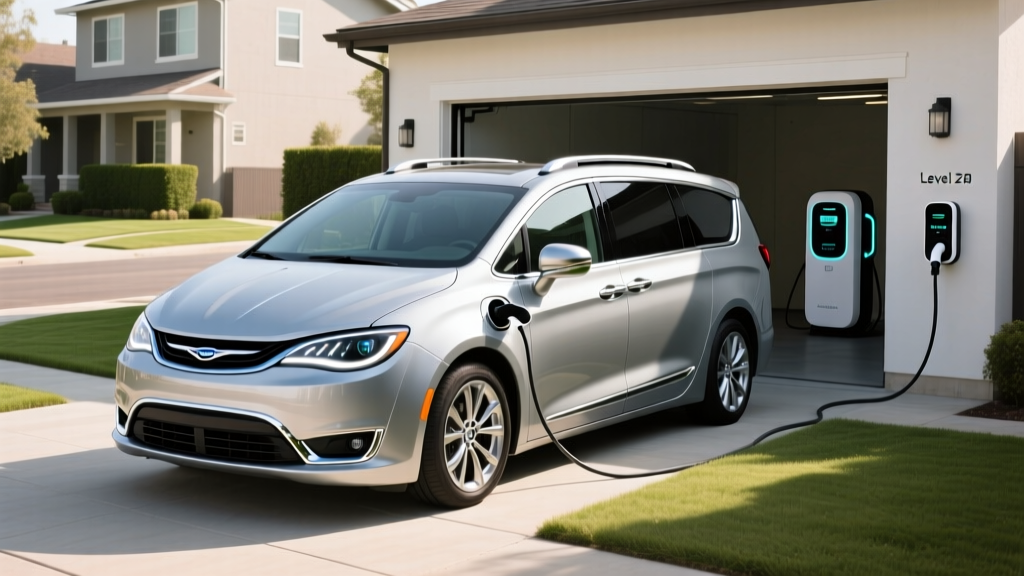
If you're researching the 2018 Chrysler Pacifica Hybrid MPG and real-world efficiency as a used-minivan shopper, you're looking at one of the earliest mainstream plug-in hybrid family haulers. The Pacifica Hybrid pairs a 3.6-liter V6 with two electric motors and a 16 kWh lithium-ion battery pack, delivering an EPA-rated 33 miles of electric-only driving and 32 MPG combined once the battery is depleted. In 2026, this PHEV minivan remains a compelling option on the used market for families who want school-run electric commutes without range anxiety on road trips.
This guide covers every number that matters: EPA city/highway/combined figures, real-world MPG observations, electric-only range, charging times, battery warranty and replacement costs, and how the Pacifica Hybrid stacks up against a conventional hybrid, a full EV, or the gas-only Pacifica.
HEV vs PHEV: Where the Pacifica Hybrid Fits
Before diving into the numbers, it's essential to understand the distinction between a conventional hybrid (HEV) and a plug-in hybrid (PHEV), because the Pacifica lineup includes both.
| Feature | Conventional Hybrid (HEV) | Plug-in Hybrid (PHEV) |
|---|---|---|
| Battery Size | 1–2 kWh | 16 kWh (Pacifica Hybrid) |
| Plug-in Charging | No — charges via regenerative braking | Yes — Level 1 or Level 2 |
| Electric-Only Range | ~1 mile or less at low speed | EPA 33 miles |
| Gas Engine | Always available | Always available after battery depletion |
| Federal Tax Credit (New) | None under §30D | Up to $7,500 (when new; expired for new purchases) |
The 2018 Chrysler Pacifica Hybrid is a PHEV. The gas-only Pacifica and the later Pacifica Hybrid (non-plug mild-hybrid variants) are different animals. If you see a Pacifica listed as "Hybrid" on a used lot, verify whether it has a charge port — that's the quickest visual tell. The PHEV has a J1772 charge port on the driver-side fender; the gas-only model does not.
2018 Chrysler Pacifica Hybrid MPG: EPA Numbers
Here's the official fuel economy data from fueleconomy.gov for the 2018 Chrysler Pacifica Hybrid:
| Metric | EPA Rating |
|---|---|
| MPGe (Electric + Gas Combined) | 84 MPGe |
| Combined MPG (Gas Only, Battery Depleted) | 32 MPG |
| City MPG (Gas Only) | 29 MPG |
| Highway MPG (Gas Only) | 30 MPG |
| Electric-Only Range | 33 miles |
| Total Combined Range (Electric + Gas) | ~566 miles |
| Fuel Tank Capacity | 16.0 gallons |
| Battery Usable Capacity | ~13 kWh (of 16 kWh total) |
How to read these numbers: The 84 MPGe figure applies only while you're driving on battery power and blending electricity with gas. Once the 33 miles of electric range are consumed, the Pacifica Hybrid operates as a conventional hybrid, and the 32 MPG combined figure is what you'll see on longer trips.
Real-World MPG vs. EPA Estimates
The 32 MPG combined EPA rating is a reasonable baseline, but real-world results vary significantly depending on how you use the vehicle.
City driving with regular charging: Owners who plug in nightly and drive mostly under 33 miles per day report burning almost no gasoline for weeks at a time. In this scenario, your effective "MPG" is essentially infinite for daily driving — you're running on electricity alone.
Highway road trips (battery depleted): Expect 27–29 MPG at 70–75 mph on the interstate. The Pacifica Hybrid's added battery weight (roughly 600 lbs more than the gas Pacifica) and minivan aerodynamics hurt highway efficiency. This is slightly below the EPA's 30 MPG highway sticker.
Cold weather impact: In freezing temperatures, electric-only range drops to roughly 22–26 miles as the battery loses efficiency and cabin heating draws energy. Gas-mode MPG also dips 2–3 MPG due to cold-start enrichment and increased accessory loads.
Hybrid driving in the city: Like most hybrids and PHEVs, the Pacifica Hybrid tends to match or slightly exceed its EPA city rating in stop-and-go traffic, where regenerative braking recovers energy that a gas-only vehicle wastes as brake heat. Drivers in urban environments report 31–34 MPG in gas-only city driving.
Electric-Only Range, Charging Times & Battery Specs
The Pacifica Hybrid's 16 kWh battery pack (with roughly 13 kWh usable to preserve longevity) delivers an EPA-rated 33 miles of electric-only range. Here are the charging specifics:
| Charging Level | Power (kW) | Time to Full Charge | Connector |
|---|---|---|---|
| Level 1 (120V household outlet) | ~1.4 kW | ~14 hours | |
| Level 2 (240V, 30A circuit) | ~6.6 kW | ~2 hours | |
| DC Fast Charging | Not supported | N/A |
Critical note: The 2018 Pacifica Hybrid cannot DC fast charge. It uses a J1772 connector for Level 1 and Level 2 AC charging only. For most PHEV owners, this is fine — you charge overnight at home on Level 2 and start each morning with a full 33-mile electric buffer. But don't expect to top up at a highway Electrify America or Tesla Supercharger station.
On a standard 120V household outlet (Level 1), a full charge takes roughly 14 hours. This works if you plug in every evening and drive less than 33 miles daily, but it won't fully replenish the battery between a morning and evening commute. A Level 2 home charger is strongly recommended — installation typically costs $500–$1,500 including equipment and electrician labor, depending on your panel capacity and wiring distance.
Powertrain: V6 Meets Dual Electric Motors
The 2018 Pacifica Hybrid uses Chrysler's eFlite continuously variable transmission (CVT) to blend power from three sources:
| Component | Specification |
|---|---|
| Engine | 3.6L Pentastar V6 (Atkinson cycle) |
| Engine Horsepower | 240 hp (standalone) |
| Electric Motors | Dual motor/generator units integrated in eFlite CVT |
| Combined System Output | 260 hp |
| 0–60 mph | ~7.1 seconds |
| Drivetrain | Front-wheel drive (no AWD option) |
| Transmission | eFlite CVT (single-speed with dual motor/generators) |
The combined 260 hp output provides adequate acceleration for a minivan weighing over 5,000 lbs. The electric motors deliver instant torque at low speeds, making the Pacifica Hybrid feel surprisingly responsive around town. Highway merging is competent, though the V6 drone under hard acceleration is noticeable — a characteristic of the Atkinson-cycle tuning that prioritizes efficiency over power.
Battery Warranty, Reliability & Replacement Cost
High-Voltage Battery Warranty: 10 years / 100,000 miles (whichever comes first) in CARB states; 8 years / 100,000 miles in non-CARB states. Warranty covers defects and capacity loss below a defined threshold (typically ~70% state of health).
For a 2018 model in 2026, the battery is 8 years old. If the vehicle was originally sold and registered in a CARB state (California, New York, Massachusetts, and others), the 10-year/100,000-mile warranty may still be active through 2028. In non-CARB states, the 8-year warranty has likely expired unless the vehicle has under 100,000 miles and was purchased late in the 2018 model year.
Reliability track record: The Pacifica Hybrid's early model years (2017–2018) had some documented issues, including a recall for a potential battery-pack fire risk related to a manufacturing defect in certain cells. Chrysler issued a software update and, in some cases, battery pack replacements under recall. Before purchasing a used 2018 Pacifica Hybrid, verify with the seller or a Chrysler dealer that all recall campaigns — particularly the high-voltage battery recall — have been completed. You can check recall status at nhtsa.gov/recalls using the VIN.
Battery replacement cost: If the high-voltage battery fails out of warranty, a replacement pack costs approximately $8,000–$12,000 including parts and labor at a dealership. Third-party hybrid battery rebuild services may offer lower-cost options in the $4,000–$6,500 range, but availability varies. This is a significant potential expense that used buyers should budget for.
12V auxiliary battery: Like all vehicles, the Pacifica Hybrid also has a conventional 12V battery for accessories and computer systems. Expect to replace this every 4–5 years at a cost of $150–$250.
Pricing & Tax Credit Eligibility (Used in 2026)
The 2018 Chrysler Pacifica Hybrid was originally available in three trims: Hybrid Premium, Hybrid Touring L, and Hybrid Limited. Original MSRPs ranged from approximately $41,995 to $47,295 (before the federal tax credit that was available at the time of new purchase).
Used market pricing (2026): Expect to pay roughly $18,000–$28,000 for a 2018 Pacifica Hybrid depending on mileage, condition, trim level, and battery health. Lower-mileage Limited trims command the top of that range.
Federal tax credit for used EVs/PHEVs (§25E): Under current IRS §25E rules, you may qualify for a used clean vehicle credit of up to $4,000 (or 30% of the sale price, whichever is less) when purchasing from a licensed dealer. Eligibility requirements include:
- Sale price must be $25,000 or less
- Buyer income caps: $75,000 single / $112,500 head of household / $150,000 married filing jointly
- Vehicle must be at least 2 model years old (a 2018 qualifies in 2026)
- Must purchase from a licensed dealer (private-party sales do not qualify)
- The vehicle must have a battery capacity of at least 7 kWh (the Pacifica Hybrid's 16 kWh qualifies)
- Credit is non-refundable and can only be claimed once per vehicle
Given the $25,000 sale-price cap, only lower-mileage Touring L or higher-mileage Premium trims are likely to fall within the credit threshold. Always verify eligibility with a tax professional before purchase.
Pacifica Hybrid vs. Full EV vs. Gas Minivan: Which Fits You?
Choose the 2018 Pacifica Hybrid (PHEV) if:
- Your daily driving is under 30–35 miles and you can charge at home nightly
- You take 3+ road trips per year and don't want to plan around charging stations
- You need a minivan (7-passenger, sliding doors, stroller/cargo space) and no full-electric minivan fits your budget
- You want to reduce fuel consumption without committing to a full EV
Choose a full EV (like a used Tesla Model X or Rivian R1S) if:
- You have reliable home Level 2 charging and your daily driving stays under 250 miles
- You want zero tailpipe emissions and minimal maintenance (no oil changes, no spark plugs)
- You're comfortable planning road-trip charging stops
Choose the gas-only Pacifica if:
- You can't charge at home (apartment, street parking, no garage access)
- Your budget is tighter — used gas Pacificas run $14,000–$22,000
- You drive predominantly highway miles where the PHEV's electric range provides little benefit
Pros & Cons of the 2018 Pacifica Hybrid
Pros
- 33 miles electric-only covers most school runs and commutes
- 32 MPG combined in gas mode beats the gas Pacifica's 22 MPG
- Smooth, quiet electric driving around town
- Minivan practicality: 7 seats, stow-and-go second row (limited by battery), power sliding doors
- Eligible for up to $4,000 used clean vehicle credit (§25E) if priced at or below $25,000
- Strong regenerative braking reduces brake wear
Cons
- No DC fast charging — Level 2 only, ~2 hours to full
- Battery pack occupies under-floor space, eliminating Stow 'n Go for second-row seats (they fold flat but don't stow into the floor)
- Early recall history for battery fire risk — verify recall completion
- Out-of-warranty battery replacement: $8,000–$12,000
- Front-wheel drive only — no AWD option for snow-belt buyers
- Added weight (~600 lbs over gas model) affects handling and highway MPG
Frequently Asked Questions
How many MPG does the 2018 Chrysler Pacifica Hybrid get?
The EPA rates it at 32 MPG combined (29 city / 30 highway) when running on gasoline after the battery is depleted. In electric-only mode, it achieves 84 MPGe. Real-world highway driving typically yields 27–29 MPG, while city driving in gas mode can reach 31–34 MPG thanks to regenerative braking.
How far can the 2018 Pacifica Hybrid go on electric only?
The EPA rates it at 33 miles of electric-only range. In real-world conditions, expect 28–33 miles in mild weather and 22–26 miles in freezing temperatures. Highway speeds above 65 mph also reduce electric range more quickly than city driving.
Does the 2018 Pacifica Hybrid qualify for any tax credit?
It no longer qualifies for the new-vehicle §30D credit (that expired for new purchases). However, under the §25E used clean vehicle credit, you may qualify for up to $4,000 if you buy from a licensed dealer for $25,000 or less and your income falls within IRS caps ($75,000 single / $150,000 married filing jointly). Consult a tax professional to confirm eligibility.
Is the 2018 Pacifica Hybrid reliable?
Reliability is mixed. The powertrain is generally durable, but the 2017–2018 model years were subject to a high-voltage battery recall for a potential fire risk. Ensure all recall work has been completed. The eFlite CVT and V6 are proven components, but the added complexity of the hybrid system means more potential failure points than a gas-only minivan. Battery longevity depends on usage patterns and climate — most PHEV batteries retain 85–90% capacity at 8 years.
What does a replacement battery cost?
A new OEM high-voltage battery replacement runs approximately $8,000–$12,000 at a Chrysler dealership. Third-party rebuilds may be available for $4,000–$6,500. Before buying used, ask for a battery state-of-health (SoH) reading from a dealer diagnostic tool — anything above 80% is acceptable for a vehicle of this age.
Can I charge the Pacifica Hybrid at a public DC fast charger?
No. The 2018 Pacifica Hybrid only supports AC charging via a J1772 connector at Level 1 (120V) or Level 2 (240V). It has no DC fast-charge port. Plan to charge at home or at Level 2 public stations (grocery stores, workplaces, parking garages).
How does the Pacifica Hybrid compare to the Toyota Sienna Hybrid?
The Toyota Sienna Hybrid (introduced for the 2021 model year) is a conventional HEV, not a PHEV — it cannot plug in and has no electric-only range. However, it achieves an EPA-rated 36 MPG combined, beating the Pacifica Hybrid's 32 MPG in gas-only mode. The Pacifica Hybrid's advantage is its 33-mile electric-only range for short trips. If you can charge at home and drive under 33 miles daily, the Pacifica Hybrid uses less gasoline overall. If you can't plug in, the Sienna Hybrid is more efficient.
For used-buyers in 2026, the 2018 Chrysler Pacifica Hybrid occupies a specific niche: the family that wants electric daily driving without sacrificing road-trip flexibility. Its 33-mile electric range and 32 MPG gas-mode efficiency are genuinely useful numbers — not marketing fluff. The key risks are battery replacement cost and the early-model-year recall history. Verify recall completion, get a battery health check, and if you can charge at home, this PHEV minivan can cut your fuel bill dramatically on the school run while still handling a 500-mile weekend trip without a second thought.