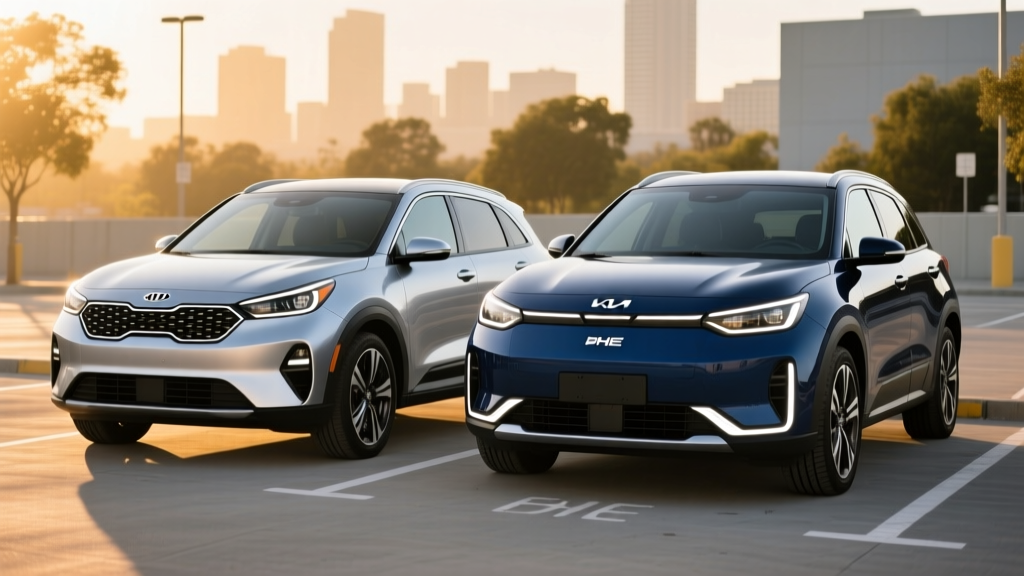
The Kia Niro occupies a specific niche in the electrified crossover market: it's one of the few nameplates that lets you choose between a conventional hybrid (HEV) and a plug-in hybrid (PHEV) in the same compact body. For 2026, the Niro continues to serve buyers who want meaningful fuel savings without committing to a full battery-electric vehicle. But the two powertrains behave very differently in daily use, and the pricing gap between them matters.
This guide breaks down the 2026 Kia Niro Hybrid and Niro Plug-In Hybrid side by side — EPA fuel economy, real-world MPG behavior, electric-only range, powertrain specs, battery warranty, tax credit eligibility, and which version actually fits your driving pattern.
HEV vs PHEV: Understanding the Two Niro Powertrains
Before comparing numbers, the distinction between the two Niro variants needs to be clear, because it affects everything from daily routine to total cost of ownership.
Kia Niro Hybrid (HEV)
How it works: A small battery (1.56 kWh) is charged by the gasoline engine and regenerative braking. You never plug it in. The electric motor assists the engine to reduce fuel consumption, but the car cannot drive on electricity alone for more than a fraction of a mile.
Daily experience: Identical to driving a gas car — fill up at the station, no charging cables, no range planning. You simply get dramatically better MPG.
Kia Niro Plug-In Hybrid (PHEV)
How it works: A larger battery (11.1 kWh) can be charged by plugging into a wall outlet or Level 2 charger. This gives you roughly 33 miles of electric-only driving before the gasoline engine kicks in and the car operates as a conventional hybrid.
Daily experience: If your commute is under ~30 miles and you charge at home, you may go weeks without buying gas. For longer trips, the gas engine takes over seamlessly — no range anxiety.
Fuel Economy: EPA MPG and Real-World Expectations
According to EPA data on fueleconomy.gov, the 2026 Kia Niro achieves the following fuel economy ratings:
| Model | City MPG | Highway MPG | Combined MPG | Combined MPGe (PHEV) |
|---|---|---|---|---|
| Niro Hybrid (HEV) | 53 | 54 | 53 | — |
| Niro Plug-In Hybrid (PHEV) | 49 (hybrid mode) | 47 (hybrid mode) | 48 (hybrid mode) | 108 MPGe |
Real-World MPG: What Owners Actually See
Hybrids consistently outperform their EPA city ratings in stop-and-go traffic, where regenerative braking recaptures the most energy. Niro HEV owners commonly report 55–58 MPG in city driving during mild weather. Highway mileage tends to track closer to the EPA sticker or slightly below, around 48–52 MPG at 70–75 mph.
For the PHEV, the 48 MPG combined figure applies only after the battery is depleted. In electric-only mode, the car doesn't burn fuel at all — its efficiency is measured in MPGe (miles per gallon equivalent), rated at 108 MPGe. In practice, expect the electric-only range to contract to roughly 26–28 miles in cold weather (below 40°F) and about 30–32 miles in moderate temperatures, because cabin heating and battery chemistry both reduce usable capacity.
Electric-Only Range and Total Range (PHEV)
The Niro PHEV's 11.1 kWh lithium-ion polymer battery delivers an EPA-rated 33 miles of electric-only range. This is enough to cover the average American one-way commute (approximately 16 miles, per Census Bureau data) with room to spare.
Once the battery depletes to its buffer threshold, the 1.6-liter engine engages and the car operates as a standard hybrid. With a full tank of gas (11.1 gallons) plus a full battery, total combined range exceeds 550 miles — eliminating any range anxiety on road trips.
Real-world range note: The 33-mile electric rating assumes moderate temperatures and mixed driving. Sustained highway speeds above 70 mph, aggressive acceleration, or winter conditions can reduce electric-only range by 15–25%. Preconditioning the cabin while plugged in helps preserve battery energy for driving.
Charging the Niro PHEV: Times and Limitations
The Niro PHEV uses a standard J1772 connector for AC charging. It does not support DC fast charging — this is typical for plug-in hybrids, whose smaller batteries don't justify the added cost and weight of DC hardware.
| Charging Method | Power | Time (0–100%) | Notes |
|---|---|---|---|
| Level 1 (120V household outlet) | ~1.4 kW | ~9 hours | Useful for overnight top-up if daily driving is under 20 miles |
| Level 2 (240V home or public charger) | 3.3 kW (onboard charger limit) | ~2 hours 45 minutes | Recommended for daily full charges; requires 240V outlet or home charger |
The onboard charger is limited to 3.3 kW, meaning even a 7.2 kW or 11.5 kW Level 2 station will only deliver 3.3 kW to the Niro PHEV. This is adequate — a full charge in under three hours means you can easily recharge during a workday or between errands.
The Niro HEV requires no charging infrastructure whatsoever.
Powertrain Specs and Performance
| Specification | Niro Hybrid (HEV) | Niro Plug-In Hybrid (PHEV) |
|---|---|---|
| Engine | 1.6L GDI 4-cylinder | 1.6L GDI 4-cylinder |
| Engine HP | 104 hp | 104 hp |
| Electric Motor HP | 43 hp (32 kW) | 83 hp (62 kW) |
| Combined System HP | 139 hp | 180 hp |
| Combined Torque | 195 lb-ft | 195 lb-ft (engine) + motor torque |
| Transmission | 6-speed dual-clutch automatic | 6-speed dual-clutch automatic |
| 0–60 mph | ~9.5 seconds | ~7.2 seconds |
| Battery Capacity | 1.56 kWh (Li-ion polymer) | 11.1 kWh (Li-ion polymer) |
| Drivetrain | Front-wheel drive | Front-wheel drive |
The PHEV's larger electric motor (83 hp vs. 43 hp) gives it noticeably stronger acceleration, particularly from a stop. The 7.2-second 0–60 time makes highway merging confident. The HEV, at 9.5 seconds, is adequate for city driving but requires more planning for highway on-ramps.
Both use Kia's 6-speed dual-clutch transmission rather than a CVT. This means shifts feel like a conventional automatic — no rubber-band drone under hard acceleration, which is a common complaint with Toyota and Honda hybrid CVTs.
Pricing and Tax Credit Eligibility
For the 2026 model year, Kia Niro pricing breaks down as follows:
| Trim | Niro HEV MSRP | Niro PHEV MSRP |
|---|---|---|
| LX (base) | ~$28,415 | — |
| EX | ~$30,915 | ~$35,565 |
| SX / SX Touring | ~$33,515 | ~$37,965 |
Prices include destination charge. MSRP figures are approximate and may vary by dealer.
Federal Tax Credit: Does the Niro Qualify?
Under the IRS §30D Clean Vehicle Credit rules, only plug-in electric vehicles qualify for the federal tax credit. This means:
- Niro HEV (conventional hybrid): Does NOT qualify for the federal §30D tax credit. No plug-in capability means no federal incentive.
- Niro PHEV (plug-in hybrid): May qualify for up to $3,750 under §30D, depending on battery component and critical mineral sourcing requirements. The full $7,500 requires meeting both sourcing thresholds, and PHEVs with smaller batteries often qualify for the partial credit.
- Income caps apply: Modified AGI must not exceed $150,000 (single), $225,000 (head of household), or $300,000 (joint filers).
- MSRP cap: The Niro PHEV falls well under the $80,000 MSRP cap for SUVs/passenger vehicles.
- Point-of-sale transfer: As of 2024, eligible buyers can transfer the credit to the dealer for an immediate price reduction at purchase, rather than waiting to claim it on their tax return.
Because battery sourcing requirements tighten annually and vary by production batch, consult a tax professional and check the latest fueleconomy.gov credit listings before assuming a specific credit amount.
Battery Warranty, Reliability, and Replacement Costs
Kia Hybrid/PHEV Battery Warranty:
- Hybrid battery: 10 years / 100,000 miles (whichever comes first)
- Hybrid system components (motor, inverter, converter): 10 years / 100,000 miles
- Limited basic warranty: 5 years / 60,000 miles
- Powertrain warranty: 10 years / 100,000 miles
Kia's 10-year hybrid battery warranty is among the longest in the industry, matching Hyundai and exceeding Toyota's standard 8-year/100,000-mile coverage. The warranty covers the battery if it falls below approximately 70% of original capacity.
Reliability Track Record
The Niro has been in production since 2017, giving it a long reliability history. The 1.6L GDI engine is a proven Kia/Hyundai design with no widespread failure patterns. The dual-clutch transmission has been reliable in this application, though some owners report occasional low-speed shudder in early model years (2017–2019) — largely resolved in later production.
Hybrid batteries in the Niro have shown strong longevity. Lithium-ion polymer cells in mild hybrid applications (shallow charge/discharge cycles) typically retain 85–90% capacity after 100,000 miles. Out-of-warranty battery replacement for the HEV runs approximately $2,500–$3,500 (parts and labor). The PHEV's larger battery is costlier: expect $5,000–$7,000 if replacement is needed outside warranty coverage.
In practice, most hybrid batteries outlast the vehicle itself. Consumer Reports and iSeeCars data consistently show hybrid battery failure rates below 5% within the warranty period for modern Kia/Hyundai hybrid systems.
Who Should Choose the Niro HEV, PHEV, or a Full EV?
Choose the Niro Hybrid (HEV) if:
- You cannot charge at home or work (apartment, street parking, no garage)
- You want maximum MPG with zero change to your fueling routine
- Your budget is under $30,000 and you don't want to invest in home charging
- You drive more than 15,000 miles/year and want proven, simple efficiency
Choose the Niro Plug-In Hybrid (PHEV) if:
- You can install a 240V outlet or Level 2 charger at home
- Your daily commute is under 30 miles round-trip
- You want electric driving for daily errands but gas flexibility for road trips
- You qualify for the partial federal tax credit, narrowing the price gap with the HEV
Choose a full EV (like the Kia EV6 or Hyundai Ioniq 5) if:
- You have reliable home charging and your daily driving is under 250 miles
- You want zero tailpipe emissions and the lowest per-mile fuel cost
- You're eligible for the full $7,500 federal tax credit on a qualifying EV
- You want the lowest maintenance costs (no oil changes, no spark plugs, minimal brake wear from regen)
The Niro PHEV is the bridge option: it rewards home charging with near-EV daily costs but removes range anxiety for longer trips. If your commute is 20 miles and you charge overnight, you might buy gas four times a year. If you can't charge at home, the PHEV premium over the HEV (~$5,000–$7,000) is harder to justify, since you'd rarely use the electric-only range.
Pros and Cons
Pros
- HEV achieves 53 MPG combined — among the highest for any crossover
- PHEV offers 33 miles electric-only, covering most commutes gas-free
- 10-year/100,000-mile battery warranty provides long-term peace of mind
- Dual-clutch transmission feels more natural than a CVT
- Practical cargo space (22.8 cu ft behind rear seats, 63.7 cu ft folded)
- PHEV qualifies for partial federal tax credit (up to $3,750, subject to sourcing rules)
Cons
- No AWD option — FWD only, limiting appeal in heavy snow regions
- HEV acceleration is modest at 9.5 seconds 0–60
- PHEV 3.3 kW onboard charger limits Level 2 charging speed
- No DC fast charging on PHEV (typical for the segment)
- PHEV price premium of ~$5,000–$7,000 over equivalent HEV trim
- HEV does not qualify for any federal tax credit
Frequently Asked Questions
How many MPG does the Kia Niro Hybrid get in real-world driving?
The EPA rates the Niro HEV at 53 city / 54 highway / 53 combined. In real-world use, city drivers frequently see 55–58 MPG thanks to regenerative braking in stop-and-go traffic. Highway cruising at 70–75 mph typically yields 48–52 MPG. Cold weather (below 30°F) can reduce MPG by 5–10% due to increased engine warm-up time and cabin heating demands.
How far can the Niro PHEV go on electric power alone?
The EPA rates the Niro PHEV at 33 miles of electric-only range. In moderate temperatures with mixed driving, expect 30–32 miles. In cold weather, the range contracts to approximately 26–28 miles. Sustained highway speeds above 70 mph also reduce electric range more quickly than city driving.
Does the Kia Niro Hybrid need to be plugged in?
No. The conventional Niro Hybrid (HEV) charges its small battery through regenerative braking and the gasoline engine. You never plug it in — you simply refuel at a gas station. Only the Niro Plug-In Hybrid (PHEV) benefits from being plugged into a charger.
Is the Kia Niro hybrid battery reliable, and what does replacement cost?
Kia covers the Niro's hybrid battery for 10 years or 100,000 miles. Real-world failure rates within the warranty period are low (under 5% based on industry data). If replacement is needed out of warranty, expect approximately $2,500–$3,500 for the HEV battery and $5,000–$7,000 for the PHEV battery, including labor.
Does the Kia Niro qualify for a federal tax credit?
The Niro HEV (conventional hybrid) does not qualify for any federal tax credit. The Niro PHEV (plug-in hybrid) may qualify for up to $3,750 under the IRS §30D Clean Vehicle Credit, subject to battery sourcing requirements, buyer income caps ($150K single / $300K joint), and MSRP limits. Check current eligibility on fueleconomy.gov and consult a tax professional before purchasing.
Can I charge the Niro PHEV at home on a regular outlet?
Yes. A standard 120V household outlet (Level 1) will fully charge the Niro PHEV in approximately 9 hours. For faster charging, a 240V Level 2 station fills the battery in about 2 hours 45 minutes. Note that the Niro PHEV's onboard charger is limited to 3.3 kW, so higher-power Level 2 stations won't charge it any faster.
Hybrid vs PHEV vs EV — which Kia Niro is right for me?
Choose the HEV if you can't charge at home and want maximum MPG with no routine changes. Choose the PHEV if you have home charging and a commute under 30 miles — you'll drive mostly on electricity daily but keep gas flexibility for longer trips. Consider a full EV (like the Kia EV6) if you have home charging, drive under 250 miles daily, and want the lowest fuel and maintenance costs with zero tailpipe emissions.