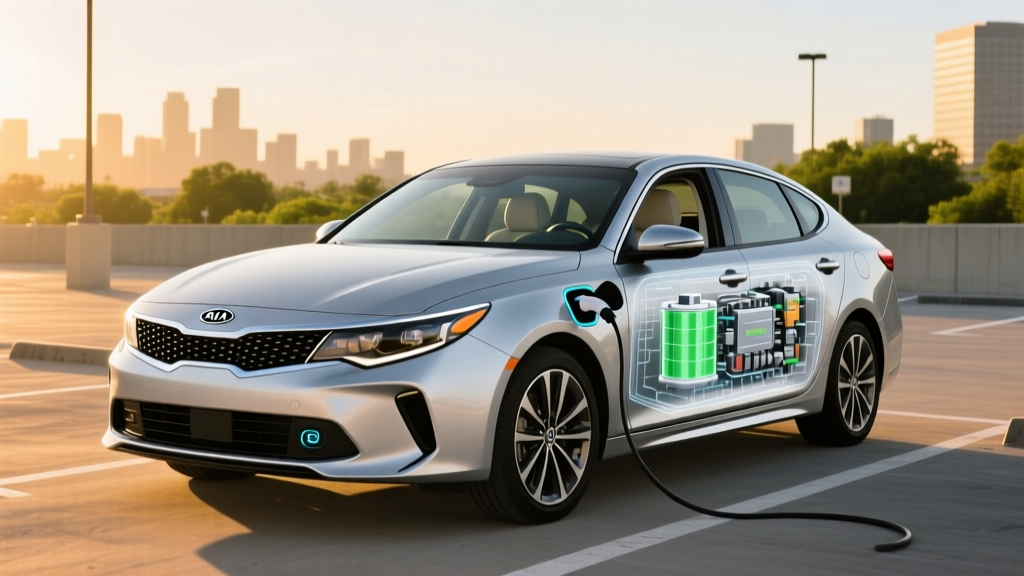
Kia's first plug-in hybrid sedan arrived for the 2017 model year as the Optima PHEV, offering a practical bridge between conventional hybrids and full battery-electric vehicles. Nearly a decade later, the 2017 Kia plug-in hybrid remains a common sight on the used market, and its specs still hold up for budget-conscious buyers who want electric commuting without range anxiety. This guide covers everything a 2026 used-car shopper needs to know: real-world MPG, electric-only range, battery health, charging logistics, and whether this aging PHEV still makes financial sense.
What Is the 2017 Kia Optima Plug-In Hybrid?
The 2017 Kia Optima PHEV is a midsize sedan built on the same platform as the conventional Optima but fitted with a 2.0-liter four-cylinder engine, a 50 kW (67 hp) electric motor, and a 9.8 kWh gross (approximately 8.9 kWh usable) lithium-polymer battery pack. Combined system output is 202 horsepower and 276 lb-ft of torque, routed through a six-speed automatic transmission — not a CVT, which gives it a more natural driving feel than many competitors from the same era.
Kia offered the Optima PHEV in two trims: the base EX and the higher-spec EX Premium. Both share the same powertrain and battery. The EX Premium added LED headlights, a panoramic sunroof, a Harman Kardon audio system, and additional driver-assistance features like adaptive cruise control and blind-spot monitoring.
The conventional 2017 Kia Optima Hybrid (HEV) uses a smaller 1.62 kWh battery and a 38 kW motor. It cannot be plugged in and achieves about 42 MPG combined. The Optima Plug-In Hybrid (PHEV) has a battery roughly six times larger, can be plugged in to charge, and delivers up to 27 miles of pure electric driving before the gasoline engine engages. If you see "2017 Kia plug in hybrid" in a listing, confirm it's the PHEV — the regular hybrid is a different vehicle entirely.
Fuel Economy and Electric-Only Range
The EPA rated the 2017 Kia Optima PHEV at 104 MPGe when operating on electricity and 39 MPG combined (40 city / 39 highway) once the battery is depleted and it operates as a conventional hybrid. On a full charge, the EPA estimated 27 miles of electric-only range, with a total combined range (electric + gasoline) of approximately 570 miles.
| Metric | EPA Rating |
|---|---|
| Electric-only range | 27 miles |
| MPGe (electric mode) | 104 MPGe |
| MPG city (hybrid mode) | 40 MPG |
| MPG highway (hybrid mode) | 39 MPG |
| MPG combined (hybrid mode) | 39 MPG |
| Total combined range | ~570 miles |
| Fuel tank | 14.8 gallons |
Source: fueleconomy.gov
Real-World MPG vs. EPA Estimates
Owner reports and long-term testing from the era consistently show the Optima PHEV meeting or slightly exceeding its EPA hybrid-mode figures in city driving — 41-43 MPG is achievable in stop-and-go traffic where regenerative braking recaptures energy frequently. Highway driving at 70+ MPH tends to drop to 35-37 MPG due to the sedan's aerodynamic profile and the engine working harder without electric assist at sustained speeds.
Electric-only range is more variable. In mild weather (60-75°F) with conservative throttle use, owners report 25-30 miles on a full charge. In cold weather (below 35°F), expect that figure to drop to 18-22 miles as the battery's chemical efficiency decreases and cabin heating draws from the pack. The Optima PHEV uses a resistive PTC heater rather than a heat pump, which is a notable energy draw in winter.
Battery, Charging, and Powertrain Specs
The 8.9 kWh usable battery pack is a lithium-polymer unit supplied by LG Chem, mounted behind the rear seats. This placement reduces trunk space to 9.9 cubic feet (compared to 15.9 cu ft in the non-hybrid Optima) — a significant cargo compromise that buyers should factor in.
| Specification | Value |
|---|---|
| Gasoline engine | 2.0L GDI 4-cylinder, 154 hp |
| Electric motor | 50 kW (67 hp) |
| Combined system output | 202 hp / 276 lb-ft |
| Transmission | 6-speed automatic |
| Battery (gross / usable) | 9.8 kWh / ~8.9 kWh |
| Battery chemistry | Lithium-polymer (LG Chem) |
| Level 1 charging (120V) | ~9 hours (full charge) |
| Level 2 charging (240V, 3.3 kW) | ~3 hours (full charge) |
| DC fast charging | Not supported |
| Charge port | J1772 (driver-side front fender) |
| 0-60 mph | ~7.7 seconds |
| Drivetrain | Front-wheel drive |
The onboard charger maxes out at 3.3 kW on Level 2 (240V). This means the Optima PHEV cannot accept DC fast charging — there is no CCS or CHAdeMO port. All charging is AC, which is typical for PHEVs of this generation. A standard 120V household outlet (Level 1) will replenish the battery in roughly 9 hours, making overnight charging feasible. A 240V Level 2 home charger cuts that to about 3 hours, though most PHEV owners find overnight Level 1 charging sufficient given the small battery.
Kia provided a 10-year / 100,000-mile hybrid battery warranty on the 2017 Optima PHEV (10 years in CARB states, 10 years / 100,000 miles federally for hybrid-specific components). If the battery drops below approximately 70% of its original capacity within that period, Kia covers replacement. For a 2017 model in 2026, most original battery warranties are expiring by model year or mileage — verify remaining coverage with a Kia dealer using the VIN before purchase.
Used Pricing and Tax Credit Eligibility
When new, the 2017 Kia Optima PHEV started at approximately $36,090 (EX trim) and $41,090 (EX Premium), before a then-available $4,543 federal tax credit. That credit has long since expired for new purchases of this model.
On the used market in early 2026, expect to find 2017 Optima PHEV examples between $12,000 and $17,000 depending on mileage, condition, and battery state of health. Lower-mileage EX Premium models command the upper end of that range.
Does the 2017 Kia Optima PHEV Qualify for Any Tax Credit?
Federal used-EV credit (§25E): Under current IRS rules, a used plug-in hybrid can qualify for up to $4,000 (or 30% of the sale price, whichever is less) if all conditions are met. The vehicle must be purchased from a licensed dealer for $25,000 or less, the buyer must meet income thresholds ($75,000 single / $150,000 joint), and the vehicle must have a battery capacity of at least 7 kWh — the Optima PHEV's 9.8 kWh pack clears this bar. However, the vehicle must be at least two model years old (which a 2017 model satisfies), and the dealer must report the sale through the IRS Energy Credits Online system. Confirm eligibility at irs.gov before relying on this credit.
State incentives: These vary widely and change frequently. Some states offer rebates for used PHEVs; others do not. Check your state's energy office or DMV for current programs.
Reliability, Battery Degradation, and Replacement Cost
The 2017 Optima PHEV's powertrain is generally reliable. The 2.0L GDI engine is a well-proven Hyundai-Kia unit with a timing chain (not a belt), and the six-speed automatic avoids the complexity of CVTs or dual-clutch transmissions. The most common complaints center on infotainment glitches and minor interior rattles rather than drivetrain failures.
Battery Degradation in a 9-Year-Old PHEV
Lithium-polymer batteries of this generation typically lose 15-25% of their original capacity over 8-10 years, depending on climate and charging habits. For the Optima PHEV, that translates to a real-world electric range of roughly 20-23 miles on a well-maintained example, down from the original 27. Vehicles in hot climates (Arizona, Texas) tend to show more degradation than those in cooler regions.
Before purchasing, request a battery state-of-health (SoH) reading from a Kia dealer or use an OBD-II scanner with EV-compatible software (such as Car Scanner or Torque Pro with the appropriate PID profiles) to check the battery's remaining capacity percentage.
Battery Replacement Cost
If the hybrid battery fails outside of warranty, a replacement from Kia typically costs between $3,500 and $5,500 including labor. Third-party refurbished packs may be available for $2,000-$3,500. Given the vehicle's used value of $12,000-$17,000, an out-of-warranty battery replacement represents a significant percentage of the car's worth — making pre-purchase battery health verification essential.
Pros
- 27 mi electric range covers most commutes
- 39 MPG as a hybrid after battery depletes
- 6-speed auto feels natural (no CVT drone)
- 202 hp provides confident passing power
- Strong safety ratings (IIHS Top Safety Pick)
- Level 1 overnight charging is sufficient
- Comfortable, spacious cabin (front seats)
Cons
- Trunk shrunk to 9.9 cu ft (battery intrusion)
- No DC fast charging capability
- 3.3 kW onboard charger is slow for Level 2
- Resistive heater (no heat pump) drains battery in winter
- Battery warranty likely expiring on 2017 models
- Outdated infotainment by 2026 standards
- No Apple CarPlay / Android Auto on base EX
Optima PHEV vs. the Alternatives: Which Fits You?
The 2017 Kia plug-in hybrid competes in the used market against several other midsize PHEVs and efficient hybrids. Here's how to decide:
| Vehicle | EV Range | Hybrid MPG | Combined HP | Used Price (2026) |
|---|---|---|---|---|
| 2017 Kia Optima PHEV | 27 mi | 39 MPG | 202 hp | $12-17K |
| 2017 Hyundai Sonata PHEV | 27 mi | 39 MPG | 202 hp | $11-16K |
| 2017 Ford Fusion Energi | 22 mi | 39 MPG | 188 hp | $10-15K |
| 2017 Chevy Volt | 53 mi | 42 MPG | 149 hp | $13-18K |
| 2017 Toyota Prius Prime | 25 mi | 54 MPG | 121 hp | $14-19K |
Choose the 2017 Kia Optima PHEV if: You need a proper midsize sedan with confident highway power (202 hp), your commute is under 25 miles round-trip, you can charge at home overnight, and you want a car that still functions as a comfortable 39-MPG hybrid on road trips.
Choose the Chevy Volt instead if: Your commute is longer (up to 53 miles electric) and you prioritize maximum electric range over interior space and highway passing power.
Choose the Prius Prime instead if: Fuel efficiency in hybrid mode matters most (54 MPG vs. 39) and you're willing to accept significantly less power (121 hp).
Consider a full EV if: You have reliable home charging, your daily driving stays under 200 miles, and you want zero gasoline maintenance. A used 2017-2019 Chevrolet Bolt EV (238 mi range) or Nissan Leaf (150 mi range) eliminates oil changes and emissions entirely, though you sacrifice the gas-engine safety net for long trips.
Ownership Costs and Practical Considerations
Beyond the purchase price, the 2017 Optima PHEV's ownership economics depend heavily on your charging access and driving patterns. If you charge nightly at home on Level 1 and your commute fits within the 27-mile electric envelope, you may use gasoline only on weekends and road trips — effectively achieving 80-100+ MPGe on an annualized basis. At $0.14/kWh (national average residential electricity), a full charge costs roughly $1.39, equating to about $0.05 per mile on electricity versus $0.12-$0.14 per mile on gasoline at $3.50/gallon.
Insurance premiums for the Optima PHEV are moderate — typically $1,200-$1,600 annually depending on location and driving record, comparable to a conventional Optima. Maintenance is straightforward: the gasoline engine requires standard oil changes (every 7,500 miles), and the regenerative braking system extends brake pad life significantly, often pushing replacements past 60,000-80,000 miles.
Home Charging Setup
Most 2017 Optima PHEV owners charge on a standard 120V outlet (Level 1), which adds roughly 3 miles of range per hour — sufficient for overnight replenishment of the 27-mile battery. If you prefer faster turnaround, a 240V Level 2 charger (even a basic 16-amp unit) will fully charge the pack in about 3 hours. Installation of a dedicated 240V circuit typically costs $400-$1,200 depending on panel proximity and local permit requirements. Have a licensed electrician assess your panel capacity before installation.
Frequently Asked Questions
How many MPG does the 2017 Kia Optima Plug-In Hybrid get?
The EPA rates it at 40 city / 39 highway / 39 combined MPG when operating as a hybrid (battery depleted). In electric mode, it achieves 104 MPGe. Real-world city driving often yields 41-43 MPG thanks to regenerative braking, while sustained highway driving at 70+ MPH typically drops to 35-37 MPG.
How far can the 2017 Kia Optima PHEV go on electric only?
The EPA estimated 27 miles of electric-only range when new. In 2026, expect a well-maintained example to deliver 20-25 miles on a full charge, depending on battery degradation, temperature, and driving style. Cold weather can reduce this to 18-22 miles.
Is the 2017 Kia Optima PHEV reliable?
Yes, generally. The powertrain is mechanically conventional — a proven 2.0L engine and six-speed automatic with an integrated electric motor. The main long-term risk is hybrid battery degradation, which typically reduces electric range by 15-25% over 8-10 years. Verify battery state of health before purchase. The original 10-year/100,000-mile battery warranty is likely expiring or expired on 2017 models.
What does it cost to replace the hybrid battery?
A new OEM replacement battery from Kia runs approximately $3,500-$5,500 including labor. Third-party refurbished options may cost $2,000-$3,500. Given the vehicle's $12,000-$17,000 used value, a battery replacement is a significant expense — always verify SoH before buying.
Does the 2017 Kia Optima PHEV qualify for a federal tax credit in 2026?
Not as a new vehicle — the original federal credit has expired. However, it may qualify for the used clean vehicle credit (§25E) of up to $4,000 if purchased from a dealer for $25,000 or less and the buyer meets income limits ($75K single / $150K joint). The battery capacity (9.8 kWh) exceeds the 7 kWh minimum. Verify all requirements at irs.gov before purchase.
Can I DC fast charge the 2017 Kia Optima PHEV?
No. The Optima PHEV supports only AC charging: Level 1 (120V, ~9 hours full charge) and Level 2 (240V at 3.3 kW, ~3 hours full charge). There is no DC fast-charge port. This is standard for PHEVs of this era — the small battery doesn't require fast charging for practical daily use.
Hybrid vs. PHEV vs. full EV — which should I buy?
A conventional hybrid (HEV) like the Optima Hybrid is best if you cannot charge at home and want maximum simplicity — no plug, just better fuel economy (42 MPG). A PHEV like the Optima PHEV suits drivers with home charging and short commutes who still want a gasoline engine for long trips. A full EV eliminates gasoline entirely and offers the lowest per-mile fuel cost, but requires reliable charging access and acceptance of range limitations. For a one-car household with unpredictable driving needs, the PHEV remains the safest bridge.
For official fuel economy data, consult fueleconomy.gov. For safety ratings, see IIHS and NHTSA. Tax credit rules are subject to change — always verify with a tax professional and the IRS.