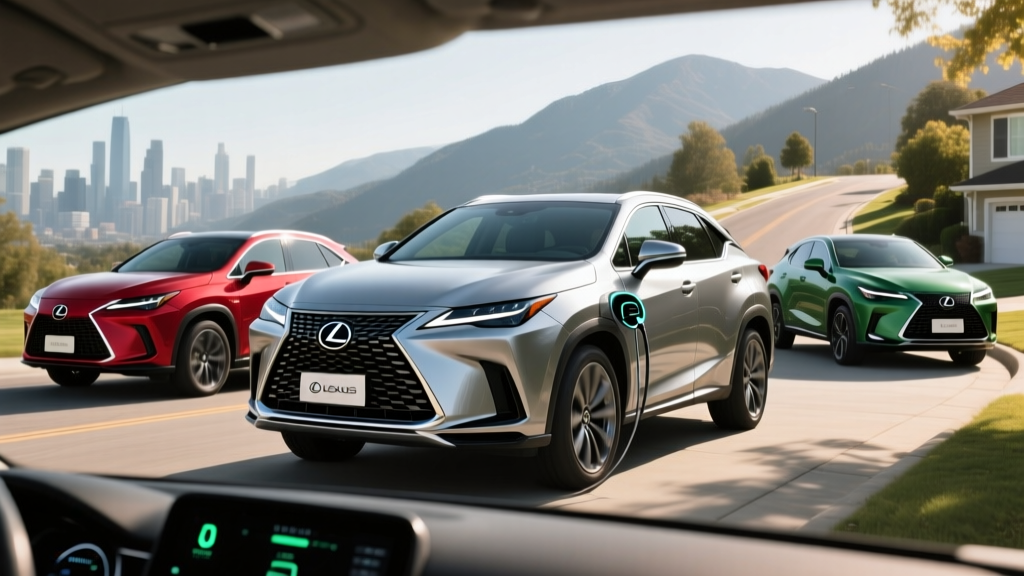
If you're searching for a 2025 Lexus hybrid SUV, you'll find one of the broadest electrified lineups in the luxury segment — spanning conventional hybrids (HEVs) that never need a plug and plug-in hybrids (PHEVs) that deliver meaningful electric-only miles. Lexus offers six hybrid SUV variants for 2025 across four nameplates: the subcompact UX 300h, compact NX 350h and NX 450h+, midsize RX 350h, RX 500h, and RX 450h+, and the three-row TX 350h and TX 500h. Each targets a different buyer, from the city commuter who wants 40+ MPG to the family hauler who needs 300+ total range with a plug-in option.
This guide breaks down every 2025 Lexus hybrid SUV by powertrain, EPA fuel economy, electric-only range (for PHEVs), real-world efficiency, pricing, tax-credit eligibility, and battery warranty — so you can match the right model to your driving pattern.
HEV vs PHEV: Which 2025 Lexus Hybrid SUV Type Fits You?
Conventional Hybrid (HEV): UX 300h, NX 350h, RX 350h, RX 500h, TX 350h, TX 500h
- How it works: A gasoline engine paired with one or more electric motors and a small battery (typically 1–2 kWh). The battery recharges via regenerative braking and the engine — you never plug it in.
- Best for: Drivers without reliable home charging access, high-mileage commuters, and those who want zero behavior change from a gas car.
- Trade-off: No electric-only driving beyond very low-speed creep; efficiency gains come from the hybrid system optimizing engine load.
Plug-In Hybrid (PHEV): NX 450h+, RX 450h+
- How it works: A larger battery (18.1 kWh usable) paired with a gasoline engine and electric motors. You plug in to charge, and the vehicle can drive on electricity alone for a meaningful distance before the engine engages.
- Best for: Drivers with home Level 2 charging who commute 20–35 miles daily and want electric-only weekday driving with gas-engine freedom for road trips.
- Trade-off: Higher purchase price, added weight from the larger battery, and you need to actually plug in regularly to capture the efficiency benefit.
2025 Lexus Hybrid SUV EPA MPG & Efficiency Breakdown
Fuel economy varies significantly across the lineup. The UX 300h leads in pure MPG, while the larger TX models trade efficiency for three-row capability. Here's the complete EPA data from fueleconomy.gov:
| Model | Type | City MPG | Highway MPG | Combined MPG | MPGe (PHEV) |
|---|---|---|---|---|---|
| UX 300h (AWD) | HEV | 41 | 38 | 39 | — |
| NX 350h (AWD) | HEV | 41 | 37 | 39 | — |
| NX 450h+ (AWD) | PHEV | 38 (gas) | 37 (gas) | 37 (gas) | 84 MPGe |
| RX 350h (AWD) | HEV | 37 | 34 | 36 | — |
| RX 500h (AWD) | HEV | 27 | 28 | 27 | — |
| RX 450h+ (AWD) | PHEV | 38 (gas) | 35 (gas) | 36 (gas) | 65 MPGe |
| TX 350h (AWD) | HEV | 35 | 33 | 34 | — |
| TX 500h (AWD) | HEV | 26 | 26 | 26 | — |
Real-World MPG vs. EPA Sticker
Lexus hybrids, like most Toyota/Lexus hybrid systems, tend to meet or exceed EPA city estimates in real-world urban driving. The hybrid system recaptures energy during stop-and-go traffic that a conventional car wastes as brake heat. Expect the UX 300h and NX 350h to deliver 40–43 MPG in mixed city driving, with highway numbers dropping to 35–37 MPG at sustained 75+ mph speeds.
For the PHEV models (NX 450h+ and RX 450h+), real-world electric-only range depends on temperature and driving style. The NX 450h+ carries an EPA electric-only rating of 37 miles; in mild weather with moderate acceleration, owners report 35–40 miles. In cold weather (below 35°F), expect that to drop to 28–32 miles as cabin heating and battery conditioning draw from the pack.
PHEV Deep Dive: Electric-Only Range, Charging & Battery Specs
The NX 450h+ and RX 450h+ share the same plug-in hybrid architecture. Here's what you need to know if you're considering a 2025 Lexus PHEV SUV:
| Spec | NX 450h+ | RX 450h+ |
|---|---|---|
| Battery capacity (usable) | 18.1 kWh (lithium-ion) | 18.1 kWh (lithium-ion) |
| EPA electric-only range | 37 miles | 37 miles |
| Total combined range (gas + electric) | ~550 miles | ~520 miles |
| Level 1 charging (120V, ~1.4 kW) | ~12 hours (0–100%) | ~12 hours (0–100%) |
| Level 2 charging (240V, ~6.6 kW) | ~2.5 hours (0–100%) | ~2.5 hours (0–100%) |
| DC fast charging | No | No |
| Combined horsepower | 304 hp | 302 hp |
| 0–60 mph | 6.0 sec | 6.2 sec |
| Engine | 2.5L 4-cyl + 2 electric motors | 2.5L 4-cyl + 2 electric motors |
Critical note on DC fast charging: Neither Lexus PHEV supports DC fast charging. This is typical for plug-in hybrids — the 18.1 kWh battery is small enough that Level 2 at 6.6 kW fully recharges it in about 2.5 hours, which covers overnight or workplace charging. If you rely exclusively on public DC fast chargers, a PHEV won't leverage that infrastructure.
Powertrain & Performance Across the Lineup
The 2025 Lexus hybrid SUV range uses three distinct powertrain architectures:
2.5L 4-Cylinder Hybrid (UX 300h, NX 350h, RX 350h, TX 350h)
This is the efficiency-first setup. A 2.5-liter inline-four pairs with electric motors for combined output ranging from 196 hp (UX 300h) to 246 hp (RX 350h/TX 350h). These models prioritize low-rpm torque delivery and seamless engine-motor handoff. The NX 350h hits 60 mph in 7.2 seconds — adequate for merging, not thrilling.
Hybrid MAX (RX 500h, TX 500h)
Lexus's performance hybrid pairs a 2.4-liter turbocharged inline-four with a more powerful electric motor and a 6-speed automatic (rather than the eCVT in the efficiency models). The RX 500h produces 366 hp and reaches 60 mph in 5.9 seconds; the TX 500h makes 366 hp with a 5.7-second run. Efficiency drops to 26–27 MPG combined, but these models deliver genuine passing power and a more engaging drive.
Plug-In Hybrid (NX 450h+, RX 450h+)
The PHEV powertrain combines the 2.5L engine with two high-output electric motors and the 18.1 kWh battery. Combined output is 302–304 hp. When the battery is charged, the vehicle defaults to EV mode and can sustain highway speeds (up to ~85 mph) on electricity alone. Once the battery depletes, it operates as a conventional hybrid at 36–37 MPG combined.
Pricing, Tax Credits & Incentives
Here's the 2025 MSRP lineup by base trim (destination included). Prices reflect Lexus's official pricing:
| Model | Base MSRP | Federal Tax Credit (§30D) | Effective Price (with credit) |
|---|---|---|---|
| UX 300h | $38,490 | $0 (HEV — not eligible) | $38,490 |
| NX 350h | $43,990 | $0 (HEV — not eligible) | $43,990 |
| NX 450h+ | $59,805 | Up to $7,500* | ~$52,305* |
| RX 350h | $53,090 | $0 (HEV — not eligible) | $53,090 |
| RX 500h | $62,400 | $0 (HEV — not eligible) | $62,400 |
| RX 450h+ | $65,650 | Up to $7,500* | ~$58,150* |
| TX 350h | $56,800 | $0 (HEV — not eligible) | $56,800 |
| TX 500h | $64,900 | $0 (HEV — not eligible) | $64,900 |
*Federal tax credit eligibility for PHEV models: The IRS §30D New Clean Vehicle Credit provides up to $7,500 for qualifying PHEVs, but eligibility depends on multiple factors that change regularly:
- Battery sourcing & critical minerals: A percentage of battery components must be manufactured or assembled in North America, and critical minerals must be sourced from the U.S. or FTA partners. These thresholds increase annually.
- MSRP cap: SUVs (which all Lexus hybrid SUVs classify as) must have an MSRP at or below $80,000. All models above qualify.
- Income cap: Buyer AGI must not exceed $150,000 (single), $225,000 (head of household), or $300,000 (joint filing).
- Point-of-sale transfer: As of 2024, buyers can transfer the credit to the dealer at purchase, reducing the sale price directly rather than waiting for a tax refund.
Conventional hybrids (HEVs) do not qualify for the §30D federal credit. Some states offer separate rebates or HOV-lane access for HEVs — check your state's energy office for current programs.
Battery Warranty, Reliability & Replacement Cost
Lexus Hybrid Battery Warranty
All 2025 Lexus hybrid and plug-in hybrid models carry a hybrid battery warranty of 10 years or 150,000 miles (whichever comes first), transferable to subsequent owners. The general hybrid system components (inverter, motor, control module) carry the same 10-year/150,000-mile coverage.
Reliability Track Record
Lexus consistently ranks at or near the top of J.D. Power Vehicle Dependability Studies and Consumer Reports reliability surveys. The Toyota/Lexus hybrid system (now in its fourth generation across most models) has been in production since 1997 with over 20 million units on the road globally. Hybrid battery failures before 150,000 miles are uncommon in Lexus vehicles based on long-term ownership data.
Battery Replacement Cost
If your hybrid battery does fail outside warranty, replacement costs vary by model:
- UX 300h / NX 350h (HEV): $3,000–$5,000 for the hybrid battery pack
- RX 350h / TX 350h (HEV): $4,000–$6,000
- NX 450h+ / RX 450h+ (PHEV): $8,000–$12,000 for the larger 18.1 kWh pack
Independent hybrid shops and refurbished battery options can reduce these costs by 30–50%. Lexus dealers typically replace with new OEM packs.
Who Should Choose a 2025 Lexus Hybrid SUV?
Choose a Lexus HEV (UX 300h, NX 350h, RX 350h, TX 350h) if:
- You don't have access to home or workplace charging
- You want 35+ MPG without changing any habits
- You drive 12,000–20,000 miles/year and want low fuel costs
- You value Lexus's reliability record and don't want plug-in complexity
Choose a Lexus PHEV (NX 450h+, RX 450h+) if:
- You have Level 2 home charging (or can install it)
- Your daily commute is under 35 miles round-trip
- You want electric-only weekday driving with gas flexibility for weekend trips
- You want to capture the $7,500 federal tax credit (if eligible)
Choose a full EV (e.g., Lexus RZ 450e) instead if:
- You want zero tailpipe emissions and no gasoline engine maintenance
- You have reliable home charging and your trips rarely exceed 200 miles
- You want the lowest per-mile fuel cost (~$0.04–$0.06/mile on home electricity vs. $0.12–$0.16/mile for a 36 MPG hybrid on $3.50/gal gas)
Pros & Cons: 2025 Lexus Hybrid SUV Lineup
Pros
- Industry-leading reliability and 10-year/150,000-mile hybrid battery warranty
- UX 300h and NX 350h achieve 39 MPG combined — among the most efficient luxury SUVs sold
- PHEV models offer genuine 37-mile electric-only range with no range anxiety
- No charging infrastructure required for HEV models
- Hybrid MAX powertrains (RX 500h, TX 500h) deliver 366 hp with reasonable 26–27 MPG
- Quiet cabin, smooth eCVT transitions, strong low-speed torque from electric motors
Cons
- PHEV models (NX 450h+, RX 450h+) start above $59K — premium pricing
- No DC fast charging on PHEVs — irrelevant for most, limiting for some
- Hybrid MAX models (RX 500h, TX 500h) sacrifice efficiency for power — 26 MPG is unremarkable
- HEV models don't qualify for the federal §30D tax credit
- Regenerative braking feel is less aggressive than pure EVs — limited one-pedal driving capability
- PHEV electric-only range (37 mi) trails competitors like the Toyota RAV4 Prime (42 mi)
Frequently Asked Questions
How many MPG does a 2025 Lexus hybrid SUV get?
It depends on the model. The UX 300h and NX 350h lead at 39 MPG combined (41 city / 37–38 highway). The RX 350h delivers 36 MPG combined, the TX 350h gets 34 MPG combined, and the performance-oriented RX 500h and TX 500h achieve 26–27 MPG combined. In real-world city driving, expect HEV models to meet or slightly exceed their EPA city numbers thanks to regenerative braking in stop-and-go traffic.
How far can the 2025 Lexus PHEV SUVs go on electric only?
Both the NX 450h+ and RX 450h+ carry an EPA-rated 37 miles of electric-only range from their 18.1 kWh battery packs. Real-world range in mild weather is typically 35–40 miles; in cold weather (below 35°F), expect 28–32 miles. Once the battery depletes, the gasoline engine engages and the vehicle continues as a conventional hybrid at 36–37 MPG combined.
Do Lexus hybrid SUVs need to be plugged in?
Only the PHEV models (NX 450h+ and RX 450h+) benefit from being plugged in — and they need regular charging to capture their electric-only range and efficiency advantage. Conventional hybrid models (UX 300h, NX 350h, RX 350h, RX 500h, TX 350h, TX 500h) never need to be plugged in; their batteries recharge through regenerative braking and the gasoline engine.
Is the 2025 Lexus hybrid battery reliable and what does replacement cost?
Lexus hybrid batteries are among the most reliable in the industry, backed by a 10-year/150,000-mile warranty. Failures before 150,000 miles are rare based on long-term data from the Toyota/Lexus hybrid system, which has been in production since 1997. Out-of-warranty replacement costs range from $3,000–$6,000 for HEV models and $8,000–$12,000 for PHEV models, with refurbished options available at lower cost.
Does the 2025 Lexus hybrid SUV qualify for a tax credit?
Only the plug-in hybrid models (NX 450h+ and RX 450h+) qualify for the federal §30D New Clean Vehicle Credit, which provides up to $7,500. Eligibility depends on your income (AGI caps apply), battery sourcing requirements, and the vehicle's MSRP (must be ≤$80,000 for SUVs — all qualify). Conventional hybrid models do not qualify for the federal EV credit. Check the IRS §30D page for current-year rules before purchasing, as sourcing thresholds change annually.
Should I buy a Lexus hybrid or a full EV?
If you lack reliable home charging, drive more than 250 miles regularly, or frequently take road trips to areas with sparse charging infrastructure, a Lexus HEV or PHEV is the practical choice. If you have home Level 2 charging, your daily driving is under 200 miles, and you want the lowest per-mile energy cost with zero gasoline use, consider the fully electric Lexus RZ 450e (EPA range: 220–260 miles depending on trim and wheel size) or competitors like the BMW iX or Genesis Electrified GV70.