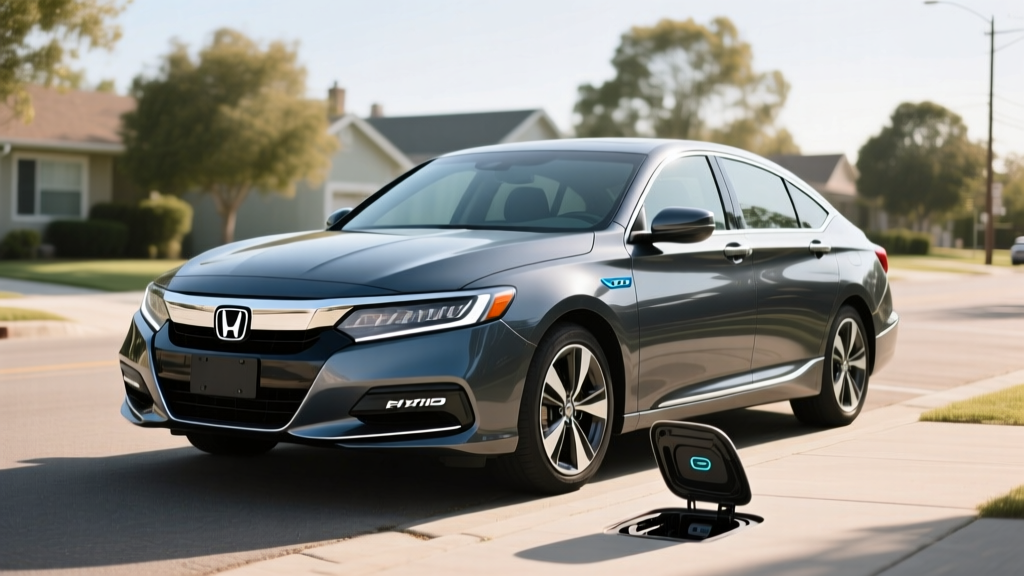
The 2017 Honda Accord Hybrid occupies a specific niche in the used-car market: a midsize sedan that delivers genuine hybrid efficiency without the complexity, cost, or charging requirements of a plug-in vehicle. Honda's two-motor i-MMD system in this generation was genuinely competitive with the Toyota Camry Hybrid, and on the used market in 2026, it remains one of the most efficient non-plug-in sedans available.
This guide covers the exact EPA figures, what you'll actually see at the pump, battery longevity data, and whether this hybrid still makes financial sense compared to modern PHEVs and full EVs.
2017 Honda Accord Hybrid MPG: Official EPA Ratings
The EPA rated the 2017 Accord Hybrid with the following fuel economy figures across all trims (Hybrid, Hybrid EX-L, and Hybrid Touring):
| Driving Cycle | EPA MPG |
|---|---|
| City | 49 MPG |
| Highway | 47 MPG |
| Combined | 48 MPG |
Source: fueleconomy.gov — 2017 Honda Accord Hybrid. These figures placed the Accord Hybrid at the top of the midsize hybrid sedan segment for 2017, edging out the contemporaneous Toyota Camry Hybrid LE (40/38/39 MPG).
Real-World MPG: What Owners Actually Report
EPA stickers are a starting point, not a guarantee. The Accord Hybrid's two-motor system (which Honda calls "Sport Hybrid Intelligent Multi-Mode Drive") is optimized for city and suburban driving, where the electric motor handles most low-speed propulsion and the gasoline engine acts primarily as a generator.
- City/suburban driving: 45–52 MPG — hybrids routinely meet or exceed EPA city estimates in stop-and-go traffic because regenerative braking recovers energy and the engine operates in its most efficient range as a generator.
- Highway (70+ mph, sustained): 40–44 MPG — at steady highway speeds, the engine must directly drive the wheels via a clutch, and aerodynamic drag reduces efficiency. Expect 5–7 MPG below the EPA highway figure on long interstate trips.
- Cold weather (below 35°F): 38–43 MPG combined — the engine runs more frequently to maintain cabin heat and battery temperature, reducing electric-only operation.
- Mixed real-world average: 43–47 MPG — owner-reported data on Fuelly and forums clusters in this range for typical driving mixes.
The Accord Hybrid's real-world advantage is strongest in urban environments. If your commute involves heavy stop-and-go traffic, you'll likely see numbers close to or above the 49 MPG city rating. Highway-heavy drivers should expect figures closer to 42 MPG.
Powertrain: How the Accord Hybrid System Works
The 2017 Accord Hybrid uses Honda's two-motor i-MMD system, which operates differently from Toyota's planetary-gear hybrid synergy drive:
| Component | Specification |
|---|---|
| Gasoline Engine | 2.0L Atkinson-cycle inline-4, 143 hp / 129 lb-ft |
| Propulsion Motor | AC permanent-magnet synchronous, 181 hp / 232 lb-ft |
| Generator Motor | AC permanent-magnet synchronous (charges battery / powers propulsion motor) |
| Combined System Output | 212 hp |
| Hybrid Battery | 1.3 kWh lithium-ion (usable capacity ~0.9 kWh) |
| Transmission | No conventional transmission — direct-drive clutch at highway speeds |
| 0–60 mph | ~7.1 seconds |
| Fuel Tank | 12.8 gallons |
| Total Range (est.) | ~575–615 miles |
Unlike a conventional hybrid with a continuously variable transmission (CVT), the Accord Hybrid uses three modes:
- EV Drive: Battery powers the propulsion motor alone (short distances, low speeds).
- Hybrid Drive: Engine spins the generator motor, which either powers the propulsion motor or charges the battery. No mechanical connection to the wheels.
- Engine Drive: At highway cruising speeds (~45–80 mph), a lock-up clutch mechanically connects the engine to the front wheels for efficiency.
This architecture eliminates the "rubber-band" feel of some CVT hybrids and provides strong low-end torque from the electric motor.
HEV vs PHEV vs EV: Where Does the Accord Hybrid Fit?
The 2017 Accord Hybrid is a conventional hybrid (HEV). It does not plug in, has no meaningful electric-only range (roughly 1–2 miles at very low speeds), and generates all its electricity from regenerative braking and the gasoline engine.
| Factor | HEV (Accord Hybrid) | PHEV (e.g., Prius Prime) | BEV (e.g., Tesla Model 3) |
|---|---|---|---|
| Plug-in Required? | No | Yes (for max benefit) | Yes |
| Electric-Only Range | ~1 mi | 25–44 mi | 250–360 mi |
| Home Charging Needed? | No | Recommended (120V OK) | Essential (240V) |
| Federal Tax Credit | $0 | Up to $7,500 (new only) | Up to $7,500 (new only) |
| Used Market Price (2026) | $14,000–$20,000 | $22,000–$32,000 | $18,000–$35,000 |
| Fuel Cost per Mile | ~$0.08–$0.10 | ~$0.04–$0.10 | ~$0.03–$0.06 |
| Maintenance Complexity | Low | Moderate | Low |
Choose the Accord Hybrid (HEV) if: You have no access to home or workplace charging, want a proven midsize sedan with low running costs, and your budget is under $20,000. You'll never need to think about charging — just fill up at any gas station.
Choose a PHEV if: You can charge at home (even a standard 120V outlet works overnight), your daily commute is under 30 miles, and you want the option of electric-only commuting with a gas engine for road trips.
Choose a full EV if: You have reliable Level 2 home charging, your daily driving is under 200 miles, and you want the lowest per-mile energy cost and near-zero routine maintenance.
Battery Longevity, Warranty, and Replacement Cost
The 2017 Accord Hybrid's 1.3 kWh lithium-ion battery pack is small by modern standards, but that actually works in its favor for longevity — shallow charge/discharge cycles and conservative state-of-charge windows reduce degradation.
- Original Honda warranty: 8 years / 100,000 miles (10 years / 150,000 miles in CARB states including CA, CT, ME, MA, NJ, NY, OR, RI, VT, WA). Covers capacity loss below approximately 60–70% of original.
- Expected lifespan: Honda's IMA/hybrid batteries in this generation typically last 120,000–180,000 miles before significant capacity loss. Many exceed 200,000 miles with gradual degradation rather than sudden failure.
- Replacement cost (2026): A refurbished/remanufactured hybrid battery pack costs $1,500–$2,500 installed. A new OEM battery from Honda runs $2,800–$4,000 installed. Independent hybrid-battery specialists often offer reconditioned units at the lower end of this range.
Unlike a full EV where battery replacement can cost $10,000–$20,000, the Accord Hybrid's small battery is relatively affordable to replace. The hybrid system's reliability has been well-documented: the i-MMD system has fewer wear-prone components than a conventional automatic transmission, and the electric motors have no brushes or consumable parts.
Signs of hybrid battery degradation: Noticeable drop in fuel economy (5+ MPG below normal), the engine running more frequently at low speeds, or a dashboard warning light. A hybrid battery health check at any Honda dealer can confirm state of health (SoH).
Is the 2017 Accord Hybrid Reliable?
The 2017 Accord Hybrid's reliability record is solid, though it sits slightly below the Toyota Camry Hybrid in long-term dependability surveys. Key points:
- Consumer Reports: The 2017 Accord Hybrid received average to above-average reliability ratings, with the hybrid system itself proving robust. Minor complaints centered on infotainment responsiveness and occasional brake feel inconsistency (a common trait in regenerative-braking systems).
- NHTSA recalls: Check the VIN at nhtsa.gov/recalls — the 2017 model year had recalls related to the fuel pump assembly and, in some cases, the high-voltage battery cooling fan. Most should be resolved on any used example by now.
- Common wear items: Brake pads last 60,000–90,000 miles thanks to regenerative braking. The engine uses a timing chain (no belt replacement). Coolant and transmission fluid should be changed per Honda's maintenance minder schedule.
- 48 MPG combined EPA — still class-leading for a midsize sedan
- No plug-in required; zero charging infrastructure needed
- Strong 212 hp system output; responsive in city driving
- Comfortable, spacious cabin with 15.5 cu ft trunk
- Affordable used pricing ($14K–$20K in 2026)
- Low battery replacement cost vs full EV
- Highway MPG drops to 40–44 in real-world use
- No federal or state tax credit (used HEV)
- Infotainment system dated by 2026 standards
- Only 1–2 miles of electric-only driving at low speeds
- Cargo space slightly reduced vs gas Accord (battery under trunk floor)
- Higher insurance costs than non-hybrid Accord in some states
Tax Credits and Incentives: What Applies in 2026?
The 2017 Honda Accord Hybrid does not qualify for any federal tax credit. Under IRS §30D rules, only new plug-in electric vehicles (PHEVs and BEVs with at least 7 kWh of battery capacity) are eligible for the up-to-$7,500 federal credit. Conventional hybrids (HEVs) like the Accord Hybrid have never qualified.
Used EV credit (§25E): The up-to-$4,000 used-EV tax credit also does not apply — it covers only used BEVs and PHEVs, not conventional hybrids.
State incentives: A handful of states previously offered rebates for conventional hybrids, but most have expired or shifted focus to PHEVs and BEVs. Check your state's energy office or afdc.energy.gov/laws for current local programs, but expect $0 in incentives for this vehicle.
The Accord Hybrid's value proposition is purely operational: lower fuel cost per mile, not purchase incentives.
Ownership Cost: Fuel Savings vs Gas Accord
At current fuel prices (national average ~$3.20/gallon in early 2026), the Accord Hybrid's efficiency advantage translates into meaningful annual savings:
| Vehicle | Combined MPG | Gallons/Year | Annual Fuel Cost |
|---|---|---|---|
| 2017 Accord Hybrid | 48 (real-world ~45) | 333 | ~$1,067 |
| 2017 Accord 1.5T (gas) | 30 (real-world ~28) | 536 | ~$1,714 |
| 2017 Accord 2.0T (gas) | 26 (real-world ~24) | 625 | ~$2,000 |
Annual savings vs gas Accord: $650–$930 per year in fuel, depending on engine comparison and driving mix. Over five years of ownership, that's $3,250–$4,650 in fuel savings — enough to offset a significant portion of the used-car purchase price.
Who Should Buy the 2017 Accord Hybrid in 2026?
This vehicle is the right fit for a specific buyer profile:
- Apartment dwellers or renters without access to home or workplace EV charging who still want excellent fuel economy.
- High-mileage commuters (15,000–25,000 miles/year) in urban or suburban environments where the hybrid system's city efficiency shines.
- Budget-conscious buyers who want a reliable midsize sedan under $20,000 with low running costs and no charging logistics.
- Single-vehicle households that need one car to handle daily commuting and long road trips without range planning or charging stops.
It is not the right fit if you have home charging access and want the lowest possible per-mile cost (a used BEV like a 2019 Chevrolet Bolt or 2020 Nissan Leaf will cost $0.03–$0.05/mile in electricity), or if you want electric-only commuting (look at a used PHEV like the Toyota Prius Prime or Honda Clarity PHEV).
Frequently Asked Questions
How many MPG does the 2017 Honda Accord Hybrid get?
The EPA rates it at 49 city / 47 highway / 48 combined MPG. In real-world mixed driving, most owners report 43–47 MPG, with city-heavy drivers occasionally exceeding 50 MPG and highway-heavy drivers seeing 40–44 MPG.
Does the 2017 Accord Hybrid need to be plugged in?
No. It is a conventional hybrid (HEV), not a plug-in hybrid (PHEV). The battery charges exclusively through regenerative braking and the gasoline engine. You fuel it like any other car at a gas station.
How long will the hybrid battery last?
Expect 120,000–180,000 miles before significant capacity loss, with many batteries lasting beyond 200,000 miles. Honda's original warranty covered 8 years/100,000 miles (10/150,000 in CARB states). Replacement costs $1,500–$4,000 depending on whether you choose a refurbished or new OEM unit.
Does the 2017 Accord Hybrid qualify for any tax credit?
No. Federal tax credits under §30D and §25E apply only to plug-in electric vehicles (PHEVs and BEVs). Conventional hybrids have never qualified for the federal credit. State incentives for hybrids have largely expired.
Is the 2017 Accord Hybrid better than a used EV in 2026?
It depends on your charging access. If you can install a Level 2 home charger, a used EV (Chevy Bolt, Nissan Leaf, older Tesla Model 3) will cost less per mile to operate and qualify for the up-to-$4,000 used-EV tax credit. If you cannot charge at home, the Accord Hybrid remains the most practical efficient-vehicle option with zero charging logistics.
What is the total driving range on a full tank?
With a 12.8-gallon fuel tank and real-world combined MPG of ~45, expect approximately 575 miles between fill-ups. Highway-heavy driving reduces this to ~540 miles; city-heavy driving can push it past 600 miles.