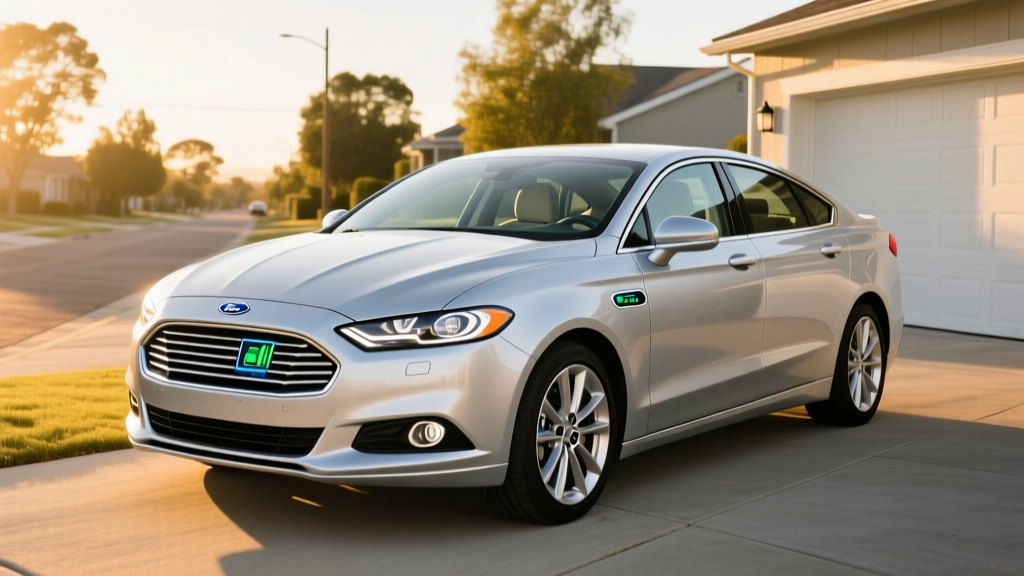
Quick Verdict: A Proven Hybrid Sedan for Budget-Conscious Commuters
The 2017 Ford Fusion SE Hybrid is a conventional hybrid electric vehicle (HEV) — meaning it never plugs in and recharges its small battery entirely through regenerative braking and the gasoline engine. With an EPA-rated 42 MPG combined, a comfortable midsize cabin, and a used-market price that has settled well below $15,000 in 2026, it remains one of the most cost-effective ways to cut fuel consumption without changing your driving habits.
Ford discontinued the Fusion after the 2020 model year, so every example on the market today is at least six years old. That raises legitimate questions about hybrid battery longevity, replacement cost, and whether a used HEV still competes against newer plug-in hybrids and battery-electric vehicles. This guide covers every number you need to decide.
HEV vs. PHEV vs. EV: Where the Fusion Hybrid Fits
Before diving into specs, it's critical to understand what the Fusion SE Hybrid is — and what it isn't. Ford sold three powertrain variants of the Fusion in 2017:
- Fusion Hybrid (HEV): The subject of this review. Self-charging via regenerative braking. No plug. Small 1.4 kWh battery. EPA 42 MPG combined.
- Fusion Energi (PHEV): A plug-in hybrid with a larger 7.6 kWh battery offering 22 miles of electric-only range before the gas engine engages. Requires plugging in to realize its efficiency advantage. Rated at 97 MPGe on electric + 42 MPG on gas. This is a different vehicle — do not confuse the two.
- Fusion Gas (ICE): Conventional 2.5L four-cylinder, EPA ~25 MPG combined. No electrification.
| Attribute | Fusion Hybrid (HEV) | Fusion Energi (PHEV) | Fusion 2.5L Gas |
|---|---|---|---|
| Plug-in required? | No — self-charging | Yes — Level 1/2 | No |
| Battery capacity | 1.4 kWh | 7.6 kWh | N/A |
| Electric-only range | N/A (EV assist only) | 22 mi (EPA) | N/A |
| EPA combined | 42 MPG | 42 MPG (gas) / 97 MPGe (elec) | 25 MPG |
| Combined horsepower | 188 hp | 188 hp | 175 hp |
| Federal tax credit (2026) | None | Expired (was up to $4,007) | None |
If you don't have access to home or workplace charging, the conventional Hybrid is the correct choice. It extracts maximum efficiency from every gallon without requiring any infrastructure.
Fuel Economy: EPA Numbers and Real-World MPG
| Driving Cycle | EPA Rating |
|---|---|
| City | 43 MPG |
| Highway | 41 MPG |
| Combined | 42 MPG |
Source: fueleconomy.gov — 2017 Ford Fusion Hybrid FWD
The Fusion Hybrid's city MPG actually exceeds its highway rating — a hallmark of Toyota- and Ford-style planetary-gear hybrid systems. In stop-and-go traffic, the electric motor handles low-speed propulsion while regenerative braking recovers energy that a gas car would waste as heat. On the highway, the gasoline engine carries the load with less electric assist.
Real-World MPG: What Owners Actually See
On fueleconomy.gov's My MPG tracker, owner-reported averages for the 2017 Fusion Hybrid cluster around 39–44 MPG, with a median near 41 MPG. In warm-weather city driving with moderate acceleration, exceeding the 43 MPG city sticker is realistic. On sustained 75+ MPH highway runs in cold weather, expect the number to dip to 36–38 MPG.
Key variables that shift real-world results:
- Cold weather (below 35°F): Expect a 5–10% drop. The engine runs more often to provide cabin heat and maintain catalyst temperature.
- Hilly terrain: Regenerative braking on descents partially offsets climbing consumption, but net MPG typically drops 2–4 MPG in mountainous routes.
- Driving style: The hybrid system rewards smooth inputs. Aggressive acceleration forces the gas engine to engage more frequently, eroding the electric motor's efficiency advantage.
Powertrain and Performance Specs
| Specification | Value |
|---|---|
| Engine | 2.0L Atkinson-cycle I4 |
| Engine output | 141 hp / 129 lb-ft torque |
| Electric motor output | 120 hp (88 kW) |
| Combined system horsepower | 188 hp |
| Transmission | eCVT (planetary gearset, not a belt CVT) |
| Drivetrain | Front-wheel drive |
| Battery capacity | 1.4 kWh (lithium-ion) |
| 0–60 mph (est.) | ~8.4 seconds |
| Curb weight | ~3,650 lbs |
| Fuel tank | 13.5 gallons |
| Total driving range (est.) | ~567 miles |
The 2.0-liter Atkinson-cycle engine sacrifices some peak power for thermal efficiency — it runs a late intake-valve closing cycle that extracts more work from each combustion event. The 88 kW (120 hp) permanent-magnet electric motor fills in torque at low RPMs, providing smooth launch from stops. The eCVT is a power-split device using a planetary gearset, not the rubber-belt continuously variable transmissions found in some competitors. This design is mechanically robust with no belts or cones to wear.
Battery Longevity, Warranty, and Replacement Cost
Hybrid Battery Warranty (Original)
Ford's original coverage: 8 years / 100,000 miles (whichever comes first) for hybrid battery components, including the high-voltage battery pack, DC/DC converter, and electric motor. In California Air Resources Board (CARB) states, coverage extends to 10 years / 150,000 miles.
Source: Ford Warranty Guide
For a 2017 model in 2026, the original 8-year/100k federal warranty has expired for most vehicles (nine years have elapsed). CARB-state 10-year coverage may still apply through 2027 for examples under 150,000 miles registered in California, New York, Massachusetts, and other adopting states.
Real-World Battery Degradation
The 1.4 kWh lithium-ion pack in the Fusion Hybrid is deliberately small and conservatively managed. Ford's hybrid control software maintains a narrow state-of-charge window — typically cycling between roughly 30% and 70% actual SoC — which dramatically reduces calendar and cycle degradation compared to a full EV battery that regularly charges to 90%+.
Owner reports and fleet data suggest the Fusion Hybrid battery retains 85–95% of original capacity at 150,000 miles. Because the battery is small and the system doesn't rely on it for long electric-only stretches, even moderate degradation has minimal impact on fuel economy. A 10% capacity loss might reduce city MPG by 1–2 MPG — barely perceptible in daily driving.
Battery Replacement Cost
If the hybrid battery does fail outside warranty:
- New OEM replacement (Ford dealer): $3,000–$4,500 including parts and labor.
- Refurbished/remanufactured pack: $1,500–$2,500 from independent hybrid specialists.
- Individual cell/module replacement: $500–$1,200 if only one or two modules have degraded (a common repair at hybrid specialty shops).
Given the Fusion Hybrid's current used-market value of $8,000–$15,000 in 2026, a full OEM battery replacement represents a significant percentage of the car's worth. Refurbished packs or module-level repairs are the economically rational choice for most owners.
Pricing and Tax Credit Eligibility in 2026
The 2017 Ford Fusion SE Hybrid originally carried an MSRP of approximately $26,060 (including destination). In the 2026 used market, pricing has settled into these ranges based on mileage and condition:
- 80,000–120,000 miles, good condition: $8,500–$11,000
- 50,000–80,000 miles, excellent condition: $11,000–$14,000
- Under 50,000 miles, certified/low-wear: $14,000–$16,500
Does the 2017 Fusion Hybrid Qualify for Any Tax Credit?
No. The 2017 Fusion Hybrid (HEV) does not qualify for the federal §30D Clean Vehicle Credit. Under current IRS rules, only battery-electric vehicles (BEVs) and plug-in hybrid electric vehicles (PHEVs) with a minimum battery capacity of 7 kWh are eligible. Conventional hybrids that don't plug in have never qualified for §30D.
The Fusion Energi (PHEV variant) originally qualified for up to $4,007 in federal credits when new, but that credit is only available to the original purchaser and does not transfer to used buyers under §30D rules. The Used Clean Vehicle Credit (§25E) — up to $4,000 or 30% of sale price for qualifying used EVs and PHEVs — also requires plug-in capability and a minimum 7 kWh battery, so neither the Fusion Hybrid nor the Fusion Energi (7.6 kWh battery, but originally priced above certain thresholds and subject to sourcing rules) is a straightforward candidate. Always consult a tax professional for your specific situation.
Some states and local utilities offer rebates for used hybrid purchases. Check your state energy office or utility provider for current programs.
Who Should Buy the 2017 Fusion Hybrid — and Who Shouldn't
Pros
- 42 MPG combined with no plug-in requirement — ideal for apartment dwellers and street parkers
- Smooth, quiet powertrain with strong low-speed electric torque
- Comfortable midsize cabin with competitive trunk space (12.0 cu ft)
- Conservative battery management yields excellent long-term reliability
- Low used-market entry price vs. newer hybrids
- Proven eCVT design with minimal wear components
Cons
- No electric-only driving mode — gas engine engages regularly
- Discontinued after 2020 — future parts availability may narrow
- Infotainment (SYNC 3) feels dated vs. 2026 systems
- Trunk space reduced vs. gas Fusion due to battery placement
- No DC fast charging (not applicable to HEVs)
- Original hybrid battery warranty mostly expired by 2026
Choose the 2017 Fusion Hybrid If:
- You lack access to home or workplace charging and can't plug in regularly.
- Your commute is stop-and-go city driving where the hybrid system delivers maximum MPG gains.
- You want to reduce fuel spending without the upfront cost of a new EV or PHEV.
- You drive 10,000–15,000 miles/year and want a dependable, comfortable sedan.
Look at a PHEV or Full EV Instead If:
- You have Level 2 home charging and a short commute (under 30 miles) — a PHEV like the Toyota RAV4 Prime or a BEV like the Chevrolet Bolt could eliminate gas use on daily trips.
- You want access to HOV lane stickers (available in some states for PHEVs and BEVs, rarely for HEVs).
- You're eligible for the §30D federal tax credit on a new EV and can leverage the $7,500 point-of-sale reduction.
- You want the latest ADAS features — the 2017 Fusion's driver-assist suite (available adaptive cruise, lane-keeping) is SAE Level 1, far behind 2026 Level 2+ systems.
Reliability Track Record and Common Issues
The second-generation Fusion Hybrid (2013–2020) has built a strong reliability reputation. The planetary eCVT has no friction bands or clutch packs to wear, and the 2.0L Atkinson-cycle engine operates under less thermal stress than a conventional Otto-cycle engine because of its lower effective compression ratio.
Common issues reported by owners and tracked by NHTSA include:
- 12V auxiliary battery drain: The 12V lead-accent battery (separate from the hybrid traction battery) can discharge if the vehicle sits unused for extended periods. This is a maintenance item, not a hybrid-specific defect.
- Brake actuator module: Some 2013–2018 Fusion Hybrids were included in a service campaign related to the brake actuator assembly. Check NHTSA recall status using the VIN before purchasing.
- Coolant intrusion (2.0L engine): A known issue in some Ford 2.0L EcoBoost and Atkinson engines where coolant can leak into cylinders. While less common on the hybrid variant, it's worth checking for white exhaust smoke or coolant loss during a pre-purchase inspection.
Overall, the Fusion Hybrid's powertrain is among the least problematic in Ford's 2017 lineup. The hybrid system adds complexity but has proven durable well past 200,000 miles in fleet and taxi service.
Frequently Asked Questions
How many MPG does the 2017 Ford Fusion SE Hybrid get?
The EPA rates it at 43 MPG city, 41 MPG highway, and 42 MPG combined. Real-world owner averages cluster between 39 and 44 MPG depending on climate, terrain, and driving style. City driving with frequent stops yields the best results because regenerative braking recaptures energy that would otherwise be lost.
Does the 2017 Fusion Hybrid need to be plugged in?
No. The Fusion Hybrid is a conventional HEV (hybrid electric vehicle). It charges its 1.4 kWh battery entirely through regenerative braking and the gasoline engine. You never plug it in. If you want plug-in capability, you'd need the Fusion Energi (PHEV), which is a different model.
How long will the hybrid battery last?
Ford's original warranty covered the hybrid battery for 8 years/100,000 miles (10 years/150,000 miles in CARB states). Real-world data from fleet and owner reports indicates the battery commonly retains 85–95% capacity at 150,000 miles thanks to conservative charge-window management. Many Fusion Hybrids exceed 200,000 miles on the original battery pack.
What does a replacement hybrid battery cost?
A new OEM battery from a Ford dealer runs $3,000–$4,500 installed. Refurbished packs from independent hybrid specialists cost $1,500–$2,500. Module-level repairs (replacing only the degraded cells) can be as low as $500–$1,200. Given the car's used value, refurbished or module-level repair is usually the most cost-effective path.
Does the 2017 Fusion Hybrid qualify for any federal tax credit?
No. Under IRS §30D rules, only plug-in vehicles (BEVs and PHEVs with at least 7 kWh of battery capacity) qualify for federal clean vehicle credits. The Fusion Hybrid is a conventional HEV with a 1.4 kWh battery and no plug-in capability, so it has never been eligible. The used-vehicle credit (§25E) similarly requires plug-in capability.
Hybrid vs. PHEV vs. full EV — which should I choose?
Choose a conventional hybrid (HEV) like this Fusion if you can't plug in at home or work and want maximum fuel savings with zero behavior change. Choose a PHEV if you have home charging and a short commute — you'll drive most days on electricity with gas backup for longer trips. Choose a full EV (BEV) if you have reliable home charging, want zero tailpipe emissions, and your daily driving falls within the vehicle's range (typically 250–350 miles for 2026 models).
Is the 2017 Fusion Hybrid still a smart buy in 2026?
For budget-conscious buyers who lack charging access, yes. At $8,500–$15,000 on the used market with 42 MPG combined, the Fusion Hybrid delivers strong fuel savings per dollar invested. The main risks are the expired battery warranty and Ford's discontinuation of the Fusion nameplate, which could gradually affect body-panel and trim availability. Mechanically, the powertrain remains well-supported by Ford's parts network and independent hybrid shops.