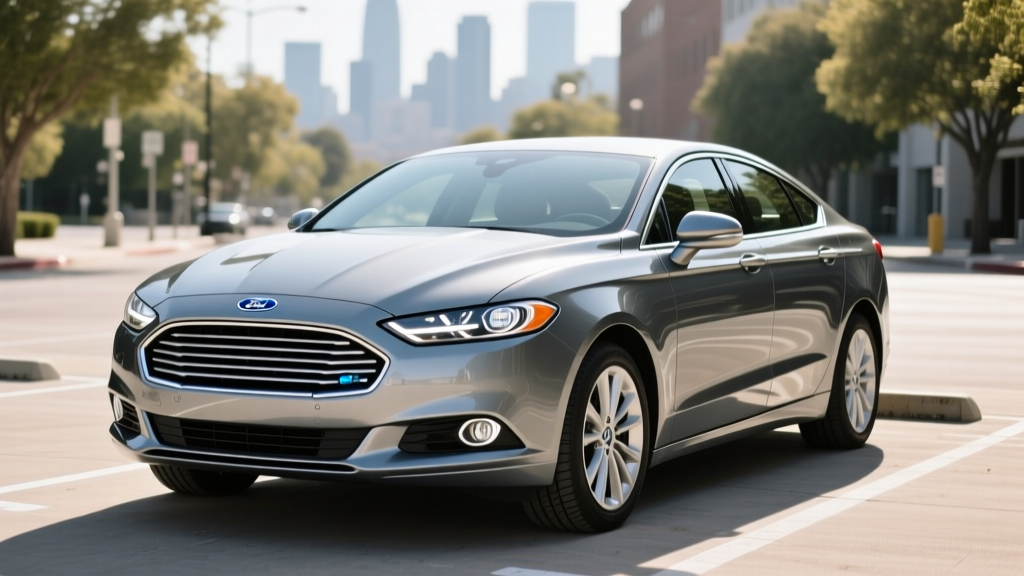
The 2017 Ford Fusion Hybrid SE: A Used Hybrid Worth Considering?
The Ford Fusion Hybrid was discontinued after the 2020 model year, but the 2017 Ford Fusion Hybrid SE remains one of the most visible nameplates on the used-hybrid market. With an EPA-rated 42 MPG combined, a comfortable midsize cabin, and Ford's proven hybrid powertrain, it continues to attract buyers who want serious fuel savings without the plug-in commitment or the upfront cost of a new EV.
This guide breaks down everything a 2026 used-car shopper needs to know: real-world fuel economy, powertrain specs, battery longevity, reliability data, and how the Fusion Hybrid SE stacks up against plug-in hybrids and full battery-electric vehicles available today.
HEV vs. PHEV: What the Fusion Hybrid Actually Is
Before diving into specs, it's critical to understand that the 2017 Ford Fusion Hybrid SE is a conventional hybrid (HEV), not a plug-in hybrid (PHEV). Ford also sold a plug-in variant called the Fusion Energi, which is a different vehicle with different capabilities.
Conventional Hybrid (HEV) — Fusion Hybrid
- No plug required — the battery charges via regenerative braking and the gas engine
- Small battery (~1.4 kWh usable) — electric-only driving limited to low speeds and short bursts
- Optimized for maximum MPG in all conditions
- No electric-only range figure — the engine and motor work together seamlessly
Plug-In Hybrid (PHEV) — Fusion Energi
- Plugs into a wall outlet or Level 2 charger
- Larger battery (~7.6 kWh usable on 2017 model) — delivers EPA-rated 21 miles electric-only
- After the battery depletes, operates as a conventional hybrid
- Eligible for certain incentives that HEVs are not
If you're looking at a listing that says "Fusion Hybrid," it does not plug in. If it says "Fusion Energi," it does. Confusing the two is the most common mistake used buyers make.
Fuel Economy: EPA Ratings and Real-World MPG
The 2017 Ford Fusion Hybrid SE carries EPA ratings that remain competitive nearly a decade later. Here's the official breakdown from fueleconomy.gov:
| Metric | EPA Rating |
|---|---|
| City MPG | 43 MPG |
| Highway MPG | 41 MPG |
| Combined MPG | 42 MPG |
| Fuel Tank Capacity | 13.5 gallons |
| Total Range (estimated) | ~567 miles |
| Annual Fuel Cost (EPA est.) | ~$1,250 (based on 15,000 mi/yr) |
Real-World MPG: What Owners Actually See
Hybrids tend to perform very close to — or even exceed — their EPA ratings in city driving because regenerative braking recovers energy that gas cars waste. On the 2017 Fusion Hybrid SE:
- City / suburban driving: Many owners report 43–47 MPG. Stop-and-go traffic is where this powertrain shines.
- Highway cruising (70+ mph): Expect 37–41 MPG. The hybrid system provides less benefit at sustained high speeds.
- Cold weather (below 30°F): Expect a 5–10% drop (roughly 38–40 MPG combined). The engine runs more frequently to provide cabin heat, reducing electric-motor utilization.
- Combined real-world average: Most drivers land between 39–44 MPG depending on driving mix and climate.
This is a vehicle where the EPA sticker is genuinely representative — not something every car can claim.
Powertrain and Performance Specs
| Specification | 2017 Fusion Hybrid SE |
|---|---|
| Engine | 2.0L Atkinson-cycle inline-4 |
| Engine Power | 141 HP @ 6,000 RPM |
| Engine Torque | 129 lb-ft @ 4,000 RPM |
| Electric Motor | Permanent-magnet AC synchronous |
| Motor Power | 118 HP (88 kW) |
| Combined System Output | 188 HP |
| Transmission | eCVT (electronic continuously variable) |
| Drivetrain | Front-wheel drive |
| 0–60 MPH | ~7.8 seconds (independent testing) |
| Hybrid Battery (gross) | 1.4 kWh lithium-ion |
| Battery Location | Behind rear seat (reduces trunk space) |
| Curb Weight | ~3,568 lbs |
| Trunk Volume | 12.0 cu ft (vs. 16.0 cu ft gas model) |
The eCVT is not a belt-driven CVT like those found in some competitors. Ford uses a planetary gearset that blends engine and motor power with no fixed gear ratios — the result is smooth, linear acceleration without the "rubber band" feel associated with traditional CVTs.
The 188 combined horsepower is adequate for merging and passing. The Fusion Hybrid SE is not quick by modern EV standards (a Tesla Model 3 RWD does 0–60 in 5.8 seconds), but it's perfectly competent for daily driving and feels more refined than the Toyota Camry Hybrid of the same era.
Battery Longevity, Warranty, and Replacement Cost
Original Hybrid Battery Warranty
- Ford's original coverage: 8 years / 100,000 miles (whichever comes first) for hybrid battery components
- California and CARB states: 10 years / 150,000 miles under California emissions warranty requirements
- Capacity threshold: Ford warranted the battery against defects and significant capacity loss — unlike EVs, hybrid batteries rarely degrade to a point that affects drivability because the usable window is small
Will You Need a Battery Replacement?
The 1.4 kWh lithium-ion battery in the Fusion Hybrid is small and operates within a narrow state-of-charge window — typically between 40% and 60%. This shallow cycling dramatically extends cell life compared to a full EV battery that cycles from 10% to 90% daily.
Based on long-term owner reports and fleet data:
- Most Fusion Hybrid batteries last 150,000–200,000+ miles without significant degradation.
- Failures before 100,000 miles are uncommon and would typically have been covered under the original warranty.
- For a 2017 model in 2026, the original 8-year/100,000-mile warranty has expired unless the vehicle is in a CARB state with the 10-year/150,000-mile provision and still under that mileage.
Replacement Cost if Needed
If the hybrid battery does fail out of warranty:
- New OEM battery from Ford: $2,500–$3,500 (parts only; add $300–$600 labor)
- Refurbished/remanufactured battery: $1,200–$2,000 installed
- Individual cell/module replacement: Some hybrid specialist shops can replace only the degraded modules for $500–$1,000
Compare this to EV battery replacements ($8,000–$20,000+), and the hybrid battery risk looks quite manageable. It's also worth noting that the 12V auxiliary battery (a standard lead-acid or AGM unit) will need replacement every 3–5 years at $150–$250 — same as any conventional car.
SE Trim: What You Get and What It Costs in 2026
The SE was the mid-level trim in the Fusion Hybrid lineup, sitting above the base S and below the Titanium. It struck the best value balance for most buyers.
Key SE Standard Equipment (2017)
- SYNC 3 infotainment with 8-inch touchscreen, Apple CarPlay, and Android Auto
- Dual-zone automatic climate control
- Push-button start with intelligent access
- 17-inch alloy wheels
- Power-adjustable driver's seat (10-way)
- Rearview camera
- Ford Co-Pilot360 precursor features: Lane-keeping assist, auto high beams
- Adaptive cruise control (optional on SE via SE Cold Weather & Driver Assist packages)
Used Pricing in 2026
As of early 2026, the 2017 Ford Fusion Hybrid SE trades in the used market at approximately:
- Private party (80,000–100,000 miles, clean title): $10,500–$13,500
- Dealer retail: $12,000–$16,000
- Lower-mileage examples (under 60,000 miles): $14,000–$17,500
Original MSRP for the 2017 Fusion Hybrid SE was approximately $26,795 (including destination). That means current buyers are getting this vehicle at 40–55% of its original sticker — strong depreciation value for the buyer, painful for the original owner.
Tax Credit Eligibility
The 2017 Ford Fusion Hybrid SE does not qualify for the federal §30D new clean vehicle tax credit — that credit applies only to new vehicle purchases and has specific MSRP, income, and battery-sourcing requirements detailed on IRS.gov.
For used vehicles, the federal Used Clean Vehicle Credit (§25E) offers up to $4,000 (30% of sale price, capped at $4,000) — but it applies only to plug-in EVs and fuel-cell vehicles with a minimum 7 kWh battery capacity. The Fusion Hybrid's 1.4 kWh battery does not meet this threshold. The Fusion Energi (PHEV) with its 7.6 kWh battery may qualify if purchased from a dealer for under $25,000 and the buyer meets income limits ($75,000 single / $150,000 joint).
Bottom line: the Fusion Hybrid HEV carries no federal tax incentives in 2026. Your savings come entirely at the fuel pump.
Reliability and Common Issues
The 2017 Fusion Hybrid benefits from Ford's second-generation hybrid system, which had most of its early bugs worked out. Here's what used buyers should know:
Strengths
- The hybrid powertrain (engine, motor, eCVT) is one of the most reliable components — fewer moving parts than a conventional automatic transmission
- No traditional starter motor or alternator to fail (the hybrid motor handles both functions)
- Regenerative braking reduces wear on friction brake pads — many owners report 80,000+ miles on original pads
Known Issues to Check
- Trunk space: The battery pack intrudes into the trunk, reducing capacity to 12.0 cu ft (vs. 16.0 in the gas Fusion). Verify this meets your cargo needs.
- Infotainment glitches: Early SYNC 3 units can freeze or reboot. Ensure software updates were applied.
- Engine coolant intrusion: Some 2.0L Atkinson-cycle engines in this generation have reported coolant intrusion into cylinders. A pre-purchase compression test or borescope inspection is recommended above 100,000 miles.
- 12V battery drain: If the car sits unused for extended periods, the 12V battery can drain, preventing the car from starting (even though the high-voltage hybrid battery may be charged).
For safety ratings, the 2017 Fusion earned a 5-star overall rating from NHTSA and was an IIHS Top Safety Pick+ when equipped with optional front crash prevention.
Who Should Choose the Fusion Hybrid vs. a PHEV or EV?
Pros
- 42 MPG combined — genuine fuel savings without behavior change
- No plug required — works for apartment dwellers and street parkers
- Low used pricing ($10K–$16K) with proven powertrain
- Comfortable midsize sedan with good ride quality
- Strong safety ratings and available driver-assist features
- Minimal maintenance: no transmission fluid changes, reduced brake wear
Cons
- Trunk compromised to 12.0 cu ft by battery placement
- No electric-only driving capability (unlike PHEV or EV)
- Discontinued model — long-term parts availability could thin over time
- No federal tax credit available for the HEV variant
- Acceleration is adequate but unexciting (7.8 sec 0–60)
- Design dates to 2013 (refreshed 2017) — looks and feels older than newer competitors
The Decision Framework
Choose the 2017 Fusion Hybrid SE if:
- You can't charge at home (apartment, street parking, no garage)
- Your budget is $10K–$16K and you want maximum MPG per dollar
- You drive 12,000–20,000 miles/year and want to cut fuel costs 40–50% vs. a gas-only sedan
- You want a proven, low-risk hybrid with no plug-in complexity
Look at a used PHEV (like a Prius Prime or Fusion Energi) if:
- You can charge at home (even a standard 120V outlet works for PHEVs)
- Your daily commute is under 25 miles and you want electric-only driving most days
- You want to reduce gasoline consumption further without full EV range commitment
Consider a used EV (like a Chevy Bolt or Model 3) if:
- You have reliable home Level 2 charging access
- You want zero tailpipe emissions and the lowest per-mile fuel cost
- You drive under 250 miles/day and are comfortable with public charging on road trips
Frequently Asked Questions
How many MPG does the 2017 Ford Fusion Hybrid SE get?
The EPA rates it at 43 city / 41 highway / 42 combined MPG. In real-world driving, most owners see 39–44 MPG combined, with city driving often exceeding the EPA estimate thanks to regenerative braking.
Does the 2017 Fusion Hybrid plug in?
No. The Fusion Hybrid is a conventional HEV — it charges its small battery through regenerative braking and the gas engine. If you want a plug-in version, look for the Fusion Energi, which is Ford's PHEV variant with 21 miles of electric-only range.
How far can the Fusion Energi (PHEV) go on electric only?
The 2017 Fusion Energi has an EPA-rated 21 miles of electric-only range from its 7.6 kWh battery. After that, it operates as a conventional hybrid with an EPA-rated 42 MPG combined. Total combined range (electric + gas) exceeds 550 miles.
Is the 2017 Fusion Hybrid reliable?
Yes. The second-generation Ford hybrid system has proven durable, with many examples exceeding 150,000–200,000 miles on the original hybrid battery. The eCVT has fewer wear components than a traditional automatic. The main items to inspect on a used example are the 2.0L engine for coolant intrusion and the 12V battery condition.
What does a hybrid battery replacement cost?
A new OEM hybrid battery from Ford runs $2,500–$3,500 plus labor. Refurbished units are available for $1,200–$2,000 installed. However, most Fusion Hybrid batteries last 150,000+ miles, making this an unlikely expense for typical used buyers.
Does the 2017 Fusion Hybrid qualify for any tax credit?
No. The Fusion Hybrid HEV does not qualify for the federal §30D new vehicle credit (it's not a new purchase) or the §25E used clean vehicle credit (its battery is below the 7 kWh minimum). Only the Fusion Energi PHEV may qualify for the used credit under current IRS rules, subject to income and price limits.
How does the Fusion Hybrid compare to the Toyota Camry Hybrid?
The 2017 Camry Hybrid LE is rated at 40/38/40 MPG (city/highway/combined) — slightly below the Fusion's 43/41/42. The Fusion offers a more refined ride and better highway manners, while the Camry has a slight edge in trunk space and Toyota's long-standing hybrid reliability reputation. Both are strong used hybrid choices.
Is the eCVT transmission reliable?
Ford's eCVT uses a planetary gearset rather than a push-belt design. It has no clutches, bands, or torque converter to wear out, and it's widely regarded as one of the most durable transmission designs in any vehicle. Transmission-related failures on the Fusion Hybrid are rare.