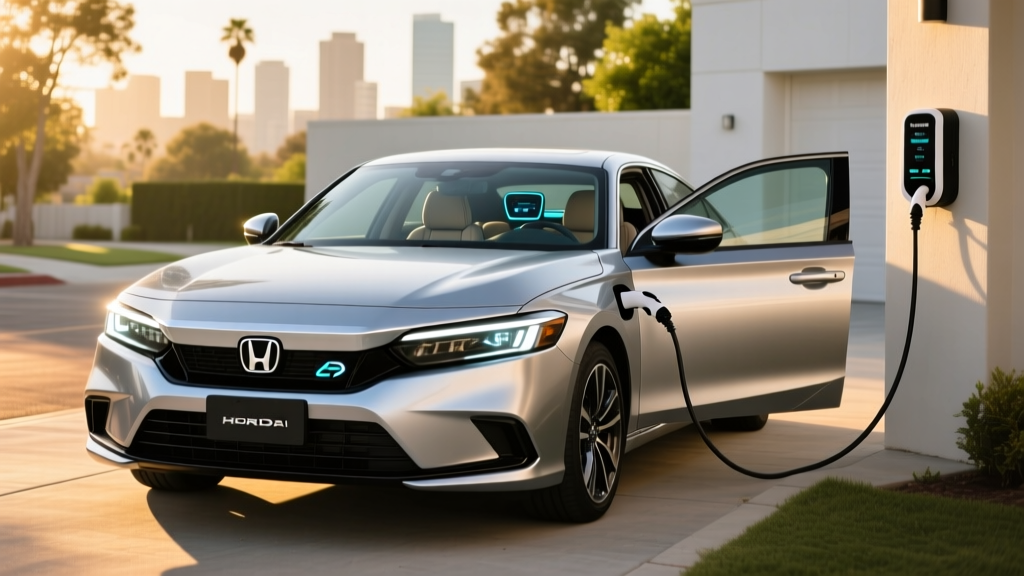
The 2026 Honda Civic Sedan Hybrid arrives at a moment when buyers want fuel savings without committing to a plug. Honda's two-motor hybrid system pairs a 2.0-liter Atkinson-cycle engine with electric motors for a combined 200 horsepower and an EPA-estimated 49 MPG combined — making it one of the most efficient compact sedans on the market without requiring any change to your fueling routine.
This guide breaks down everything you need to know: real-world MPG expectations, how the Civic Hybrid compares to plug-in hybrids and full EVs, battery longevity, and whether any tax credits apply.
2026 Honda Civic Sedan Hybrid: Quick Specs
| Specification | 2026 Civic Hybrid (Sport Hybrid) |
|---|---|
| Powertrain Type | Conventional Hybrid (HEV) — no plug required |
| Combined Horsepower | 200 hp / 232 lb-ft torque |
| Engine | 2.0L DOHC Atkinson-cycle 4-cylinder |
| EPA MPG (City / Hwy / Combined) | 50 / 47 / 49 MPG |
| Fuel Tank Capacity | 10.6 gallons |
| Total Driving Range | ~519 miles (EPA est.) |
| 0–60 mph | ~7.2 seconds (est.) |
| Drivetrain | Front-wheel drive (FWD) |
| Starting MSRP | ~$29,845 (Sport Hybrid, incl. destination) |
| Federal Tax Credit (§30D) | Not eligible (HEV, not a PHEV or BEV) |
| Hybrid Battery Warranty | 8 years / 100,000 miles (10 yr/150k mi in CARB states) |
Source: EPA Fuel Economy, Honda Official Specs. MSRP includes destination charge. Pricing and specs subject to change by model year.
How Many MPG Does the Civic Hybrid Actually Get?
Honda's EPA-estimated fuel economy for the 2026 Civic Sedan Hybrid is strong across the board, but the city number is where this powertrain shines:
| Driving Condition | EPA Estimate | Real-World Expectation |
|---|---|---|
| City | 50 MPG | 48–53 MPG (hybrids often exceed EPA in stop-and-go) |
| Highway | 47 MPG | 42–46 MPG (sustained 70+ mph reduces regen benefit) |
| Combined | 49 MPG | 45–50 MPG (varies with driving mix) |
Why city MPG is higher than highway: The Civic Hybrid's two-motor system uses regenerative braking to recapture energy during deceleration and stops. In city driving, frequent braking events mean more energy recovery. On the highway, the gasoline engine operates more directly, and the electric motor plays a smaller role — which is the opposite of how a full EV behaves.
Cold-weather impact: Expect a 5–10% fuel economy reduction in winter months (roughly 43–46 MPG combined). The engine runs more often to provide cabin heat and maintain battery temperature, reducing electric-only operation time. This is far less dramatic than the 20–30% range loss a battery-electric vehicle experiences in cold weather, but it's still measurable.
HEV vs. PHEV vs. EV: Which Powertrain Fits You?
The 2026 Civic Sedan Hybrid is a conventional hybrid (HEV). It does not plug in. It has no electric-only range to speak of — the small lithium-ion battery (approximately 1.1 kWh usable) exists solely to assist the gasoline engine and capture regenerative braking energy. You fuel it like any other car.
Here's how that compares to the alternatives:
| Feature | HEV (Civic Hybrid) | PHEV (e.g., Toyota Prius Prime) | BEV (e.g., Tesla Model 3) |
|---|---|---|---|
| Plug-in Required? | No | Yes (for EV range) | Yes (always) |
| Electric-Only Range | ~1 mile (low-speed assist) | 35–44 miles | 250–360+ miles |
| Total Range | ~519 miles | ~550–600 miles (EV + gas) | 250–360 miles (electric only) |
| Combined Efficiency | 49 MPG | 48 MPG + 120+ MPGe (EV mode) | 120–140 MPGe |
| Home Charging Needed? | No | Recommended (Level 2, ~4 hrs) | Essential (Level 2, ~8–12 hrs) |
| Federal Tax Credit (§30D) | Not eligible | Up to $7,500 (if eligible) | Up to $7,500 (if eligible) |
| Starting Price Range | ~$29,845 | ~$33,000–$40,000 | ~$38,000–$55,000 |
- You don't have access to home or workplace charging
- You want maximum fuel savings with zero lifestyle change
- Your budget is under $32,000 and you want a proven, reliable sedan
- You drive 12,000–15,000 miles/year and want low cost-per-mile without plug-in complexity
- You can charge at home (Level 2) and most daily trips are under 40 miles
- You want electric commuting but gas flexibility for road trips
- You qualify for the §30D federal tax credit (see eligibility below)
- You have reliable home charging and drive under 300 miles daily
- You want the lowest per-mile fuel cost and zero tailpipe emissions
- You want to take advantage of the full $7,500 federal tax credit
Powertrain Deep Dive: How the Two-Motor System Works
Honda's hybrid system in the 2026 Civic uses a two-motor configuration rather than a traditional planetary gearset (like Toyota's Hybrid Synergy Drive). Here's the architecture:
- 2.0L Atkinson-cycle engine (143 hp): Optimized for thermal efficiency, not peak power. The Atkinson cycle keeps the intake valve open longer during the compression stroke, extracting more energy from each combustion event at the cost of low-end torque — which the electric motors compensate for.
- Drive motor (184 hp / 232 lb-ft): The primary propulsion source in most driving conditions. The engine often acts as a generator rather than directly driving the wheels.
- Generator motor: Starts the engine, generates electricity, and smooths power delivery during transitions.
- Lithium-ion battery pack (~1.1 kWh usable): Small by EV standards, but sufficient to buffer energy for acceleration assist and regenerative capture.
The result is a system that feels more like an EV than a traditional hybrid. At low and moderate speeds, the engine generates electricity and the drive motor handles propulsion. At highway cruising speeds, a lockup clutch connects the engine directly to the wheels for maximum efficiency. Combined system output is 200 horsepower — a meaningful upgrade over the non-hybrid Civic's 158 hp (2.0L) or 180 hp (1.5T).
Acceleration is brisk: 0–60 mph in approximately 7.2 seconds, which puts it ahead of most compact hybrid competitors and close to the Civic Sport Touring with the 1.5L turbo.
Pricing, Trims, and Tax Credit Eligibility
The 2026 Civic Sedan Hybrid is available in Sport Hybrid and Sport Touring Hybrid trims:
| Trim | MSRP (incl. destination) | Key Features |
|---|---|---|
| Sport Hybrid | ~$29,845 | 200 hp hybrid, 18" wheels, 7" touchscreen, Honda Sensing suite |
| Sport Touring Hybrid | ~$32,845 | Adds leather, Bose audio, wireless CarPlay/Android Auto, navigation, heated seats |
Does the Civic Hybrid Qualify for a Federal Tax Credit?
No. The 2026 Honda Civic Sedan Hybrid is a conventional hybrid (HEV), not a plug-in hybrid or battery-electric vehicle. Under IRS §30D rules, only vehicles with a battery capacity of at least 7 kWh that can be recharged from an external power source qualify for the federal clean vehicle credit. The Civic Hybrid's ~1.1 kWh battery charges only from the engine and regenerative braking.
This means the out-of-pocket cost is the full MSRP (minus any dealer discounts or Honda incentives). However, the fuel savings relative to the gas-only Civic (which gets roughly 33–36 MPG combined) are significant:
| 5-Year Cost Comparison | Civic Hybrid (49 MPG) | Civic Gas (35 MPG) | Difference |
|---|---|---|---|
| Fuel cost (75,000 mi @ $3.40/gal) | $5,204 | $7,286 | Hybrid saves ~$2,082 |
| Higher upfront cost (Hybrid vs. gas LX) | — | — | ~$3,500–$4,500 more |
| Net 5-year position | Hybrid costs ~$1,400–$2,400 more over 5 years | Break-even around year 7–8 | |
Note: Fuel cost estimates based on 15,000 miles/year at $3.40/gallon regular unleaded. Actual costs vary by region and driving pattern. The hybrid's advantage grows significantly if gas prices rise or if you drive more than 15,000 miles annually.
State and Local Incentives
Some states offer rebates or HOV lane access for hybrid vehicles, though these programs are increasingly focused on PHEVs and BEVs. Check your state's energy office or Alternative Fuels Data Center for current programs. These vary by jurisdiction and change frequently — always verify with official state sources before relying on a specific incentive.
Battery Longevity, Warranty, and Replacement Cost
Hybrid battery anxiety is one of the most common concerns we hear from buyers transitioning from a conventional gas car. Here's what the data says:
- Federal (all states): 8 years / 100,000 miles
- CARB states (CA, NY, MA, WA, CO, and others adopting California emissions standards): 10 years / 150,000 miles
- Coverage threshold: Battery capacity loss below approximately 60–70% of original capacity (specific threshold defined in warranty documentation)
Real-world degradation data: Honda's lithium-ion hybrid batteries have proven durable. Unlike the nickel-metal hydride (NiMH) packs in early 2000s hybrids that were prone to capacity loss, modern Li-ion packs with active thermal management degrade slowly. Honda has not published a specific degradation curve for the Civic Hybrid, but data from Honda Accord Hybrid and CR-V Hybrid owners suggests less than 10% capacity loss over 100,000 miles under normal use.
Replacement cost: If the hybrid battery does fail outside of warranty, replacement costs for Honda's current-generation hybrid batteries typically range from $2,000 to $3,500 (parts and labor) at a dealership. Independent hybrid specialists may offer refurbished packs for $1,200–$2,000. However, given the warranty coverage and the track record of Honda's Li-ion packs, most owners will never face this expense.
What kills hybrid batteries: The primary degradation accelerants are extreme heat (sustained ambient temps above 100°F), frequent deep discharge cycles (unlikely in Honda's system, which maintains a generous state-of-charge buffer), and prolonged storage at very low or very high charge states. Normal daily driving is actually the best thing for hybrid battery longevity — the system is designed for regular use.
Reliability: What the Data Shows
Honda's hybrid powertrains have built a strong reliability record over the past decade. The two-motor system used in the Civic Hybrid is a derivative of the architecture that has powered the Accord Hybrid, CR-V Hybrid, and Insight (discontinued) with minimal widespread issues.
Key reliability considerations:
- No traditional transmission: The Civic Hybrid uses an e-CVT (electric continuously variable transmission), which has no gears, bands, or torque converter to wear out. This eliminates one of the most common failure points in conventional vehicles.
- Brake wear reduction: Regenerative braking handles much of the deceleration, meaning the friction brakes see significantly less use. Many hybrid owners report original brake pads lasting 80,000+ miles.
- Engine longevity: The Atkinson-cycle 2.0L runs under less stress than a comparable turbocharged engine, and the electric motor handles peak acceleration loads. Honda's naturally aspirated engines have historically been among the longest-lasting in the industry.
- Consumer Reports / IIHS: The Civic platform consistently earns strong reliability and safety ratings. Check IIHS for the latest crash test results when available.
Who Should Buy the 2026 Civic Hybrid?
- 49 MPG combined EPA — among the best in the compact sedan class
- 200 hp provides confident acceleration (quicker than most competitors)
- No plug-in required — zero lifestyle change vs. a gas car
- 519-mile total range eliminates fuel stops on most road trips
- Honda Sensing ADAS suite standard (adaptive cruise, lane keeping, AEB)
- Strong resale value and proven hybrid reliability
- 8–10 year battery warranty depending on state
- No federal tax credit eligibility (HEV, not PHEV/BEV)
- Highway MPG drops to low 40s at sustained 75+ mph
- FWD only — no AWD option (unlike Toyota Prius or some competitors)
- ~$3,500–$4,500 premium over gas-only Civic base trim
- Smaller trunk than gas Civic (battery placement reduces cargo slightly)
- No DC fast charging capability (not applicable — HEV)
The ideal Civic Hybrid buyer drives 12,000–18,000 miles per year in a mix of city and suburban conditions, doesn't have access to home charging (apartment, street parking, or no garage), and wants to reduce fuel costs without the complexity of plugging in. It's also the right call for buyers in areas with limited public charging infrastructure who still want meaningful efficiency gains.
Skip the Civic Hybrid if you have reliable home Level 2 charging and a short commute — a PHEV like the Toyota Prius Prime or a BEV like the Chevrolet Equinox EV will deliver lower per-mile costs and may qualify for the $7,500 federal credit, effectively closing the price gap.
Frequently Asked Questions
How many MPG does the 2026 Honda Civic Hybrid get?
The EPA rates the 2026 Civic Sedan Hybrid at 50 MPG city, 47 MPG highway, and 49 MPG combined. In real-world driving, expect 45–50 MPG combined depending on your driving mix, with city-heavy commutes often exceeding the EPA estimate and sustained highway driving pulling it toward the low-to-mid 40s.
Does the Civic Hybrid need to be plugged in?
No. The Civic Hybrid is a conventional hybrid (HEV). Its battery charges exclusively from the gasoline engine and regenerative braking. You simply fill it with regular unleaded gasoline, just like any other car.
How far can the Civic Hybrid drive on electric power alone?
Effectively about 1 mile at very low speeds (under 25 mph) in EV mode. The battery is far too small (~1.1 kWh) for meaningful electric-only driving. The electric motor's primary role is to assist the gasoline engine and capture braking energy, not to replace it.
Is the hybrid battery reliable and what does replacement cost?
Honda's lithium-ion hybrid batteries have a strong track record, with most showing less than 10% degradation over 100,000 miles. The battery is covered by an 8-year/100,000-mile warranty (10 years/150,000 miles in CARB states). Out-of-warranty replacement typically costs $2,000–$3,500 at a dealership, though most owners will never need one.
Does the 2026 Civic Hybrid qualify for any tax credit?
Not for the federal §30D clean vehicle credit — that requires a plug-in vehicle (PHEV or BEV) with at least 7 kWh of battery capacity. The Civic Hybrid is a conventional HEV. Some states may offer minor incentives for hybrids, but these vary by jurisdiction. Consult a tax professional and check your state's energy office for current programs.
How does the Civic Hybrid compare to the Toyota Prius?
The 2026 Toyota Prius gets up to 57 MPG combined (LE trim, FWD) but offers less power (194 hp combined with AWD, 196 hp FWD). The Civic Hybrid sacrifices a few MPG for noticeably stronger acceleration (200 hp vs. 194–196 hp) and a more conventional sedan driving experience. The Prius also offers AWD; the Civic Hybrid does not.
Is the Civic Hybrid good for road trips?
Yes. With a 519-mile EPA-estimated total range and a conventional gasoline fueling experience, the Civic Hybrid handles road trips identically to a gas car — just with fewer fuel stops. Highway MPG of 42–46 real-world at 70–75 mph means roughly 450–480 miles between fill-ups on the interstate.