Quick Verdict: A Proven Full-Size Hybrid Sedan
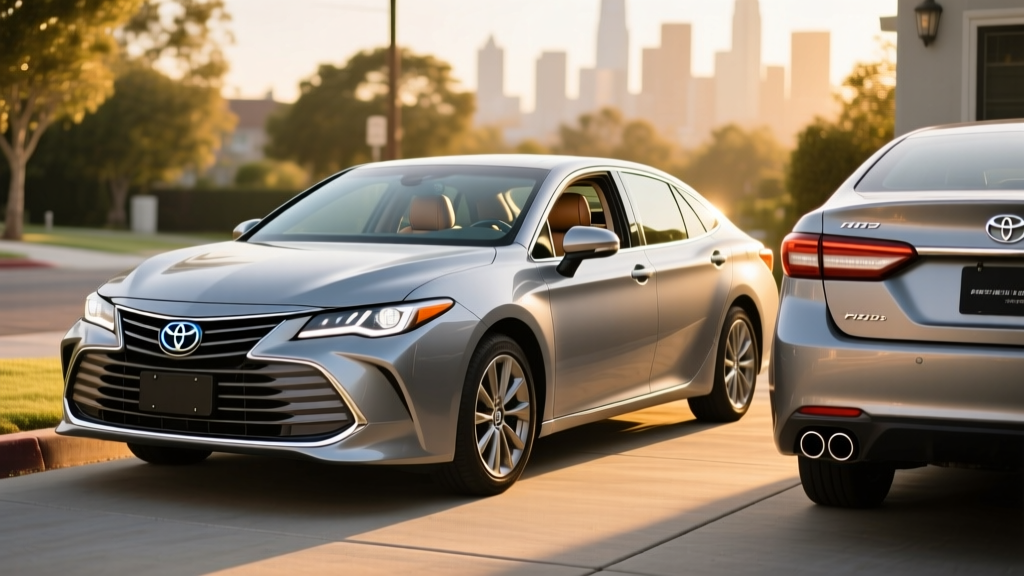
The 2017 Toyota Avalon Hybrid remains one of the most compelling used full-size sedans for buyers who want maximum fuel economy without plug-in complexity. Built on Toyota's fourth-generation Hybrid Synergy Drive, it pairs a 2.5-liter Atkinson-cycle four-cylinder with an electric motor for a combined 200 horsepower — enough for confident highway merging while returning an EPA-estimated 40 MPG combined. In 2026's used market, well-maintained examples typically list between $14,000 and $19,000 depending on mileage and trim, making it a high-value entry into hybrid ownership with minimal risk.
| Spec | Value |
|---|---|
| Powertrain | 2.5L I4 Atkinson + electric motor (HEV) |
| Combined Horsepower | 200 hp |
| EPA MPG (City / Hwy / Combined) | 40 / 39 / 40 |
| Fuel Tank Capacity | 17.0 gallons |
| Total Range | ~680 miles |
| 0–60 mph | ~8.0 seconds |
| Hybrid Battery | 1.6 kWh NiMH (sealed, self-charging) |
| Drivetrain | Front-wheel drive (eCVT) |
| Cargo Volume | 14.0 cu ft |
| Original MSRP (base XLE Premium) | $36,770 |
| Typical 2026 Used Price | $14,000–$19,000 |
HEV vs PHEV: What the Avalon Hybrid Actually Is
Before diving into fuel economy, it's critical to understand exactly what the 2017 Avalon Hybrid is — and isn't. This is a conventional hybrid electric vehicle (HEV), not a plug-in hybrid (PHEV). That distinction drives everything about how you own it.
| Feature | Avalon Hybrid (HEV) | Typical PHEV (e.g., Prius Prime) |
|---|---|---|
| Plug-in charging required? | No — self-charging via regen & engine | Yes — plug in for electric-only miles |
| Electric-only range | None (EV mode limited to ~1 mi at low speed) | 25–44 miles typical |
| Battery size | 1.6 kWh NiMH | 8.8–18.1 kWh Li-ion |
| Federal tax credit (§30D) | Not eligible | Up to $7,500 (if new, subject to sourcing rules) |
| Ownership complexity | Identical to a gas car — just add fuel | Requires home/work charging access for max benefit |
The Avalon Hybrid recovers energy through regenerative braking and its gasoline engine to keep the small nickel-metal hydride (NiMH) battery charged. You never plug it in. You never change how you fuel it. You simply drive and let the powertrain manage the gas-electric balance automatically. For buyers without access to home or workplace charging, this is a significant advantage over PHEVs and full EVs.
Fuel Economy: EPA Ratings and Real-World MPG
The EPA rates the 2017 Avalon Hybrid at 40 MPG city, 39 MPG highway, and 40 MPG combined. Those numbers are remarkably consistent across driving conditions — a hallmark of Toyota's hybrid system, which leans heavily on electric assist in stop-and-go traffic where conventional engines are least efficient.
| Driving Condition | EPA MPG | Real-World Expectation |
|---|---|---|
| City | 40 | 40–44 MPG (hybrids often exceed EPA in city) |
| Highway | 39 | 35–39 MPG (sustained 75+ mph reduces regen benefit) |
| Combined | 40 | 38–42 MPG depending on driving mix |
| Cold weather (below 32°F) | — | 34–37 MPG (engine runs more for cabin heat) |
Why Hybrids Often Beat EPA in City Driving
The EPA's city test cycle involves frequent stops — exactly where regenerative braking shines. Every deceleration converts kinetic energy back into the battery, and the electric motor handles low-speed launches where gasoline engines are least efficient. Many Avalon Hybrid owners report 42–44 MPG in urban commutes. Highway driving is the opposite: sustained high speeds mean less regen opportunity and more aerodynamic drag, so expect 35–38 MPG on long interstate trips at 75 mph.
Cold weather impacts any hybrid's efficiency. Below freezing, the engine runs more frequently to maintain cabin heat and keep the catalytic converter at operating temperature. Expect a 5–8 MPG penalty in winter conditions — still far better than a conventional V6 sedan's year-round average.
Powertrain and Driving Experience
The 2017 Avalon Hybrid uses Toyota's well-proven Hybrid Synergy Drive, pairing a 2.5-liter Atkinson-cycle inline-four (156 hp, 156 lb-ft) with a permanent-magnet electric motor (105 kW). Net system output is 200 horsepower, routed through an electronically controlled continuously variable transmission (eCVT) to the front wheels.
The eCVT is not a belt-driven CVT like those in some competitors — it's a planetary gearset that blends engine and motor power with no fixed gear ratios. The result is seamless acceleration with no shift shock, though the engine drone under hard acceleration is the classic "rubber-band" effect common to Toyota hybrids. At part throttle, the cabin is remarkably quiet, and the transition between electric and gasoline power is nearly imperceptible.
The Avalon Hybrid offers selectable EV, Eco, and Sport drive modes. EV mode forces electric-only operation at speeds up to ~25 mph for roughly one mile — useful for creeping through a parking garage but not a practical commuting tool. Eco mode softens throttle response and reduces climate-control draw. Sport mode sharpens throttle mapping and adds weight to the electric power steering.
Reliability, Battery Lifespan, and Warranty
This is where the 2017 Avalon Hybrid earns its reputation. Toyota's hybrid powertrain has accumulated decades of real-world data, and the Avalon's system is among the most durable in the industry.
Hybrid Battery Warranty & Replacement Cost
- Original warranty: 8 years / 100,000 miles (10 years / 150,000 miles in CARB states including CA, NY, MA, and others)
- Real-world battery lifespan: 150,000–250,000+ miles with normal use; many original batteries still functioning at 200,000 miles
- Replacement cost (2026): $2,000–$3,500 for a refurbished NiMH pack; $3,500–$4,500 for a new OEM pack from Toyota
- Failure rate: Very low — NiMH chemistry is less prone to sudden failure than early Li-ion packs; degradation is gradual and linear
NiMH batteries degrade more gracefully than lithium-ion. Rather than a sudden capacity cliff, you'll notice a gradual reduction in EV-mode availability and a slight MPG decline over many years. The 1.6 kWh pack is small enough that even 20% degradation has minimal impact on overall fuel economy because the engine is always available as backup.
For used buyers in 2026: a 2017 model is now 9 years old. In CARB states, the 10-year/150,000-mile hybrid warranty may still have remaining coverage. Ask for the hybrid battery health report from a Toyota dealer — they can pull a State of Health (SoH) reading via the OBD-II diagnostic system. Any SoH above 70% is considered acceptable for continued reliable service.
General Reliability
According to NHTSA records, the 2017 Avalon Hybrid has minimal safety recalls and strong long-term reliability scores across major tracking services. The eCVT has no belts, clutches, or torque converter to wear out — it's essentially a sealed planetary gearset with far fewer failure points than a conventional automatic transmission. Brake pads last 80,000–100,000+ miles thanks to regenerative braking handling most deceleration.
Pricing, Tax Credits, and Ownership Costs
The 2017 Avalon Hybrid was offered in three trims: XLE Premium ($36,770), XLE Touring ($38,870), and Limited ($42,170). In the 2026 used market, expect to pay:
- XLE Premium (80k–110k miles): $14,000–$16,000
- XLE Touring (60k–90k miles): $15,500–$17,500
- Limited (50k–80k miles): $17,000–$19,000
Federal Tax Credit Eligibility
The 2017 Avalon Hybrid does not qualify for the federal §30D new clean vehicle tax credit (up to $7,500) because it is a conventional HEV, not a plug-in vehicle. The §30D credit applies only to battery electric vehicles (BEVs) and plug-in hybrids (PHEVs) with battery capacities of at least 7 kWh. The Avalon's 1.6 kWh NiMH pack falls far short of that threshold.
The used clean vehicle credit (up to $4,000 or 30% of sale price, whichever is less) under IRC §25E also does not apply here — it requires the vehicle to be a qualified plug-in EV or fuel cell vehicle. Conventional hybrids are excluded from both federal credits.
Some states offer their own incentives for hybrid purchases, but these vary widely by jurisdiction and change frequently. Check your state's energy or environmental agency website for current programs.
Five-Year Cost of Ownership Estimate
| Category | Avalon Hybrid (40 MPG) | Gas V6 Sedan (24 MPG) |
|---|---|---|
| Purchase price (typical) | $16,500 | $14,000 |
| Fuel (75,000 mi at $3.40/gal avg) | $6,375 | $10,625 |
| Maintenance (5 years) | $2,200 | $3,000 |
| Insurance (5 years avg) | $6,500 | $6,200 |
| Total 5-year cost | ~$31,575 | ~$33,825 |
The hybrid's fuel savings typically offset its slightly higher purchase price within 2–3 years of average driving (15,000 miles/year). Longer ownership horizons widen the gap further.
Who Should Buy the 2017 Avalon Hybrid?
Pros
- 40 MPG combined — exceptional for a full-size sedan
- No plug-in charging required; ownership identical to a gas car
- Proven NiMH battery with 200,000+ mile track record
- Spacious rear seat and smooth, quiet ride
- Strong reliability and low maintenance costs
- Regenerative braking extends brake pad life significantly
Cons
- No electric-only commuting range (EV mode is ~1 mile)
- No federal tax credit eligibility
- eCVT drone under hard acceleration
- Trunk space reduced to 14.0 cu ft due to battery placement
- Discontinued after 2018 — no new examples available
- Infotainment system feels dated by 2026 standards (no standard Apple CarPlay)
Decision Framework: Is This the Right Electrified Vehicle for You?
- Choose the Avalon Hybrid if: You want 40 MPG without changing your fueling habits, you lack home charging access, you prioritize reliability and low running costs, and you need a spacious rear seat for passengers.
- Choose a PHEV (e.g., Prius Prime, RAV4 Prime) if: You have home charging, your commute is under 40 miles round-trip, and you want electric-only daily driving with gas backup for road trips.
- Choose a full EV (e.g., Tesla Model 3, Hyundai Ioniq 6) if: You have reliable home Level 2 charging, you want zero tailpipe emissions, minimal maintenance, and access to the §30D federal tax credit on a new purchase.
- Stick with a conventional gas sedan if: You drive fewer than 8,000 miles per year (fuel savings won't offset the hybrid premium), or you need maximum trunk space.
Buying Tips for a Used 2017 Avalon Hybrid in 2026
- Get the hybrid battery SoH checked. Any Toyota dealer can pull this diagnostic. Avoid examples below 65% SoH unless the price reflects an imminent $2,500–$4,000 battery replacement.
- Verify CARB-state warranty eligibility. If the car was originally sold and registered in a CARB state (CA, CT, ME, MA, NJ, NY, OR, RI, VT, WA, and others), the 10-year/150,000-mile hybrid warranty may still apply through model year 2027.
- Check for the inverter coolant pump recall. Some 2013–2018 Toyota hybrids had a recall for the hybrid inverter coolant pump. Verify this was completed via the NHTSA recall lookup.
- Inspect brake rotors, not just pads. Because regen handles most braking, the friction brakes see less use — which can lead to rotor surface rust or corrosion in humid climates. Budget $400–$600 for a rotor resurfacing or replacement if needed.
- Test the EV mode transition. During your test drive, engage EV mode at low speed and listen for any unusual sounds during the engine start/stop transition. It should be nearly silent.
Frequently Asked Questions
How many MPG does the 2017 Avalon Hybrid get?
The EPA rates it at 40 MPG city, 39 MPG highway, and 40 MPG combined. Real-world results typically range from 36 MPG (winter highway driving) to 44 MPG (warm-weather city commuting). The 17-gallon fuel tank provides approximately 680 miles of total range.
Does the 2017 Avalon Hybrid need to be plugged in?
No. The Avalon Hybrid is a conventional HEV — it charges its own 1.6 kWh NiMH battery through regenerative braking and the gasoline engine. You fuel it exactly like a regular car. There is no charging port, no plug, and no electric-only commuting range beyond about one mile at very low speeds.
Is the hybrid battery reliable, and what does replacement cost?
Toyota's NiMH hybrid batteries are among the most durable in the industry, routinely lasting 150,000–250,000+ miles. The original warranty covered 8 years/100,000 miles (10 years/150,000 miles in CARB states). If replacement is needed, expect $2,000–$3,500 for a refurbished pack or $3,500–$4,500 for a new OEM unit. Failure is gradual — you'll notice slightly reduced MPG rather than a sudden breakdown.
Does the 2017 Avalon Hybrid qualify for any tax credit?
No federal tax credit applies. The §30D new vehicle credit and the §25E used vehicle credit both require plug-in vehicles (BEVs or PHEVs) with battery capacities of at least 7 kWh. The Avalon's 1.6 kWh pack does not qualify. Some states may offer separate hybrid incentives — check your state energy office for current programs.
How does the Avalon Hybrid compare to a full EV or PHEV?
The Avalon Hybrid trades electric-only range for zero lifestyle change — no charging infrastructure, no range planning, no cold-weather range loss anxiety. A PHEV like the RAV4 Prime gives you 42 miles of electric commuting but requires home charging to realize those benefits. A full EV like a Model 3 eliminates fuel costs entirely but demands reliable charging access and a higher upfront investment. The Avalon Hybrid is the lowest-friction path to 40 MPG.
What should I look for when buying a used 2017 Avalon Hybrid?
Prioritize a hybrid battery State of Health reading above 70%, verify the inverter coolant pump recall was completed, check for brake rotor condition (regen reduces friction brake use, which can cause rotor corrosion), and confirm remaining CARB-state warranty coverage if applicable. A pre-purchase inspection at a Toyota dealer is strongly recommended.