The 2015 Sonata Hybrid at a Glance
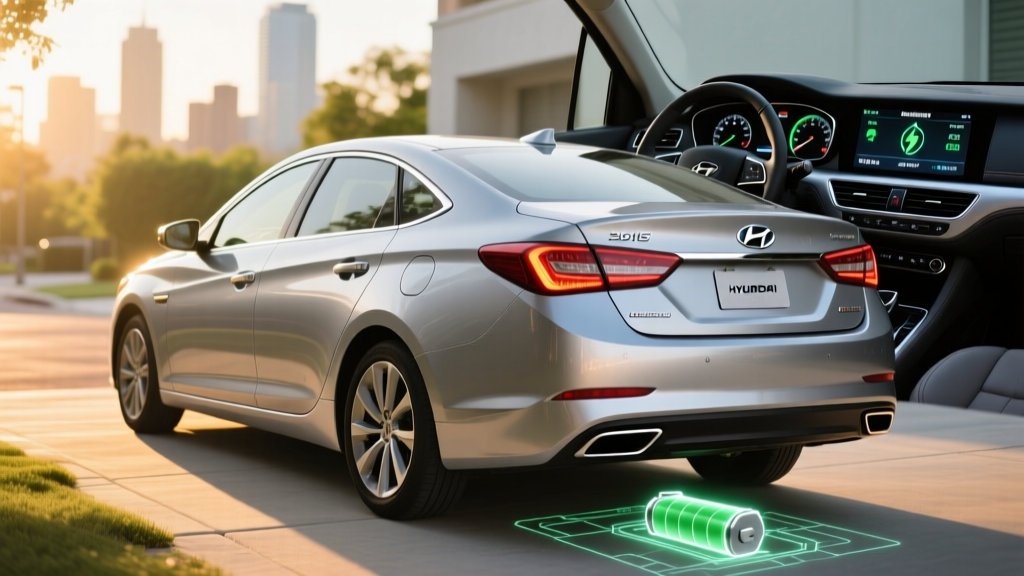
If you're shopping the used midsize sedan market in 2026 and want hybrid efficiency without the complexity of plugging in, the 2015 Hyundai Sonata Hybrid remains a compelling budget option. Built on Hyundai's YF-generation platform, this conventional hybrid (HEV) pairs a 2.4-liter four-cylinder engine with an electric motor to deliver an EPA-estimated 36 MPG combined — a figure that still holds up against many newer hybrids. With used examples routinely selling between $8,000 and $13,000 depending on mileage and condition, the 2015 Sonata Hybrid offers a low-cost entry into hybrid ownership. But before you sign the paperwork, you need to understand what you're getting — and what you're not.
| Spec | 2015 Sonata Hybrid |
|---|---|
| Powertrain Type | Conventional Hybrid (HEV) — no plug |
| Engine | 2.4L GDI 4-cylinder (169 hp) |
| Electric Motor | 35 kW (47 hp) |
| Combined System Output | 199 hp |
| Transmission | 6-speed automatic |
| Hybrid Battery | 1.4 kWh lithium-polymer |
| EPA MPG (City / Hwy / Combined) | 36 / 40 / 36 |
| 0-60 mph | ~8.5 seconds |
| Fuel Tank | 18.5 gallons |
| Total Range | ~666 miles |
| Battery Warranty (Original) | 8 years / 100,000 miles |
| Used Price Range (2026) | $8,000–$13,000 |
Understanding the HEV vs PHEV Distinction
A common mistake among used-car shoppers is confusing the 2015 Sonata Hybrid with a plug-in hybrid. It's critical to understand the difference:
| Feature | 2015 Sonata Hybrid (HEV) | Plug-In Hybrid (PHEV) Example |
|---|---|---|
| Needs to be plugged in? | No — charges via regenerative braking and engine | Yes — requires Level 1 or Level 2 charging for full EV range |
| Electric-only range | Less than 1 mile at low speeds | 20–40+ miles (model dependent) |
| Battery size | 1.4 kWh | 9–20+ kWh typical |
| DC fast charging | Not applicable | Rare; most PHEVs are Level 2 only |
| Federal tax credit (new) | None (no §30D credit for HEVs) | Up to $7,500 under §30D (if eligible when new) |
| Best for | Drivers without home charging access | Drivers with home charging who want short EV commutes |
The 2015 Sonata Hybrid is a self-charging HEV. You never plug it in. The 1.4 kWh lithium-polymer battery recharges through regenerative braking and the gasoline engine. This makes it ideal for apartment dwellers, street parkers, or anyone without access to a charging outlet. However, it also means you get zero meaningful electric-only driving — the motor assists the engine but cannot propel the car on electricity alone for any practical distance.
Hyundai did not offer a plug-in variant of the 2015 Sonata in the U.S. market. The Sonata Plug-in Hybrid arrived for the 2016 model year with a 9.8 kWh battery and an EPA-rated 27 miles of electric-only range. If plug-in capability matters to you, you'll need to look at the 2016+ Sonata PHEV or a different model entirely.
Fuel Economy: EPA Ratings vs Real-World MPG
The EPA rates the 2015 Sonata Hybrid at 36 MPG city, 40 MPG highway, and 36 MPG combined. These numbers deserve context.
| Driving Scenario | EPA Estimate | Real-World Expectation |
|---|---|---|
| City (stop-and-go) | 36 MPG | 36–40 MPG (hybrids often exceed EPA in city) |
| Highway (65–75 mph) | 40 MPG | 34–38 MPG (aerodynamic drag reduces regen advantage) |
| Combined (mixed) | 36 MPG | 34–37 MPG |
| Cold weather (below 32°F) | — | 30–33 MPG (engine runs more for cabin heat) |
Like most conventional hybrids, the Sonata Hybrid actually performs best in city driving, where frequent stops allow regenerative braking to recharge the battery and the engine shuts off at idle. Highway driving is where this car loses its advantage — at sustained 70+ mph speeds, the electric motor contributes less and the 2.4L engine does most of the work. Expect highway fuel economy to dip to the mid-30s in real-world conditions, particularly with roof racks, aggressive acceleration, or summer A/C use.
In cold climates, hybrid efficiency drops noticeably. The engine must run more frequently to provide cabin heat (there's no electric heater in this generation), and the battery's ability to accept and deliver charge diminishes at low temperatures. Owners in northern states should budget for 30–33 MPG in winter months.
For comparison, a 2026 Toyota Camry Hybrid LE achieves an EPA-estimated 52 MPG combined — a 44% improvement driven by Toyota's more efficient series-parallel hybrid system and a larger, more capable battery. If maximum MPG is your priority, newer hybrids have moved the goalposts significantly.
Powertrain and Driving Experience
The 2015 Sonata Hybrid's powertrain combines a 2.4-liter GDI four-cylinder engine (169 hp, 156 lb-ft of torque) with a 35 kW electric motor (47 hp) integrated into the transmission housing. Total system output is 199 horsepower, routed through a conventional 6-speed automatic transmission rather than the continuously variable transmission (CVT) found in most competing hybrids.
This transmission choice defines the driving experience. Unlike the Toyota Camry Hybrid or Ford Fusion Hybrid, which use planetary-gear eCVTs that deliver seamless but sometimes drone-heavy acceleration, the Sonata's 6-speed automatic shifts through actual gears. The result is a more familiar, conventional driving feel — you hear and feel gear changes, and the engine doesn't hold a constant RPM under hard acceleration. Some drivers prefer this; others notice the slight hesitation during downshifts when the electric motor and engine coordinate torque delivery.
The 0-60 mph time of approximately 8.5 seconds is adequate for merging and passing but won't feel quick by modern standards. The electric motor provides useful low-speed torque fill, making the car feel more responsive around town than the 199 hp figure alone suggests. Braking feel is a known weak point — the transition between regenerative braking and friction braking can be abrupt, a common complaint in Hyundai/Kia hybrids of this era.
Battery Health, Warranty, and Replacement Costs
For any used hybrid buyer, the traction battery is the single biggest financial risk. Here's what you need to know about the 2015 Sonata Hybrid's 1.4 kWh lithium-polymer pack.
Original Battery Warranty: 8 years / 100,000 miles (10 years / 100,000 miles in CARB states including California, Connecticut, Maine, Maryland, Massachusetts, New Jersey, New York, Oregon, Rhode Island, Vermont, and Washington).
2026 Status: The 8-year federal warranty has expired for all 2015 models. The 10-year CARB-state warranty expires at the end of the 2025 model year for most vehicles, meaning nearly all 2015 Sonata Hybrids are now out of factory battery warranty regardless of location.
Degradation Reality: Lithium-polymer batteries from this era typically lose 15–25% of their original capacity over 10 years and 100,000–150,000 miles. Because the Sonata Hybrid's battery is small (1.4 kWh) and the hybrid system doesn't rely on deep cycling, degradation primarily manifests as slightly reduced regenerative braking capacity and marginally lower city MPG — not a dramatic failure. Catastrophic battery failure is uncommon in this generation, but it does happen.
Replacement Cost: If the hybrid battery does fail out of warranty, expect to pay between $2,500 and $4,000 for a replacement, including labor. A new OEM battery from Hyundai typically runs $3,000–$3,500 installed at a dealership. Independent hybrid specialists and refurbished battery options can reduce this to $1,500–$2,500. Before purchasing any used 2015 Sonata Hybrid, request a hybrid battery health check — many dealers and independent shops can read the battery's state of health (SoH) percentage via OBD-II diagnostics.
12V Battery Note: Like all hybrids, the Sonata Hybrid also has a conventional 12V auxiliary battery that powers the electronics and boots the hybrid system. This 12V battery typically needs replacement every 4–6 years and costs $150–$250. If a used example won't start, it's usually the 12V battery, not the hybrid pack.
Pricing, Tax Credits, and Total Cost of Ownership
As of early 2026, used 2015 Sonata Hybrid sedans trade between $8,000 and $13,000 depending on mileage, condition, and trim level (Base or Limited). The Limited trim adds leather seats, a premium audio system, navigation, and a panoramic sunroof, and commands a $1,500–$2,500 premium over the Base model.
Federal Tax Credit: The 2015 Sonata Hybrid does not qualify for the IRS §30D Clean Vehicle Credit. This credit applies only to new plug-in electric vehicles (BEVs and PHEVs) meeting battery-sourcing, MSRP, and buyer-income requirements. Conventional hybrids (HEVs) like this Sonata have never been eligible for the federal EV tax credit. When purchased new, the 2015 Sonata Hybrid received no federal incentive.
Used EV Credit (§25E): The used clean vehicle credit of up to $4,000 applies only to used BEVs and PHEVs — not conventional hybrids. The 2015 Sonata Hybrid does not qualify.
Total Cost of Ownership: At $10,000 purchase price, 36 MPG combined, and current fuel prices (~$3.30/gallon national average), annual fuel costs run approximately $1,375 for a driver covering 15,000 miles per year. Compare that to a non-hybrid 2015 Sonata 2.4L (rated at 28 MPG combined), which would cost roughly $1,768 per year in fuel — a $393 annual savings for the hybrid. Over five years of ownership, that's roughly $1,965 in fuel savings, which partially offsets the hybrid's higher purchase price and potential battery replacement risk.
Pros
- No plug-in charging required — works for apartment and street parking
- Conventional 6-speed automatic feels natural to drivers who dislike CVTs
- Spacious cabin with 16.4 cu ft trunk (only slightly less than gas Sonata)
- Strong city MPG; regenerative braking shines in stop-and-go traffic
- Low used purchase price ($8K–$13K)
- Good safety ratings: IIHS Top Safety Pick for 2015
Cons
- Highway MPG underwhelms vs. modern hybrids (mid-30s real-world)
- Original battery warranty expired for all 2015 models
- Brake feel can be grabby during regen-to-friction transition
- No electric-only driving capability
- Outdated infotainment (no Apple CarPlay/Android Auto)
- Significantly less efficient than 2024+ Camry Hybrid, Accord Hybrid
Who Should Buy the 2015 Sonata Hybrid — and Who Shouldn't
Choose the 2015 Sonata Hybrid if:
- You need a budget-friendly midsize sedan under $13,000
- You drive primarily in city/suburban stop-and-go traffic
- You don't have access to home or workplace charging (ruling out PHEVs and BEVs)
- You prefer a conventional automatic transmission over a CVT
- You want lower fuel costs without changing your driving or fueling habits
Choose a different vehicle if:
- You drive mostly highway miles — a modern hybrid like the 2025+ Camry Hybrid (52 MPG combined) will save far more fuel
- You have home charging access — a used PHEV (like a 2017+ Prius Prime or 2018+ Clarity PHEV) gives you 20–47 miles of electric commuting with a gas backup
- You want electric-only driving for short trips — this HEV can't do it
- Modern tech features (CarPlay, ADAS, large touchscreen) are important — this 2015 model predates most of these
- You plan to keep the car 5+ years and want battery warranty coverage — all 2015 models are out of warranty
2015 Sonata Hybrid vs Modern Alternatives
To put this car's value in perspective, here's how it compares to alternatives you might consider in 2026:
| Vehicle | EPA Combined MPG | Type | Approx. Used Price (2026) | Battery Warranty Remaining? |
|---|---|---|---|---|
| 2015 Hyundai Sonata Hybrid | 36 MPG | HEV | $8,000–$13,000 | No (expired) |
| 2018 Toyota Camry Hybrid | 52 MPG | HEV | $18,000–$23,000 | Possibly (8yr/100k) |
| 2017 Toyota Prius Prime | 54 MPG + 25 mi EV | PHEV | $17,000–$22,000 | Possibly (8yr/100k) |
| 2020 Honda Accord Hybrid | 48 MPG | HEV | $20,000–$25,000 | Yes (most examples) |
| 2015 Honda Accord Hybrid | 47 MPG | HEV | $10,000–$14,000 | No (expired) |
The 2015 Sonata Hybrid's main advantage is price. If your budget is firm at $12,000 or below, your hybrid options are limited to older models that are also out of battery warranty. The 2015 Accord Hybrid offers significantly better MPG (47 combined) in the same price range and is worth cross-shopping. If you can stretch to $18,000+, a 2018 Camry Hybrid nearly doubles the Sonata's combined fuel economy while likely still carrying battery warranty coverage.
Frequently Asked Questions
How many MPG does the 2015 Sonata Hybrid get in real-world driving?
The EPA rates it at 36 city / 40 highway / 36 combined. In real-world use, expect 36–40 MPG in city driving (hybrids often beat their EPA city estimate), 34–38 MPG on the highway, and 30–33 MPG in cold winter weather. Your results will vary based on driving style, terrain, and climate.
Does the 2015 Sonata Hybrid need to be plugged in?
No. This is a conventional hybrid (HEV), not a plug-in hybrid (PHEV). The 1.4 kWh battery charges itself through regenerative braking and the gasoline engine. You fuel it like any other car — with gasoline at a gas station.
Is the 2015 Sonata Hybrid reliable?
The 2015 Sonata Hybrid has average-to-good reliability for its class. The 2.4L engine and 6-speed automatic are proven components, and the hybrid system is less complex than a PHEV or BEV powertrain. The main risk is hybrid battery degradation or failure at higher mileages (120,000+ miles), which can cost $2,500–$4,000 to repair out of warranty. Common non-hybrid complaints include brake wear, suspension components, and infotainment glitches. Check NHTSA recall and complaint data before purchasing.
What is the hybrid battery replacement cost for the 2015 Sonata Hybrid?
A new OEM replacement hybrid battery costs approximately $3,000–$3,500 installed at a Hyundai dealership. Refurbished or aftermarket batteries from independent hybrid specialists typically run $1,500–$2,500 installed. Given that the car's used value is $8,000–$13,000, a battery replacement represents a significant percentage of the vehicle's worth — factor this into your purchase decision, especially for examples over 100,000 miles.
Does the 2015 Sonata Hybrid qualify for any tax credit?
No. The 2015 Sonata Hybrid is a conventional hybrid (HEV) and has never qualified for the federal §30D Clean Vehicle Credit, which is reserved for plug-in vehicles (BEVs and PHEVs). It also does not qualify for the §25E used clean vehicle credit. Some states offered rebates for hybrids when the car was new, but these have long since expired. Check your state's current incentive programs at the Alternative Fuels Data Center for any local benefits.
Hybrid vs PHEV vs EV — which is right for me?
The choice depends on your charging access and driving pattern. A conventional hybrid (HEV) like the 2015 Sonata Hybrid requires no charging infrastructure and works for any driver — but offers the smallest fuel savings (36 MPG combined). A plug-in hybrid (PHEV) gives you 20–40 miles of electric-only range for short commutes plus a gas engine for longer trips — ideal if you have home charging. A battery-electric vehicle (BEV) eliminates gasoline entirely with 200–350+ miles of range but requires reliable home or public charging access. If you can't charge at home or work, an HEV is the pragmatic choice. If you can charge, a PHEV or BEV will save more money over time.
What should I check before buying a used 2015 Sonata Hybrid?
Request an OBD-II hybrid battery health report showing the battery's state of health (SoH) percentage — anything below 75% SoH suggests a replacement may be needed within a few years. Check for open recalls on the NHTSA website. Inspect the brake pads and rotors (regen braking reduces wear, but at 100,000+ miles they may need service). Verify the 12V auxiliary battery age — if it's over 4 years old, budget for a replacement. Finally, take a test drive that includes both city stops and highway merging to evaluate the transmission shifts and brake feel.