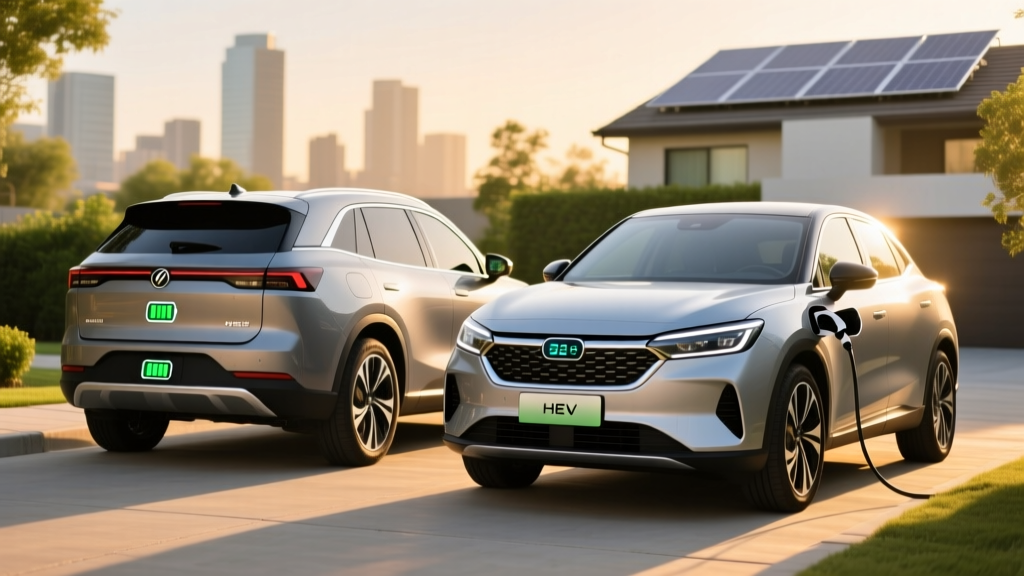
When a window sticker or dealership listing says "hybrid fuel type," it means the vehicle pairs a gasoline engine with one or more electric motors and a battery pack to improve efficiency. But that label covers two very different powertrains: the conventional hybrid (HEV) you never plug in, and the plug-in hybrid (PHEV) that can drive 25–50 miles on electricity alone before the engine kicks on. Understanding the split is the single most important step before you buy.
This guide breaks down exactly how each hybrid fuel type works, what MPG and range numbers to expect in the real world, what battery longevity looks like, and which powertrain actually saves you money based on how you drive.
What "Hybrid Fuel Type" Actually Means on a Spec Sheet
The term hybrid fuel type is an umbrella. On fueleconomy.gov, the EPA classifies vehicles into two distinct categories under this umbrella:
- HEV (Hybrid Electric Vehicle): A small battery (typically 1–2 kWh) captures energy from regenerative braking and the engine. It assists during acceleration and enables brief engine-off coasting. You fuel it exclusively with gasoline — there is no plug.
- PHEV (Plug-in Hybrid Electric Vehicle): A larger battery (typically 13–25 kWh) can be recharged from a wall outlet or public charger. It powers the car for a meaningful electric-only distance before a gasoline engine takes over for extended range.
Both use gasoline as a fuel, but only the PHEV can also use grid electricity as a primary fuel source for daily driving. That distinction drives everything from your monthly fuel bill to your federal tax credit eligibility.
HEV vs PHEV at a Glance
| Attribute | HEV (Conventional Hybrid) | PHEV (Plug-in Hybrid) |
|---|---|---|
| Plugs in? | No | Yes (Level 1 / Level 2) |
| Battery size | ~1–2 kWh | ~13–25 kWh |
| Electric-only range | ~1 mile or less (low speed) | 25–50 miles (EPA) |
| Fuel | Gasoline only | Gasoline + grid electricity |
| Federal tax credit (§30D) | No | Up to $7,500 (if eligible) |
| Price premium over gas model | $1,000–$3,000 | $4,000–$9,000 |
How Many MPG Does a Hybrid Get? EPA and Real-World Numbers
Hybrids are rated by the EPA just like conventional cars, in city/highway/combined MPG. The key insight: conventional hybrids almost always exceed their EPA city rating in real-world stop-and-go driving because regenerative braking feeds energy back to the battery constantly. Highway MPG tends to track closer to the sticker or fall slightly short at sustained 75+ mph speeds.
Below is a snapshot of popular 2025–2026 models with verified EPA data from fueleconomy.gov:
| Model (2025–2026) | Type | City MPG | Hwy MPG | Combined MPG | PHEV EV Range |
|---|---|---|---|---|---|
| Toyota Prius LE | HEV | 57 | 56 | 57 | — |
| Honda Accord Hybrid | HEV | 51 | 44 | 48 | — |
| Toyota RAV4 Hybrid | HEV | 41 | 38 | 40 | — |
| Toyota RAV4 Prime | PHEV | 40 (gas) | 36 (gas) | 38 / 94 MPGe | 42 mi |
| Chrysler Pacifica Hybrid | PHEV | 29 (gas) | 30 (gas) | 30 / 82 MPGe | 32 mi |
| Hyundai Tucson PHEV | PHEV | 35 (gas) | 35 (gas) | 35 / 80 MPGe | 33 mi |
MPGe explained: For PHEVs, the EPA publishes two numbers — MPG when the engine runs, and MPGe (miles per gallon equivalent) when driving on electricity. MPGe converts kWh of electricity into the energy equivalent of a gallon of gasoline (33.7 kWh = 1 gallon). A PHEV rated at 94 MPGe means it uses electricity as efficiently as a 94 MPG gas car would use fuel.
Real-world caveat: Cold weather (below 35°F) typically reduces a PHEV's electric-only range by 15–25% because the battery is less efficient and cabin heating draws from the pack. HEVs see a smaller hit — roughly 5–10% MPG loss in winter — because the engine waste heat warms the cabin.
Powertrain, Battery Size, and Charging: What's Under the Hood
A hybrid's efficiency comes from its powertrain architecture. Most modern systems use one of two layouts:
- Series-parallel (power-split): Toyota's Hybrid Synergy Drive and similar systems use a planetary gearset to blend engine and motor power seamlessly. The engine can drive the wheels directly, generate electricity, or both.
- Series-dominant: Honda's two-motor system and Hyundai's TMED II often use the electric motor as the primary drive force, with the engine acting mainly as a generator at lower speeds and clutching in for highway cruising.
| Spec | Toyota Prius (HEV) | Toyota RAV4 Prime (PHEV) | Hyundai Tucson PHEV |
|---|---|---|---|
| Combined HP | 196 | 302 | 261 |
| Engine | 2.0L 4-cyl | 2.5L 4-cyl | 1.6L turbo 4-cyl |
| Battery (kWh) | ~1.0 kWh (NiMH/Li-ion) | 18.1 kWh (Li-ion) | 13.8 kWh (Li-ion) |
| Level 2 charge time | N/A | ~2.5 hrs (6.6 kW) | ~2.0 hrs (7.2 kW) |
| DC fast charge? | No | No | No |
| 0–60 mph | 7.0 sec | 5.7 sec | 7.1 sec |
Critical PHEV charging note: Nearly all current PHEVs do not support DC fast charging. They are limited to Level 1 (120V household outlet, ~1.4 kW, adding ~4–5 miles of range per hour) or Level 2 (240V, typically 3.6–7.2 kW). A full charge on Level 2 takes 2–3 hours. This means PHEVs are designed for overnight home charging, not public fast-charger pit stops.
For context on kW vs kWh: kW (kilowatts) measures the rate of charging — like water flow from a hose. kWh (kilowatt-hours) measures the battery's total energy capacity — like the size of the tank. A 7.2 kW Level 2 charger refilling an 18.1 kWh battery takes roughly 2.5 hours from empty.
Battery Longevity, Warranty, and Replacement Costs
Hybrid battery anxiety is the top concern for first-time buyers, but the data is reassuring. Federal law mandates that hybrid and PHEV batteries carry a warranty of at least 8 years / 100,000 miles. In California Air Resources Board (CARB) states, that extends to 10 years / 150,000 miles.
Hybrid Battery Warranty Snapshot
- Federal minimum: 8 years / 100,000 miles on all hybrid/PHEV battery packs
- CARB states (CA, NY, MA, WA, and others): 10 years / 150,000 miles
- Toyota: 10 years / 150,000 miles nationwide on all hybrid batteries (2020+ models)
- Hyundai/Kia: 10 years / 100,000 miles (150,000 in CARB states)
- Capacity threshold: Warranty typically triggers if the pack falls below 60–70% of original capacity
Real-world longevity: Toyota Prius taxis routinely surpass 300,000 miles on the original battery pack. Nickel-metal hydride (NiMH) packs in older hybrids and lithium-ion (Li-ion) packs in newer ones both show gradual degradation — typically 10–15% capacity loss over 10 years for PHEVs, and even less for HEVs because the battery is kept in a narrow state-of-charge window by the onboard computer.
Replacement cost if out of warranty:
- HEV battery (Prius-class): $2,000–$4,000 for a new OEM pack; $1,000–$2,000 for a refurbished unit
- PHEV battery (RAV4 Prime-class): $6,000–$10,000+ due to larger capacity
Most owners never face this cost because the battery outlasts the vehicle's economic life, and third-party refurbishment options continue to grow.
Pricing and Federal Tax Credit Eligibility
Here's where the HEV vs PHEV split matters most for your wallet.
Conventional hybrids (HEVs) do not qualify for the federal §30D Clean Vehicle Credit. The IRS limits this credit to plug-in vehicles with a battery capacity of at least 7 kWh. An HEV's ~1 kWh pack falls well short. You pay sticker price, though many HEVs carry only a modest premium ($1,000–$3,000) over their gas-only counterparts and recoup that through fuel savings within 2–4 years.
Plug-in hybrids (PHEVs) can qualify for up to $7,500 under IRS §30D rules, but eligibility depends on several conditions that change frequently:
- Battery sourcing: A percentage of critical minerals and battery components must be sourced from the U.S. or free-trade-agreement partners (thresholds increase annually through 2026)
- MSRP caps: Vans/SUVs/pickups must be under $80,000; sedans under $55,000
- Buyer income caps: Modified AGI must not exceed $150,000 (single), $225,000 (head of household), or $300,000 (joint)
- Point-of-sale transfer: As of 2024+, you can transfer the credit to the dealer for an immediate price reduction at purchase rather than waiting to claim it on your tax return
- Final assembly: Vehicle must undergo final assembly in North America
Because battery-sourcing rules tighten each year, a PHEV that qualifies in early 2026 may lose eligibility later. Always verify the current list at fueleconomy.gov's tax credit page before purchasing. Consult a tax professional for your specific situation.
Hybrid vs PHEV vs Full EV: Which Fits Your Life?
The right electrified vehicle depends on three variables: your daily mileage, your access to charging, and your road-trip tolerance.
Decision Framework
Choose an HEV if: You drive 20–60 miles daily, have no access to home or workplace charging, want maximum simplicity, and want a $1,000–$3,000 price premium over a gas car with zero behavior change. Best for apartment dwellers and street parkers.
Choose a PHEV if: You drive 25–50 miles daily, can install a Level 2 charger at home (or have reliable workplace charging), want to drive most weekdays on electricity but need gasoline freedom for weekend road trips without route-planning. Best for homeowners with a garage and a two-car household downsizing to one.
Choose a full BEV if: You drive 30–100+ miles daily, have reliable home Level 2 charging, want to eliminate gasoline entirely, and are comfortable planning DC fast-charge stops on road trips. Best for high-mileage commuters who want the lowest per-mile fuel cost.
Total cost of ownership note: A PHEV that you charge nightly and drive 35 electric miles per weekday may use gasoline only on weekends, achieving an effective 100+ MPGe across a typical week. But a PHEV you never plug in becomes a heavy, slightly less efficient HEV — you're carrying 300+ lbs of battery and motor you never use. If you won't plug it in, buy an HEV instead.
Pros and Cons of Each Hybrid Fuel Type
HEV (Conventional Hybrid) Pros
- No plug needed — fuels exactly like a gas car
- 40–57 MPG combined (top-tier efficiency)
- Lowest upfront cost premium ($1K–$3K)
- Proven 25-year reliability track record
- No charging infrastructure dependency
HEV Cons
- No federal tax credit
- No electric-only driving (except brief low-speed)
- Still pays full gas prices
PHEV (Plug-in Hybrid) Pros
- 25–50 miles electric = near-zero gas on short commutes
- Up to $7,500 federal tax credit (if eligible)
- 300+ mile total range eliminates range anxiety
- Stronger performance (often 250+ combined HP)
- Gas engine as backup for road trips
PHEV Cons
- Requires home/workplace charging to realize value
- $4K–$9K price premium over gas equivalent
- No DC fast charging on most models
- Heavier = lower MPG once battery depletes
Frequently Asked Questions
How many MPG does a hybrid get compared to a regular gas car?
A typical HEV achieves 40–57 MPG combined versus 25–35 MPG for a comparable gas-only model. That's a 40–65% improvement, most pronounced in city driving where regenerative braking recovers energy that a gas car wastes as heat in the brake pads. On the highway at 75 mph, the gap narrows to roughly 15–25% because aerodynamic drag dominates and the electric motor provides less advantage.
How far can a PHEV go on electric only?
Current 2025–2026 PHEVs deliver 25–50 miles of EPA-rated electric-only range. The Toyota RAV4 Prime leads at 42 miles; the Hyundai Tucson PHEV delivers 33 miles; the Chrysler Pacifica Hybrid manages 32 miles. In cold weather (below 35°F), expect 15–25% less — so a 42-mile rated PHEV may deliver 32–35 electric miles in January. Once the battery depletes, the gas engine takes over seamlessly, giving a total combined range of 400–550 miles.
Do conventional hybrids need to be plugged in?
No. A conventional HEV charges its small battery entirely through regenerative braking and the gasoline engine. There is no plug, no charging cable, and no change to your fueling routine. You simply fill up at a gas station as usual. Only PHEVs require (or benefit from) plugging in.
Is a hybrid reliable and what does battery replacement cost?
Hybrids from Toyota, Honda, and Hyundai/Kia rank among the most reliable vehicles in IIHS and J.D. Power dependability studies. The hybrid battery is warrantied for 8–10 years / 100,000–150,000 miles. Real-world data shows most packs last 15+ years. Out-of-warranty replacement runs $2,000–$4,000 for an HEV and $6,000–$10,000 for a PHEV, though refurbished options cost roughly half.
Does a hybrid qualify for any tax credit?
Conventional HEVs do not qualify for the federal §30D Clean Vehicle Credit. PHEVs may qualify for up to $7,500, subject to IRS rules on buyer income (e.g., $150K single / $300K joint), vehicle MSRP caps ($55K sedans, $80K SUVs), battery component and critical-mineral sourcing thresholds, and North American final assembly. Eligibility changes as sourcing rules tighten. Verify at fueleconomy.gov and consult a tax professional.
Can a PHEV use DC fast chargers?
Almost no current PHEVs support DC fast charging. They are limited to Level 1 (120V, ~1.4 kW) and Level 2 (240V, 3.6–7.2 kW). A full Level 2 charge takes 2–3 hours. This is intentional: PHEV batteries are small enough that overnight home charging fully replenishes them, and adding DC fast-charge hardware would increase cost and weight for a marginal benefit. If you need DC fast charging, a full BEV is the appropriate choice.