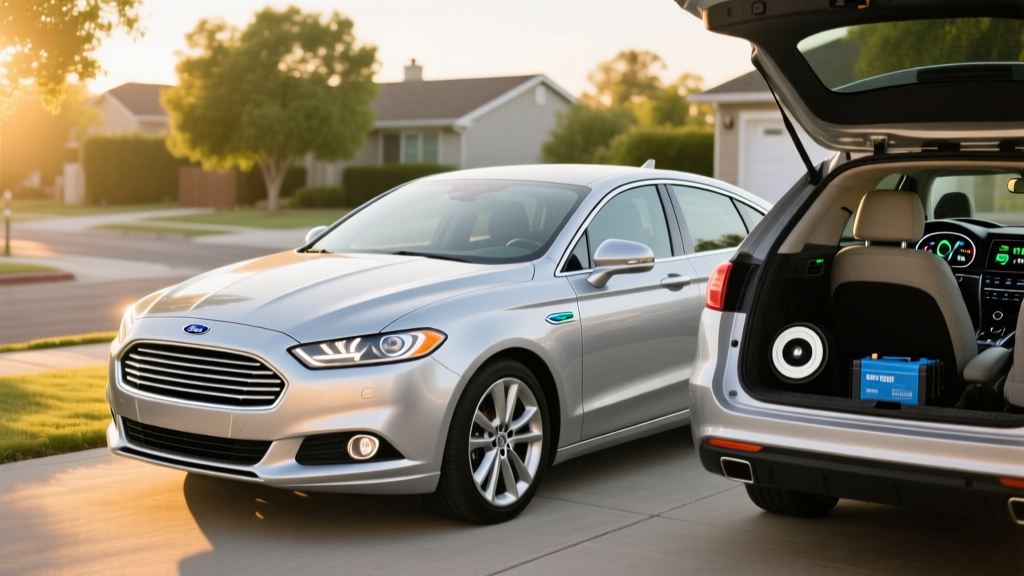
The 2015 Ford Fusion SE Hybrid remains one of the most popular used midsize hybrids on the road. With EPA-rated 44 mpg city and 41 mpg highway, it delivers fuel savings that still compete with newer models — and at used-market prices well under $15,000, it attracts buyers who want hybrid efficiency without the new-car premium. But a decade-old hybrid raises specific questions: How has the battery held up? What does replacement cost? And does this conventional hybrid (HEV) still make sense in a market now full of plug-in hybrids and full EVs?
This guide breaks down every number that matters for a used 2015 Fusion SE Hybrid purchase — from real-world MPG to battery State of Health (SoH) — so you can evaluate one with confidence.
2015 Fusion SE Hybrid: Powertrain and Core Specifications
The 2015 Fusion SE Hybrid pairs a 2.0-liter Atkinson-cycle four-cylinder gasoline engine with an electric motor integrated into Ford's eCVT transaxle. Unlike turbocharged or conventional automatic transmissions, the eCVT uses a planetary gearset to blend power from both sources seamlessly — there are no fixed gear ratios and no traditional belt-and-pulley CVT feel.
| Specification | Value |
|---|---|
| Gas Engine | 2.0L Atkinson-cycle I4, 141 hp / 129 lb-ft |
| Electric Motor | 88 kW (118 hp) permanent-magnet synchronous |
| Combined System Output | 188 hp (net combined) |
| Transmission | eCVT (planetary gearset) |
| Hybrid Battery | 1.4 kWh (usable ~0.6 kWh), lithium-ion, 18 modules |
| Drivetrain | Front-wheel drive |
| 0-60 mph | ~7.8 seconds |
| Curb Weight | ~3,615 lbs |
| Original MSRP (SE trim) | ~$26,200 (base), ~$30,000+ (well-equipped) |
| Typical Used Price (2025-2026) | $8,000–$14,000 depending on mileage/condition |
A critical distinction: the 2015 Fusion SE Hybrid is a conventional hybrid (HEV). It cannot be plugged in. The 1.4 kWh battery charges exclusively through regenerative braking and the gasoline engine. Ford also sold the Fusion Energi — a plug-in hybrid (PHEV) variant — with a larger 7.6 kWh battery and an electric-only range of roughly 19 miles. The Energi is a fundamentally different vehicle, and we'll compare the two below.
EPA Fuel Economy and Real-World MPG
The EPA rates the 2015 Ford Fusion Hybrid at 44 mpg city, 41 mpg highway, and 42 mpg combined. These numbers apply to all trims (S, SE, Titanium) because they share the same powertrain.
| Driving Cycle | EPA MPG | Real-World Expectation |
|---|---|---|
| City | 44 mpg | 44–48 mpg (hybrids often exceed EPA in stop-and-go) |
| Highway | 41 mpg | 37–40 mpg (sustained high speed reduces regen benefit) |
| Combined | 42 mpg | 40–44 mpg (mixed driving typical for most owners) |
Why city MPG is higher: Hybrids recapture kinetic energy through regenerative braking every time you slow down, then use that stored energy to assist acceleration. Stop-and-go traffic is where the electric motor does its best work. At sustained highway speeds above 70 mph, the gasoline engine carries most of the load, and aerodynamic drag dominates — the same physics that hurt any car's efficiency.
Owner-reported data on fueleconomy.gov shows many Fusion Hybrid owners averaging 39–44 mpg combined in everyday driving. Cold weather, aggressive acceleration, and hilly terrain can drop real-world figures to the mid-30s.
Hybrid Battery Health, Lifespan, and Replacement Cost
The lithium-ion hybrid battery is the single biggest concern for any used-hybrid buyer. The 2015 Fusion Hybrid's 1.4 kWh pack contains 18 individual modules and operates within a narrow state-of-charge window (roughly 40–80%) managed by the battery control module. This shallow cycling strategy is designed to maximize longevity.
Typical degradation: At 10 years old, a Fusion Hybrid battery will have lost some capacity. Because the usable window is already small (~0.6 kWh of the 1.4 kWh total), even moderate degradation shows up as reduced electric-assist frequency, slightly lower city MPG, and more frequent engine starts at low speeds.
Replacement cost (2026 estimates):
- New OEM battery (Ford dealer): $2,500–$3,800 installed
- Remanufactured battery: $1,500–$2,200 installed
- Individual module replacement: $400–$800 if only 1–3 modules are weak (a hybrid shop can test and replace individual modules)
Pre-purchase battery check: Any qualified hybrid technician can read the battery's State of Health (SoH) via OBD-II. Look for a shop with Toyota/Ford hybrid diagnostic capability. An SoH reading above 75% is generally acceptable for daily driving; below 65% suggests replacement within 1–2 years.
HEV vs. PHEV vs. EV: Which Fusion (or Alternative) Fits You?
Ford offered the Fusion in three powertrain configurations for 2015: gasoline-only, hybrid (HEV), and Energi plug-in hybrid (PHEV). Understanding the differences is essential before buying.
| Attribute | Fusion Hybrid (HEV) | Fusion Energi (PHEV) | Fusion Gas (2.0T) |
|---|---|---|---|
| Plug-in Charging | No — self-charging | Yes — 120V or 240V | |
| Electric-Only Range | ~0.5–1 mile at low speed | ~19 miles (EPA) | |
| Total Range | ~588 miles | ~550 miles (EV + gas) | |
| Combined Fuel Economy | 42 mpg (EPA) | 38 mpg (gas) / 88 MPGe (EV+gas) | |
| Battery Size | 1.4 kWh | 7.6 kWh | |
| Charge Time (240V) | N/A | ~2.5 hours | |
| DC Fast Charge | No | No | |
| Combined HP | 188 hp | 188 hp | |
| Cargo Space (trunk) | 12.0 cu ft | 8.2 cu ft (battery intrusion) | |
| Used Price Range (2026) | $8,000–$14,000 | $9,000–$15,000 |
Choose the Fusion Hybrid (HEV) if:
- You have no access to plug-in charging at home or work
- You want maximum trunk space and a simpler ownership experience
- Your driving is mostly city/suburban where regen braking maximizes MPG
- You want the lowest total cost of ownership without infrastructure changes
Choose the Fusion Energi (PHEV) if:
- You can install a Level 2 (240V) charger at home and your commute is under 20 miles round-trip
- You want electric-only daily driving with gas-engine flexibility for road trips
- You don't mind reduced trunk space (8.2 cu ft vs. 12.0)
Choose a full EV (e.g., used Tesla Model 3, Chevrolet Bolt) if:
- You have reliable home Level 2 charging and your daily driving is under 200 miles
- You want zero tailpipe emissions and minimal drivetrain maintenance
- You're willing to plan for public DC fast charging on longer trips
Does the 2015 Fusion Hybrid Qualify for Any Tax Credit?
No. The 2015 Ford Fusion Hybrid does not qualify for the federal IRS §30D Clean Vehicle Credit. That credit applies only to new plug-in electric vehicles (BEVs and PHEVs) meeting current battery-sourcing, MSRP, and buyer-income requirements.
The 2015 Fusion Energi (PHEV) originally qualified for a federal credit of up to $4,007 when new, but that credit was available only to the original purchaser at the time of sale. There is no mechanism to claim it on a used purchase today.
Used EV credit (§25E): The federal used-clean-vehicle credit of up to $4,000 applies to previously owned plug-in vehicles (BEVs and PHEVs) purchased from a dealer for $25,000 or less, subject to buyer income caps. The Fusion Energi PHEV could potentially qualify under §25E if purchased from a licensed dealer and meeting all current IRS requirements. The conventional Fusion Hybrid (HEV) does not qualify under §25E, as it is not a plug-in vehicle.
Some states offer additional incentives for hybrid or plug-in purchases — check your state energy office or DMV for current programs. These vary widely and change frequently.
Reliability, Maintenance, and Ownership Costs
The 2015 Fusion Hybrid has a generally solid reliability record. The Atkinson-cycle 2.0L engine is under-stressed compared to turbocharged alternatives, and the eCVT has no friction bands, clutches, or torque converter to wear out. Key maintenance considerations for a 10-year-old example:
- Hybrid battery cooling fan: Located behind the rear seat, this fan can accumulate dust and debris. A clogged filter causes the battery to run hot and degrade faster. Inspect and clean annually — a $15 filter replacement can save thousands.
- Inverter coolant: Ford recommends periodic inverter coolant service. Neglected coolant can lead to inverter failure, which is a $1,500–$2,500 repair.
- Brake pads: Regenerative braking significantly reduces pad wear. Many Fusion Hybrid owners report original brake pads at 80,000+ miles. However, rear drum-in-hat parking brake mechanisms can corrode if the car sits for extended periods.
- Standard maintenance: Oil changes every 7,500–10,000 miles (the engine runs less than in a gas car, so oil stays cleaner longer), tire rotations, cabin air filter, engine air filter.
According to NHTSA records, the 2015 Fusion Hybrid has relatively few technical service bulletins related to the hybrid system specifically. Most recalls and complaints concern non-hybrid components (power steering, airbags, interior trim).
2015 Fusion SE Hybrid: Pros and Cons for Today's Buyer
Pros
- 42 mpg combined EPA — still competitive in 2026
- Real-world city MPG often exceeds EPA (44–48 mpg)
- Smooth, quiet eCVT with no gear hunting
- Low brake wear thanks to regen
- No plug-in infrastructure needed
- Spacious midsize interior with 12 cu ft trunk
- Used pricing under $14K for well-maintained examples
Cons
- Original battery warranty has expired (most examples)
- Battery replacement cost: $1,500–$3,800 if degraded
- No EV-only driving mode for meaningful distances
- No federal tax credit eligibility (HEV)
- Infotainment (Sync 2 / MyFord Touch) is dated and slow
- Highway MPG drops to mid-to-high 30s at 75+ mph
- Discontinued model — no new parts pipeline from Ford
Frequently Asked Questions
How many MPG does the 2015 Ford Fusion SE Hybrid get?
The EPA rates it at 44 mpg city, 41 mpg highway, and 42 mpg combined. Real-world city driving often yields 44–48 mpg because regenerative braking recovers more energy in stop-and-go traffic. Highway driving at sustained high speeds typically returns 37–40 mpg.
Does the 2015 Fusion Hybrid need to be plugged in?
No. The 2015 Fusion Hybrid is a conventional hybrid (HEV). Its 1.4 kWh battery charges entirely through regenerative braking and the gasoline engine. You never plug it in. The Fusion Energi (PHEV variant) is the plug-in model.
How long does the 2015 Fusion Hybrid battery last?
Ford designed the battery for the life of the vehicle, and many examples have exceeded 150,000 miles on the original pack. At 10+ years old, moderate degradation is expected. A pre-purchase OBD-II State of Health check is strongly recommended. If replacement is needed, expect $1,500–$3,800 depending on whether you choose remanufactured or new OEM.
Is the 2015 Fusion Hybrid reliable?
Overall reliability is good. The 2.0L Atkinson engine and eCVT are proven, low-stress components. The main risk on a 2015 model is hybrid battery age. Non-hybrid components (suspension, electronics, power steering) carry similar risk to any 10-year-old midsize sedan. Regular maintenance and a clean hybrid-battery cooling system are key.
Hybrid vs. PHEV vs. EV — which should I buy in 2026?
If you cannot charge at home, a conventional hybrid like the Fusion HEV remains the simplest path to high fuel economy. If you can install a Level 2 charger and your commute is short, a PHEV (like a used Fusion Energi, Toyota RAV4 Prime, or Chrysler Pacifica Hybrid) gives you electric-only daily driving with gas backup. A full EV makes sense if you have home charging, drive under 200 miles daily, and want the lowest per-mile energy cost and minimal maintenance. Each option has trade-offs in upfront cost, charging access, and trip flexibility.
Does the 2015 Fusion Hybrid qualify for a federal tax credit?
No. The federal §30D credit applies only to new plug-in vehicles meeting current sourcing and pricing rules. The §25E used-vehicle credit may apply to the plug-in Fusion Energi PHEV if purchased from a dealer under $25,000, but it does not apply to the conventional Fusion Hybrid.