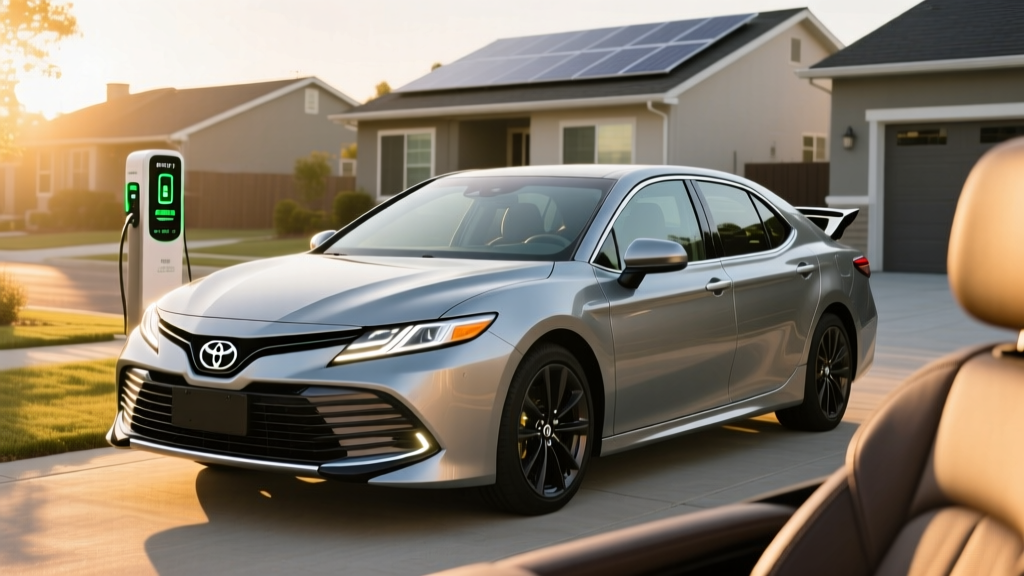
The 2025 Toyota Camry arrived with a powertrain lineup that surprised long-time followers: every single Camry is now a hybrid. Toyota dropped the four-cylinder gas-only engine entirely, betting that its fifth-generation Toyota Hybrid System (THS) delivers the efficiency buyers want without the range compromises of a full EV. For shoppers researching 2025 Toyota Camry hybrids, that means more trim choices, standard hybrid efficiency across the board, and the elimination of any confusion about which Camry is "the hybrid one." They all are.
This guide covers the complete 2025 Camry Hybrid lineup — powertrain specs, EPA and real-world MPG, FWD vs. AWD trade-offs, pricing by trim, battery longevity, and whether this hybrid sedan is the right fit versus a plug-in hybrid or full battery-electric vehicle.
Every 2025 Camry Is a Hybrid: HEV vs. PHEV Clarified
Before diving into trims and numbers, an important distinction for shoppers cross-comparing electrified sedans:
Conventional Hybrid (HEV) — 2025 Camry
The 2025 Camry is a conventional hybrid (HEV). It uses a small lithium-ion battery (approximately 1.0 kWh usable) paired with a 2.5-liter four-cylinder engine and electric motor(s). You never plug it in. The battery recharges through regenerative braking and the gasoline engine. There is no electric-only driving range to speak of — the electric motor assists the engine and enables brief low-speed electric movement, but the gas engine is always part of the equation.
Plug-In Hybrid (PHEV) — Not Available for the Camry
Toyota does not offer a Camry PHEV (sometimes called the Camry Prime, which doesn't exist). If you want a Toyota plug-in hybrid with meaningful electric-only range, you'd look at the RAV4 Prime (42 miles EV) or the Prius Prime (up to 44 miles EV). The Camry remains strictly HEV — no plug, no electric-only commute, but also no charging infrastructure dependency.
This matters because some buyers confuse "hybrid" with "plug-in hybrid." The 2025 Camry Hybrid is a fill-up-and-go vehicle that happens to achieve exceptional fuel economy. No home charger needed, no public charging dependency, no range planning.
Powertrain Specs: Fifth-Gen THS Breakdown
The 2025 Camry uses Toyota's fifth-generation hybrid system, which is lighter and more efficient than the outgoing fourth-gen setup. Here's the hardware:
| Specification | FWD Models | AWD Models |
|---|---|---|
| Engine | 2.5L 4-cylinder + 2 electric motors | 2.5L 4-cylinder + 3 electric motors |
| Combined Horsepower | 225 hp | 232 hp |
| Drivetrain | Front-wheel drive | Electronic AWD (rear electric motor) |
| Transmission | eCVT | eCVT |
| Battery Type | Lithium-ion | Lithium-ion |
| Battery Capacity (approx.) | ~1.0 kWh usable | ~1.0 kWh usable |
| 0–60 mph (est.) | ~7.2 seconds | ~6.9 seconds |
| Towing Capacity | Not rated | Not rated |
The AWD system is worth explaining: it's not a mechanical driveshaft. Instead, a dedicated rear-mounted electric motor engages when the system detects slip or when extra traction is needed. This means AWD adds roughly 7 horsepower and modest weight but doesn't dramatically penalize fuel economy — a trade-off that makes the AWD Camry one of the most efficient all-wheel-drive sedans available.
EPA Fuel Economy: Trim-by-Trim MPG
Fuel economy varies slightly by trim, wheel size, and drivetrain. Here are the official EPA figures for the 2025 Camry Hybrid lineup:
| Trim / Drivetrain | City MPG | Highway MPG | Combined MPG |
|---|---|---|---|
| LE FWD | 53 | 50 | 51 |
| LE AWD | 51 | 49 | 50 |
| SE FWD | 48 | 47 | 47 |
| SE AWD | 46 | 46 | 46 |
| XLE FWD | 48 | 47 | 47 |
| XLE AWD | 46 | 46 | 46 |
| XSE FWD | 48 | 47 | 47 |
| XSE AWD | 44 | 43 | 44 |
The LE trim with its smaller wheels and lighter equipment achieves the headline 51 MPG combined figure — remarkable for a midsize sedan with 225 horsepower. Moving up to SE, XLE, or XSE trims costs you 4–7 MPG combined, primarily due to larger wheels (18" or 19" vs. 16"), sport-tuned suspensions, and added weight from premium features.
Real-World MPG: What to Actually Expect
Toyota hybrids have a well-documented characteristic: they often exceed EPA city estimates in real-world stop-and-go driving, because regenerative braking recaptures energy that a gas car wastes as heat. Conversely, sustained highway driving at 75+ mph tends to produce numbers slightly below the EPA highway sticker.
Based on owner-reported data and independent testing:
- City / suburban driving: LE FWD owners commonly report 52–56 MPG in mixed stop-and-go conditions.
- Highway cruising (70 mph): Expect 46–49 MPG for the LE FWD, dropping to 41–44 MPG for the XSE AWD at 75+ mph.
- Cold weather (below 35°F): Expect a 5–10% reduction in MPG during short trips, as the engine runs more frequently to maintain cabin heat and battery temperature.
- Combined real-world average: Most LE owners settle around 48–52 MPG over a full tank in mixed driving; sportier trims average 42–46 MPG.
With a 13.2-gallon fuel tank, the LE FWD delivers a real-world range of approximately 630–685 miles per fill-up. That's Los Angeles to San Francisco and back on one tank, with fuel to spare.
Pricing by Trim: 2025 Camry Hybrid MSRP
Toyota has kept the Camry Hybrid aggressively priced, especially given that hybrid is now the only option. Here's the MSRP breakdown for the 2025 model year (destination charge included at approximately $1,150):
- LE FWD: ~$28,700
- LE AWD: ~$30,100
- SE FWD: ~$30,900
- SE AWD: ~$32,300
- XLE FWD: ~$33,400
- XLE AWD: ~$34,800
- XSE FWD: ~$35,100
- XSE AWD: ~$36,500
Adding AWD costs approximately $1,400 across all trims — a modest premium for all-weather traction with only a 1 MPG combined penalty on most trims.
Tax Credit Eligibility
Here's what hybrid buyers need to know about incentives: the 2025 Toyota Camry Hybrid does not qualify for the federal §30D clean vehicle tax credit. That credit (up to $7,500) applies only to plug-in electric vehicles — battery-electric vehicles (BEVs) and plug-in hybrids (PHEVs) that meet battery capacity, critical-mineral sourcing, MSRP caps, and buyer income requirements under current IRS rules.
Since the Camry is a conventional HEV with no plug, it is ineligible. However, some states and utilities offer rebates or reduced registration fees for hybrid vehicles — check your state's energy office or local utility for current programs. These are typically modest ($250–$500) compared to the federal EV credit.
Battery Longevity, Warranty & Replacement Costs
2025 Camry Hybrid Battery Warranty
- Hybrid Battery Warranty: 10 years / 150,000 miles (whichever comes first)
- Hybrid System Components: 8 years / 100,000 miles
- Powertrain Warranty: 5 years / 60,000 miles
- Basic Warranty: 3 years / 36,000 miles
Toyota's 10-year/150,000-mile hybrid battery warranty is among the longest in the industry and reflects the company's confidence in the technology. The fifth-generation system uses a lithium-ion pack that's smaller, lighter, and more durable than the nickel-metal hydride batteries in older Camry Hybrids.
Real-World Battery Lifespan
Toyota hybrid batteries have an excellent longevity track record. Data from fleet operators and high-mileage owners shows:
- Most Toyota hybrid batteries last 150,000–200,000+ miles before significant degradation.
- Unlike full EVs, the Camry's small ~1.0 kWh battery operates in a narrow state-of-charge window (roughly 40–80%), which dramatically reduces stress and extends cycle life.
- The battery is never fully charged or fully depleted — the hybrid system manages this buffer automatically.
Battery Replacement Cost
If the hybrid battery does fail outside of warranty, replacement costs for a Camry Hybrid typically range from $2,000 to $4,000 for a new OEM battery pack, plus labor. Refurbished or reconditioned batteries are available for $1,000–$2,000. Independent hybrid specialists in most metro areas can perform the swap. This is significantly less expensive than a full EV battery replacement ($8,000–$20,000+), which is one reason hybrid buyers cite lower long-term anxiety.
Reliability & Ownership Costs
The Camry has been a reliability benchmark for decades, and the hybrid variant is no exception. The hybrid system actually reduces wear on several components:
- Brakes: Regenerative braking significantly reduces pad and rotor wear. Many Camry Hybrid owners report 80,000–100,000+ miles on original brake pads.
- Engine: The Atkinson-cycle 2.5L runs under less stress than a conventional engine, as the electric motor handles low-speed load.
- Transmission: The eCVT has no traditional gears, belts, or clutches to wear — it's a planetary gearset that's extremely durable.
- No 12V alternator or starter motor: These common failure points in gas cars don't exist in the Camry Hybrid.
The Camry Hybrid does still have a conventional 12V auxiliary battery (located in the trunk) that powers electronics and starts the hybrid system. This is a standard AGM or lead-acid battery that will need replacement every 4–6 years like any other car.
Insurance costs for the Camry Hybrid are competitive with the broader midsize sedan segment. Expect annual premiums in the $1,400–$2,000 range depending on your profile — slightly higher than a base gas Camry from prior model years, but lower than most EVs due to the lower MSRP and well-established repair network.
Camry Hybrid vs. PHEV vs. Full EV: Which Fits You?
Choose the Camry Hybrid (HEV) If:
- You want 50+ MPG with zero behavior change — no plugging in, no range planning
- You don't have access to home or workplace charging
- You take frequent long road trips and don't want to plan around DC fast chargers
- You want a proven, low-risk powertrain with a 10-year battery warranty
- Your budget is $28,000–$37,000
Consider a PHEV (e.g., Prius Prime) If:
- You have home charging and a short commute (under 40 miles round-trip)
- You want electric-only daily driving but gas flexibility for road trips
- You qualify for the $7,500 federal tax credit (PHEVs may qualify depending on sourcing rules)
- You don't mind the higher MSRP premium ($33,000–$40,000+)
Consider a Full EV (e.g., Tesla Model 3, Hyundai Ioniq 6) If:
- You have reliable Level 2 home charging
- Your daily driving is under 250 miles and you rarely road-trip to charging deserts
- You want zero tailpipe emissions and the lowest per-mile "fuel" cost
- You qualify for the federal tax credit and state EV incentives
- You're comfortable with long-term battery degradation uncertainty
The Camry Hybrid occupies a specific niche: maximum efficiency with minimum lifestyle change. It doesn't require a home charger, doesn't depend on public charging infrastructure, doesn't need route planning for road trips, and delivers 600+ miles of range per tank. For the majority of American drivers — especially those in apartments, condos, or areas with limited charging — it's arguably the most practical electrified vehicle choice available.
Frequently Asked Questions
How many MPG does the 2025 Toyota Camry Hybrid get?
The most efficient trim, the LE FWD, is EPA-rated at 53 city / 50 highway / 51 combined MPG. Sportier trims (SE, XLE, XSE) and AWD models range from 44 to 47 MPG combined. In real-world city driving, many owners exceed the EPA city estimate by 2–5 MPG thanks to aggressive regenerative braking.
Does the 2025 Camry Hybrid need to be plugged in?
No. The Camry Hybrid is a conventional HEV, not a plug-in hybrid. It charges its small battery through regenerative braking and the gasoline engine. You simply fill it with gas like any other car.
Can the Camry Hybrid drive on electric power alone?
Only for very brief, low-speed moments (e.g., creeping through a parking lot). It does not have a meaningful electric-only range. If you want 30–40+ miles of electric-only driving, you need a PHEV like the Prius Prime or RAV4 Prime.
Is the 2025 Camry Hybrid reliable?
Toyota's hybrid system is one of the most proven electrified powertrains in the world, with over two decades of real-world deployment. The hybrid battery is warranted for 10 years / 150,000 miles and typically lasts well beyond that. The eCVT transmission has fewer wear components than a conventional automatic.
How much does a Camry Hybrid battery replacement cost?
Out-of-warranty replacement runs approximately $2,000–$4,000 for a new OEM battery, or $1,000–$2,000 for a refurbished unit. Most batteries last 150,000–200,000+ miles. Given the 10-year warranty, most original owners will never face this cost.
Does the 2025 Camry Hybrid qualify for a federal tax credit?
No. The federal §30D clean vehicle credit applies only to plug-in vehicles (BEVs and PHEVs) that meet battery sourcing, MSRP, and income requirements. The Camry Hybrid is a conventional HEV and does not qualify. Some state or utility-level hybrid incentives may apply — check local programs.
Is AWD worth it on the Camry Hybrid?
If you regularly drive in snow, rain, or on loose surfaces, the electronic AWD system adds meaningful traction for a $1,400 premium and only a 1 MPG combined penalty. For dry-climate drivers who rarely encounter slippery conditions, the FWD model saves money and delivers the best fuel economy.
How does the Camry Hybrid compare to the Honda Accord Hybrid?
The Accord Hybrid is the Camry's closest rival, offering similar combined MPG (44–48 depending on trim) and comparable pricing. The Camry LE edges ahead on pure efficiency (51 vs. 48 combined for the Accord Hybrid's top rating), while the Accord offers a slightly roomier rear seat and a more refined interior in some reviewers' assessments. Both carry strong hybrid battery warranties.