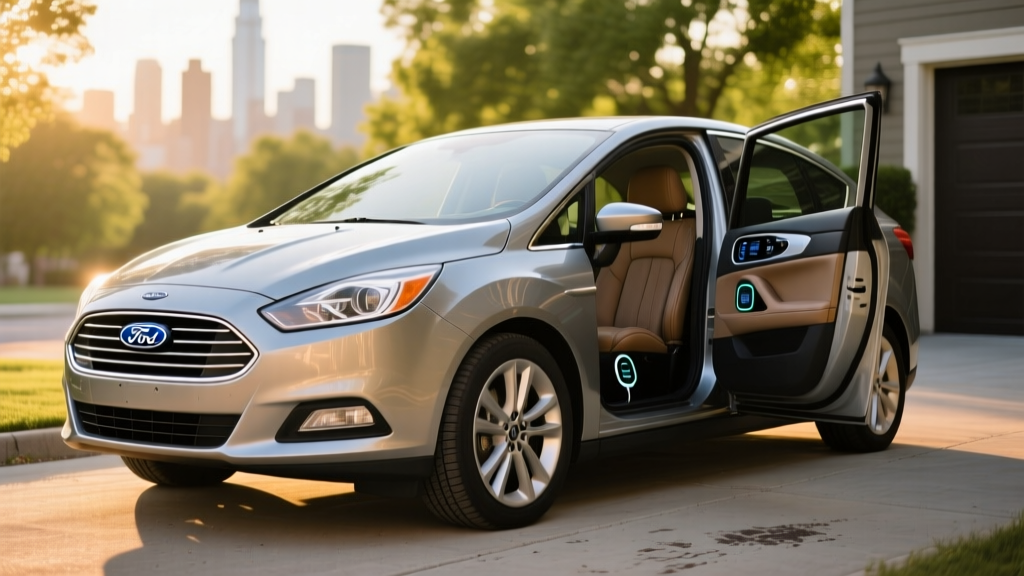
The 2015 Ford C-Max Hybrid occupies a specific niche in the used-car market: a compact hybrid hatchback that delivers strong city fuel economy, practical cargo space, and a comfortable ride at a bargain used price. Ford discontinued the C-Max line after the 2018 model year, but the 2015 C-Max Hybrid remains a popular search among budget-conscious hybrid shoppers. This guide covers everything a 2026 used buyer needs to know — real-world MPG, HEV vs. Energi PHEV differences, battery longevity, and whether this hybrid still makes sense against modern alternatives.
2015 Ford C-Max Hybrid: Quick Verdict
If you need a practical, fuel-efficient daily driver for under $12,000 in 2026, the 2015 C-Max Hybrid is a strong contender. Its 40 MPG combined EPA rating holds up well against newer compact hybrids, and the hatchback body style offers cargo versatility that sedans can't match. The main caveats are its age — most examples are approaching or past the 10-year hybrid battery warranty — and the fact that Ford no longer produces the model, which can complicate some parts sourcing. For city-heavy commuters, the C-Max Hybrid's regenerative braking system and Atkinson-cycle engine deliver real-world MPG that often exceeds the EPA sticker.
HEV vs. PHEV: C-Max Hybrid vs. C-Max Energi Explained
Ford sold the 2015 C-Max in two electrified variants, and confusing them is a common buyer mistake. Here's the critical distinction:
Conventional Hybrid (HEV) — C-Max Hybrid
- No plug required. The 1.4 kWh lithium-ion battery recharges via regenerative braking and the gasoline engine.
- Cannot drive on electric power alone for meaningful distances — the electric motor assists the engine at low speeds but the gas engine is always available.
- No electric-only range rating. Fuel economy is measured in standard MPG.
- No federal tax credit eligibility — new or used — for conventional hybrids under current IRS §30D rules.
Plug-In Hybrid (PHEV) — C-Max Energi
- Must be plugged in to take advantage of its larger 7.6 kWh battery and ~19 miles of electric-only range.
- Can drive on electricity alone at highway speeds for short commutes before the gas engine engages.
- Rated in MPGe (electric mode) and MPG (hybrid mode) — 95 MPGe combined, 38 MPG combined when operating as a hybrid.
- Originally eligible for a $4,007 federal tax credit when new, but the IRS §30D credit no longer applies to this discontinued model on the used market (the Used Clean Vehicle Credit under §25E covers vehicles under $25,000 but requires the vehicle to be at least 10 model years old and meet income caps — the 2015 Energi may qualify through 2026, but verify with a tax professional).
This article focuses on the C-Max Hybrid (HEV). If you're looking at a plug-in variant, search specifically for the "C-Max Energi" — the two have different batteries, different charging needs, and different ownership profiles.
Fuel Economy: EPA Ratings and Real-World MPG
The 2015 Ford C-Max Hybrid carries EPA ratings that remain competitive more than a decade later. According to fueleconomy.gov, the official figures are:
| Metric | EPA Rating | Real-World Expectation |
|---|---|---|
| City MPG | 42 MPG | 40–45 MPG |
| Highway MPG | 38 MPG | 34–38 MPG |
| Combined MPG | 40 MPG | 37–42 MPG |
| Fuel Tank Capacity | 13.5 gallons | ~500 mi total range |
Real-world note: Like most hybrids, the C-Max Hybrid tends to outperform its EPA rating in stop-and-go city driving, where regenerative braking recaptures energy and the electric motor handles low-speed propulsion. On the highway, where the gasoline engine does most of the work and aerodynamic drag increases, expect fuel economy to drop to the mid-to-upper 30s. Owner forums and long-term reports consistently show combined averages between 37 and 42 MPG, with city-heavy drivers occasionally hitting 45 MPG in warm weather.
Cold-weather impact: In sub-freezing temperatures, hybrid fuel economy typically drops 5–15% due to increased engine idling for cabin heat, thicker fluids, and reduced battery efficiency. Expect 34–37 MPG combined in winter conditions — still strong, but plan accordingly.
Powertrain Specifications
| Specification | 2015 C-Max Hybrid |
|---|---|
| Engine | 2.0L Atkinson-cycle I4 |
| Engine Horsepower | 141 hp |
| Electric Motor Output | 118 hp (88 kW) |
| Combined Net Horsepower | 188 hp |
| Transmission | eCVT (planetary gearset, not belt-driven) |
| Hybrid Battery | 1.4 kWh lithium-ion (air-cooled) |
| Drivetrain | Front-wheel drive |
| 0–60 mph (est.) | ~8.1 seconds |
| Cargo Volume (behind rear seats) | 24.5 cu ft |
| Cargo Volume (seats folded) | 52.6 cu ft |
The 2.0L Atkinson-cycle four-cylinder sacrifices some peak power for thermal efficiency — it runs a shorter intake valve closing to reduce pumping losses, which is why the engine alone produces a modest 141 hp. The electric motor fills the torque gap, particularly from a stop, giving the C-Max Hybrid surprisingly responsive acceleration in city driving. Ford's eCVT is a planetary gearset design (similar to Toyota's Hybrid Synergy Drive), not a traditional belt-and-pulley CVT, which means there are no belts to wear out and the driving feel is smooth rather than rubber-band-like.
Hybrid Battery Health, Warranty & Replacement Cost
Battery Warranty — Critical for Used Buyers
Original Ford warranty: 8 years / 100,000 miles (whichever comes first) on the hybrid battery and all hybrid-specific components (power control module, inverter, electric motor).
2026 reality: A 2015 model year vehicle's factory hybrid battery warranty expired no later than 2023 or at 100,000 miles. Most used 2015 C-Max Hybrids are now out of factory battery warranty unless a previous owner purchased an extended coverage plan that remains transferable.
California and CARB states: In states that adopted California Air Resources Board (CARB) emissions standards, the hybrid battery warranty was extended to 10 years / 150,000 miles. For a 2015 model, this coverage expired in 2025. Verify the vehicle's original sale state if warranty status matters to you.
Battery degradation in practice: The C-Max Hybrid's 1.4 kWh battery is small by modern standards and operates in a narrow state-of-charge window (roughly 40–60%) managed by the hybrid control system. This shallow-cycling strategy dramatically extends cell life. Most C-Max Hybrid batteries show minimal capacity loss even at 150,000+ miles. Owner reports of full hybrid battery failure before 200,000 miles are uncommon.
Replacement cost (2026 estimates):
- New OEM battery from Ford: ~$2,500–$3,500 (parts only) — availability may be limited as Ford phases out C-Max support
- Remanufactured/reconditioned battery: ~$1,200–$2,000 installed at an independent hybrid specialist
- Individual cell module replacement: $300–$600 if only one or two modules have degraded (requires diagnostic scan to identify weak cells)
Pro tip for used buyers: Before purchasing, have a qualified technician run an OBD-II hybrid battery health scan. Tools like FORScan (Ford-specific) can read individual cell voltages and identify imbalances that indicate impending issues. A healthy C-Max Hybrid battery should show cell voltages within 0.2V of each other at rest.
Pricing, Tax Credits & Ownership Costs in 2026
The 2015 Ford C-Max Hybrid originally started at an MSRP of approximately $24,200 (SE trim) and $27,200 (SEL trim), before destination charges. In the 2026 used market, expect the following pricing based on condition and mileage:
| Condition / Mileage | Estimated Price (2026) |
|---|---|
| Excellent, under 60k miles | $10,000–$13,000 |
| Good, 60k–100k miles | $7,500–$10,000 |
| Fair, 100k–150k miles | $5,500–$7,500 |
| High mileage, 150k+ | $4,000–$5,500 |
Tax credit eligibility: The conventional C-Max Hybrid (HEV) does not qualify for any federal tax credit — new or used. The IRS Used Clean Vehicle Credit (§25E) of up to $4,000 applies only to plug-in electric vehicles and fuel cell vehicles, not conventional hybrids. If you're considering the plug-in C-Max Energi instead, it may qualify under §25E since the 2015 model year is now more than 10 years old, but income caps ($75,000 single / $150,000 joint) and the $25,000 sale-price cap apply. Consult a tax professional to verify eligibility.
Five-year ownership cost estimate (assuming 12,000 miles/year, $3.50/gal gas, 38 MPG combined):
- Annual fuel cost: ~$1,105
- 5-year fuel cost: ~$5,525
- Insurance (avg.): ~$1,200–$1,500/year (varies by state and driver profile)
- Maintenance: Low — regenerative braking extends brake pad life significantly; standard oil changes every 7,500–10,000 miles
For comparison, a non-hybrid compact car averaging 28 MPG combined would cost roughly $1,500/year in fuel — making the C-Max Hybrid's fuel savings approximately $1,975 over five years at current gas prices.
Reliability & Known Issues
The 2015 C-Max Hybrid benefits from Ford's second-generation hybrid system, which addressed several first-generation (2013 model year) complaints. Reliability is generally solid, with these known issues to watch for:
- 12V auxiliary battery: Like all hybrids and EVs, the C-Max has a conventional 12V battery that powers electronics. It's located in the rear cargo area and typically lasts 4–6 years. A dead 12V battery will prevent the car from starting, even though the hybrid traction battery is fine. Replacement: ~$200–$300.
- Transmission shudder (rare): Some owners reported a shudder during low-speed electric-to-gas transitions at higher mileage. Usually resolved with a software update or fluid change.
- A/C compressor: Electrically driven A/C compressors on hybrids can be expensive to replace ($800–$1,200) if they fail — verify cold A/C during a test drive.
- SYNC infotainment: The 2015 model uses Ford SYNC with MyFord Touch, which was widely criticized for sluggish response and occasional freezing. Functional but dated by 2026 standards.
Overall, the C-Max Hybrid's powertrain — the engine, electric motor, eCVT, and hybrid battery — has proven durable. The most common high-mileage maintenance items are standard wear components: suspension bushings, brake calipers, and the 12V battery.
Who Should Buy the 2015 C-Max Hybrid vs. Alternatives
Pros
- 40 MPG combined still competitive in 2026
- Hatchback cargo versatility (24.5 / 52.6 cu ft)
- Comfortable ride quality, quiet cabin
- Low used pricing ($5,500–$13,000 range)
- Proven hybrid powertrain with shallow-cycle battery strategy
- No plug-in requirement — fuel it like a gas car
Cons
- Discontinued model — some body/interior parts harder to source
- Factory battery warranty expired on all examples
- MyFord Touch infotainment is outdated and sluggish
- No Apple CarPlay / Android Auto support
- Modest highway MPG (38) compared to city (42)
- No DC fast charging (not applicable to HEV — no plug)
Decision Framework: Is the 2015 C-Max Hybrid Right for You?
Choose the C-Max Hybrid if:
- Your budget is under $12,000 and you want maximum MPG per dollar
- You drive primarily in city/suburban conditions where regenerative braking shines
- You need hatchback cargo space but don't want an SUV
- You lack access to home or workplace charging (making a PHEV or EV impractical)
Consider a modern PHEV (e.g., Toyota Prius Prime) if:
- You have home charging access and a short commute (25–40 miles) you want to cover on electricity
- You want current safety tech (automatic emergency braking, lane-keeping) and modern infotainment
- You want a remaining factory warranty
Consider a full EV (e.g., used Chevy Bolt, Nissan Leaf) if:
- You have reliable home Level 2 charging
- Your daily driving is under 150 miles
- You want zero tailpipe emissions and minimal drivetrain maintenance
- You want to qualify for the Used Clean Vehicle Credit (up to $4,000, income caps apply)
Frequently Asked Questions
How many MPG does the 2015 Ford C-Max Hybrid get?
The EPA rates the 2015 C-Max Hybrid at 42 MPG city, 38 MPG highway, and 40 MPG combined. Real-world owners typically report 37–42 MPG combined, with city-heavy drivers occasionally exceeding 42 MPG and highway-heavy drivers seeing the mid-30s. Cold weather reduces fuel economy by roughly 5–15%.
Does the 2015 C-Max Hybrid need to be plugged in?
No. The C-Max Hybrid is a conventional hybrid (HEV). Its 1.4 kWh battery charges exclusively through regenerative braking and the gasoline engine. You never plug it in. If you see a C-Max with a charge port, that's the C-Max Energi — a different, plug-in hybrid (PHEV) variant with a larger 7.6 kWh battery and ~19 miles of electric-only range.
How far can the C-Max Energi go on electric only?
The 2015 C-Max Energi (PHEV variant) has an EPA-rated 19 miles of electric-only range on a full charge, with a total combined range of approximately 550 miles (electric + gasoline). It charges via Level 1 (120V) in about 7 hours or Level 2 (240V) in about 2.5 hours. It does not support DC fast charging.
Is the 2015 C-Max Hybrid reliable?
Yes, generally. The second-generation Ford hybrid system in the 2015 C-Max has proven durable, with many examples exceeding 200,000 miles without major powertrain issues. The shallow-cycling battery management strategy preserves cell life. Key things to check when buying used: 12V battery condition, A/C compressor function, hybrid battery cell balance via OBD-II scan, and transmission fluid condition.
What does a replacement hybrid battery cost?
A new OEM hybrid battery from Ford runs approximately $2,500–$3,500 for parts alone, though availability is declining as Ford phases out C-Max support. Remanufactured batteries installed at independent hybrid shops typically cost $1,200–$2,000. In some cases, only individual cell modules need replacement ($300–$600). Full battery failure before 200,000 miles is uncommon on the C-Max Hybrid.
Does the 2015 C-Max Hybrid qualify for any tax credit?
The conventional C-Max Hybrid (HEV) does not qualify for any federal tax credit — neither the new vehicle credit (§30D) nor the used vehicle credit (§25E), as both require a plug-in electric or fuel cell vehicle. The plug-in C-Max Energi may qualify for the Used Clean Vehicle Credit (up to $4,000) under §25E since it's now over 10 model years old, subject to buyer income caps ($75,000 single / $150,000 joint) and a $25,000 maximum sale price. Verify current eligibility at irs.gov or with a tax professional.
How does the C-Max Hybrid compare to a Toyota Prius of the same year?
The 2015 Toyota Prius rates at 50 MPG combined (vs. 40 for the C-Max Hybrid) and has a larger dealer/parts network since it's still in production. The C-Max Hybrid counters with more cargo space (24.5 vs. 21.6 cu ft behind rear seats), a more comfortable ride, and a more powerful powertrain (188 hp combined vs. 134 hp for the Prius). If maximum fuel economy is the priority, the Prius wins. If you value driving comfort and cargo versatility alongside strong MPG, the C-Max Hybrid is the better choice.