Quick Verdict: The 2015 Camry Hybrid SE at a Glance
The 2015 Toyota Camry Hybrid SE occupies a specific niche in the used hybrid market: it's the sport-tuned variant of Toyota's midsize hybrid sedan, pairing the proven 2.5-liter Atkinson-cycle four-cylinder with Toyota's Hybrid Synergy Drive for an EPA-estimated 40 MPG combined. Unlike the LE and XLE trims, the SE adds sport-tuned suspension, paddle shifters, a rear spoiler, and unique 17-inch alloy wheels — giving buyers a slightly more engaging drive without sacrificing the fuel economy that defines the Camry Hybrid lineup.
As of 2026, the 2015 Camry Hybrid SE is over a decade old, meaning most examples are well outside factory warranty. That makes battery health, maintenance history, and real-world efficiency the critical factors in any purchase decision. This guide covers everything a used-car buyer needs to know before signing the paperwork.
| Specification | Value |
|---|---|
| Powertrain | 2.5L Atkinson-cycle I4 + electric motor (Hybrid Synergy Drive) |
| Combined Horsepower | 200 hp (net system output) |
| Engine Output | 156 hp @ 5,700 rpm / 156 lb-ft torque |
| Electric Motor Output | 105 kW (141 hp) / 199 lb-ft torque |
| Transmission | eCVT (electronically controlled continuously variable) |
| Hybrid Battery | 1.6 kWh NiMH (nickel-metal hydride), 244.8V nominal |
| EPA MPG (City / Hwy / Combined) | 40 / 38 / 40 |
| Fuel Tank | 17.0 gallons |
| Estimated Total Range | ~680 miles |
| 0-60 mph | ~7.6 seconds |
| Drivetrain | Front-wheel drive |
| Original MSRP (2015) | ~$29,270 (including destination) |
| Typical Used Price (2026) | $9,000 – $14,500 depending on mileage and condition |
HEV vs PHEV: Understanding What the 2015 Camry Hybrid SE Is
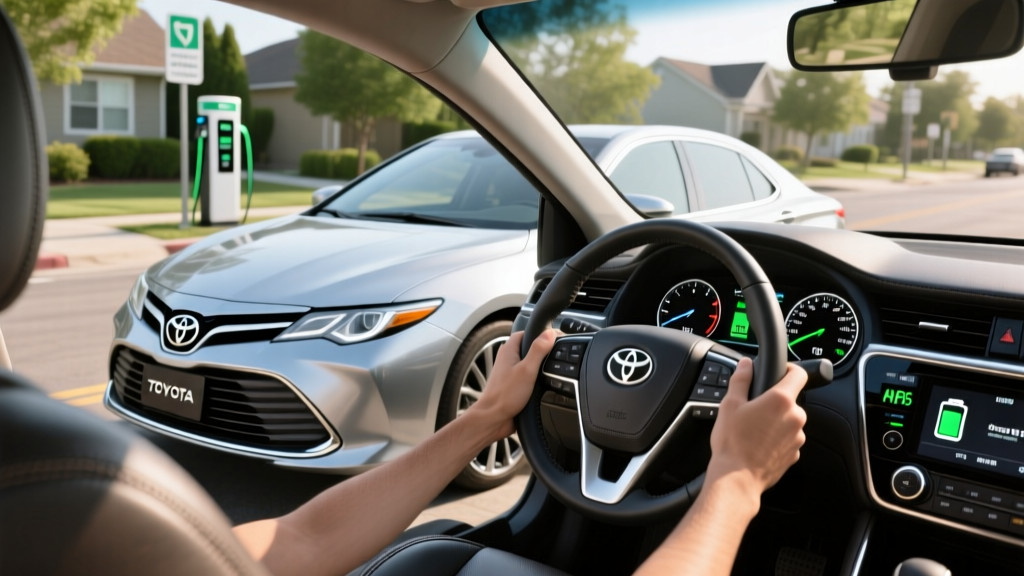
Conventional Hybrid (HEV) — The 2015 Camry Hybrid SE is a conventional hybrid, also called a self-charging hybrid or HEV. It does not plug into any external power source. The 1.6 kWh NiMH battery recharges exclusively through regenerative braking and the gasoline engine. You fuel it like any other car — at a gas station — and the hybrid system automatically manages the blend of electric and gasoline power to maximize efficiency.
Plug-In Hybrid (PHEV) — A PHEV (like the Toyota Prius Prime or RAV4 Prime) has a larger battery (typically 13–22 kWh), can be plugged into a wall outlet or charger, and offers 25–45 miles of electric-only driving before the gas engine kicks in. The 2015 Camry Hybrid SE has no electric-only range in the traditional sense — it can creep short distances at low speed on electric power alone, but the engine engages almost immediately under any meaningful acceleration.
This distinction matters for buyers cross-shopping electrified vehicles. If you want plug-in capability and electric-only commuting, the Camry Hybrid SE won't deliver that. If you want zero lifestyle change — no charging cables, no range planning, just better fuel economy from a standard gas station fill-up — this HEV design is exactly the point.
Fuel Economy: EPA Ratings and Real-World MPG
| Driving Condition | EPA Estimate |
|---|---|
| City | 40 MPG |
| Highway | 38 MPG |
| Combined | 40 MPG |
The SE trim's EPA ratings match the LE and XLE trims for the 2015 model year, as confirmed by fueleconomy.gov. The sport-tuned suspension and 17-inch wheels don't impose a measurable efficiency penalty versus the other trims.
Real-World MPG: What Owners Actually See
Toyota's hybrid system excels in stop-and-go city driving, where regenerative braking frequently recharges the battery and the electric motor handles low-speed propulsion. Many owners report exceeding the 40 MPG city EPA estimate in moderate-temperature urban commuting — figures of 42–45 MPG are common on forums and fuel-tracking apps like Fuelly.
Highway driving tells a slightly different story. At sustained 70–80 mph speeds, the gasoline engine carries most of the load, and real-world highway MPG tends to settle around 35–38 MPG. Cold weather (below 35°F) further reduces efficiency because the engine runs more frequently to maintain cabin heat and battery temperature, potentially dropping combined MPG into the 33–36 MPG range during winter months.
For a driver covering 15,000 miles per year with a 60/40 city/highway split, expect roughly 38–40 MPG combined in real-world conditions — translating to about 375–395 gallons of fuel annually, or roughly $1,300–$1,500 in fuel costs at $3.50/gallon.
Powertrain Deep Dive: How the Hybrid Synergy Drive Works
The 2015 Camry Hybrid SE uses Toyota's second-generation Hybrid Synergy Drive for the Camry platform, pairing a 2.5-liter Atkinson-cycle inline-four (2AR-FXE) with a permanent-magnet synchronous electric motor through a planetary gearset eCVT. The combined system output is rated at 200 net horsepower.
The Atkinson-cycle engine sacrifices some low-end torque for greater thermal efficiency — it produces 156 hp and 156 lb-ft of torque. The electric motor fills the torque gap instantly, delivering 199 lb-ft from zero rpm. This combination gives the Camry Hybrid SE surprisingly responsive acceleration from a stop, even though the 7.6-second 0–60 mph time won't win any drag races.
The SE trim specifically adds paddle shifters that simulate six fixed "gear ratios" in the eCVT, providing a more engaged driving feel during spirited driving. The sport-tuned suspension uses stiffer spring rates and revised damping compared to the LE and XLE, reducing body roll in corners without making the ride harsh. It's a meaningful difference for enthusiasts, though the fundamental character remains a comfortable midsize sedan.
Hybrid Battery: Lifespan, Warranty, and Replacement Cost
Original Battery Warranty
When new, Toyota covered the 2015 Camry Hybrid's NiMH battery pack for 8 years / 100,000 miles in most states, and 10 years / 150,000 miles in California Air Resources Board (CARB) states (CA, CT, MA, ME, NJ, NY, OR, RI, VT, WA, and others that adopted CARB standards). Hybrid system components including the inverter, converter, and control modules received the same coverage.
As of 2026, even the most generous 10-year CARB warranty has expired on all 2015 models. Battery replacement and hybrid system repairs are the owner's responsibility unless an extended aftermarket warranty was purchased.
NiMH Battery Degradation and Real-World Longevity
The 1.6 kWh NiMH battery in the 2015 Camry Hybrid is deliberately small — Toyota's hybrid system keeps the battery operating in a narrow state-of-charge window (roughly 40%–80%) to minimize stress and extend lifespan. This "shallow cycling" strategy is why Toyota hybrid batteries routinely last 150,000–200,000+ miles before significant degradation occurs.
That said, at 10+ years old, age-related degradation is a factor regardless of mileage. NiMH chemistry slowly loses capacity over time even when not in use. Most 2015 Camry Hybrids still on the road show only modest efficiency loss — perhaps 1–3 MPG below original figures — but individual battery health varies based on climate (extreme heat accelerates degradation), driving patterns, and maintenance history.
Battery Replacement Cost
If the hybrid battery fails or degrades significantly, replacement options for the 2015 Camry Hybrid include:
- New OEM Toyota battery pack: $2,500–$3,500 for the part, plus $500–$800 in labor — total roughly $3,000–$4,300 at a dealership.
- Refurbished/remanufactured battery: $1,200–$2,000 installed from independent hybrid specialists. These use reconditioned NiMH cells and typically carry a 1–3 year warranty.
- Individual cell replacement: Some specialist shops can diagnose and replace only the failed cells within the pack for $500–$1,000, though this is a temporary fix if other cells are also aging.
For a used 2015 Camry Hybrid SE valued at $9,000–$14,500, a full OEM battery replacement represents a significant percentage of the car's value. Buyers should factor this potential cost into their purchase budget, especially for examples with 130,000+ miles.
Reliability and Common Issues
The 2015 Camry Hybrid benefits from Toyota's reputation for long-term reliability, and the Hybrid Synergy Drive is one of the most proven hybrid systems in the world — millions of units have been deployed across the Prius, Camry, Highlander, and RAV4 lineups since 1997.
According to NHTSA complaint data, the 2015 Camry Hybrid has a relatively low complaint volume for its class. The most commonly reported issues include:
- 12V auxiliary battery drain: The conventional 12V battery (separate from the hybrid traction battery) can die if the car sits for extended periods. This is common to all hybrids and is a $150–$250 replacement.
- Brake actuator assembly: Some Toyota hybrids from this era have experienced premature wear in the brake actuator, which manages the transition between regenerative and friction braking. Replacement costs $1,200–$1,800. Listen for unusual brake pedal feel or warning lights.
- Inverter coolant pump: The electric water pump that cools the hybrid inverter can fail, potentially triggering a "Check Hybrid System" warning. Replacement runs $400–$700.
- EGR (Exhaust Gas Recirculation) valve clogging: Carbon buildup in the EGR system can cause rough idle or reduced efficiency. A $200–$400 cleaning or replacement resolves this.
For used buyers, a pre-purchase inspection by a technician familiar with Toyota hybrid systems is strongly recommended. Ask specifically for a hybrid battery health check — many OBD-II scanners can read the battery's state-of-health (SoH) and individual cell voltage balance.
Tax Credits and Incentives: What Applies in 2026?
The 2015 Camry Hybrid SE does not qualify for the federal §30D Clean Vehicle Credit (up to $7,500). That credit applies only to new qualifying plug-in electric vehicles (BEVs and PHEVs) meeting battery sourcing, MSRP, and buyer income requirements. Conventional hybrids like the Camry Hybrid SE have never been eligible for §30D.
For used buyers, the §25E Used Clean Vehicle Credit (up to $4,000 or 30% of sale price, whichever is less) also requires the vehicle to be a qualifying plug-in vehicle — meaning BEVs and PHEVs only. The Camry Hybrid SE, as a conventional HEV, is excluded.
Some states or municipalities may offer minor incentives for efficient vehicles, but these are typically targeted at new plug-in purchases. Check your state's energy office or DMV for any local programs. For the 2015 Camry Hybrid SE as a used purchase, expect no federal or state tax credits.
Who Should Buy the 2015 Camry Hybrid SE — and Who Shouldn't
Pros
- Proven 40 MPG combined efficiency with zero charging infrastructure needed
- Sport-tuned suspension and paddle shifters add engagement uncommon in hybrids
- Toyota reliability and parts availability keep long-term ownership costs manageable
- Roomy midsize sedan with 15.4 cu-ft trunk and comfortable rear seating
- NiMH battery shallow-cycling design supports 150K–200K+ mile lifespan
- Low used-car pricing ($9K–$14.5K) with strong value retention
Cons
- Factory hybrid battery warranty expired — replacement is an out-of-pocket risk ($3K–$4.3K OEM)
- No electric-only driving range — purely a fuel-efficiency play, not an electrification experience
- NiMH battery chemistry is dated compared to modern lithium-ion hybrid packs
- Brake actuator and inverter coolant pump are known failure points at high mileage
- No federal or state tax credit eligibility as a used conventional hybrid
- eCVT drone under hard acceleration lacks the refinement of modern hybrid transmissions
Choose the 2015 Camry Hybrid SE If:
- You want maximum MPG with zero lifestyle change — no charging, no range planning, no home electrical upgrades.
- Your commute is city-heavy, where the hybrid system's regenerative braking maximizes efficiency.
- You want a reliable, affordable used sedan with low running costs and widely available parts.
- You appreciate the SE's sport-tuned suspension as a slight upgrade over the base LE hybrid.
Consider a PHEV or Full EV Instead If:
- You have home charging access and want electric-only commuting (consider a used Prius Prime, RAV4 Prime, or a BEV like the Chevy Bolt EV or Hyundai Ioniq 5).
- You want to qualify for federal tax credits — the §25E used credit applies to qualifying plug-in vehicles under $25,000.
- You want modern battery chemistry (lithium-ion) with better energy density and longer projected lifespan.
Frequently Asked Questions
How many MPG does the 2015 Camry Hybrid SE get?
The EPA rates the 2015 Camry Hybrid SE at 40 MPG city, 38 MPG highway, and 40 MPG combined. Real-world results typically match or slightly exceed EPA city figures (42–45 MPG) in moderate-temperature urban driving, while highway-heavy driving at 70+ mph tends to yield 35–38 MPG. Cold weather can drop combined efficiency to 33–36 MPG.
Does the 2015 Camry Hybrid SE plug in?
No. The 2015 Camry Hybrid SE is a conventional hybrid (HEV), not a plug-in hybrid (PHEV). It has no charging port and no meaningful electric-only range. The hybrid battery recharges through regenerative braking and the gasoline engine. You refuel it exclusively at a gas station.
How far can it drive on electric power alone?
Effectively zero miles in practical terms. The 1.6 kWh NiMH battery can propel the car at very low speeds (under ~25 mph) for short distances (a few hundred feet) in stop-and-go traffic, but the gasoline engine engages almost immediately under any real acceleration or at higher speeds. This is normal for conventional hybrids — the electric motor assists the engine rather than replacing it.
Is the hybrid battery reliable, and what does replacement cost?
Toyota's NiMH hybrid batteries are among the most durable in the industry, routinely lasting 150,000–200,000+ miles thanks to shallow-cycling battery management. At 10+ years old, age-related degradation is the primary concern. A new OEM replacement costs $3,000–$4,300 installed; refurbished packs run $1,200–$2,000. A pre-purchase hybrid battery health check is strongly recommended for any used example.
Does the 2015 Camry Hybrid SE qualify for any tax credit?
No. The federal §30D new vehicle credit and §25E used vehicle credit both require a qualifying plug-in electric vehicle (BEV or PHEV). The Camry Hybrid SE is a conventional hybrid and does not qualify for federal EV tax credits. Some states may offer minor efficiency incentives, but these are uncommon for used conventional hybrids.
How does the SE trim differ from the LE and XLE Camry Hybrids?
The SE adds sport-tuned suspension, paddle shifters, unique 17-inch alloy wheels, a rear spoiler, and sport front seats. Mechanically, the hybrid powertrain is identical across all trims — 200 hp combined, 40 MPG EPA. The XLE adds luxury features (leather, premium audio, navigation) that the SE lacks. The LE is the base value-oriented trim.
Should I buy a used 2015 Camry Hybrid SE or a newer hybrid?
If budget is the primary constraint, the 2015 Camry Hybrid SE offers strong value at $9,000–$14,500 with proven efficiency and reliability. However, a newer hybrid (2020+ Camry Hybrid, for example) will have a lithium-ion battery with better longevity prospects, updated safety tech (Toyota Safety Sense), and potentially remaining factory warranty — at a higher price ($20,000–$28,000 used). The decision comes down to budget tolerance for the battery replacement risk on the older car.