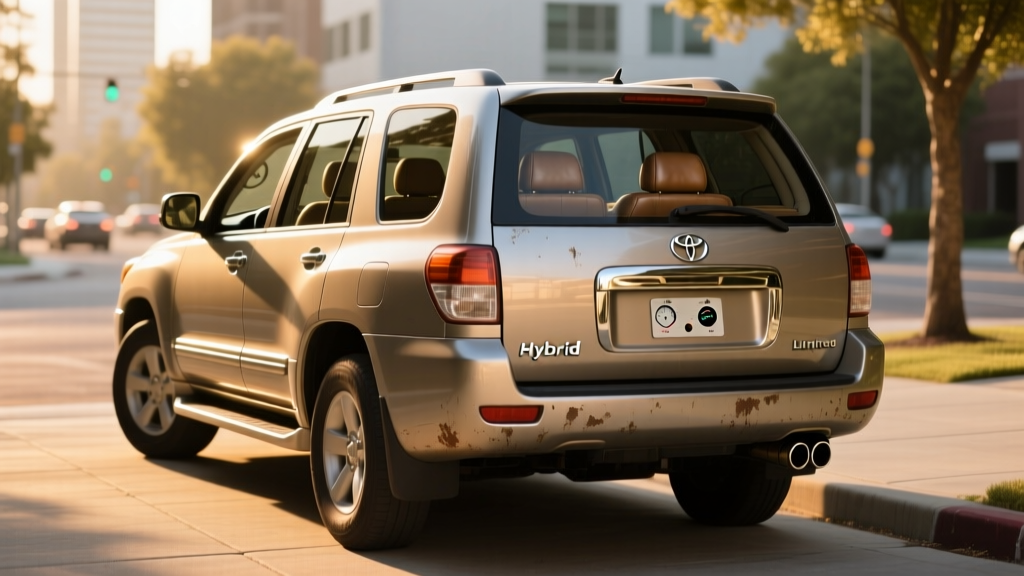
The 2008 Toyota Highlander Hybrid Limited 4WD occupies a specific niche in the used-vehicle market: a three-row, all-wheel-drive midsize SUV that delivers meaningfully better fuel economy than its gas-only counterparts without requiring a plug, a charging routine, or any change in driving habits. Nearly two decades after its debut, it remains one of the most durable hybrid powertrains Toyota ever built — and a compelling budget option for buyers who want hybrid efficiency without EV range anxiety or home-charging infrastructure.
This guide covers everything a 2026 buyer needs to know: real EPA fuel economy figures, how the hybrid system actually works, what to expect from the high-voltage battery at this age, replacement costs, and whether this SUV still makes sense against modern hybrids, PHEVs, and full EVs.
Fuel Economy: EPA Ratings vs. Real-World MPG
The 2008 Highlander Hybrid pairs a 3.3-liter V6 with Toyota's Hybrid Synergy Drive system and an electronically controlled CVT. The EPA rated it at the following figures, which remain on record at fueleconomy.gov:
| Metric | Value |
|---|---|
| City MPG | 27 |
| Highway MPG | 25 |
| Combined MPG | 26 |
| Annual fuel cost (EPA est.) | ~$2,550 |
| Fuel type | Regular unleaded (87 octane) |
Compared to the gas-only 2008 Highlander V6 4WD (rated at 17 city / 23 highway / 19 combined), the hybrid delivers a 37% improvement in combined fuel economy — a substantial gap that translates to roughly $600–$900 in annual fuel savings at 2026 gas prices, depending on mileage and local fuel costs.
How the Hybrid System Works: HEV, Not PHEV
It is critical to understand that the 2008 Highlander Hybrid is a conventional hybrid electric vehicle (HEV), not a plug-in hybrid (PHEV). It has no charging port. You cannot plug it in. The high-voltage nickel-metal hydride (NiMH) battery charges exclusively through regenerative braking and the gasoline engine. This is the same architecture used in the Prius of that era — proven, simple, and maintenance-light.
| Feature | HEV (this vehicle) | PHEV (e.g., RAV4 Prime) | BEV (e.g., Tesla Model Y) |
|---|---|---|---|
| Plug-in charging | No | Yes (Level 1/2) | Yes (Level 1/2/DC) |
| Electric-only range | ~1 mile at low speed | 25–42 miles typical | 250–330+ miles |
| Battery size | ~1.9 kWh (NiMH) | 13–18 kWh (Li-ion) | 60–100+ kWh (Li-ion) |
| Fuel/energy source | Gasoline only | Gasoline + electricity | Electricity only |
| Federal tax credit | No | Up to $7,500 (new) | Up to $7,500 (new) |
| Home charging needed | No | Recommended | Essential |
The Highlander Hybrid's electric motors can propel the vehicle at very low speeds (parking lots, creeping in traffic) for brief distances — typically under one mile and below ~25 MPH. This is not usable electric-only range in the PHEV sense. Think of the electric motor as a torque-assist and efficiency-optimization layer, not a standalone propulsion system.
Powertrain Specs and Performance
| Specification | Value |
|---|---|
| Engine | 3.3L V6 (3MZ-FE) |
| Engine horsepower | 208 HP @ 5,600 RPM |
| Front electric motor | 123 kW (165 HP) |
| Rear electric motor | 50 kW (67 HP) |
| Net combined system output | 270 HP |
| Transmission | Electronically controlled CVT (eCVT) |
| Drivetrain | Electronic 4WD (e-Four, no mechanical link to rear) |
| 0–60 MPH | ~7.8 seconds (est.) |
| Towing capacity | 3,500 lbs |
| High-voltage battery | NiMH, ~1.9 kWh (nominal) |
The "4WD" in this vehicle is Toyota's e-Four system — there is no driveshaft connecting the engine to the rear wheels. Instead, a dedicated 50 kW rear electric motor engages when the system detects front-wheel slip or when additional traction is needed. This provides genuine all-weather capability but is not designed for serious off-road use. The e-Four system is seamless and requires no driver intervention.
The Limited trim added leather seats, a JBL audio system, heated front seats, a power liftgate, and Toyota's Smart Key system. In 2008, this was one of the most well-equipped hybrid SUVs available, with an original MSRP of approximately $42,000–$44,000 depending on options.
Hybrid Battery Lifespan, Reliability, and Replacement Cost
The 2008 Highlander Hybrid uses a nickel-metal hydride (NiMH) battery pack — the same chemistry Toyota deployed across millions of Prius, Camry Hybrid, and Highlander Hybrid vehicles from roughly 2004–2015. NiMH batteries are less energy-dense than modern lithium-ion packs, but they are remarkably tolerant of heat and deep cycling. Real-world data from owner communities and repair shops shows these packs commonly last 150,000–220,000 miles before significant capacity loss triggers a check-engine light or noticeable efficiency decline.
At 18 years old in 2026, most surviving 2008 Highlander Hybrids will have had their battery pack replaced at least once — or are candidates for replacement. Here is what that costs:
| Option | Cost Range | Warranty |
|---|---|---|
| New OEM Toyota pack (dealer) | $3,500–$5,000 | 3 yr / 36,000 mi |
| Remanufactured pack (specialist shop) | $1,800–$2,800 | 1–3 yr typical |
| Used/salvage pack | $800–$1,500 | 30–90 days typical |
| Individual module replacement (reconditioning) | $500–$1,200 | Varies; often 1 yr |
Individual module replacement (swapping only the degraded cells within the pack) has become a viable option offered by hybrid-specialist shops. It is less expensive but requires diagnostic expertise to identify weak modules. A full remanufactured pack from a reputable supplier like Green Bean Battery or Dorman is the most common choice for owners who plan to keep the vehicle another 3–5 years.
According to NHTSA records, the 2008 Highlander Hybrid has relatively few complaints for a vehicle of its age and production volume. The most commonly reported issues are age-related rather than hybrid-specific: worn suspension components, power window motor failures, and dashboard cracking — all shared with the non-hybrid Highlander.
Pricing in 2026: Used Market Values
As of early 2026, the 2008 Toyota Highlander Hybrid Limited 4WD trades on the used market in the following ranges, depending on mileage, condition, and battery health:
| Condition / Mileage | Typical Price Range |
|---|---|
| Under 120K mi, documented battery replacement | $8,500–$11,000 |
| 120K–160K mi, original or unknown battery | $5,500–$8,000 |
| 160K+ mi, high-mileage driver | $3,500–$5,500 |
The Limited trim commands a $1,000–$2,000 premium over the base Hybrid trim due to leather, JBL audio, and additional features. A documented recent battery replacement is the single biggest value-adder on these vehicles — it effectively resets the hybrid system's clock and removes the largest near-term maintenance risk.
Tax Credits and Incentives
The 2008 Toyota Highlander Hybrid does not qualify for the federal §30D new-vehicle EV tax credit, as that credit applies exclusively to plug-in electric vehicles (BEVs and PHEVs) meeting specific battery-sourcing and MSRP requirements under current IRS rules. Conventional hybrids (HEVs) are not eligible.
For used-vehicle buyers, the federal Used Clean Vehicle Credit (up to $4,000 or 30% of sale price, whichever is less) also applies only to plug-in vehicles — BEVs and PHEVs — not conventional hybrids. The 2008 Highlander Hybrid does not qualify.
Some states historically offered rebates for hybrid purchases, but most state-level hybrid incentive programs have sunset or shifted exclusively to plug-in vehicles. Check your state's current energy or environmental agency website for any remaining local incentives, but do not count on them for a conventional HEV purchase in 2026.
Who Should Buy This Hybrid — and Who Shouldn't
- You need three rows and AWD on a sub-$10K budget
- You cannot install a home charger (apartment, street parking)
- You want hybrid MPG without changing any habits
- You prioritize Toyota reliability and low repair frequency
- You drive primarily in city/suburban stop-and-go traffic
- You want electric-only driving or plug-in capability
- You want modern ADAS (this vehicle has no AEB, lane-keep, or adaptive cruise)
- You want Apple CarPlay / Android Auto (not available in 2008)
- You need the latest infotainment or over-the-air updates
- You qualify for the $7,500 federal EV credit and want to maximize incentives
If you can charge at home and have a higher budget, a modern PHEV like the Toyota RAV4 Prime (42 miles electric-only, 38 MPG combined after battery depletion) or a full EV like the Hyundai Ioniq 5 (300+ miles range) will deliver dramatically lower operating costs and far more current technology. But if your budget is firm at $5,000–$10,000 and you need a three-row AWD SUV that sips fuel without any charging logistics, the 2008 Highlander Hybrid Limited remains one of the most rational choices available.
Frequently Asked Questions
How many MPG does the 2008 Toyota Highlander Hybrid get?
The EPA rates it at 27 city / 25 highway / 26 combined MPG. Real-world city driving often yields 28–30 MPG in moderate climates, while sustained highway driving at 70+ MPH typically returns 23–25 MPG.
Can you plug in the 2008 Highlander Hybrid to charge?
No. This is a conventional hybrid (HEV), not a plug-in hybrid (PHEV). It has no charging port. The battery charges through regenerative braking and the gasoline engine only.
How far can it drive on electric power alone?
Less than one mile, and only at very low speeds (under ~25 MPH), such as in a parking lot. It does not offer usable electric-only range like a PHEV.
Is the 2008 Highlander Hybrid reliable?
Yes. The 3.3L V6 and Hybrid Synergy Drive system are among Toyota's most proven powertrains. The main age-related concern is the NiMH hybrid battery, which typically lasts 150,000–220,000 miles before needing replacement at a cost of $1,800–$5,000 depending on the option chosen.
Does it qualify for any federal tax credit?
No. The federal §30D credit and the used clean vehicle credit both require a plug-in vehicle (BEV or PHEV). Conventional hybrids are not eligible for federal purchase incentives as of 2026.
How does the e-Four 4WD system work?
The rear wheels are driven exclusively by a 50 kW electric motor — there is no mechanical driveshaft from the engine. The system engages the rear motor automatically when front-wheel slip is detected or when extra traction is needed. It provides effective all-weather grip but is not intended for off-road use.
What should I check before buying a used 2008 Highlander Hybrid?
Prioritize: (1) hybrid battery health — ask for a recent health report or budget for replacement, (2) maintenance records, especially transmission fluid and coolant changes, (3) suspension condition at higher mileage, and (4) any outstanding recalls verified through the VIN at nhtsa.gov/recalls.