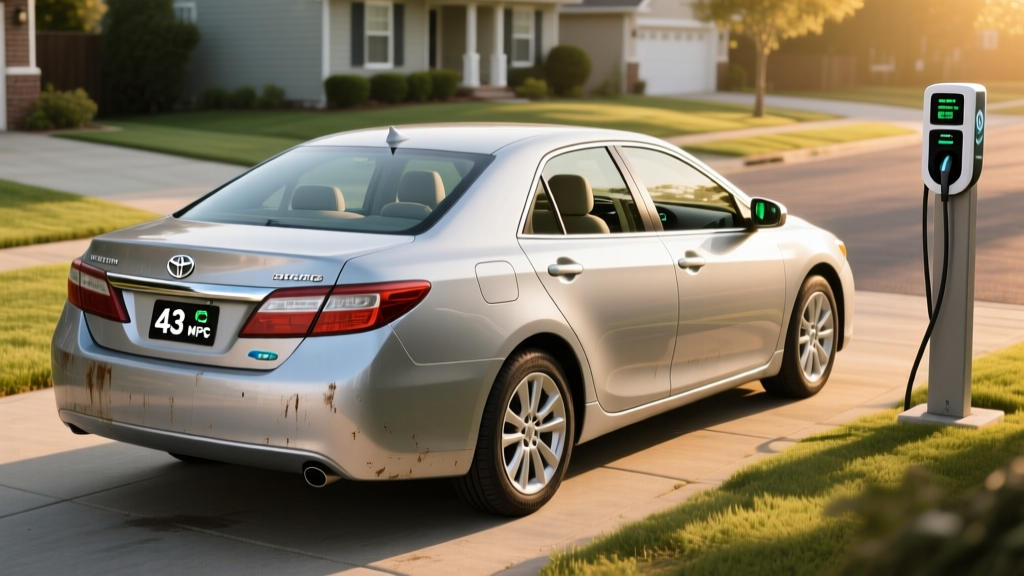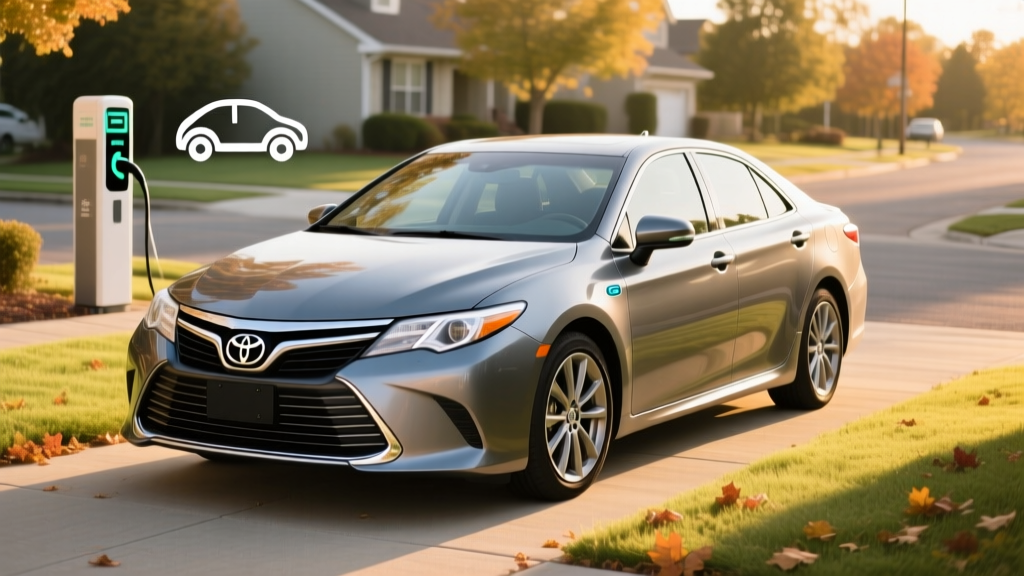
If you are shopping the used midsize sedan market in 2026 and searching for camry 2014 hybrid mpg data, you are likely weighing a well-proven hybrid against newer plug-in hybrids and full battery-electric vehicles. The 2014 Toyota Camry Hybrid remains one of the most dependable, fuel-efficient sedans ever sold in the US — and more than a decade later, its numbers still hold up against far more expensive alternatives.
This guide covers everything a used-car buyer needs: EPA and real-world MPG, the conventional hybrid powertrain (no plug required), battery longevity and replacement cost, and how the 2014 Camry Hybrid stacks up against a modern PHEV or BEV for your daily commute.
EPA and Real-World MPG: What to Actually Expect
The 2014 Camry Hybrid is a conventional hybrid electric vehicle (HEV). It cannot be plugged in. It recharges its small battery pack entirely through regenerative braking and the gasoline engine. That simplicity is a major selling point for buyers without access to home charging.
| Metric | Value |
|---|---|
| City MPG | 41 |
| Highway MPG | 38 |
| Combined MPG | 40 |
| Fuel Tank Capacity | 17.0 gallons |
| EPA Estimated Total Range | ~680 miles |
| Regular Gasoline (87 octane) | Required |
Source: fueleconomy.gov — 2014 Toyota Camry Hybrid
Hybrids like the 2014 Camry often exceed their EPA city rating in stop-and-go driving because regenerative braking recovers energy that a gas car wastes as heat. Owner-reported data on fueleconomy.gov shows many drivers averaging 42–45 MPG in city-heavy commuting. Highway-only driving at 75+ mph tends to drop to 35–37 MPG, as the electric motor contributes less at sustained high speed. In cold climates (below 30°F), expect a 5–10% reduction due to engine warm-up cycles and cabin heating load.
Powertrain Specs: Engine, Motor, and Combined Output
The 2014 Camry Hybrid uses Toyota's well-proven Hybrid Synergy Drive system — the same architecture refined across multiple Prius generations. It pairs a naturally aspirated four-cylinder with an electric motor through a planetary gearset (eCVT).
| Component | Specification |
|---|---|
| Engine | 2.5L inline-4 Atkinson cycle |
| Engine Power | 156 hp @ 5,700 rpm |
| Electric Motor | Permanent-magnet synchronous (105 kW / 141 hp) |
| Net Combined Horsepower | 200 hp |
| Transmission | eCVT (planetary gearset) |
| Drivetrain | Front-wheel drive |
| 0–60 mph | ~7.6 seconds |
| Hybrid Battery | 1.6 kWh NiMH (nickel-metal hydride) |
| Curb Weight | ~3,435 lbs |
At 200 combined horsepower, the 2014 Camry Hybrid is not slow. It merges onto highways confidently and passes without strain. The eCVT is seamless — there are no gear shifts to feel, just linear acceleration. The trade-off is that the engine drones under hard acceleration, a characteristic of the Atkinson cycle and planetary gearset design.
HEV vs. PHEV vs. BEV: Which Powertrain Fits You?
Since you are researching a 2014 Camry Hybrid, you are looking at a conventional hybrid. But it is worth understanding where HEVs, PHEVs, and BEVs sit on the electrification spectrum so you can confirm this is the right choice.
| Feature | HEV (e.g., 2014 Camry Hybrid) | PHEV (e.g., 2026 RAV4 Prime) | BEV (e.g., 2026 Tesla Model 3) |
|---|---|---|---|
| Plug-in Charging | No — self-charging | Yes — Level 1/2 | Yes — Level 1/2/DC fast |
| Electric-Only Range | ~1 mile at low speed | 35–42 miles typical | 250–360+ miles (full battery) |
| Gasoline Engine | Yes (primary + assist) | Yes (backup + highway) | No |
| Fuel Cost per Mile | ~$0.08 (at $3.20/gal, 40 MPG) | ~$0.04 electric / ~$0.09 gas | ~$0.04 (at $0.14/kWh) |
| Home Charging Needed | No | Strongly recommended | Essential |
| Tailpipe Emissions | Low | Low to zero (electric mode) | Zero |
| Federal Tax Credit (§30D) | Not eligible | Up to $7,500 (if eligible) | Up to $7,500 (if eligible) |
- You rent or live in an apartment without charging access
- Your budget is under $12,000 (typical used pricing in 2026)
- You want maximum simplicity — no plug, no range planning, no charging apps
- Your commute is city-heavy, where hybrid MPG shines
- You have access to Level 2 home charging
- You want electric-only commuting (zero gas for short trips)
- You want to qualify for federal or state EV tax credits on a new purchase
Hybrid Battery Longevity and Replacement Cost
Battery lifespan is the single biggest concern for used hybrid buyers. The 2014 Camry Hybrid uses a nickel-metal hydride (NiMH) battery pack rated at 1.6 kWh. Unlike modern BEV batteries, this pack is small, relatively simple, and inexpensive to replace.
Toyota warranted the 2014 Camry Hybrid battery for 8 years / 100,000 miles in most states, and 10 years / 150,000 miles in California Air Resources Board (CARB) states (CA, CT, ME, MA, NJ, NY, OR, RI, VT, WA, and others that adopted CARB standards). By 2026, most original warranties have expired unless the vehicle was very low-mileage.
How Long Do Camry Hybrid Batteries Last?
NiMH batteries in Toyota hybrids have an exceptional track record. Data from fleet operators, taxi services, and long-term owner surveys consistently show these packs lasting 150,000 to 200,000+ miles before significant degradation. Many 2014 Camry Hybrids still running on their original battery pack in 2026 have crossed 180,000 miles without a replacement.
The key factors that shorten NiMH hybrid battery life are:
- Extreme heat: Sustained operation in 100°F+ climates accelerates cell degradation
- Prolonged storage at low charge: Letting the car sit unused for months can damage cells
- High mileage without maintenance: Cooling fan blockage (dust/debris) causes overheating
Battery Replacement Cost in 2026
| Option | Cost Range | Warranty |
|---|---|---|
| New OEM Toyota battery | $2,500–$3,500 (installed) | 3 years / unlimited miles |
| Remanufactured battery | $1,200–$2,000 (installed) | 1–3 years depending on supplier |
| Used/salvage battery | $500–$900 (installed) | 30–90 days typical |
| Individual cell reconditioning | $300–$600 (specialist shop) | Varies |
Compared to a BEV battery replacement ($10,000–$20,000+), the Camry Hybrid's NiMH pack is remarkably affordable. A remanufactured replacement at $1,500 installed is routine work at any Toyota dealer or independent hybrid specialist.
Pricing and Tax Credit Eligibility in 2026
The 2014 Toyota Camry Hybrid originally started at an MSRP of $26,380 (LE trim) and $27,700 (XLE trim), including destination. In the 2026 used market, expect to pay:
- $8,000–$10,000 for a high-mileage example (150,000+ miles, fair condition)
- $10,000–$13,000 for a well-maintained example (80,000–120,000 miles, good condition)
- $13,000–$16,000 for a low-mileage, excellent-condition XLE or LE with service records
Federal Tax Credits
The 2014 Camry Hybrid is a conventional HEV — it does not qualify for the IRS §30D federal tax credit. That credit applies only to plug-in electric vehicles (BEVs and PHEVs) that meet battery sourcing, MSRP cap, and buyer income requirements. Used hybrids of any type are ineligible for the used-EV credit (§25E) as well, since that credit also requires a plug-in powertrain.
Some states offer minimal incentives for used hybrid purchases, but these are uncommon and typically small ($250–$500 rebates). Check your state's energy office or department of environmental quality for current programs. For federal rules, see the IRS clean vehicle credits page.
Reliability, Safety, and Ownership Costs
The 2014 Camry Hybrid benefits from Toyota's reputation for durability and one of the simplest hybrid systems on the road. The eCVT has no belts, clutches, or friction bands to wear out — it is a gearset that is essentially bulletproof. The 2.5L Atkinson-cycle engine is under-stressed and routinely exceeds 200,000 miles with basic oil changes.
Safety Ratings
The 2014 Camry earned strong marks in crash testing:
- NHTSA: 5-Star Overall Safety Rating
- IIHS: Good ratings in most crash tests (note: the 2014 model predates the small-overfront test update, so check specific IIHS results for the 2014 model year)
Standard safety equipment includes 10 airbags, stability control, anti-lock brakes, and tire-pressure monitoring. The 2014 model does not include Toyota Safety Sense (TSS) — that suite of pre-collision braking, lane departure alert, and adaptive cruise control became standard on the Camry starting with the 2018 model year.
Estimated Annual Ownership Costs
| Category | Estimated Cost |
|---|---|
| Fuel (12,000 mi/yr @ 40 MPG, $3.20/gal) | $960/year |
| Insurance (national average) | $1,100–$1,500/year |
| Maintenance (oil, filters, brakes, tires) | $400–$600/year |
| Registration / taxes | $100–$300/year (varies by state) |
| Total estimated annual operating cost | $2,560–$3,360 |
For comparison, a 2014 gas-only Camry (2.5L, EPA 25/35/28 combined MPG) would cost approximately $1,370/year in fuel — a $410 annual premium over the hybrid. Over five years of ownership, the hybrid saves roughly $2,050 in fuel alone, easily offsetting any used-price premium over the gas model.
- 40 MPG combined (41 city) — excellent real-world economy
- No plug-in charging required — works for any living situation
- Proven 200 hp powertrain with 200,000+ mile longevity
- Affordable battery replacement ($1,200–$3,500)
- Smooth, quiet ride quality
- Strong resale value for a 12-year-old vehicle
- No modern ADAS (no automatic emergency braking, no lane-keeping)
- Original hybrid battery warranty likely expired
- Infotainment is dated (no Apple CarPlay / Android Auto without aftermarket head unit)
- NiMH battery is less energy-dense than modern lithium-ion
- No EV tax credit eligibility
- Highway MPG drops to 35–37 at 75+ mph
Pre-Purchase Checklist for a Used 2014 Camry Hybrid
Before buying, verify these items specific to the hybrid system:
- Hybrid battery health check: Ask a Toyota dealer to run a hybrid battery diagnostic. This shows individual module voltages and identifies weak cells. A healthy pack shows module voltages within 0.2V of each other.
- Hybrid system warning lights: Start the car and confirm no "Check Hybrid System" messages appear on the multi-information display.
- Regenerative braking feel: During a test drive, braking should feel progressive. A grinding or pulsing sensation may indicate the regen system blending poorly with friction brakes — often a sign of battery weakness.
- Hybrid battery cooling fan: Located behind the rear seat on the passenger side. Listen for it running (a soft hum). A blocked or failed fan will overheat the battery.
- Inverter coolant: Check that the pink Toyota Super Long Life Coolant is at the proper level in the inverter reservoir (under the hood, separate from the engine coolant).
- 12V auxiliary battery: The 2014 Camry Hybrid also has a conventional 12V battery (in the trunk). If the car won't start or shows electrical gremlins, this is often the culprit — not the hybrid battery.
Frequently Asked Questions
How many MPG does the 2014 Camry Hybrid get?
The EPA rates the 2014 Camry Hybrid at 41 city / 38 highway / 40 combined MPG. Real-world city driving often yields 42–45 MPG thanks to regenerative braking. Highway driving above 70 mph typically returns 35–37 MPG. Cold weather can reduce fuel economy by 5–10%.
Does the 2014 Camry Hybrid need to be plugged in?
No. The 2014 Camry Hybrid is a conventional HEV. It charges its battery entirely through regenerative braking and the gasoline engine. There is no plug, no charging cable, and no need for a home charger.
How far can the 2014 Camry Hybrid drive on electric power alone?
Essentially zero meaningful electric-only distance. The 1.6 kWh NiMH battery allows very low-speed electric crawling (under 25 mph, for about a mile at most in ideal conditions). This is normal for conventional hybrids — the electric motor assists the gas engine rather than replacing it.
Is the 2014 Camry Hybrid reliable, and what does a battery replacement cost?
Yes. The 2014 Camry Hybrid is among the most reliable midsize sedans ever built. The hybrid battery typically lasts 150,000–200,000 miles. Replacement costs range from $500 (used/salvage) to $3,500 (new OEM installed), with remanufactured options at $1,200–$2,000. The eCVT transmission is virtually maintenance-free.
Does the 2014 Camry Hybrid qualify for any federal tax credit?
No. The IRS §30D clean vehicle credit and the §25E used-EV credit both require a plug-in vehicle (BEV or PHEV). The 2014 Camry Hybrid is a conventional HEV and is not eligible for any federal tax credit. Check your state energy office for any local hybrid incentives, though these are rare in 2026.
How does the 2014 Camry Hybrid compare to a modern PHEV?
A 2026 PHEV like the Toyota RAV4 Prime offers 42 miles of electric-only range, 38 MPG after the battery depletes, and eligibility for up to $7,500 in federal tax credits (if income and sourcing requirements are met). However, a RAV4 Prime starts above $45,000 new. The 2014 Camry Hybrid at $10,000–$13,000 used delivers comparable or better city MPG for a fraction of the cost — with no charging infrastructure needed.
What is the total range on a full tank?
With a 17.0-gallon fuel tank and a 40 MPG combined rating, the 2014 Camry Hybrid can travel approximately 680 miles between fill-ups. Conservative highway driving may reduce this to 600–630 miles; city-heavy driving can push it past 700 miles.