The 2024 Honda Hybrid Lineup at a Glance
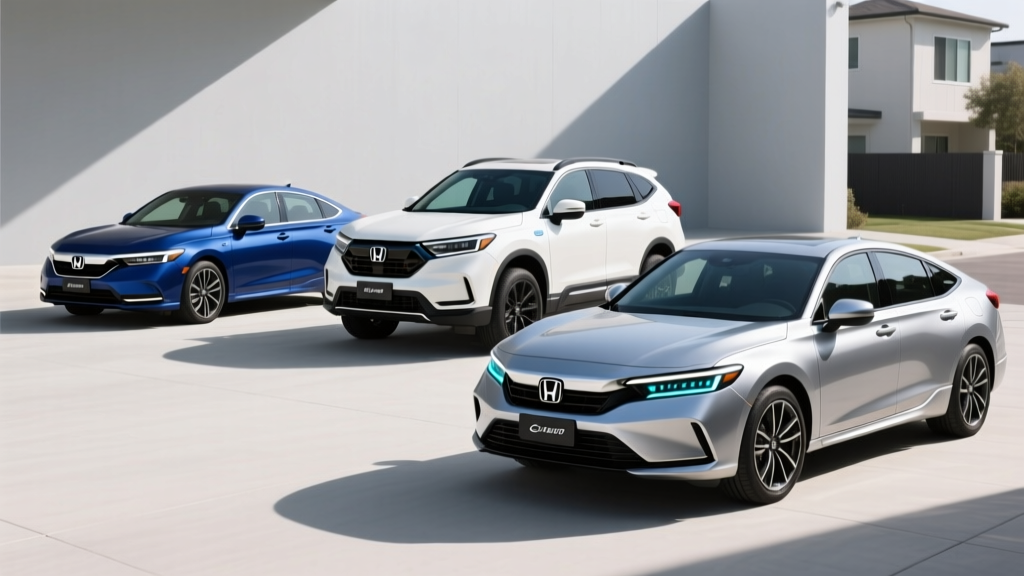
Honda's 2024 hybrid strategy centers on two high-volume models: the Accord Hybrid sedan and the CR-V Hybrid compact SUV. Both use Honda's two-motor hybrid system — a conventional hybrid (HEV) architecture that requires no plug-in charging. For buyers searching for a 2024 Honda hybrid, these two models cover the bulk of the lineup, though understanding the difference between Honda's HEV and any remaining plug-in hybrid (PHEV) offerings is essential before you sign a purchase agreement.
HEV vs PHEV: What Honda Offers in 2024
Conventional Hybrid (HEV): The Accord Hybrid and CR-V Hybrid are self-charging hybrids. A small battery (typically 1.0–1.3 kWh) captures energy from regenerative braking and the gasoline engine. You never plug in. The electric motor assists the engine and can drive the wheels alone at low speeds, boosting city MPG significantly.
Plug-in Hybrid (PHEV): Honda's Clarity Plug-in Hybrid was discontinued after the 2021 model year. As of 2024, Honda does not offer a new PHEV in the U.S. market. If plug-in capability with electric-only range is a priority, you'll need to look at competitors like the Toyota RAV4 Prime or Hyundai Tucson PHEV — or consider a full BEV.
Fuel Economy: EPA MPG for Every 2024 Honda Hybrid
The headline number for any hybrid buyer is fuel economy. Here's the EPA-rated breakdown for the 2024 Honda hybrid models, sourced from fueleconomy.gov:
| Model | City MPG | Highway MPG | Combined MPG | Powertrain |
|---|---|---|---|---|
| 2024 Accord Hybrid (Sport/L) | 51 | 44 | 48 | 2.0L 4-cyl + 2-motor hybrid |
| 2024 Accord Hybrid (EX-L/Sport-L/Touring) | 50 | 45 | 48 | 2.0L 4-cyl + 2-motor hybrid |
| 2024 CR-V Hybrid (Sport/Sport Touring AWD) | 40 | 34 | 37 | 2.0L 4-cyl + 2-motor hybrid |
| 2024 CR-V Hybrid (Sport FWD) | 43 | 36 | 40 | 2.0L 4-cyl + 2-motor hybrid |
Real-World MPG vs EPA Sticker
Honda's two-motor hybrid system excels in city driving, where the electric motor handles most low-speed propulsion and the engine acts primarily as a generator. In real-world testing, the Accord Hybrid frequently exceeds its EPA city rating — owners regularly report 52–55 MPG in stop-and-go urban commuting. Highway driving is a different story: at sustained 70–80 mph speeds, expect the Accord Hybrid to deliver 40–43 MPG, slightly below the EPA highway estimate. Aerodynamic drag at higher speeds forces the gasoline engine to do more direct work.
The CR-V Hybrid follows the same pattern. FWD models can hit 42–44 MPG in city driving, while AWD variants lose roughly 2–3 MPG due to drivetrain losses. On the highway, expect 32–35 MPG in real-world conditions. Cold weather (below 40°F) reduces hybrid efficiency by 5–10% across the board, as the engine runs more frequently to provide cabin heat and maintain battery temperature.
Powertrain Specs: Horsepower and How the System Works
| Specification | 2024 Accord Hybrid | 2024 CR-V Hybrid |
|---|---|---|
| Engine | 2.0L DOHC 4-cylinder (Atkinson cycle) | 2.0L DOHC 4-cylinder (Atkinson cycle) |
| Engine HP | 146 hp | 146 hp |
| Electric Motor HP | 181 hp (drive motor) | 181 hp (drive motor) |
| Combined System HP | 204 hp | 204 hp |
| Combined Torque | 247 lb-ft | 247 lb-ft |
| Hybrid Battery Capacity | ~1.3 kWh (lithium-ion) | ~1.3 kWh (lithium-ion) |
| Transmission | e-CVT (direct drive with lock-up clutch) | e-CVT (direct drive with lock-up clutch) |
| 0-60 mph (est.) | ~7.2 seconds | ~7.8 seconds |
| Drivetrain | FWD | FWD or AWD |
Honda's hybrid system operates in three modes. In EV Drive, the battery powers the electric motor alone — typically at low speeds and light loads for short distances (roughly 1–2 miles). In Hybrid Drive, the gasoline engine spins a generator motor to produce electricity that feeds the drive motor; the engine is not mechanically connected to the wheels. In Engine Drive, a lock-up clutch engages at highway cruising speeds, connecting the engine directly to the wheels for maximum efficiency. This architecture means the electric motor provides the primary driving force in most conditions, giving Honda hybrids a smooth, EV-like feel around town.
Pricing and Tax Credit Eligibility
Here's the 2024 MSRP breakdown for Honda's hybrid models:
| Model / Trim | MSRP (incl. destination) |
|---|---|
| Accord Hybrid Sport | $33,990 |
| Accord Hybrid EX-L | $35,635 |
| Accord Hybrid Sport-L | $36,385 |
| Accord Hybrid Touring | $40,690 |
| CR-V Hybrid Sport (FWD) | $35,950 |
| CR-V Hybrid Sport (AWD) | $37,450 |
| CR-V Hybrid Sport Touring (AWD) | $41,295 |
Does the 2024 Honda Hybrid Qualify for a Federal Tax Credit?
No. The 2024 Accord Hybrid and CR-V Hybrid are conventional hybrids (HEVs), not plug-in electric vehicles. The federal §30D Clean Vehicle Credit applies only to battery electric vehicles (BEVs) and plug-in hybrids (PHEVs) with a battery capacity of at least 7 kWh. Honda's hybrid battery at ~1.3 kWh falls far short of this threshold. There is no federal tax credit for conventional hybrids.
Some states and local utilities offer rebates or incentives for hybrid purchases, but these vary widely by jurisdiction. Check your state's energy office or utility provider for current programs. A tax professional can confirm any applicable credits.
Battery Warranty, Reliability, and Replacement Costs
Honda Hybrid Battery Warranty
Honda covers the hybrid battery (referred to as the IMA — Integrated Motor Assist — battery or hybrid system battery) under its powertrain warranty:
- Standard coverage: 8 years / 100,000 miles (whichever comes first)
- CARB-state coverage: 10 years / 150,000 miles in states that follow California Air Resources Board emissions regulations (includes CA, CT, CO, ME, MA, NJ, NY, OR, RI, VT, WA, and others adopting CARB standards)
This warranty covers defects and capacity loss that causes the battery to fail to function normally. It does not cover gradual, normal capacity degradation that doesn't result in a malfunction.
Real-World Reliability
Honda's two-motor hybrid system has been in production since the 2014 Accord Hybrid, giving it a decade-long track record. The lithium-ion hybrid battery is significantly smaller than a full EV battery, which works in its favor: smaller batteries experience less thermal stress and fewer deep discharge cycles. Industry data and owner reports suggest Honda hybrid batteries routinely last 150,000–200,000+ miles before requiring replacement. The system's simplicity — no traditional transmission, fewer moving parts than a conventional powertrain — contributes to lower long-term maintenance costs.
Battery Replacement Cost
If the hybrid battery does fail outside of warranty, replacement costs for a 2024 Accord or CR-V Hybrid are estimated at $2,000–$4,000 (parts and labor) based on current Honda hybrid battery pricing. This is substantially less than a full EV battery replacement ($10,000–$20,000+) because the hybrid battery pack is small (~1.3 kWh). Refurbished or aftermarket battery options may reduce this cost further.
2024 Honda Hybrid vs Competitors
The Accord Hybrid competes directly with the Toyota Camry Hybrid (52 MPG combined, ~$29,995 starting) and the Hyundai Sonata Hybrid (47 MPG combined, ~$30,250). The Accord Hybrid's 48 MPG combined is competitive, and its 204 hp gives it a performance edge over the Sonata Hybrid while trailing the Camry Hybrid by a few MPG.
The CR-V Hybrid faces the Toyota RAV4 Hybrid (41 MPG combined AWD, ~$32,325) and the Ford Escape Hybrid (39 MPG combined FWD). The RAV4 Hybrid holds a slight MPG advantage in AWD configurations, while the CR-V Hybrid offers a more refined interior and Honda's strong safety suite as standard equipment.
Pros
- Accord Hybrid achieves up to 51 city MPG — among the best in its class
- Smooth, EV-like driving feel at low speeds thanks to electric-motor-dominant architecture
- 204 combined HP provides confident acceleration for a hybrid
- Honda Sensing safety suite standard on all trims
- No plug-in charging required — no range anxiety, no charging infrastructure needed
- Strong 8yr/100k-mile hybrid battery warranty (10yr/150k in CARB states)
Cons
- No PHEV option in Honda's 2024 lineup — no electric-only range for short commutes
- Highway MPG drops below EPA estimates at sustained 75+ mph speeds
- Hybrid trims carry a ~$1,500–$2,000 premium over equivalent gas-only trims
- No federal tax credit available for conventional hybrids
- AWD only available on CR-V Hybrid (not Accord Hybrid)
- Cold-weather efficiency loss of 5–10% is typical but noticeable
Who Should Buy a 2024 Honda Hybrid — and Who Shouldn't?
Choose the 2024 Honda Hybrid If:
- You don't have home charging access. Conventional hybrids need zero infrastructure. If you live in an apartment or lack a garage, a Honda HEV delivers excellent efficiency without any lifestyle change.
- Your commute is city-heavy. The Accord Hybrid's 51 city MPG shines in stop-and-go traffic where the electric motor does most of the work.
- You want lower running costs without range anxiety. With a 12.8-gallon tank and 48 MPG, the Accord Hybrid delivers over 600 miles of total range.
- You plan to own the car 8–10 years. Honda's hybrid reliability record and strong warranty make long-term ownership economical.
Choose a PHEV or Full EV Instead If:
- You have home Level 2 charging and a short commute. A PHEV like the Toyota RAV4 Prime (42 miles electric-only) or a BEV like the Hyundai Ioniq 5 lets you commute on electricity alone, eliminating gasoline use for daily driving.
- You want federal tax credits. BEVs and qualifying PHEVs may be eligible for up to $7,500 under §30D, subject to MSRP caps, buyer income limits, and battery-sourcing requirements. Conventional hybrids get nothing.
- You want to minimize tailpipe emissions. A BEV produces zero tailpipe emissions. A PHEV can operate emission-free for 25–45 miles before the engine engages.
Frequently Asked Questions
How many MPG does the 2024 Honda Accord Hybrid get?
The 2024 Accord Hybrid achieves an EPA-rated 51 city / 44 highway / 48 combined MPG on Sport and L trims, and 50 city / 45 highway / 48 combined on EX-L, Sport-L, and Touring trims. In real-world city driving, owners frequently report 52–55 MPG. Highway driving at 75+ mph typically yields 40–43 MPG.
How many MPG does the 2024 Honda CR-V Hybrid get?
The FWD CR-V Hybrid Sport achieves 43 city / 36 highway / 40 combined MPG. The AWD Sport drops to 40 city / 34 highway / 37 combined. Real-world city driving often exceeds EPA estimates by 2–4 MPG; highway driving at sustained high speeds may fall 2–3 MPG short.
Does the 2024 Honda hybrid need to be plugged in?
No. Both the Accord Hybrid and CR-V Hybrid are conventional hybrids (HEVs). The battery recharges through regenerative braking and the gasoline engine. You simply fill up with gasoline like any other car.
Does Honda offer a plug-in hybrid in 2024?
No. Honda discontinued the Clarity Plug-in Hybrid after the 2021 model year. As of 2024, Honda does not sell a PHEV in the United States. If electric-only range is a priority, consider the Toyota RAV4 Prime (42 mi EV range), Hyundai Tucson PHEV (33 mi), or a full BEV.
Is the 2024 Honda hybrid reliable?
Honda's two-motor hybrid system has been in production since 2014 and has a strong reliability track record. The hybrid battery is small (~1.3 kWh), reducing thermal stress. Owner data suggests batteries regularly last 150,000–200,000+ miles. The system is backed by an 8-year/100,000-mile warranty (10-year/150,000-mile in CARB states).
What does it cost to replace a Honda hybrid battery?
Out-of-warranty replacement for a Honda hybrid battery is estimated at $2,000–$4,000 (parts and labor). This is far less than EV battery replacement due to the small pack size. Refurbished options may cost less.
Does the 2024 Honda hybrid qualify for a tax credit?
No federal tax credit is available for conventional hybrids. The IRS §30D Clean Vehicle Credit applies only to BEVs and PHEVs with at least 7 kWh of battery capacity. Some state or utility incentives may apply — check local programs.
How does the 2024 Honda hybrid compare to a full EV?
A Honda hybrid offers lower upfront cost, no charging infrastructure requirement, and 400–600+ miles of total range. A full EV offers zero tailpipe emissions, lower per-mile fuel costs (electricity vs gasoline), eligibility for federal tax credits, and near-silent operation — but requires home or public charging access and carries a higher purchase price. The right choice depends on your charging access, commute pattern, and budget.