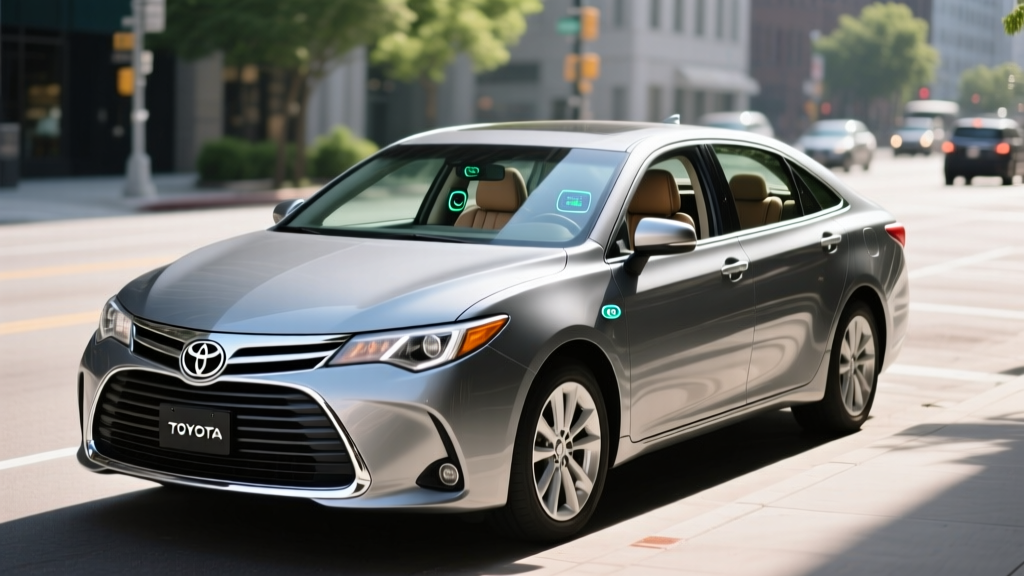
The 2013 Toyota Avalon Hybrid occupies a specific niche in the used-car market: a full-size, five-passenger sedan that sips fuel like a compact. More than a decade after its launch, this conventional hybrid (HEV) continues to attract buyers who want Toyota reliability, a spacious cabin, and fuel costs that undercut most modern gas-only midsize sedans. If you're researching a used 2013 Toyota Avalon Hybrid in 2026, this guide covers every number that matters — EPA MPG, real-world efficiency, battery health, replacement costs, and how it stacks up against newer hybrids, PHEVs, and full EVs.
HEV vs PHEV: What the 2013 Avalon Hybrid Actually Is
Before diving into specs, it's critical to understand what you're buying. The 2013 Avalon Hybrid is a conventional hybrid electric vehicle (HEV). It pairs a gasoline engine with a small electric motor and a compact nickel-metal hydride (NiMH) battery. It does not plug in. The battery recharges through regenerative braking and the gasoline engine. You fuel it at a gas station like any other car.
| Feature | HEV (e.g., 2013 Avalon Hybrid) | PHEV (e.g., Prius Prime) | BEV (e.g., Tesla Model 3) |
|---|---|---|---|
| Plugs in? | No | Yes | Yes |
| Electric-only range | None (motor assists engine) | 25–45 mi typical | 250–400 mi typical |
| Battery size | ~1.6 kWh (NiMH) | 8–18 kWh (Li-ion) | 50–100 kWh (Li-ion) |
| Fuel needed? | Yes (gasoline) | Yes (gasoline + electricity) | No (electricity only) |
| Federal tax credit | No | Up to $7,500 (§30D, new only) | Up to $7,500 (§30D, new only) |
This distinction matters because some shoppers confuse "hybrid" with "plug-in hybrid." The 2013 Avalon Hybrid has no charging port, no electric-only driving mode, and no eligibility for federal EV tax credits. Its advantage is simplicity: no charging infrastructure needed, no range anxiety, just excellent fuel economy from a proven powertrain.
Fuel Economy: EPA Ratings and Real-World MPG
The headline number for the 2013 Toyota Avalon Hybrid is its EPA-rated fuel economy. According to fueleconomy.gov, the 2013 Avalon Hybrid achieves:
| Driving Cycle | MPG |
|---|---|
| City | 40 MPG |
| Highway | 39 MPG |
| Combined | 40 MPG |
Those numbers were exceptional for a full-size sedan in 2013, and they remain competitive in 2026. For comparison, the 2026 Toyota Camry Hybrid achieves 44–51 MPG combined, but that's a midsize sedan. Among large sedans, the Avalon Hybrid's 40 MPG combined still holds up well.
Real-World MPG: What Owners Actually Report
Hybrids often exceed their EPA city ratings in stop-and-go traffic because regenerative braking recaptures energy that gas-only cars waste as heat. Owner-reported data on Fuelly and Toyota forums consistently shows the 2013 Avalon Hybrid averaging 37–42 MPG combined in mixed driving, with some owners hitting 44+ MPG in heavy city commuting. Highway-only driving at 75+ mph tends to drop efficiency to 35–37 MPG, as the electric motor provides less benefit at sustained high speeds and aerodynamic drag increases.
Cold weather reduces fuel economy by roughly 5–10% due to longer engine warm-up cycles and reduced battery efficiency. Expect 35–38 MPG combined in winter in northern climates. This is modest compared to the 20–30% range loss EVs experience in cold weather.
Powertrain Specs: Engine, Motor, and Combined Output
The 2013 Avalon Hybrid uses Toyota's well-proven Hybrid Synergy Drive system, closely related to the Camry Hybrid powertrain of the same era.
| Specification | Value |
|---|---|
| Engine | 2.5L inline-4 (2AR-FXE, Atkinson cycle) |
| Engine power | 156 hp @ 5,700 rpm |
| Engine torque | 156 lb-ft @ 4,500 rpm |
| Electric motor | Permanent-magnet synchronous (3JM) |
| Motor power | 105 kW (141 hp) |
| Combined net output | 200 hp |
| Transmission | eCVT (planetary gearset, not a belt CVT) |
| Drivetrain | Front-wheel drive |
| 0–60 mph | ~8.0 seconds |
| Hybrid battery | NiMH, ~1.6 kWh (gross), sealed |
| Curb weight | ~3,595 lbs |
The eCVT is worth noting: unlike the rubber-belt CVTs in some competitors, Toyota's eCVT uses a planetary gearset with no belts or cones to wear out. It's one of the most durable transmissions in the industry, with very few reported failures even past 200,000 miles. Acceleration is adequate for highway merging and passing, though this is a comfort-oriented sedan, not a performance car.
Hybrid Battery Lifespan, Warranty, and Replacement Cost
Battery longevity is the single biggest concern for used-hybrid buyers. Here's what the data shows for the 2013 Avalon Hybrid's NiMH pack.
Original Battery Warranty
Toyota covered the 2013 Avalon Hybrid battery for 8 years / 100,000 miles in most states, and 10 years / 150,000 miles in California Air Resources Board (CARB) states (CA, CT, ME, MD, MA, NJ, NY, OR, RI, VT, WA). By 2026, the original warranty has expired for virtually all examples on the road unless the vehicle has unusually low mileage and is registered in a CARB state.
How Long Does the Battery Actually Last?
Toyota's NiMH hybrid batteries from this generation have proven remarkably durable. Taxis and fleet vehicles using the same powertrain architecture (Camry Hybrid) routinely surpass 250,000–300,000 miles on the original battery. For a personally owned vehicle driven 12,000–15,000 miles per year, reaching 200,000+ miles on the original pack is common, though not guaranteed.
The NiMH chemistry degrades gradually rather than failing suddenly. You'll notice reduced fuel economy (perhaps dropping from 40 to 35–36 MPG) and more frequent engine engagement as the battery ages. A dashboard "Check Hybrid System" warning indicates the battery has dropped below its operational threshold.
Battery Replacement Cost in 2026
If the battery does need replacement, here's what to budget:
- Remanufactured battery (most common choice): $1,500–$2,500 installed at an independent hybrid specialist
- New OEM Toyota battery: $3,000–$4,000 installed at a dealership
- Individual module replacement: $500–$1,000 if only a few cells are weak (diagnostic-dependent)
Many independent hybrid shops now offer reconditioned packs with 1–3 year warranties. Given that a 2013 Avalon Hybrid with 120,000–160,000 miles typically sells for $8,000–$12,000 in the 2026 used market, a $2,000 battery replacement is economically justifiable if the rest of the vehicle is in good shape.
Pricing, Tax Credits, and Ownership Costs
Used Market Pricing (2026)
The 2013 Avalon Hybrid was originally priced from approximately $35,555 (XLE Premium) to $41,430 (Limited). In today's used market:
- 100,000–130,000 miles, good condition: $10,000–$13,000
- 130,000–170,000 miles, good condition: $8,000–$10,500
- 170,000+ miles or fair condition: $5,500–$8,000
Tax Credit Eligibility
The 2013 Toyota Avalon Hybrid does not qualify for any federal tax credit in 2026. The IRS §30D Clean Vehicle Credit applies only to the purchase of new qualifying plug-in electric vehicles (PHEVs and BEVs) that meet battery-sourcing, MSRP cap, and buyer income requirements. Conventional hybrids (HEVs) like the Avalon Hybrid have never qualified for §30D. Some states offer modest rebates for used hybrid purchases, but these vary by jurisdiction — check your state's energy or environmental agency for current programs.
Cost to Fuel vs. Gas-Only Competitors
At $3.25/gallon (2026 national average for regular unleaded) and 12,000 miles/year:
- 2013 Avalon Hybrid (40 MPG): ~$975/year in fuel
- 2013 Avalon gas-only (23 MPG combined): ~$1,696/year in fuel
- Annual savings: ~$721/year with the Hybrid
Over five years of ownership, that's roughly $3,600 in fuel savings — a meaningful offset against the hybrid's typically higher used purchase price versus the gas-only Avalon.
Reliability and Common Issues
The 2013 Avalon Hybrid benefits from one of Toyota's most reliable powertrain combinations. The 2AR-FXE engine is a naturally aspirated Atkinson-cycle four-cylinder with no turbocharger, direct injection complexity, or high-stress components. The eCVT has no wear-prone belts. NHTSA gave the 2013 Avalon a 5-star overall safety rating, and the IIHS named it a Top Safety Pick.
Common issues reported by owners at higher mileages include:
- Hybrid battery cooling fan: The fan filter (located behind the rear seat) can clog with dust, causing the battery to overheat. Clean it every 30,000 miles — a $15 DIY job.
- Brake actuator: Some Toyota hybrids of this era experience brake actuator failures around 120,000–160,000 miles. Replacement costs $1,200–$1,800. Listen for unusual brake pedal feel or a buzzing noise from the brake system.
- 12V auxiliary battery: Like any car, the 12V battery needs replacement every 4–6 years. In the Avalon Hybrid, it's located in the trunk.
- Water pump: The engine water pump may leak past 130,000 miles (~$400–$600 repair).
Overall, maintenance costs are low. There are no spark plug changes needed until 120,000 miles, no timing belt (it uses a chain), and brake pads last 80,000–100,000 miles thanks to regenerative braking doing most of the deceleration work.
Who Should Buy the 2013 Avalon Hybrid vs. a PHEV or EV?
Pros
- 40 MPG combined — real-world 37–42 MPG
- No charging infrastructure needed
- Spacious full-size sedan cabin, 16 cu-ft trunk
- Proven Toyota hybrid reliability past 200K miles
- Low annual fuel cost (~$975/year)
- Comfortable ride, quiet cabin
Cons
- No electric-only driving capability
- No federal tax credit eligibility
- Dated infotainment (no Apple CarPlay/Android Auto)
- NiMH battery is older tech vs. modern Li-ion
- Modest 200 hp — not a quick car
- Original hybrid battery warranty expired on most examples
Decision Framework: Is the 2013 Avalon Hybrid Right for You?
Choose the 2013 Avalon Hybrid if: You want a comfortable, fuel-efficient sedan without changing your fueling habits. You lack access to home or workplace charging. You drive 12,000+ miles/year and want to minimize fuel costs. You value proven reliability and low maintenance over cutting-edge tech.
Choose a newer PHEV (e.g., 2024–2026 Prius Prime) if: You have home Level 2 charging and a short commute (under 40 miles). You want electric-only daily driving with gas-engine backup for road trips. You want to claim the §30D federal tax credit on a new purchase.
Choose a full EV (e.g., Tesla Model 3, Hyundai Ioniq 6) if: You have reliable home charging. You want zero tailpipe emissions and the lowest per-mile energy cost (~$0.04/mi on home electricity vs. ~$0.08/mi in the Avalon Hybrid). You want modern ADAS, over-the-air updates, and current infotainment.
Frequently Asked Questions
How many MPG does the 2013 Toyota Avalon Hybrid get?
The EPA rates it at 40 MPG city, 39 MPG highway, and 40 MPG combined. Real-world owners report 37–42 MPG combined depending on driving style and climate, with city driving often exceeding the EPA estimate and highway-only driving at 75+ mph dropping to 35–37 MPG.
Does the 2013 Avalon Hybrid need to be plugged in?
No. It is a conventional hybrid (HEV), not a plug-in hybrid. The battery charges through regenerative braking and the gasoline engine. You fuel it exclusively at gas stations.
How far can it drive on electric power alone?
The 2013 Avalon Hybrid cannot drive on electric power alone for any meaningful distance. The electric motor assists the gasoline engine during acceleration and enables brief low-speed electric-only movement (under 1 mile at very low speeds), but it is not designed for electric-only commuting like a PHEV.
Is the 2013 Avalon Hybrid reliable, and what does battery replacement cost?
Yes — this is one of Toyota's most reliable models. The powertrain routinely exceeds 200,000 miles with basic maintenance. If the hybrid battery needs replacement (typically past 180,000–250,000 miles), expect to pay $1,500–$2,500 for a reconditioned pack or $3,000–$4,000 for a new OEM battery.
Does the 2013 Avalon Hybrid qualify for any tax credit?
No. Federal §30D tax credits apply only to new plug-in electric vehicles (PHEVs and BEVs). Conventional hybrids like the Avalon Hybrid do not qualify. Check your state energy office for any local used-hybrid incentives, but most states do not offer them.
What should I check before buying a used 2013 Avalon Hybrid?
Prioritize a hybrid battery health check (any Toyota dealer or hybrid specialist can pull the battery state-of-health data via OBD-II). Inspect the brake actuator for unusual noises. Verify the hybrid battery cooling fan filter has been cleaned regularly. Check for any outstanding NHTSA recalls by entering the VIN. Budget $500–$1,000 for an immediate post-purchase maintenance refresh (fluids, cabin filter, 12V battery if original).