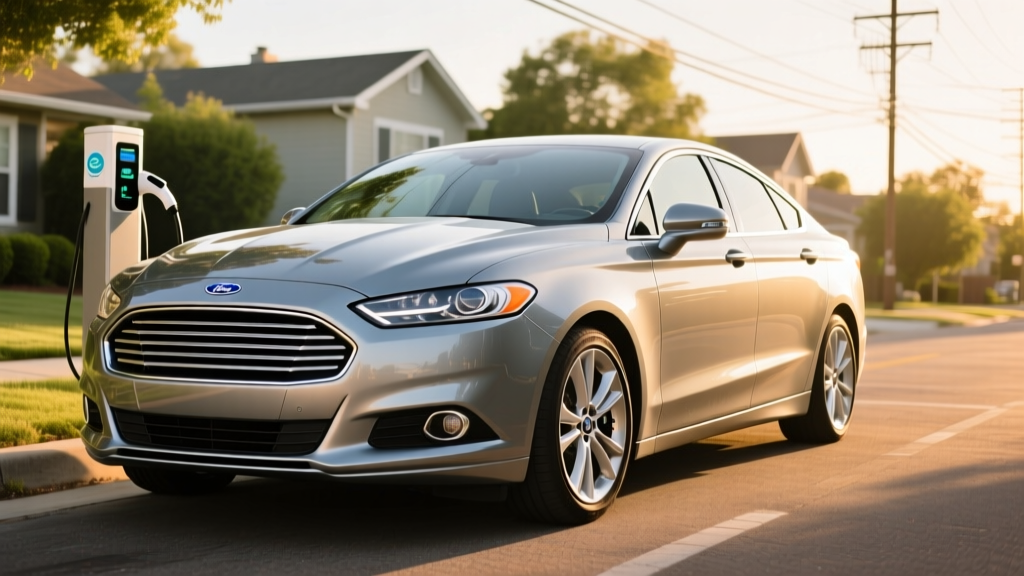
Quick Verdict: The 2013 Ford Fusion Hybrid SE in 2026
The 2013 Ford Fusion Hybrid SE remains one of the most compelling used hybrid sedans on the market. With an EPA-estimated 47 MPG combined, a refined 2.0-liter Atkinson-cycle powertrain, and Ford's proven hybrid synergy architecture, this midsize sedan punches well above its age. In 2026, clean examples typically trade between $7,500 and $11,000 depending on mileage and condition — making it a serious value proposition for commuters who want Prius-level efficiency with a full-size cabin.
But a 13-year-old hybrid raises legitimate questions: How has the battery held up? What does replacement cost? And how does this generation compare to newer hybrids or a full EV? This guide answers every question a used buyer needs resolved before signing on the dotted line.
EPA Fuel Economy and Real-World MPG
The 2013 Fusion Hybrid SE carries EPA ratings that still impress over a decade later. Here's the official breakdown from fueleconomy.gov:
| Driving Cycle | EPA Estimate | Real-World Expectation |
|---|---|---|
| City | 47 MPG | 44–50 MPG (hybrids often beat EPA in city) |
| Highway | 47 MPG | 40–44 MPG (aerodynamic drag, sustained speed) |
| Combined | 47 MPG | 42–47 MPG |
The identical city and highway ratings reflect Ford's hybrid system optimization: the electric motor handles low-speed propulsion where gas engines are least efficient, while regenerative braking recaptures energy that conventional cars waste. In real-world driving, owners frequently report exceeding the EPA city figure during stop-and-go commutes — a hallmark of series-parallel hybrid systems. Highway driving at 75+ MPH, however, typically yields 40–44 MPG as the gasoline engine carries the full load and aero drag increases exponentially.
HEV vs. PHEV: Understanding What the 2013 Fusion Hybrid Is
This is a critical distinction for shoppers cross-referencing listings. The 2013 Ford Fusion Hybrid SE is a conventional hybrid electric vehicle (HEV) — it does not plug in. Ford also offered a plug-in variant called the Fusion Energi (a PHEV), which is a separate model with different specs, a larger battery, and plug-in capability.
| Feature | Fusion Hybrid (HEV) | Fusion Energi (PHEV) |
|---|---|---|
| Plug-in Charging | No — self-charging via regen & engine | Yes — Level 1 (120V) or Level 2 (240V) |
| Electric-Only Range | ~1 mile at low speed | ~19 miles (EPA, 2013 model) |
| Battery Capacity | 1.4 kWh (usable ~1.0 kWh) | 7.6 kWh (usable ~5.5 kWh) |
| DC Fast Charging | No | No (Level 2 max) |
| Combined MPG / MPGe | 47 MPG | 100 MPGe (elec) / 38 MPG (gas) |
| Trunk Space | 12.0 cu ft | 8.2 cu ft (battery intrusion) |
If a listing advertises "plugging in" or "electric-only mode," it's likely a Fusion Energi, not the standard Hybrid SE. Verify by checking for a charge port on the driver-side front fender — the HEV has none.
Powertrain Specifications
The 2013 Fusion Hybrid pairs a 2.0-liter Atkinson-cycle inline-four with an electric motor integrated into Ford's HF35 hybrid transaxle. The combined system output is 188 horsepower — adequate for confident highway merging and passing.
| Specification | Value |
|---|---|
| Engine | 2.0L Atkinson-cycle I-4 |
| Engine Horsepower | 141 hp @ 6,000 rpm |
| Engine Torque | 129 lb-ft @ 4,000 rpm |
| Electric Motor Output | 118 hp / 117 lb-ft |
| Combined System Output | 188 hp |
| Transmission | HF35 eCVT (planetary gearset) |
| 0–60 MPH | ~8.4 seconds |
| Drivetrain | Front-wheel drive |
| Curb Weight | ~3,615 lbs |
| Fuel Tank | 13.5 gallons |
| Total Range (est.) | ~630 miles |
The eCVT is not a belt-and-pulley CVT like those found in some competitors. It uses a planetary gearset to seamlessly blend engine and motor power — a design that has proven extremely durable with virtually no wear components. There are no traditional "gears" to fail and no drive belt to replace.
Battery Health, Warranty, and Replacement Cost
The 2013 Fusion Hybrid uses a 1.4 kWh (gross) lithium-ion battery pack located behind the rear seats. This was Ford's first lithium-ion hybrid battery, replacing the older nickel-metal hydride (NiMH) packs used in the previous-generation Fusion Hybrid. Lithium-ion offers better energy density and charge/discharge efficiency, but after 13 years, degradation is a legitimate concern.
What Does Battery Degradation Look Like?
Hybrid batteries experience gradual capacity loss that reduces electric-assist duration and regenerative braking effectiveness — not total range, since the engine always supplements. Most 2013 Fusion Hybrids still on the road show 10–20% capacity loss based on owner reports and OBD-II State of Health (SoH) readings. Symptoms of significant degradation include:
- Engine running more frequently, especially at low speeds
- Reduced regenerative braking force
- Slightly lower MPG (typically 2–5 MPG drop with heavy degradation)
- Battery state-of-charge gauge swinging more rapidly
Battery Replacement Cost
If the battery fails or degrades beyond acceptable levels, replacement options in 2026 include:
- New OEM battery (Ford): $2,500–$3,500 including labor at a dealership
- Remanufactured battery: $1,500–$2,200 from third-party suppliers (e.g., Green Bean Battery, Dorman)
- Used/salvage battery: $600–$1,200, but with unknown remaining lifespan
- Individual cell/module replacement: $400–$800 at independent hybrid specialists (only viable if one or two modules have failed)
Before purchasing, request an OBD-II hybrid battery health report. Tools like the ScanGauge or app-based readers (e.g., Torque Pro with a compatible adapter) can pull battery SoH data. A pack showing 80%+ capacity retention is considered healthy for its age.
Reliability Record and Common Issues
The 2013 Fusion Hybrid has a generally strong reliability record, particularly compared to the first model year of many new platforms. According to NHTSA, there have been relatively few recalls, and none specifically targeting the hybrid powertrain. Key reliability notes:
- HF35 transaxle: Extremely reliable; no common failure modes reported
- Hybrid battery: Most packs last 150,000+ miles with gradual degradation rather than sudden failure
- 12V auxiliary battery: Like all cars, the 12V battery needs replacement every 4–6 years; a weak 12V can cause hybrid system errors
- Brakes: Regenerative braking extends pad life significantly — many owners report 80,000+ miles on original pads
- Infotainment (MyFord Touch): The SYNC/MyFord Touch system in 2013 models is notoriously slow and buggy; software updates help but don't fully resolve it
- Electric power steering: Some units developed a known fault; check for steering recall completion (NHTSA Recall 14S21)
Pricing, Tax Credits, and Total Cost of Ownership
Used Market Pricing (2026)
The 2013 Ford Fusion Hybrid SE originally carried an MSRP of approximately $27,200. In today's used market:
- High mileage (120,000+ miles): $5,500–$7,500
- Average mileage (80,000–120,000 miles): $7,500–$9,500
- Low mileage (under 80,000 miles): $9,500–$11,500
Tax Credit Eligibility
Under current IRS §30D clean vehicle credit rules, the 2013 Fusion Hybrid does not qualify for the federal new-vehicle EV/PHEV tax credit (which applies to new plug-in vehicles only). For used vehicles, the §25E used clean vehicle credit offers up to $4,000 (30% of sale price, capped at $4,000), but it requires the vehicle to be a plug-in EV or PHEV — conventional HEVs like the Fusion Hybrid are excluded. The Fusion Energi (PHEV) may qualify for §25E if it meets age, price, and buyer income requirements.
- ❌ Vehicle must be a BEV or PHEV — the Fusion Hybrid is an HEV (not eligible)
- ❌ Sale price must be $25,000 or less (HEV fails vehicle-type requirement regardless)
- ✅ Fusion Energi (PHEV variant) may qualify if price ≤ $25,000 and buyer meets income caps
- ⚠️ Always verify current-year rules with a tax professional; IRS regulations evolve
Estimated 5-Year Cost of Ownership
At 47 MPG combined and current national gas prices (~$3.40/gallon in 2026), the Fusion Hybrid costs approximately $1,085/year in fuel for 15,000 miles of driving. A comparable gas-only 2013 Fusion (2.5L, 25 MPG combined) would cost roughly $2,040/year — a savings of nearly $4,800 over five years with the hybrid.
| Cost Factor | Fusion Hybrid (5 yrs) | Gas Fusion 2.5L (5 yrs) |
|---|---|---|
| Fuel (15,000 mi/yr) | $5,425 | $10,200 |
| Insurance (avg.) | $6,500 | $6,000 |
| Maintenance | $2,200 | $3,000 |
| Potential Battery Replacement | $0–$2,500 | $0 |
| Estimated Total | $14,125–$16,625 | $19,200 |
Who Should Buy the 2013 Fusion Hybrid SE?
- You commute in heavy stop-and-go traffic (city hybrid efficiency shines)
- You want 47 MPG without plugging in or changing habits
- You need a spacious midsize sedan with a proper trunk (12.0 cu ft)
- Your budget is $7,000–$11,000 and you want maximum fuel savings per dollar
- You lack access to home or workplace charging (HEV requires none)
- You have a short commute (under 20 miles) and can charge at home
- You want electric-only driving for daily errands with gas backup for road trips
- You want to potentially qualify for the §25E used-vehicle tax credit
- You have reliable home Level 2 charging
- Your daily driving is under 200 miles
- You want zero tailpipe emissions and minimal maintenance (no oil changes, no engine)
- You qualify for the full §30D new-vehicle credit ($7,500) on a new EV purchase
- 47 MPG combined — still class-competitive in 2026
- Spacious midsize cabin with comfortable ride
- Proven, durable eCVT planetary gearset
- Strong regenerative braking extends brake pad life
- No plug-in charging required
- Low used-market entry price
- Battery warranty has expired; replacement is an out-of-pocket risk
- MyFord Touch infotainment is dated and sluggish
- No DC fast charging or plug-in capability
- Trunk space reduced vs. gas Fusion (12.0 vs. 16.0 cu ft)
- No federal tax credit eligibility as an HEV
- Electric power steering recall should be verified
Frequently Asked Questions
How many MPG does the 2013 Ford Fusion Hybrid SE get?
The EPA rates the 2013 Fusion Hybrid at 47 MPG city, 47 MPG highway, and 47 MPG combined. In real-world driving, expect 44–50 MPG in city traffic and 40–44 MPG on the highway at sustained speeds. Cold weather and aggressive driving can reduce these figures by 10–15%.
Does the 2013 Fusion Hybrid need to be plugged in?
No. The Fusion Hybrid SE is a conventional HEV that charges its battery through regenerative braking and the gasoline engine. If you see a charge port, you're looking at a Fusion Energi (PHEV), which is a different model.
Is the 2013 Fusion Hybrid reliable?
Overall reliability is good. The hybrid powertrain — particularly the HF35 eCVT transaxle and 2.0L Atkinson-cycle engine — has proven durable well past 150,000 miles. The main risk is hybrid battery degradation, which is gradual rather than catastrophic. Verify that the electric power steering recall (14S21) was completed and check battery SoH via OBD-II before purchasing.
What does a replacement hybrid battery cost?
A new OEM battery runs $2,500–$3,500 installed at a Ford dealer. Remanufactured options cost $1,500–$2,200, and individual cell repairs can be done for $400–$800 at hybrid specialists. Most 2013 batteries still function adequately with 10–20% capacity loss rather than complete failure.
Does the 2013 Fusion Hybrid qualify for any tax credit?
No. As a conventional HEV, it is excluded from both the §30D new-vehicle credit and the §25E used-vehicle credit, which require plug-in capability (BEV or PHEV). The Fusion Energi PHEV variant may qualify for §25E if other requirements are met.
Hybrid vs. PHEV vs. EV — which should I choose?
Choose the HEV (Fusion Hybrid) if you lack charging access and want simplicity. Choose a PHEV if you can charge at home and have a short commute — you'll drive mostly on electricity with gas backup. Choose a full EV if you have home charging, drive under 200 miles daily, and want the lowest operating cost with zero tailpipe emissions. For a budget under $11,000 with no charging infrastructure, the HEV remains the most practical electrified option.
How far can the Fusion Hybrid drive on electric power alone?
Approximately 0.5–1 mile at speeds under 25 MPH in ideal conditions. The 1.4 kWh battery is too small for meaningful electric-only driving. For 19+ miles of electric range, you'd need the Fusion Energi PHEV variant.