Quick Verdict: The Three-Row Hybrid Benchmark
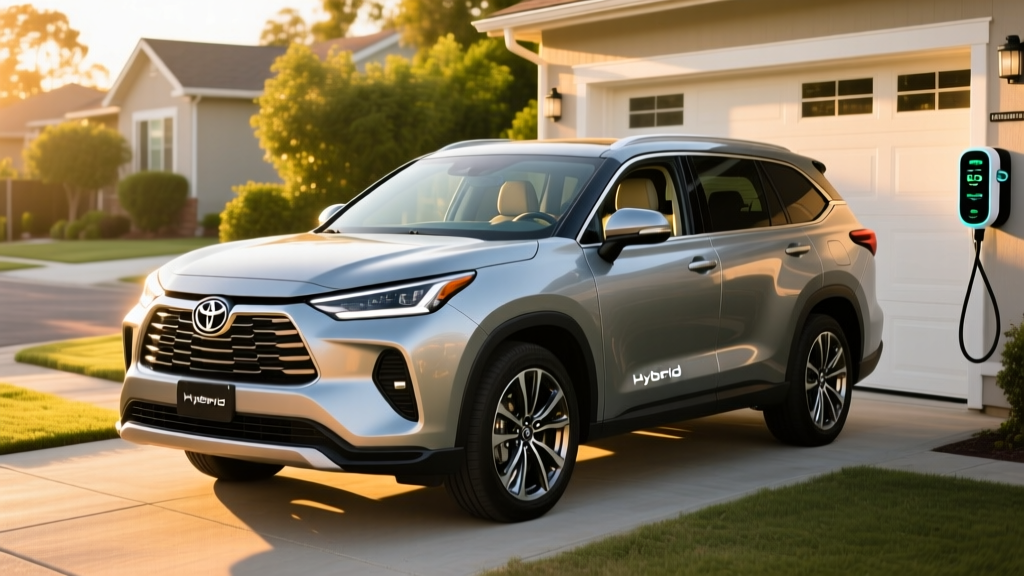
The Toyota Highlander Hybrid remains one of the most pragmatic choices in the midsize SUV segment for buyers who want three rows of seating without the fuel bills of a conventional V6. For 2026, Toyota continues the fourth-generation Highlander Hybrid with its proven 2.5-liter four-cylinder hybrid powertrain, delivering an EPA-estimated 35 MPG combined — a figure that consistently holds up in real-world driving thanks to Toyota's hybrid system favoring city and stop-and-go conditions.
This is a conventional hybrid (HEV), not a plug-in hybrid (PHEV). You never plug it in. The battery recharges through regenerative braking and the gasoline engine. If you're looking for electric-only driving range, you'll want to look at the RAV4 Prime or consider a full BEV. But if your goal is maximum fuel efficiency with zero behavior change — no charging cables, no range planning, no plug-in infrastructure — the Highlander Hybrid is purpose-built for that job.
| Spec | Value |
|---|---|
| Powertrain | 2.5L 4-cyl + 2 electric motors (AWD: 3 motors) |
| Combined Horsepower | 243 hp |
| Drivetrain | FWD or electronic AWD (AWD-i) |
| EPA Fuel Economy (FWD) | 36 city / 35 hwy / 36 combined MPG |
| EPA Fuel Economy (AWD) | 35 city / 34 hwy / 35 combined MPG |
| Hybrid Battery | 1.87 kWh (NiMH), sealed — no plug-in |
| Seating | 7 or 8 passengers (trim dependent) |
| Cargo (behind 3rd row) | 16.1 cu ft |
| Towing Capacity | 3,500 lbs |
| 0–60 mph | ~7.8 seconds |
| Base MSRP (LE FWD) | ~$41,815 |
| Hybrid Battery Warranty | 10 years / 150,000 miles |
HEV vs. PHEV: Understanding What the Highlander Hybrid Is — and Isn't
A common source of confusion among SUV shoppers is the difference between a conventional hybrid (HEV) and a plug-in hybrid (PHEV). The Highlander Hybrid is strictly an HEV.
| Feature | HEV (Highlander Hybrid) | PHEV (e.g., RAV4 Prime) |
|---|---|---|
| Plug-in charging? | No — never plug in | Yes — charges via outlet or charger |
| Electric-only range | None (EV assist only at low speed) | Typically 30–45 miles |
| Battery size | ~1.9 kWh (small buffer) | ~18–20 kWh usable |
| Federal tax credit (§30D) | Not eligible | Eligible (up to $7,500 if requirements met) |
| Best for | Drivers who can't charge at home | Drivers with home charging + short commutes |
Toyota does not currently offer a Highlander Prime (PHEV variant). If Toyota introduces one in the future, it would likely share powertrain architecture with the RAV4 Prime — but as of the 2026 model year, the Highlander Hybrid is HEV only. This matters for tax-credit eligibility, which we cover below.
Fuel Economy: EPA Ratings vs. Real-World MPG
| Drivetrain | City MPG | Highway MPG | Combined MPG |
|---|---|---|---|
| FWD | 36 | 35 | 36 |
| AWD-i (electronic AWD) | 35 | 34 | 35 |
Source: fueleconomy.gov
Toyota's hybrid system is engineered to excel in city driving, where the electric motors handle low-speed propulsion and regenerative braking recaptures energy at every stop. This means many owners report exceeding the EPA city estimate in stop-and-go traffic — 37–40 MPG is achievable in warm weather on suburban routes with moderate acceleration.
Highway driving tells a different story. At sustained speeds above 70 mph, the gasoline engine carries most of the load, and aerodynamic drag works against the tall SUV body. Expect highway fuel economy to land closer to 31–33 MPG on long road trips at 75+ mph, particularly with a full load of passengers and cargo. In cold weather (below 30°F), the engine runs more frequently to provide cabin heat, which can reduce combined MPG by 2–4 points until the powertrain reaches operating temperature.
For context, the non-hybrid Highlander with the turbocharged 2.4-liter four-cylinder returns roughly 24 MPG combined — making the hybrid's 35 MPG a roughly 46% improvement in fuel efficiency.
Powertrain and Performance: What 243 Hybrid Horsepower Feels Like
The Highlander Hybrid pairs a 2.5-liter Atkinson-cycle four-cylinder engine with two front-mounted electric motor-generators (three on AWD-i models, which add a rear-axle motor). Combined system output is 243 horsepower. The AWD-i system uses a dedicated 40 kW rear motor to provide all-wheel traction without a mechanical driveshaft — the rear wheels are powered entirely by electricity.
Acceleration to 60 mph takes approximately 7.8 seconds. This is adequate for merging and passing but noticeably slower than the turbocharged non-hybrid Highlander (which hits 60 in roughly 6.8 seconds). The hybrid powertrain prioritizes efficiency over urgency, and the continuously variable transmission (eCVT) delivers smooth, linear power delivery without traditional gear shifts.
Towing capacity is rated at 3,500 pounds across all Highlander Hybrid trims — sufficient for a small boat trailer, a pair of jet skis, or a lightweight camping trailer. This matches the non-hybrid four-cylinder Highlander but falls short of larger body-on-frame SUVs. If you need 5,000+ pounds of towing, the hybrid isn't the right tool.
Hybrid Battery Warranty, Lifespan, and Replacement Cost
Toyota Hybrid Battery Coverage
- Warranty: 10 years or 150,000 miles (whichever comes first) — covers the hybrid battery pack and related hybrid system components.
- Chemistry: Nickel-metal hydride (NiMH) — proven, thermally stable, and less prone to degradation than early lithium-ion packs.
- Expected lifespan: Toyota's hybrid batteries routinely last 150,000–200,000+ miles based on long-term fleet data from Prius and Camry Hybrid owners.
- Replacement cost (out of warranty): Approximately $3,000–$5,000 for a new OEM battery pack, including labor. Refurbished/reconditioned packs are available for $1,500–$2,500.
The hybrid battery in the Highlander is small (1.87 kWh) and operates within a narrow state-of-charge window — typically between 40% and 80% SoC. Toyota's battery management system never fully charges or fully depletes the pack, which dramatically reduces stress on the cells and extends cycle life. This is fundamentally different from a BEV or PHEV battery, which regularly cycles through a wider range.
Real-world failure data is encouraging. Independent surveys from Consumer Reports and long-term owner forums show Toyota hybrid battery failure rates well below 5% within the first 150,000 miles. Many Prius taxis have exceeded 300,000 miles on the original hybrid battery. The Highlander Hybrid uses the same proven architecture.
If the battery does eventually need replacement, the cost is manageable compared to BEV battery replacements (which can exceed $10,000–$20,000). The smaller NiMH pack and Toyota's extensive dealer network keep repair costs relatively low.
Pricing, Trims, and Tax Credit Eligibility
The 2026 Toyota Highlander Hybrid is available in LE, XLE, XLE Bronze Edition, Limited, and Platinum trims. Pricing starts around $41,815 for the LE FWD and climbs to approximately $53,000+ for a fully loaded Platinum AWD.
Federal tax credit: The Highlander Hybrid does not qualify for the federal §30D clean vehicle tax credit. That credit applies only to plug-in electric vehicles (BEVs and PHEVs) with battery capacities of at least 7 kWh, subject to MSRP caps, buyer income limits, and battery-sourcing requirements outlined by the IRS. Since the Highlander Hybrid is a conventional HEV with a 1.87 kWh battery and no plug-in capability, it is ineligible.
State incentives: Some states and local utilities offer rebates or HOV lane access for hybrid vehicles, though these programs have largely shifted toward BEVs and PHEVs. Check your state energy office or utility provider for current programs — availability varies widely by jurisdiction.
Who Should Buy the Highlander Hybrid — and Who Shouldn't
Choose the Highlander Hybrid if:
- You need three rows but want to minimize fuel costs without changing your driving habits
- You don't have access to home or workplace charging (apartment, street parking, no garage outlet)
- Your typical driving is a mix of city errands and suburban commuting where hybrid efficiency shines
- You plan to keep the vehicle 8–12 years and want Toyota's long-term reliability track record
- You tow occasionally (up to 3,500 lbs) but don't need heavy-duty capability
Consider a PHEV or full EV instead if:
- You have reliable home charging and a commute under 40 miles — a PHEV like the Chrysler Pacifica Hybrid or a BEV like the Kia EV9 could eliminate most gasoline use
- You want to claim the $7,500 federal tax credit (§30D), which requires a plug-in vehicle
- You prioritize acceleration — the Highlander Hybrid's 7.8-second 0–60 time trails many competitors
- You need more than 16.1 cu ft of cargo behind the third row — consider the Toyota Grand Highlander Hybrid (which offers more interior volume with a similar powertrain)
Pros
- 35–36 MPG combined — class-leading for a three-row SUV
- No plug-in required — zero behavior change from a gas car
- Proven Toyota hybrid reliability with 10-year/150k-mile battery warranty
- Standard Toyota Safety Sense 3.0 (adaptive cruise, lane tracing, auto emergency braking)
- Electronic AWD available without fuel-economy penalty
- Strong resale value — Toyota hybrids historically depreciate less than competitors
Cons
- Modest 243 hp — not a quick SUV by any measure
- 16.1 cu ft cargo behind third row is tight for a midsize SUV
- No federal tax credit eligibility
- Base price ~$41,800 is a premium over non-hybrid midsize SUVs
- Infotainment and interior materials lag behind Hyundai/Kia competitors at this price point
- No PHEV variant available for electric-only commuting
Frequently Asked Questions
How many MPG does the Toyota Highlander Hybrid get?
The EPA rates the 2026 Highlander Hybrid at 36 city / 35 highway / 36 combined MPG for FWD models, and 35/34/35 MPG for AWD-i models. In real-world driving, many owners report 37–40 MPG in city and suburban conditions, while sustained highway driving at 75+ mph typically yields 31–33 MPG.
Does the Highlander Hybrid need to be plugged in?
No. The Highlander Hybrid is a conventional hybrid (HEV). Its small 1.87 kWh battery recharges automatically through regenerative braking and the gasoline engine. You fuel it exactly like a conventional car — with gasoline at any station.
Is the Highlander Hybrid reliable? What about battery replacement?
Toyota's hybrid systems have an extensive reliability track record spanning over 25 years since the original Prius. The hybrid battery is covered by a 10-year/150,000-mile warranty, and real-world data shows most Toyota hybrid batteries last well beyond 150,000 miles. Out-of-warranty replacement costs approximately $3,000–$5,000 for a new OEM pack.
Does the Toyota Highlander Hybrid qualify for any tax credit?
No. The federal §30D clean vehicle credit applies only to plug-in vehicles (BEVs and PHEVs). The Highlander Hybrid is a conventional HEV and does not qualify. Some state or utility programs may offer small incentives for hybrids — check your local jurisdiction.
How does the Highlander Hybrid compare to the Grand Highlander Hybrid?
The Grand Highlander Hybrid uses the same hybrid powertrain but offers significantly more third-row legroom and cargo space (roughly 20.6 cu ft behind the third row vs. 16.1 cu ft). If you regularly carry adults in the third row or need more cargo volume, the Grand Highlander is worth the ~$2,000–$3,000 price premium. Fuel economy is nearly identical.
Hybrid vs. PHEV vs. EV — which is right for me?
A conventional hybrid (HEV) like the Highlander Hybrid is best if you can't charge at home and want maximum efficiency with zero lifestyle change. A plug-in hybrid (PHEV) suits drivers with home charging and shorter commutes who want 30–45 miles of electric-only range plus a gas engine for road trips. A full EV (BEV) makes sense if you have reliable charging access, want the lowest operating costs, and are comfortable planning longer trips around DC fast-charging stops.