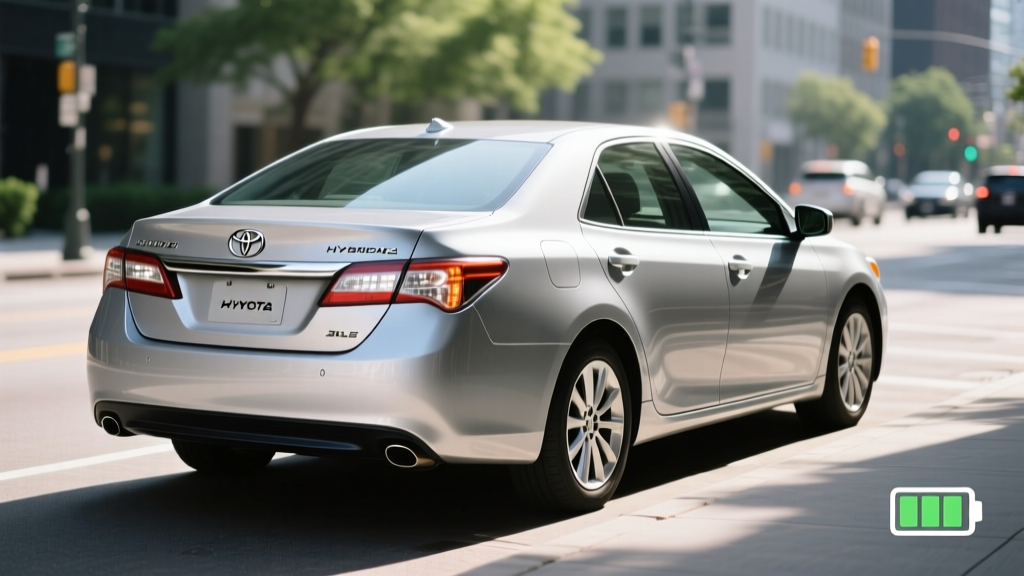
The 2012 Toyota Camry Hybrid XLE sedan occupies a specific niche in the 2026 used-car market: a midsize, no-plug-required hybrid sedan that delivers genuine 40 MPG combined fuel economy without the complexity, range anxiety, or charging infrastructure demands of a full electric vehicle. For buyers who want to cut fuel costs but lack access to home or workplace charging, this third-generation Camry Hybrid remains one of the most pragmatic choices on the pre-owned lot.
This guide breaks down the exact EPA figures, real-world MPG expectations, hybrid battery longevity data, replacement costs, powertrain specifications, and ownership economics you need to evaluate whether a 14-year-old Camry Hybrid XLE still makes financial sense in 2026.
EPA Fuel Economy and Real-World MPG
The 2012 Camry Hybrid XLE carries an EPA rating of 40 MPG city, 38 MPG highway, and 40 MPG combined according to fueleconomy.gov. These figures apply specifically to the XLE trim, which shares the same Hybrid Synergy Drive powertrain as the LE trim but adds weight from premium features, resulting in a 1 MPG penalty versus the LE's 41/38/40 split in some model-year documentation.
| Driving Cycle | EPA MPG | Real-World Expectation |
|---|---|---|
| City | 40 MPG | 42–46 MPG (hybrids excel in stop-and-go) |
| Highway | 38 MPG | 34–37 MPG (less regen opportunity at steady speed) |
| Combined | 40 MPG | 37–42 MPG depending on driving mix |
Real-world fuel economy for Toyota's Hybrid Synergy Drive system often exceeds EPA city estimates because regenerative braking recovers more energy in stop-and-go traffic. Highway driving, however, tends to fall 2–4 MPG below the sticker because the electric motor provides less assistance at sustained speeds above 65 mph and aerodynamic drag dominates. In mixed suburban driving with moderate climate-control use, expect 38–42 MPG from a well-maintained example. Cold-weather operation (below 35°F) can reduce MPG by 5–10% as the gasoline engine runs longer to heat the cabin and bring the catalytic converter to operating temperature.
HEV vs PHEV vs EV: Understanding What the Camry Hybrid Is
The 2012 Camry Hybrid is a conventional hybrid electric vehicle (HEV). It cannot plug in. It has no electric-only driving range beyond roughly one mile at very low speeds. The gasoline engine and electric motor work together seamlessly, and the battery recharges through regenerative braking and engine power. You fuel it exactly like a gas car — at any gas station — and never need to think about charging.
| Feature | HEV (Camry Hybrid) | PHEV (e.g., RAV4 Prime) | BEV (e.g., Model 3) |
|---|---|---|---|
| Plugs in? | No | Yes (Level 1/2) | Yes (Level 1/2/DC) |
| Electric-only range | ~0.5 mi at low speed | 25–42 mi typical | 250–350 mi typical |
| Gas engine? | Yes (primary) | Yes (backup) | No |
| Home charging needed? | No | Recommended | Essential |
| Fuel cost per mile | ~$0.08 | $0.03–0.08 | $0.03–0.05 |
| Upfront cost premium | Low (used market) | Moderate–High | High |
Choose the Camry Hybrid (HEV) if: You have no access to home or workplace charging, want zero lifestyle change from a gas car, and prioritize proven reliability and low operating costs.
Choose a PHEV if: You can install a Level 2 home charger, have a commute under 40 miles, and want electric-only daily driving with gas-engine road-trip flexibility.
Choose a full EV (BEV) if: You have reliable home charging, want the lowest per-mile fuel cost, and are ready to plan around DC fast charging on road trips.
Powertrain Specifications and Performance
The 2012 Camry Hybrid XLE uses Toyota's third-generation Hybrid Synergy Drive, pairing a 2.5-liter Atkinson-cycle four-cylinder engine with a permanent-magnet AC synchronous electric motor through an electronically controlled continuously variable transmission (eCVT).
| Specification | Value |
|---|---|
| Gasoline engine | 2.5L inline-4, Atkinson cycle, 156 hp / 156 lb-ft |
| Electric motor | Permanent-magnet AC synchronous, 105 kW (141 hp) |
| Net combined horsepower | 200 hp |
| Transmission | eCVT (planetary gearset, no traditional belt) |
| 0–60 mph | 7.6 seconds |
| Drivetrain | Front-wheel drive |
| Hybrid battery | Nickel-metal hydride (NiMH), ~1.6 kWh gross |
| Fuel tank | 17.2 gallons (regular unleaded, 87 octane) |
| Total driving range | ~688 miles (at 40 MPG combined) |
The 200 hp combined output makes the Camry Hybrid feel adequately quick in daily driving. The eCVT eliminates shift shock entirely, and the transition between electric-only and gasoline power is nearly imperceptible under normal acceleration. The XLE trim adds a sportier suspension tuning over the LE and includes 17-inch alloy wheels, which marginally affect ride comfort and fuel economy compared to the LE's 16-inch steel wheels with low-rolling-resistance tires.
Hybrid Battery Longevity, Warranty, and Replacement Cost
For any used hybrid buyer, the traction battery is the single biggest financial variable. The 2012 Camry Hybrid uses a nickel-metal hydride (NiMH) battery pack — a chemistry Toyota has deployed since the original 1997 Prius with exceptional long-term reliability data.
How Long Do Camry Hybrid Batteries Actually Last?
Real-world data from taxi fleets, consumer reports, and owner forums indicates that Toyota's NiMH hybrid batteries typically last 150,000 to 200,000 miles before significant capacity degradation triggers a check-engine light or noticeable fuel-economy decline. Many examples exceed 200,000 miles on the original pack. The key factors affecting longevity are:
- Heat exposure: Vehicles operated in consistently hot climates (Arizona, Texas, Florida) see earlier degradation. The battery's thermal management is air-cooled, not liquid-cooled.
- State of charge cycling: Toyota's battery management system maintains the NiMH pack between roughly 40% and 80% state of charge, avoiding the deep cycles that accelerate degradation.
- Usage frequency: Batteries in regularly driven vehicles tend to outlast those in cars that sit for weeks. The NiMH chemistry benefits from regular shallow cycling.
Battery Replacement Cost in 2026
| Option | Cost Range | Warranty |
|---|---|---|
| New OEM Toyota battery | $2,500–$3,500 (parts + labor) | 1 year / unlimited miles |
| Refurbished / reconditioned pack | $1,200–$2,000 | 1–3 years depending on vendor |
| Individual module replacement | $400–$900 (if only 1–2 modules failed) | Varies by shop |
| Aftermarket new battery (e.g., Green Bean Battery) | $1,500–$2,200 | Limited lifetime (some vendors) |
The most cost-effective path for a 2012 model in 2026 is either a refurbished pack or individual module replacement performed by a hybrid-specialist shop. A full OEM replacement rarely makes economic sense on a vehicle with a market value of $7,000–$11,000 unless you plan to keep the car for another 5+ years.
XLE Trim Features and Interior
The XLE was the top-tier trim for the 2012 Camry Hybrid, and it brought meaningful upgrades over the base LE Hybrid. Standard XLE equipment includes:
- Leather-trimmed heated front seats with power driver adjustment
- Dual-zone automatic climate control
- Smart Key with push-button start
- Backup camera with dynamic gridlines
- 6.1-inch touchscreen with Entune audio (Bluetooth, USB, auxiliary)
- 17-inch alloy wheels
- Auto-dimming rearview mirror with compass and HomeLink
- Cruise control
Optional on the XLE was the Navigation package, which added a larger touchscreen with TomTom-based navigation, JBL premium audio with 10 speakers, and a rear spoiler. The Safety Connect telematics system was also available. From a 2026 perspective, the infotainment system is dated — no Apple CarPlay or Android Auto — but aftermarket head-unit replacements ($300–$600 installed) solve this cleanly while retaining the hybrid energy-monitor display via a separate OBD2-based app.
2026 Used-Car Pricing and Value
As of early 2026, the 2012 Toyota Camry Hybrid XLE sedan trades in the following ranges depending on mileage, condition, and regional demand:
| Mileage Range | Private-Party Value | Dealer Retail |
|---|---|---|
| 80,000–110,000 mi | $9,500–$11,500 | $11,000–$13,500 |
| 110,000–150,000 mi | $7,500–$9,500 | $9,000–$11,500 |
| 150,000–200,000 mi | $5,500–$7,500 | $7,000–$9,000 |
The Camry Hybrid commands a $1,000–$2,000 premium over an equivalent-mileage gas-only 2012 Camry LE/XLE, reflecting buyer demand for fuel savings without charging infrastructure.
Does It Qualify for Any Tax Credit?
No. The 2012 Camry Hybrid does not qualify for the federal §30D new clean vehicle credit — that credit applies only to new plug-in vehicles (PHEVs and BEVs) meeting battery-sourcing, MSRP, and buyer-income requirements per current IRS guidelines. Conventional hybrids (HEVs) like the Camry Hybrid have never qualified for §30D.
For used-vehicle purchases, the IRS §25E used clean vehicle credit (up to $4,000 or 30% of sale price, whichever is less) also does not apply to the Camry Hybrid, as §25E requires the vehicle to be a qualified plug-in electric vehicle or fuel cell vehicle. The Camry Hybrid is neither.
Some states may offer registration-fee discounts, HOV-lane access, or inspection-fee waivers for hybrid vehicles, but these vary by jurisdiction and are typically modest. Check your state's DMV or energy-office website for current programs.
Reliability and Safety
The 2012 Camry Hybrid benefits from Toyota's long-standing reliability reputation. The 2AR-FXE 2.5L Atkinson-cycle engine is a proven design with minimal failure points — no turbocharger, no direct injection (in this generation), and a timing chain rather than a belt. The eCVT transmission uses a planetary gearset with no friction bands or clutches to wear, making it one of the most durable transmissions in any vehicle class.
Safety ratings from the NHTSA show the 2012 Camry Hybrid earned a 5-star overall safety rating, with 5 stars in frontal crash and side crash, and 4 stars in rollover. The IIHS rated it Good in moderate overlap front, side, and roof strength tests, though the small overlap front test (introduced later) was not performed on this model year.
Standard safety equipment includes 10 airbags, ABS with electronic brake-force distribution, traction and stability control, and front active head restraints. The XLE's standard backup camera was notable for 2012, years before it became federally mandated.
Who Should Buy the 2012 Camry Hybrid XLE in 2026?
- Want 40 MPG without changing your fueling habits (no plug, no charging apps, no route planning)
- Live in an apartment or home without Level 2 charging access
- Need a reliable daily commuter with low operating costs under $0.10/mile for fuel
- Want a comfortable midsize sedan with a proven 200,000+ mile powertrain
- Are budget-conscious and want a capable vehicle under $10,000
- Want electric-only driving for short commutes (consider a used PHEV like the Prius Prime or RAV4 Prime)
- Need all-wheel drive (the 2012 Camry Hybrid is FWD only; consider the 2019+ Camry Hybrid AWD or a RAV4 Hybrid)
- Want modern infotainment with CarPlay/Android Auto without an aftermarket upgrade
- Plan to keep the vehicle 10+ years and want to avoid potential battery replacement costs
Frequently Asked Questions
How many MPG does the 2012 Toyota Camry Hybrid XLE get?
The EPA rates it at 40 MPG city, 38 MPG highway, and 40 MPG combined. In real-world mixed driving, most owners report 37–42 MPG, with city driving often exceeding the EPA estimate thanks to regenerative braking.
Is the 2012 Camry Hybrid a plug-in vehicle?
No. It is a conventional hybrid (HEV). You never plug it in. The battery recharges through regenerative braking and the gasoline engine. You fuel it at any gas station with regular 87-octane unleaded.
How long will the hybrid battery last on a 2012 Camry?
Toyota's NiMH hybrid batteries typically last 150,000–200,000 miles. Many exceed this range. Heat exposure and long periods of inactivity are the primary factors that shorten battery life. As of 2026, a 2012 model may be on its original battery or may have already had a replacement depending on its history.
What does it cost to replace the hybrid battery?
A refurbished or reconditioned battery pack costs $1,200–$2,000 installed. A new OEM Toyota battery runs $2,500–$3,500. Individual module replacement (if only one or two cells fail) can cost as little as $400–$900 at a hybrid-specialist shop.
Does the 2012 Camry Hybrid qualify for any federal tax credit?
No. Federal §30D and §25E tax credits apply only to plug-in electric vehicles (PHEVs and BEVs). The Camry Hybrid is a conventional HEV and does not qualify for any federal purchase incentive, whether bought new or used. Check your state for possible hybrid-specific benefits.
Is the eCVT transmission reliable?
Yes. Toyota's eCVT is a planetary gearset with no belts, bands, or clutches. It is widely regarded as one of the most durable transmissions in the industry, routinely lasting 200,000+ miles with no service beyond standard transaxle fluid changes.
How does the 2012 Camry Hybrid compare to a modern hybrid?
The 2026 Camry Hybrid LE achieves 52 MPG combined — a 30% improvement over the 2012 model — thanks to a more efficient engine, lighter lithium-ion battery, and improved aerodynamics. However, a 2026 Camry Hybrid starts at approximately $30,000, while a used 2012 XLE can be had for under $10,000. The used 2012 remains compelling for budget-focused buyers who accept the MPG gap in exchange for a dramatically lower purchase price.