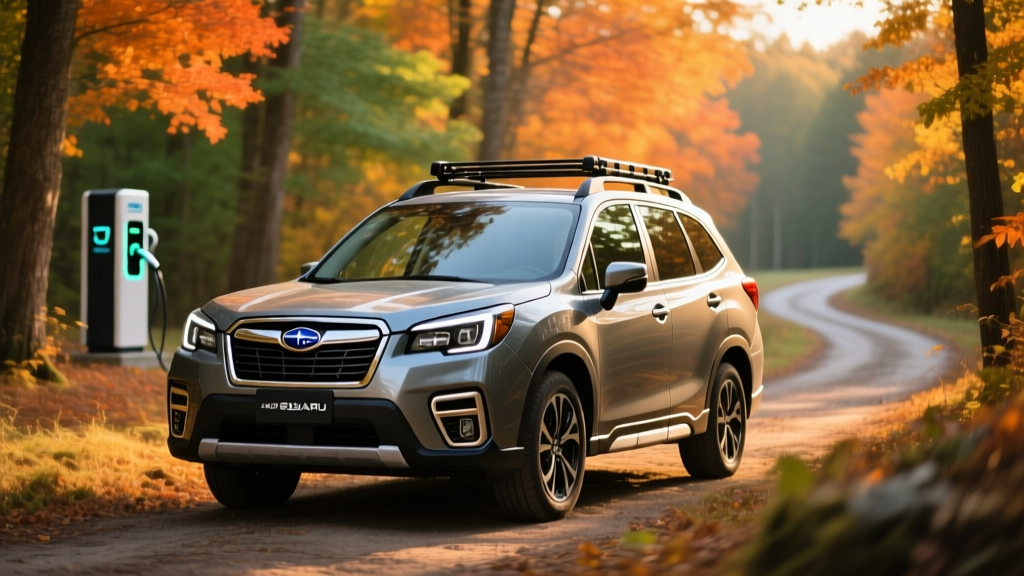
The Subaru Forester has long been a staple for outdoor-oriented buyers who need standard all-wheel drive, solid visibility, and practical cargo space. For 2025, Subaru introduced the sixth-generation Forester, and alongside it, a hybrid variant that pairs its familiar 2.5-liter boxer engine with an electric motor assist system. If you've been searching for a 2025 hybrid Subaru Forester, you're likely weighing its efficiency gains against the non-hybrid model — and possibly against plug-in hybrid or fully electric alternatives. This guide breaks down every number that matters.
HEV vs PHEV: What Kind of Hybrid Is the 2025 Forester?
Before diving into specs, it's critical to understand what the 2025 Forester Hybrid is — and what it isn't.
- HEV (Conventional Hybrid): The 2025 Forester Hybrid is a self-charging conventional hybrid. It uses a small battery recharged by regenerative braking and the gasoline engine. You never plug it in. There is no meaningful electric-only driving range.
- PHEV (Plug-In Hybrid): A plug-in hybrid, like the discontinued Subaru Crosstrek PHEV, has a larger battery (typically 8–18 kWh) that you charge via a wall outlet or public charger, enabling 17–35+ miles of electric-only driving before the gas engine kicks in. The 2025 Forester is not offered as a PHEV.
This distinction matters because it affects fuel economy expectations, charging behavior, and tax credit eligibility. The Forester Hybrid is designed for drivers who want better MPG without changing their fueling habits.
2025 Forester Hybrid Powertrain and Performance Specs
| Specification | 2025 Forester Hybrid | 2025 Forester (Gas) |
|---|---|---|
| Powertrain | 2.5L Boxer-4 + Electric Motor (e-Boxer) | 2.5L Boxer-4 |
| Combined Horsepower | ~194 hp (combined system) | 180 hp |
| Drivetrain | Symmetrical AWD (standard) | Symmetrical AWD (standard) |
| Transmission | Lineartronic CVT | Lineartronic CVT |
| Battery Type | Lithium-ion (small, ~1 kWh usable) | N/A |
| Towing Capacity | 1,500 lbs (est.) | 1,500 lbs |
| 0-60 mph | ~7.8 seconds (est.) | ~8.6 seconds |
Subaru's e-Boxer hybrid system uses the electric motor primarily for low-speed assist, smoother stop-start transitions, and brief electric-only creeping in traffic. Unlike Toyota's more aggressive hybrid systems (which can sustain electric-only driving at moderate speeds), Subaru's setup prioritizes seamless integration over maximizing electric-only operation. The result is a driving experience that feels nearly identical to the gas Forester, just slightly more responsive off the line thanks to the motor's instant torque.
EPA Fuel Economy: How Many MPG Does the Forester Hybrid Get?
| Driving Condition | Forester Hybrid (EPA Est.) | Forester Gas (EPA Est.) |
|---|---|---|
| City | 35 MPG | 26 MPG |
| Highway | 33 MPG | 33 MPG |
| Combined | 34 MPG | 29 MPG |
The headline number here is the city MPG improvement. Hybrids shine in stop-and-go traffic where regenerative braking recaptures energy and the electric motor handles low-speed propulsion. The 2025 Forester Hybrid's estimated 35 MPG city represents a substantial 9 MPG gain over the gas-only model in urban driving. Highway efficiency sees minimal improvement because the electric motor contributes less at sustained speeds.
Real-World MPG Expectations: Based on hybrid system behavior observed in Subaru's previous e-Boxer applications and comparable AWD crossovers, expect the Forester Hybrid to exceed its EPA city estimate in real-world urban driving — potentially reaching 36–38 MPG in warm-weather city commutes. Highway driving at 75+ mph will likely return 30–32 MPG. In cold weather (below 30°F), expect a 5–10% reduction across the board as the engine runs more frequently to provide cabin heat and maintain battery temperature. For official EPA figures, always check fueleconomy.gov once the vehicle is listed.
Battery Warranty, Lifespan, and Replacement Cost
Hybrid Battery Warranty: Subaru covers the Forester Hybrid's lithium-ion battery pack under its hybrid system warranty for 8 years / 100,000 miles (whichever comes first). In states that follow California Air Resources Board (CARB) emissions standards — including California, New York, Massachusetts, and several others — hybrid battery coverage extends to 10 years / 150,000 miles.
Hybrid battery degradation is far less of a concern than many buyers assume. Unlike full EV batteries that cycle through large portions of their capacity daily, the Forester Hybrid's small battery operates within a narrow state-of-charge window (roughly 40–80%). This shallow-cycling approach dramatically reduces stress on the cells. Toyota's hybrid batteries — which use a similar strategy — routinely last 150,000–200,000+ miles with minimal degradation, and Subaru's e-Boxer system follows the same engineering principle.
Replacement cost: If the hybrid battery does need replacement outside of warranty, expect to pay approximately $2,000–$4,000 for a new battery pack plus labor. However, based on industry data from similar hybrid systems, the likelihood of needing a replacement within the first 150,000 miles is low. The hybrid system also includes the electric motor and power control unit, which are covered under the same warranty terms.
Pricing, Trims, and Tax Credit Eligibility
The 2025 Subaru Forester Hybrid is available in select trims, typically starting in the Premium or Sport range. Based on Subaru's pricing structure and the hybrid premium observed in previous model years:
- Estimated base MSRP (Hybrid Premium trim): ~$33,000–$35,000
- Estimated MSRP (Hybrid Sport/Touring): ~$36,000–$39,000
- Hybrid premium over gas model: ~$1,500–$2,000
Does the 2025 Forester Hybrid Qualify for a Federal Tax Credit?
No. Under current IRS §30D rules, the federal clean vehicle tax credit of up to $7,500 applies only to plug-in electric vehicles — battery-electric vehicles (BEVs) and plug-in hybrids (PHEVs) with a minimum battery capacity of 7 kWh. Because the Forester Hybrid is a conventional HEV with a small battery (under 2 kWh) that cannot be plugged in, it does not qualify for the federal §30D tax credit.
Key §30D requirements the Forester Hybrid cannot meet:
- Must be a plug-in vehicle (BEV or PHEV)
- Minimum 7 kWh battery capacity
- Must meet critical mineral and battery component sourcing requirements
- MSRP caps: $55,000 for SUVs / $80,000 for vans and trucks
- Buyer income caps: $150,000 single / $300,000 joint filers
For current rules, always verify at IRS.gov.
Some states and utilities offer separate incentives for conventional hybrids, though these are increasingly rare as incentive programs shift toward plug-in vehicles. Check your state's energy office or utility provider for any local hybrid rebates. Subaru's official site may also list regional incentives.
Forester Hybrid vs PHEV vs EV: Which Fits You?
Choose the 2025 Forester Hybrid if:
- You want better MPG without changing your fueling routine (no plugs, no charging apps)
- You need standard AWD for snow, rain, or light off-road use
- You don't have access to home or workplace charging
- Your budget is under $40,000 and you want a practical AWD crossover
- You drive mostly in the city where hybrid efficiency gains are largest
Choose a PHEV (like the Toyota RAV4 Prime) if:
- You can charge at home (Level 2, 240V) and want 35–42 miles of electric-only commuting
- You want to qualify for the $7,500 federal tax credit (subject to eligibility)
- You take frequent short trips that could be completed entirely on electricity
- You still want a gas engine for long road trips without charging stops
Choose a full EV (like the Hyundai Ioniq 5 or Tesla Model Y) if:
- You have reliable home Level 2 charging and want the lowest per-mile fuel cost
- You want zero tailpipe emissions and minimal drivetrain maintenance
- You're eligible for the full $7,500 federal credit and state EV incentives
- Your typical weekly driving is under 250 miles, or you're comfortable with DC fast charging on road trips
Real-World Ownership: What Hybrid Buyers Should Know
Maintenance savings: The Forester Hybrid's regenerative braking system reduces wear on the friction brakes, meaning brake pads and rotors may last 80,000+ miles. Oil change intervals remain the same as the gas model (approximately every 6,000–10,000 miles with synthetic oil). The hybrid system adds no additional scheduled maintenance items — there's no hybrid-specific fluid change or filter replacement.
Insurance costs: Hybrid vehicles typically carry slightly higher insurance premiums than their gas-only counterparts due to the cost of repairing or replacing hybrid-specific components after a collision. Expect a 5–10% premium increase over the gas Forester, though this varies significantly by insurer, state, and driving record. Get quotes from multiple providers before purchasing.
Cargo space: One of the Forester Hybrid's advantages over some competitors is that the compact hybrid battery pack is packaged under the rear cargo floor, preserving the Forester's excellent 28.9 cubic feet of cargo volume behind the rear seats (and approximately 74.4 cu ft with the rear seats folded). You don't sacrifice utility for efficiency.
Cold-weather performance: Subaru's Symmetrical AWD is a genuine advantage in winter conditions, and the hybrid system doesn't compromise it. In cold weather, the gasoline engine will run more frequently to provide cabin heat, which reduces the hybrid efficiency advantage. Expect city MPG to drop to approximately 30–32 MPG in sustained sub-freezing temperatures — still better than the gas model's ~22–24 MPG in the same conditions.
Pros and Cons at a Glance
Pros
- 35 MPG city — a 9 MPG gain over the gas Forester in urban driving
- Standard Symmetrical AWD with no compromise to off-road capability
- No plug-in charging required — works with your existing gas-station routine
- Strong cargo utility preserved (28.9 cu ft behind rear seats)
- 8-year/100,000-mile hybrid battery warranty (10 yr/150,000 mi in CARB states)
- Subaru's EyeSight safety suite included standard
- Modest hybrid premium (~$1,500–$2,000) with payback in fuel savings
Cons
- No federal tax credit eligibility (HEV, not a plug-in)
- Highway MPG nearly identical to the gas model (~33 MPG)
- No meaningful electric-only driving range
- e-Boxer system less aggressive than Toyota's hybrid synergy drive
- Limited trim availability — hybrid not offered on base Forester
- Towing capacity remains modest at 1,500 lbs
Frequently Asked Questions
How many MPG does the 2025 hybrid Subaru Forester get?
The 2025 Forester Hybrid is estimated at 35 MPG city, 33 MPG highway, and 34 MPG combined. Real-world city driving in warm weather may yield 36–38 MPG thanks to regenerative braking, while cold-weather city driving will likely return 30–32 MPG.
Does the 2025 Forester Hybrid need to be plugged in?
No. The Forester Hybrid is a conventional HEV. Its small lithium-ion battery recharges through regenerative braking and the gasoline engine. You fuel it exclusively at gas stations, just like a conventional car.
How far can the Forester Hybrid drive on electric power alone?
Essentially zero meaningful miles. The e-Boxer system can propel the Forester on electric power alone only at very low speeds (under ~15 mph) for short distances, such as creeping through a parking lot or in heavy stop-and-go traffic. It is not designed for electric-only commuting.
Is the Forester Hybrid reliable?
Subaru's e-Boxer hybrid system has been in use in global markets (Japan, Europe) since 2019 and has demonstrated solid reliability. The hybrid battery and power electronics are covered by an 8-year/100,000-mile warranty. Subaru's AWD system and boxer engine are proven over decades. Check IIHS and NHTSA for the latest safety ratings once available.
What does it cost to replace the Forester Hybrid battery?
Out-of-warranty replacement of the hybrid battery pack is estimated at $2,000–$4,000 including labor. However, hybrid batteries operating in shallow-cycle mode typically last 150,000–200,000+ miles. Most owners will never need a replacement.
Does the 2025 Forester Hybrid qualify for any tax credit?
Not the federal §30D clean vehicle credit, which requires a plug-in vehicle with at least 7 kWh of battery capacity. Some states or utilities may offer small hybrid incentives — check your local programs. For federal rules, see IRS.gov.
How does the Forester Hybrid compare to the Toyota RAV4 Hybrid?
The Toyota RAV4 Hybrid (estimated 41 MPG combined) offers stronger fuel economy, particularly on the highway, because Toyota's hybrid system is more aggressive about using electric power. The RAV4 Hybrid also offers a PHEV variant (RAV4 Prime, 42 miles electric-only). However, the Forester Hybrid counters with Subaru's superior AWD system, better outward visibility, and more standard cargo volume.