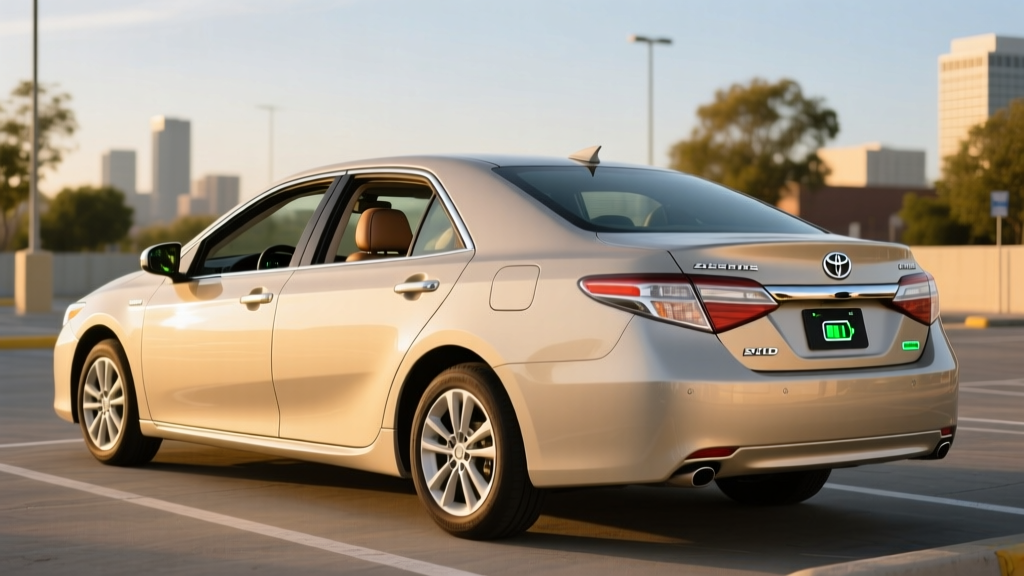
The 2012 Toyota Camry Hybrid was a watershed moment for Toyota's midsize sedan. It was the first model year of the XV50 generation, bringing a more powerful Hybrid Synergy Drive system, improved fuel economy, and a more refined interior. For used-car shoppers in 2026 eyeing the Camry XLE 2012 Hybrid, the question isn't whether it was good when new — it's whether a 14-year-old hybrid still delivers on its efficiency promises and how much battery risk you're taking on.
This guide covers the 2012 Camry Hybrid XLE's real-world MPG, powertrain specs, hybrid battery longevity, replacement costs, and how it stacks up against modern hybrids, PHEVs, and full EVs for today's buyers.
2012 Camry Hybrid XLE: Key Specifications at a Glance
| Specification | Value |
|---|---|
| Powertrain | 2.5L 4-cyl Atkinson-cycle + electric motor (Hybrid Synergy Drive) |
| Combined Horsepower | 200 hp (net system output) |
| Gas Engine Output | 156 hp @ 5,700 rpm / 156 lb-ft torque |
| Electric Motor Output | 105 kW (141 hp) |
| Transmission | eCVT (planetary gearset) |
| EPA City MPG | 43 MPG |
| EPA Highway MPG | 39 MPG |
| EPA Combined MPG | 40 MPG |
| Hybrid Battery | 1.6 kWh Nickel-Metal Hydride (NiMH), sealed |
| Battery Warranty (Original) | 8 years / 100,000 miles (10 yr / 150,000 mi in CARB states) |
| Drivetrain | Front-wheel drive |
| 0-60 mph | ~7.6 seconds |
| Cargo Volume | 13.1 cu ft (trunk) |
| Original MSRP (XLE trim) | ~$30,370 (2012) |
| 2026 Used Market Price | ~$7,000–$11,000 (depending on mileage/condition) |
How Many MPG Does the 2012 Camry Hybrid XLE Actually Get?
The EPA rates the 2012 Camry Hybrid at 43 city / 39 highway / 40 combined MPG. These figures are sourced from fueleconomy.gov. The city number is higher than the highway figure — a hallmark of Toyota's Hybrid Synergy Drive, which leverages regenerative braking and electric-only low-speed driving to excel in stop-and-go traffic.
In practice, owners and long-term testers have consistently reported that the 2012 Camry Hybrid meets or slightly exceeds its EPA city rating in urban driving, often returning 42–45 MPG in mixed suburban commutes. However, sustained highway driving at 75+ mph can drop figures to 35–37 MPG, as the electric motor assists less at high speeds and the Atkinson-cycle engine works harder. Cold weather (below 35°F) typically reduces fuel economy by 5–8 MPG combined due to extended engine warm-up cycles and increased battery internal resistance.
For context, the 2026 Toyota Camry Hybrid (now in its XV70 generation) achieves up to 52 MPG combined — a 30% improvement driven by a more efficient 2.5L Dynamic Force engine and lithium-ion battery packaging. The gap matters if fuel cost is your primary concern, but the 2012 model's 40 MPG combined still undercuts virtually any non-hybrid midsize sedan on the road.
Hybrid (HEV) vs. Plug-In Hybrid (PHEV): What the 2012 Camry Is — and Isn't
A common point of confusion among used-car shoppers: the 2012 Camry Hybrid is a conventional hybrid electric vehicle (HEV), not a plug-in hybrid (PHEV). It cannot be plugged in, has no electric-only driving range to speak of (roughly 1 mile at very low speeds on a full charge), and its 1.6 kWh NiMH battery recharges exclusively through regenerative braking and the gasoline engine.
| Feature | HEV (e.g., 2012 Camry Hybrid) | PHEV (e.g., 2026 RAV4 Prime) | BEV (e.g., 2026 Tesla Model 3) |
|---|---|---|---|
| Plug-in Charging Required? | No | Yes (optional but beneficial) | Yes (mandatory) |
| Electric-Only Range | ~1 mi (low speed) | 25–42 mi typical | 250–360+ mi |
| Battery Size | 1.6 kWh (NiMH) | 13–18 kWh (Li-ion) | 50–82 kWh (Li-ion) |
| Fuel for Long Trips | Gasoline only | Gasoline + electric | Electricity only |
| Federal Tax Credit (New) | None | Up to $7,500 (§30D) | Up to $7,500 (§30D) |
| Home Charging Needed? | No | Recommended (Level 2) | Essential (Level 2) |
| Ideal Buyer | No charging access, wants MPG gains | Home charger + short commute | Home charger, wants zero tailpipe emissions |
If you're considering the 2012 Camry XLE Hybrid because you can't install a home charger (apartment living, no garage), it's an excellent choice. You get meaningful fuel savings with zero lifestyle change. If you can charge at home, a modern PHEV like the RAV4 Prime or Prius Prime delivers 25–40 miles of electric-only commuting, which may cover your entire daily drive on electricity alone.
Powertrain Deep Dive: How the Hybrid Synergy Drive Works
The 2012 Camry Hybrid pairs a 2.5-liter Atkinson-cycle four-cylinder engine (156 hp, 156 lb-ft) with a 105 kW (141 hp) electric motor-generator through Toyota's eCVT — a planetary gearset that blends power from both sources seamlessly. Net system output is 200 horsepower, a meaningful bump over the previous-generation Camry Hybrid's 187 hp.
The Atkinson-cycle engine sacrifices low-RPM torque for higher thermal efficiency by keeping the intake valve open slightly during the compression stroke. The electric motor fills in that low-end torque gap, which is why the Camry Hybrid feels surprisingly responsive from a stop. The eCVT has no fixed gear ratios or shifting clutches — it's a continuously variable power-split device, which eliminates the "rubber-band" feel of belt-driven CVTs and is virtually maintenance-free.
Under light loads (gentle acceleration, low-speed cruising), the car can operate in EV mode using only the electric motor. Under hard acceleration, both the engine and motor deliver combined torque. During braking and deceleration, the motor acts as a generator, converting kinetic energy back into battery charge — regenerative braking that also reduces wear on the friction brake pads.
Hybrid Battery Longevity: How Long Will It Last and What Does Replacement Cost?
This is the single biggest concern for anyone buying a 14-year-old hybrid. The 2012 Camry Hybrid uses a 1.6 kWh Nickel-Metal Hydride (NiMH) battery pack located behind the rear seat. NiMH chemistry is less energy-dense than modern lithium-ion but is exceptionally durable and thermally stable.
Toyota originally warranted the hybrid battery for 8 years / 100,000 miles (extended to 10 years / 150,000 miles in CARB-emissions states including California, New York, Massachusetts, and others). By 2026, every original warranty on a 2012 model has expired.
Real-world data from taxi fleets, high-mileage owners, and Toyota service records shows NiMH hybrid batteries in the Camry and Prius routinely lasting 150,000–200,000+ miles before significant degradation. Capacity loss is gradual — you may notice slightly reduced EV-mode availability and a 2–4 MPG drop over time, rather than sudden failure.
Battery Replacement Cost in 2026
If the hybrid battery does fail, here's what you're looking at:
| Option | Cost Range | Warranty |
|---|---|---|
| New OEM Toyota Battery | $3,000–$4,000 (installed) | 3 yr / 36,000 mi |
| Refurbished / Reconditioned Pack | $1,500–$2,500 (installed) | 1–3 yr (varies by shop) |
| Individual Module Replacement | $500–$1,200 (specialist shops) | Varies |
| Aftermarket New Battery (e.g., Dorman) | $2,000–$3,000 (installed) | 2–3 yr |
Individual module replacement is worth highlighting: the NiMH pack contains 34 individual modules, and often only 1–3 degraded modules cause the entire pack to throw error codes. A hybrid specialist can test and swap only the bad modules for a fraction of a full-pack replacement. This is a well-established repair path for the Camry and Prius platforms.
Does the 2012 Camry Hybrid Qualify for Any Tax Credits?
No. The 2012 Camry Hybrid does not qualify for the federal §30D Clean Vehicle Credit. That credit applies only to new plug-in electric vehicles (BEVs and PHEVs) meeting current battery-sourcing, MSRP, and buyer-income requirements as defined by the IRS. Conventional hybrids (HEVs) like the Camry Hybrid have never been eligible for §30D.
On the used market, the federal Used Clean Vehicle Credit (§25E) offers up to $4,000 (30% of sale price, capped) for qualified used plug-in EVs and fuel-cell vehicles — but again, conventional hybrids are excluded. Your 2012 Camry Hybrid purchase is a straightforward used-car transaction with no federal tax incentives.
Some states or local utilities may offer small rebates for purchasing any high-efficiency vehicle, but these programs vary widely and change frequently. Check your state's energy office or utility provider for current offers.
2012 Camry XLE Hybrid: Ownership Costs and Value in 2026
At $7,000–$11,000 on the used market (per Kelley Blue Book and dealer listings), the 2012 Camry Hybrid XLE represents strong value for a spacious, efficient midsize sedan. Here's a realistic look at annual ownership costs:
| Category | Annual Cost |
|---|---|
| Fuel (40 MPG avg, $3.40/gal) | ~$1,275 |
| Insurance (national avg, clean record) | ~$1,100–$1,500 |
| Maintenance (oil, brakes, tires) | ~$400–$600 |
| Estimated Depreciation | ~$500–$800 |
| Total Estimated Annual Cost | ~$3,275–$4,175 |
Compared to a similarly aged non-hybrid 2012 Camry LE (EPA 25 MPG combined), the hybrid saves roughly $490/year in fuel at 15,000 miles annually. Over five years, that's ~$2,450 in fuel savings — enough to offset a meaningful portion of the purchase premium or fund a battery replacement if needed.
The XLE trim specifically adds leather-trimmed seats, a JBL audio system, dual-zone automatic climate control, and a power moonroof over the LE Hybrid. These are desirable comfort features, though the JBL amplifier and moonroof are additional items that can require repair on a 14-year-old vehicle.
Who Should Buy the 2012 Camry XLE Hybrid — and Who Should Look Elsewhere?
- You want proven 40 MPG without plugging in
- You live in an apartment or lack home charging access
- Your budget is under $12,000 for a reliable daily driver
- You prioritize low operating costs and Toyota reliability
- Your commute is city-heavy (where hybrid MPG shines brightest)
- You want a spacious trunk and comfortable rear seat for family use
- You want electric-only commuting (consider a PHEV like the Prius Prime)
- You want zero tailpipe emissions (consider a BEV like the Bolt or Model 3)
- You want modern ADAS features — the 2012 lacks automatic emergency braking, lane-keeping assist, and adaptive cruise control
- You do mostly highway driving at 75+ mph (hybrid advantage diminishes)
- You want federal tax credits (only available on new qualifying plug-in vehicles)
- The vehicle you're considering has 180,000+ miles without documented hybrid battery service
What to Inspect Before Buying a Used 2012 Camry Hybrid
If you're seriously considering one, these are the critical pre-purchase checks:
- Hybrid battery health check: Ask a Toyota dealer or hybrid specialist to run a battery health diagnostic. This reads individual module voltages and internal resistance. A healthy pack shows modules within 0.2V of each other.
- Hybrid system warning lights: Any check-engine or hybrid-system warnings should be investigated before purchase. Common codes include P0A80 (replace hybrid battery) and P0A7F (hybrid battery pack deterioration).
- Inverter coolant pump: The 2012–2014 Camry Hybrid had a known issue with the hybrid inverter coolant pump. Toyota issued a warranty enhancement for this. Verify it was serviced or check for active coolant flow in the inverter reservoir.
- Brake actuator: The regenerative braking system uses an electronic brake actuator that can fail expensively ($1,200–$1,800). Test for unusual brake pedal feel, grinding noises, or brake warning lights.
- Standard used-car checks: Transmission fluid condition, suspension wear, A/C function, and timing chain (the 2AR-FXE engine uses a chain, not a belt — no scheduled replacement needed, but listen for rattle on cold start).
Frequently Asked Questions
How many MPG does the 2012 Camry Hybrid get in real-world driving?
The EPA rates it at 43 city / 39 highway / 40 combined MPG. Real-world reports cluster around 38–44 MPG combined depending on driving style, terrain, and climate. City driving typically yields the best results; sustained 80-mph highway driving can drop to 35–37 MPG. Cold weather reduces economy by roughly 5–8 MPG combined.
Is the 2012 Camry Hybrid reliable?
Yes. The 2012 Camry Hybrid scores well in long-term reliability surveys. The 2AR-FXE engine, eCVT transmission, and NiMH hybrid battery are all proven, well-understood components. The main reliability risks on a 14-year-old example are age-related: hybrid battery degradation, inverter coolant pump failure, and brake actuator wear. A pre-purchase inspection by a hybrid-qualified technician is strongly recommended.
What is the hybrid battery replacement cost for the 2012 Camry?
A new OEM battery from Toyota costs $3,000–$4,000 installed. Refurbished packs run $1,500–$2,500, and individual module replacement at a hybrid specialist can be as low as $500–$1,200. Many examples reach 180,000+ miles on the original battery.
Does the 2012 Camry Hybrid need to be plugged in?
No. The 2012 Camry Hybrid is a conventional hybrid (HEV). Its battery charges exclusively through regenerative braking and the gasoline engine. There is no plug, no charging cable, and no electric-only range to manage. You simply fuel it with gasoline and drive.
How does the 2012 Camry Hybrid compare to the current-generation model?
The 2026 Toyota Camry Hybrid achieves up to 52 MPG combined (a 30% improvement), offers standard Toyota Safety Sense 3.0 (automatic emergency braking, lane-keeping, adaptive cruise), and uses a lighter lithium-ion hybrid battery. However, a new Camry Hybrid starts around $30,000. The 2012 model at $7,000–$11,000 delivers 77% of the fuel economy for roughly 30% of the price — a compelling value proposition for budget-conscious buyers who can accept the lack of modern safety tech.
Can I convert the 2012 Camry Hybrid to a plug-in hybrid?
Not practically. While aftermarket PHEV conversion kits exist in theory, no reputable, certified kit is available for the 2012 Camry Hybrid. The cost, complexity, safety implications, and loss of reliability make this inadvisable. If you want plug-in capability, purchase a factory PHEV like the Prius Prime or RAV4 Prime instead.