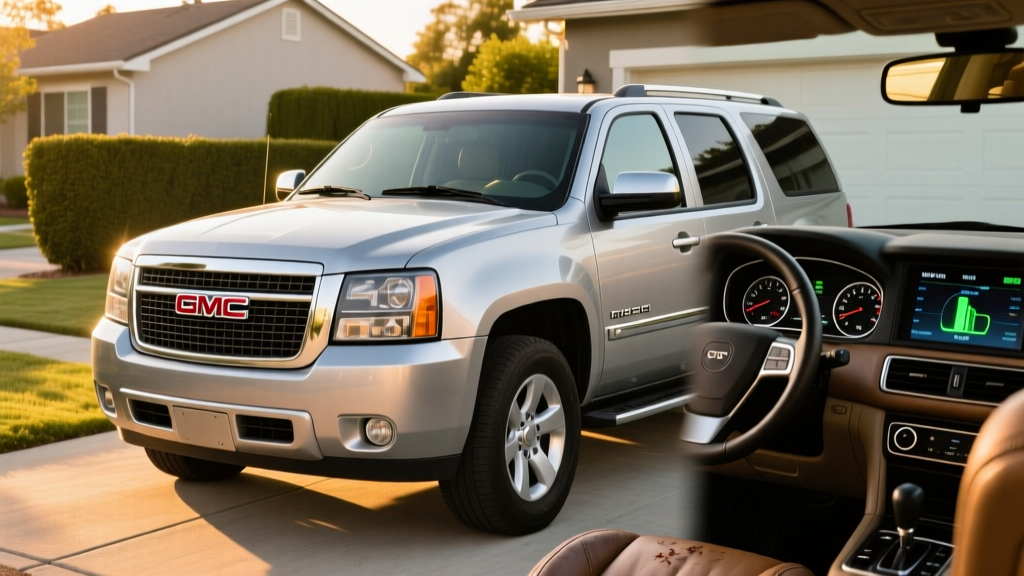
The 2009 GMC Yukon Hybrid was one of General Motors' earliest attempts at electrifying a full-size SUV, using a sophisticated Two-Mode hybrid system co-developed with BMW and Chrysler. Nearly two decades later, it remains a curiosity on the used market: a body-on-frame, three-row SUV that promised V-8 power with V-6 fuel economy. But does that promise hold up for a used-car buyer in 2026? This guide covers the real-world MPG, the hybrid battery's longevity and replacement cost, powertrain specifics, and whether this aging HEV still makes sense compared to modern hybrids, PHEVs, or full EVs.
HEV vs PHEV: What the 2009 Yukon Hybrid Actually Is
Before diving into specs, it's critical to understand what this vehicle is—and what it isn't. The 2009 GMC Yukon Hybrid is a conventional hybrid electric vehicle (HEV). It cannot be plugged in. It has no electric-only driving range to speak of. The hybrid system recovers energy through regenerative braking and uses a small battery pack to assist the gasoline engine, reducing fuel consumption versus the standard V-8 Yukon.
HEV vs PHEV vs EV — Quick Reference
| Feature | HEV (e.g., 2009 Yukon Hybrid) | PHEV (e.g., Chrysler Pacifica Hybrid) | BEV (e.g., Rivian R1S) |
|---|---|---|---|
| Plug-in charging? | No | Yes (Level 1/2) | Yes (Level 1/2/DC) |
| Electric-only range | ~0 miles (low-speed assist only) | 20–45 miles typical | 250–400+ miles |
| Gas engine? | Yes (primary) | Yes (backup) | No |
| Battery size | ~1.8 kWh (NiMH) | 12–20 kWh (Li-ion) | 75–150 kWh (Li-ion) |
| Federal tax credit (new) | None (expired) | Up to $7,500 (§30D) | Up to $7,500 (§30D) |
| Fuel/energy | Gasoline only | Gasoline + electricity | Electricity only |
The distinction matters because some used buyers see "hybrid" and assume they can plug it in for electric commuting. You cannot. The Yukon Hybrid's battery charges solely through regenerative braking and engine-driven generation. If plug-in electric range is a priority, you need a PHEV or a BEV—not this vehicle.
Powertrain Specs: The Two-Mode Hybrid System
The 2009 Yukon Hybrid used GM's Two-Mode Hybrid system, a technically complex powertrain that paired a 6.0-liter V-8 engine with two electric motors integrated into a specially designed 4-speed automatic transmission (the 2ML70, also called the Electrically Variable Transmission or EVT).
| Specification | 2009 GMC Yukon Hybrid |
|---|---|
| Engine | 6.0L V-8 (Vortec), Active Fuel Management (cylinder deactivation) |
| Engine HP | 332 hp @ 5,100 rpm |
| Electric Motors | Two AC synchronous motors (60 kW each) |
| Combined System HP | 379 hp |
| Transmission | 2ML70 EVT (Electrically Variable Transmission, 4-speed) |
| Hybrid Battery | ~1.8 kWh, Nickel-Metal Hydride (NiMH), 300V nominal |
| Drivetrain | RWD (2WD) or 4WD available |
| Towing Capacity | 5,800 lbs (2WD), 5,600 lbs (4WD) |
| 0-60 mph | ~8.0 seconds (est.) |
| Curb Weight | ~5,800 lbs |
The Two-Mode system was genuinely innovative for its time. In "Mode 1" (low-speed, city driving), the electric motors handled more of the workload, enabling brief electric-only movement at very low speeds (under ~30 mph) and allowing the V-8 to shut off at stops. In "Mode 2" (highway cruising), the system locked into a more conventional mechanical path for efficiency, with the electric motors providing assist during acceleration. The Active Fuel Management system could also deactivate four of the eight cylinders under light-load conditions.
The result was a full-size, body-on-frame SUV that could tow over 5,500 pounds while returning meaningfully better fuel economy than its conventional counterpart. It was an engineering achievement—but complexity came with long-term ownership implications that matter today.
Fuel Economy: EPA MPG and Real-World Expectations
According to EPA data on fueleconomy.gov, the 2009 GMC Yukon Hybrid achieved the following fuel economy ratings:
| Drivetrain | City MPG | Highway MPG | Combined MPG |
|---|---|---|---|
| 2WD Hybrid | 21 | 22 | 21 |
| 4WD Hybrid | 20 | 20 | 20 |
| 2WD Gas (5.3L V-8, non-hybrid) | 14 | 20 | 16 |
| 4WD Gas (5.3L V-8, non-hybrid) | 14 | 19 | 16 |
The hybrid's advantage was most pronounced in city driving, where the electric assist and engine shutoff at stops made a significant difference—a 50% improvement in city MPG for the 2WD model (21 vs 14). Highway gains were smaller because aerodynamic drag and the vehicle's 5,800-pound mass dominated at speed, limiting how much the hybrid system could help.
Real-World MPG: What to Expect from a 17-Year-Old Hybrid
If you're evaluating a 2009 Yukon Hybrid in 2026, temper expectations. Real-world fuel economy will depend heavily on the condition of the hybrid battery, driving habits, and terrain:
- City driving (healthy battery): Expect 18–21 MPG. The hybrid system still provides benefit if the NiMH pack holds adequate charge.
- Highway driving: Expect 19–22 MPG. Hybrid advantage narrows at sustained speed.
- Combined real-world: Most owners report 17–20 MPG in mixed driving.
- With degraded battery: If the hybrid battery is significantly degraded or has failed, the vehicle defaults to engine-only operation. Expect 14–16 MPG—essentially the same as the non-hybrid V-8, but with the dead weight of the hybrid system.
- Towing: Fuel economy drops to 10–13 MPG when towing near capacity, hybrid or not.
Hybrids of this era often exceeded their EPA city ratings when new because the test cycle captured regenerative braking benefits well. But a 2009 model with 150,000+ miles and an aging battery will likely fall short of those original sticker numbers.
Battery Life, Warranty, and Replacement Cost
The hybrid battery is the single biggest ownership question for any used hybrid—and it's especially critical for a vehicle that's now 17 years old.
Original Hybrid Battery Warranty
When new, GM covered the 2009 Yukon Hybrid's battery pack under its hybrid component warranty: 8 years / 100,000 miles (10 years / 150,000 miles in CARB states including California, New York, Massachusetts, and others). This warranty has expired for all 2009 models as of 2017 (or 2019 in CARB states), meaning any battery failure is now the owner's full financial responsibility.
NiMH Battery Degradation and Lifespan
The 2009 Yukon Hybrid uses a Nickel-Metal Hydride (NiMH) battery pack manufactured by Cobasys (a Chevron-Sanyo joint venture). NiMH chemistry is more tolerant of temperature extremes and abuse than modern lithium-ion, but it has lower energy density and a typical useful life of 10–15 years depending on usage and climate.
By 2026, virtually every 2009 Yukon Hybrid is operating on either:
- The original battery, significantly degraded: Reduced hybrid assist, lower MPG, more frequent engine cycling. The vehicle still drives, but the fuel-economy advantage is diminished.
- A replacement battery (OEM or aftermarket): Some owners have replaced the pack, restoring hybrid functionality.
- A failed battery: The vehicle operates in engine-only limp mode with a check-engine light. It's drivable but gets gas-V-8 fuel economy.
Battery Replacement Cost
Replacement options for the 2009 Yukon Hybrid battery include:
- OEM replacement (GM dealer): $3,000–$4,500 for the battery pack, plus $500–$1,000 in labor. Total: $3,500–$5,500. Availability may be limited as GM discontinues parts for older models.
- Aftermarket/remanufactured pack: $2,000–$3,000 from third-party hybrid battery suppliers (e.g., Green Bean Battery, Dorman). Total with labor: $2,500–$4,000.
- Individual cell/module replacement: Some hybrid specialists can replace only the failed modules within the pack for $800–$1,500. This is a temporary fix—other modules may fail soon after.
- Used pack from a salvage yard: $500–$1,200, but you're inheriting someone else's degradation. High risk.
Given that a clean 2009 Yukon Hybrid sells for roughly $5,000–$9,000 in the used market (depending on mileage and condition), a $3,000–$5,000 battery replacement represents a significant percentage of the vehicle's value. This economics problem is the central challenge of buying any 15+ year-old hybrid.
Pricing, Tax Credits, and Ownership Costs
The 2009 GMC Yukon Hybrid originally carried an MSRP of approximately $55,000–$62,000 depending on trim and drivetrain—a substantial premium over the gas-only Yukon, which started around $38,000.
Used Market Pricing (2026)
In today's used market, expect to pay:
- $5,000–$7,000: High-mileage examples (150,000+ miles), likely with degraded or failed hybrid battery
- $7,000–$9,000: Moderate-mileage examples (100,000–140,000 miles) in good condition, battery functional
- $9,000–$12,000: Lower-mileage, well-maintained examples with documented battery replacement or excellent battery health
Tax Credit Eligibility
The 2009 Yukon Hybrid does not qualify for any current federal tax credit. When new, GM's hybrid tax credit (a separate, smaller credit than the current §30D EV credit) had already phased out for GM vehicles by 2009 due to the manufacturer sales cap under the original Energy Policy Act of 2005. The current IRS §30D Clean Vehicle Credit applies only to new plug-in electric vehicles (BEVs and PHEVs meeting battery-sourcing and critical-mineral requirements)—not to used conventional hybrids.
Some states offer modest incentives for used hybrid or EV purchases, but these vary by jurisdiction and change frequently. Check your state's energy or environmental agency for current programs.
Insurance and Maintenance
Insurance costs for a 2009 Yukon Hybrid are generally low due to the vehicle's age and depreciated value—expect $80–$130/month for liability and comprehensive coverage depending on your state and driving record. However, maintenance costs can be higher than a standard Yukon due to the hybrid system's complexity. The EVT transmission, high-voltage cabling, and NiMH battery all require specialized diagnostic tools and trained technicians.
Reliability and Common Issues
The Two-Mode Hybrid system was over-engineered but not over-built. Common issues reported by owners and documented by NHTSA include:
- Hybrid battery degradation/failure: The most common and costly issue. NiMH cells lose capacity over time, especially in hot climates. Complete failure triggers a check-engine light and loss of hybrid functionality.
- EVT transmission concerns: The 2ML70 transmission is complex, with integrated electric motors and power electronics. Failures are uncommon but expensive ($4,000–$7,000 to replace).
- Active Fuel Management (AFM) lifter failure: The 6.0L V-8's cylinder-deactivation system is known for lifter collapse at higher mileages, leading to misfires and costly engine repairs ($2,000–$4,000).
- Power steering pump: The electric power steering pump can fail, a known issue across GM trucks of this era.
- Standard GM truck issues: Dashboard cracking, interior trim wear, suspension component wear, and exhaust manifold bolt failure are common across the GMT900 platform.
The hybrid system added a layer of complexity that the standard Yukon didn't have. For a first or second owner under warranty, this was manageable. For a third or fourth owner in 2026, it's a financial risk that must be factored into the purchase decision.
Who Should Buy the 2009 Yukon Hybrid in 2026?
Pros
- Significantly better city MPG than gas V-8 Yukon (21 vs 14)
- Full towing capability (5,600–5,800 lbs)
- Three-row seating for up to 8 passengers
- Body-on-frame durability and parts availability (GMT900 platform)
- Low purchase price on the used market
Cons
- Hybrid battery likely degraded or near end-of-life; replacement costs $2,500–$5,500
- No plug-in capability; no electric-only range
- Highway MPG barely better than gas model
- Complex powertrain = expensive repairs out of warranty
- AFM lifter failure risk on the 6.0L V-8
- No federal or state tax credit available
- Dated interior tech and safety features by 2026 standards
Decision Framework: Is This the Right Hybrid for You?
Choose the 2009 Yukon Hybrid if: You need a cheap, large SUV with three rows and towing capacity, your driving is predominantly city-based, you can verify the hybrid battery's health (or budget for replacement), and you accept the maintenance risk of a complex 17-year-old powertrain.
Choose a modern hybrid instead (e.g., Toyota Highlander Hybrid, Toyota Grand Highlander) if: You want current safety tech (automatic emergency braking, lane-keeping), modern infotainment, a fresh battery warranty, and 35+ MPG combined. Expect to pay $38,000–$52,000 new.
Choose a PHEV (e.g., Chrysler Pacifica Hybrid) if: You want electric-only commuting (32 miles EPA) with gas-engine backup for road trips, and you have access to Level 2 home charging.
Choose a full EV (e.g., Rivian R1S, Kia EV9) if: You want zero tailpipe emissions, minimal maintenance, home charging, and 270–350+ miles of range. Expect $55,000–$80,000+ and eligibility for the §30D federal tax credit (up to $7,500, subject to MSRP caps, income limits, and battery-sourcing rules).
Frequently Asked Questions
How many MPG does the 2009 GMC Yukon Hybrid get?
The EPA rates the 2WD model at 21 city / 22 highway / 21 combined MPG, and the 4WD model at 20/20/20 MPG. Real-world fuel economy for a 2026-purchase example with an aging battery is typically 17–20 MPG combined, dropping to 14–16 MPG if the hybrid battery has failed.
Can you plug in the 2009 GMC Yukon Hybrid?
No. The 2009 Yukon Hybrid is a conventional hybrid (HEV), not a plug-in hybrid (PHEV). It has no charging port and no meaningful electric-only range. The battery charges exclusively through regenerative braking and the gasoline engine.
How far can the 2009 Yukon Hybrid drive on electric only?
Effectively zero miles. The Two-Mode system can move the vehicle at very low speeds (under ~30 mph) on electric power alone for very short distances (a few hundred feet), such as in stop-and-go traffic. It is not designed for electric-only commuting or driving.
Is the 2009 GMC Yukon Hybrid reliable?
The GMT900 platform is generally robust, but the Two-Mode Hybrid system adds complexity that increases repair risk and cost. The biggest reliability concern in 2026 is the NiMH hybrid battery, which is past its expected 10–15 year lifespan. The 6.0L V-8's Active Fuel Management system is also known for lifter failures. Budget $2,000–$5,000 for potential hybrid-related repairs in the first year of ownership.
What does it cost to replace the hybrid battery?
An OEM replacement through a GM dealer costs approximately $3,500–$5,500 including labor. Aftermarket/remanufactured packs cost $2,500–$4,000 installed. Individual module replacement (a partial fix) costs $800–$1,500 but may not be a lasting solution.
Does the 2009 Yukon Hybrid qualify for any tax credit?
No. The original GM hybrid tax credit phased out before 2009 due to the manufacturer sales cap. The current federal §30D Clean Vehicle Credit applies only to new plug-in vehicles (BEVs and qualifying PHEVs). No federal tax credit is available for used conventional hybrids.
How does the 2009 Yukon Hybrid compare to the Toyota Highlander Hybrid?
The current Toyota Highlander Hybrid delivers 35–36 MPG combined with a modern, proven series-parallel hybrid system, standard AWD, current safety tech, and a 10-year/150,000-mile hybrid battery warranty. It's a generation ahead in every measurable way, but it costs $40,000+ new versus $5,000–$9,000 for a used Yukon Hybrid. The comparison is apples-to-oranges: the Yukon offers body-on-frame towing and size; the Highlander offers efficiency and reliability.
Should I buy a 2009 Yukon Hybrid or a regular gas Yukon?
If the hybrid battery is confirmed healthy (via a hybrid system diagnostic at a qualified shop), the hybrid's city MPG advantage is meaningful. If the battery is degraded or failed, you're better off with the simpler, cheaper-to-maintain gas V-8 Yukon—you'll get similar fuel economy without the hybrid repair risk. Always get a pre-purchase hybrid battery health check before buying.