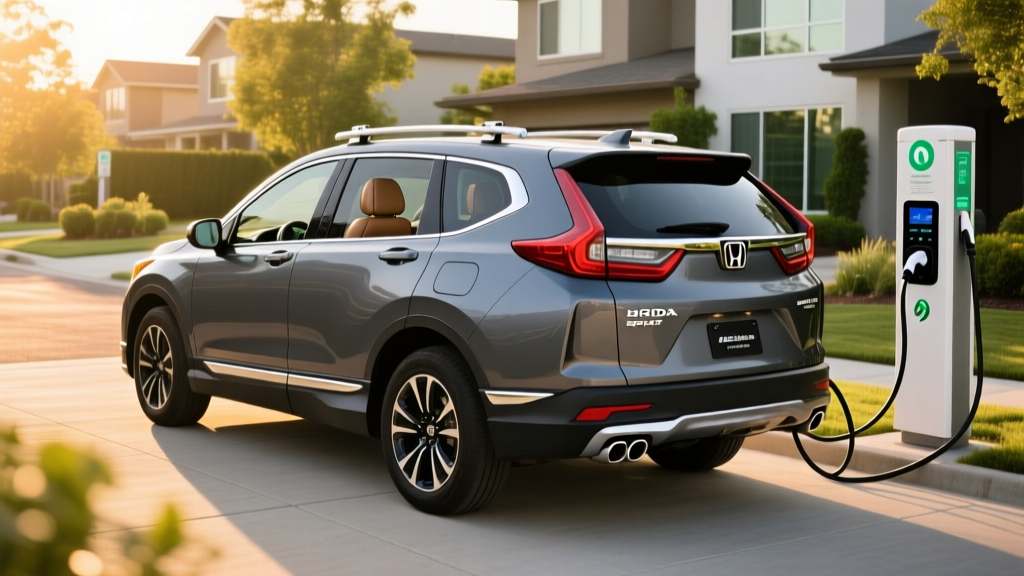
The Honda CR-V Hybrid Sport Touring sits at the top of Honda's compact-SUV hybrid lineup, pairing a 204-horsepower two-motor hybrid system with the premium features buyers expect from a range-topping trim. For 2026, it remains one of the most compelling choices for drivers who want electrified efficiency without plug-in complexity or range anxiety. But does its EPA-estimated fuel economy hold up in real-world driving, and how does it stack up against plug-in hybrids and full EVs? Here's the data-driven breakdown.
2026 Honda CR-V Hybrid Sport Touring: Core Specs at a Glance
| Specification | Value |
|---|---|
| Powertrain | 2.0L DOHC 4-cyl + 2-motor hybrid system |
| Combined Horsepower | 204 hp (system net) |
| Combined Torque | 247 lb-ft (electric motor) |
| Drivetrain | AWD (standard on Sport Touring) |
| EPA Fuel Economy (City / Hwy / Combined) | 40 / 34 / 37 MPG |
| Fuel Tank Capacity | 14.0 gallons |
| Total Driving Range | ~518 miles |
| 0–60 mph (est.) | ~7.6 seconds |
| Cargo Volume (rear seats up / folded) | 36.3 / 76.5 cu ft |
| Towing Capacity | 1,000 lbs |
| Hybrid Battery Warranty | 8 years / 100,000 miles |
| Starting MSRP (Sport Touring AWD) | ~$40,850 |
The Sport Touring trim is exclusively all-wheel drive, which accounts for the slight MPG reduction versus the FWD Sport trim (which rates 43/36/40 MPG per fueleconomy.gov). If maximum efficiency is your priority and you don't need AWD traction, the lower Sport trim delivers a meaningful bump.
How Many MPG Does the CR-V Hybrid Actually Get?
| Driving Scenario | City | Highway | Combined |
|---|---|---|---|
| EPA Estimate | 40 MPG | 34 MPG | 37 MPG |
| Real-World (mixed suburban) | 38–42 MPG | 31–34 MPG | 35–38 MPG |
| Cold Weather (below 32°F) | 34–37 MPG | 28–31 MPG | 31–34 MPG |
Like most conventional hybrids, the CR-V Hybrid tends to exceed its EPA city rating in stop-and-go traffic, where regenerative braking and electric-only low-speed propulsion shine. Highway driving is where efficiency drops — the gasoline engine carries more of the load at sustained speeds, and aerodynamic drag works against the tall SUV body.
In real-world mixed driving, owners consistently report 35–38 MPG combined, which aligns closely with the EPA sticker. Expect a 3–5 MPG penalty in sustained cold weather due to increased engine idling for cabin heat and reduced battery efficiency. If your commute is primarily city-based, seeing 40+ MPG on the trip computer is entirely realistic.
HEV vs. PHEV vs. EV: Which Powertrain Fits You?
Important distinction: The Honda CR-V Hybrid is a conventional hybrid (HEV). It does not plug in. It has no electric-only driving range. The gasoline engine and regenerative braking charge a small battery (approximately 1.1 kWh) that assists the electric motors. Honda does not currently sell a plug-in hybrid (PHEV) CR-V in the United States for the 2026 model year.
| Factor | CR-V Hybrid (HEV) | Typical Compact PHEV SUV | Full EV (e.g., Ioniq 5, Model Y) |
|---|---|---|---|
| Plug-in Required? | No | Yes (for EV range) | Yes |
| Electric-Only Range | 0 miles | 25–38 miles | 250–320 miles |
| Fuel / Energy Cost (annual, 15k mi) | ~$1,620 (gas at $3.50/gal) | ~$900–$1,200 | ~$540–$810 (home charging) |
| Home Charging Needed? | No | Recommended (Level 2) | Essential (Level 2) |
| Tax Credit Eligibility | None (federal) | Up to $7,500 (§30D, if eligible) | Up to $7,500 (§30D, if eligible) |
| Upfront Cost | Lowest | Moderate | Highest |
| Best For | No home charging; road trips; simplicity | Short commute + home charging; weekend trips | Home charging access; daily commute; lowest running cost |
Choose the CR-V Hybrid if: You lack reliable home charging access, take frequent long road trips, want zero behavior change from a gas car, and prefer the lowest purchase price among electrified options.
Choose a PHEV if: Your daily round-trip commute is under 30 miles, you can install a Level 2 charger at home, and you want electric-only daily driving with a gas engine for longer trips.
Choose a full EV if: You have home charging, your daily driving is under 250 miles, and you want the lowest per-mile energy cost and minimal maintenance.
Powertrain Deep Dive: How the Two-Motor Hybrid System Works
The CR-V Hybrid uses Honda's fourth-generation two-motor hybrid system. A 2.0-liter Atkinson-cycle four-cylinder engine (146 hp, 134 lb-ft) works in tandem with two electric motors — one serves primarily as a generator, while the drive motor delivers 184 hp and 247 lb-ft to the wheels. Combined system output is 204 hp.
In normal driving below ~45 mph, the CR-V Hybrid operates primarily in EV mode, with the gas engine running only to spin the generator motor. At highway speeds, a lock-up clutch connects the engine directly to the front wheels for efficiency. The AWD system uses a rear-mounted electric motor that engages when additional traction is needed — there is no mechanical driveshaft connecting the engine to the rear axle.
This architecture gives the CR-V Hybrid a smooth, electric-like feel in city driving while maintaining the flexibility of gasoline for long-distance travel. Acceleration is adequate but not brisk — the 0–60 mph time of approximately 7.6 seconds is competitive with rivals like the Toyota RAV4 Hybrid but noticeably slower than turbocharged gas-only alternatives.
Sport Touring Trim: What You Get for the Premium
The Sport Touring is the most expensive CR-V Hybrid trim, and it earns that price with a comprehensive feature list:
- 19-inch alloy wheels with all-season tires
- Leather-trimmed seats with heated front and rear seats
- Heated steering wheel
- 9-inch touchscreen with wireless Apple CarPlay and Android Auto
- Bose premium 12-speaker audio system
- Wireless phone charging pad
- Hands-free power liftgate
- Honda Sensing suite (adaptive cruise, lane-keeping, collision mitigation, blind-spot monitoring)
- Low Speed Braking Control and Traffic Jam Assist
The Sport Touring also includes a panoramic moonroof on some model years and a more refined interior aesthetic with contrast stitching and ambient lighting. It positions the CR-V Hybrid squarely against premium compact crossovers at a mainstream price point.
Tax Credits and Incentives: Does the CR-V Hybrid Qualify?
Federal tax credit status: The conventional Honda CR-V Hybrid does not qualify for the IRS §30D Clean Vehicle Credit. That credit applies only to plug-in electric vehicles (BEVs and PHEVs) with battery capacities of at least 7 kWh. The CR-V Hybrid's ~1.1 kWh battery places it well below the threshold.
However, some states and local utilities offer rebates or incentives for conventional hybrids. Check your state's energy office or utility provider for current programs. These vary significantly by jurisdiction and change frequently.
If a federal tax credit is a priority in your purchase decision, you would need to look at a qualifying PHEV (such as the Toyota RAV4 Prime or Chrysler Pacifica Hybrid) or a full battery-electric vehicle. Per current IRS §30D rules, eligible new EVs and PHEVs can receive up to $7,500, subject to buyer income caps ($150K single / $300K joint), MSRP caps ($55K sedans / $80K SUVs and trucks), and critical-mineral and battery-component sourcing requirements. Point-of-sale transfer is available at participating dealers, effectively reducing the purchase price at signing.
Battery Warranty, Reliability, and Replacement Costs
| Metric | Detail |
|---|---|
| Hybrid Battery Warranty | 8 years / 100,000 miles (10 yr / 150,000 mi in CARB states) |
| Battery Chemistry | Lithium-ion |
| Expected Battery Lifespan | 10–15 years / 150,000–200,000+ miles |
| Out-of-Warranty Replacement Cost | $2,000–$4,000 (estimated) |
| Powertrain Warranty | 5 years / 60,000 miles |
Honda's hybrid battery warranty covers defects and capacity loss below a specified threshold (typically 60–70% of original capacity) for 8 years or 100,000 miles. In states that follow California Air Resources Board (CARB) emissions standards — including California, New York, Massachusetts, and several others — that warranty extends to 10 years / 150,000 miles.
In practice, Honda's hybrid batteries have proven highly durable. The CR-V Hybrid uses a relatively small battery that cycles shallowly (it never fully depletes or fully charges during normal operation), which significantly extends cell life. Most owners will never need a hybrid battery replacement. When replacement is needed out of warranty, costs typically range from $2,000 to $4,000 including labor — far less than the $10,000–$20,000+ associated with full EV battery packs.
Overall reliability ratings for the CR-V Hybrid are strong. IIHS has historically awarded the CR-V line top safety marks, and the hybrid powertrain adds minimal mechanical complexity over the gas model since it eliminates the traditional transmission entirely.
Pros, Cons, and the Final Verdict
Pros
- 37–40 MPG combined with no plug-in requirement
- Standard AWD on Sport Touring — all-weather capability
- Smooth, electric-like low-speed driving feel
- Premium Sport Touring features at a mainstream price (~$40,850)
- 8-year / 100,000-mile hybrid battery warranty (10/150k in CARB states)
- Strong cargo space (36.3 cu ft) with no battery intrusion
- No behavioral change needed vs. a gas car — just fill up and go
Cons
- No federal tax credit eligibility (HEV, not PHEV/BEV)
- Highway MPG drops to ~31–34 real-world (aerodynamic penalty)
- 204 hp is adequate but not quick for highway merging
- 1,000-lb towing capacity is low for the class
- Cold-weather MPG penalty of 3–5 MPG combined
- Sport Touring price approaches some PHEV competitors after their tax credits
The verdict: The 2026 Honda CR-V Hybrid Sport Touring is the right choice for buyers who want meaningful fuel savings (37–40 MPG) without the infrastructure demands of a plug-in vehicle. It excels in city and suburban driving, offers a premium interior at a reasonable price, and carries a proven, low-risk hybrid powertrain. It is not the right choice if you need a federal tax credit, want electric-only daily commuting, or prioritize rapid acceleration. For those needs, a PHEV or full EV better serves the use case.
Frequently Asked Questions
How many MPG does the Honda CR-V Hybrid Sport Touring get?
The EPA rates the 2026 CR-V Hybrid Sport Touring AWD at 40 city / 34 highway / 37 combined MPG. Real-world combined driving typically yields 35–38 MPG, with city driving sometimes exceeding 40 MPG and highway driving dropping to 31–34 MPG.
Does the CR-V Hybrid need to be plugged in?
No. The CR-V Hybrid is a conventional hybrid (HEV), not a plug-in hybrid. It charges its battery entirely through regenerative braking and the gasoline engine. You never plug it in — you simply refuel at a gas station as you would with any conventional vehicle.
How far can the CR-V Hybrid drive on electric power alone?
The CR-V Hybrid has no meaningful electric-only range. It can creep at very low speeds (under ~15 mph) for short distances on battery power, but the gasoline engine engages frequently. If you want 25–38 miles of electric-only commuting, you need a plug-in hybrid (PHEV), which Honda does not currently offer in the CR-V lineup for the US market.
Is the CR-V Hybrid reliable, and what does battery replacement cost?
Yes. Honda's hybrid system has a strong reliability track record. The hybrid battery is warranted for 8 years/100,000 miles (10 years/150,000 miles in CARB states). Out-of-warranty replacement costs are estimated at $2,000–$4,000. Most hybrid batteries last 150,000–200,000+ miles given the shallow charge cycles.
Does the CR-V Hybrid qualify for any tax credit?
The conventional CR-V Hybrid does not qualify for the federal §30D Clean Vehicle Credit, which requires a plug-in vehicle with at least 7 kWh of battery capacity. Some state or utility incentives may apply to hybrids — check your local programs. If a federal credit is important, consider a qualifying PHEV or BEV instead.
How does the CR-V Hybrid compare to the Toyota RAV4 Hybrid?
Both are strong competitors. The RAV4 Hybrid (219 hp, 41/38/40 MPG AWD) offers slightly more power and marginally better highway MPG. The CR-V Hybrid counters with a more refined interior in the Sport Touring trim, a smoother ride, and Honda's driver-assist suite. Both carry strong hybrid battery warranties. The choice often comes down to styling preference and which dealership experience you prefer.
Can the CR-V Hybrid tow a trailer?
The CR-V Hybrid is rated for 1,000 lbs of towing capacity — enough for a small utility trailer or a pair of dirt bikes, but not a camping trailer or boat. If towing is a priority, look at a body-on-frame hybrid or a full-size SUV.