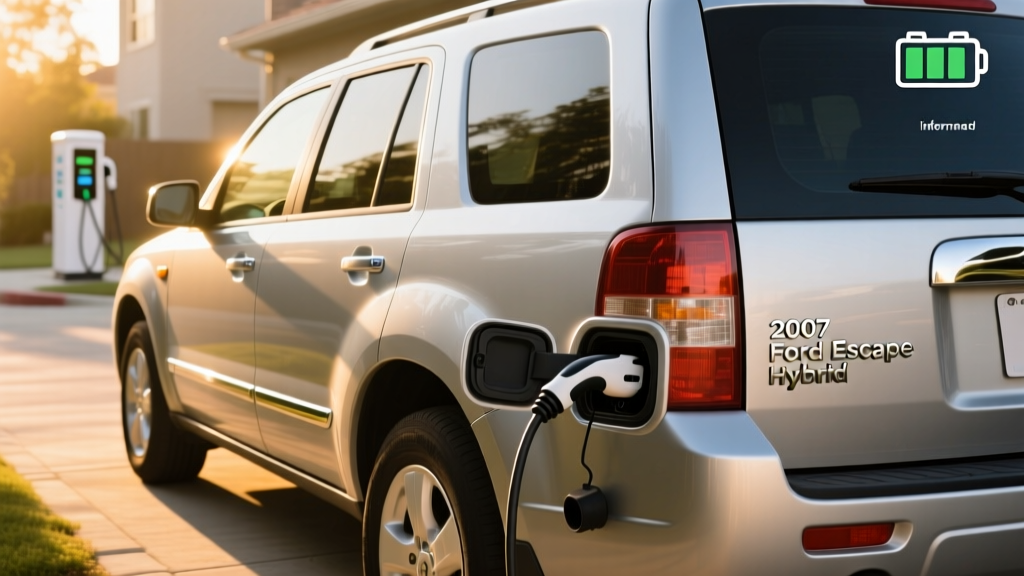
The 2007 Ford Escape Hybrid holds a unique place in automotive history. As one of the first hybrid SUVs ever sold in the United States, it proved that electrified powertrains could work in a practical, family-friendly package. Nearly two decades later, budget-conscious shoppers still search for this model on the used market — drawn by its reputation for strong city fuel economy, proven Toyota-sourced hybrid technology, and bargain-basement prices that typically range from $2,500 to $5,500 depending on condition and mileage.
But buying a 19-year-old hybrid in 2026 raises serious questions. How does the high-voltage battery hold up? What does replacement cost? And does this early-generation hybrid still make financial sense versus a newer conventional car or a modern hybrid? This guide breaks down every number that matters.
2007 Ford Escape Hybrid: Key Specifications at a Glance
| Specification | Value |
|---|---|
| Powertrain Type | Conventional Hybrid (HEV) — no plug-in |
| Engine | 2.3L Atkinson-cycle inline-4 |
| Combined Horsepower | 155 hp (engine + electric motor) |
| Transmission | Electronically controlled CVT (eCVT) |
| Drivetrain | FWD standard; AWD optional (AWD drops MPG) |
| EPA Fuel Economy (FWD) | 34 city / 30 highway / 32 combined MPG |
| EPA Fuel Economy (AWD) | 29 city / 27 highway / 28 combined MPG |
| Hybrid Battery | ~1.8 kWh NiMH (nickel-metal hydride) |
| Fuel Tank Capacity | 16.5 gallons |
| Total Driving Range (FWD) | ~528 miles (EPA combined) |
| 0–60 mph | ~10.5 seconds |
| Cargo Volume (rear seats up) | 29.3 cu ft |
| Original MSRP (2007) | ~$27,000–$31,000 depending on trim |
| Typical Used Price (2026) | $2,500–$5,500 |
Sources: EPA Fuel Economy, Ford Motor Company historical specifications.
Understanding the Powertrain: A Conventional Hybrid, Not a Plug-In
The 2007 Ford Escape Hybrid is a conventional hybrid electric vehicle (HEV). It cannot be plugged in. The high-voltage battery charges exclusively through regenerative braking and the gasoline engine. This is a critical distinction: Ford did not offer a plug-in hybrid (PHEV) Escape until the 2013 model year, when the Escape Energi debuted with a larger lithium-ion battery and roughly 19 miles of electric-only range.
HEV vs. PHEV — What's the Difference?
| Feature | HEV (2007 Escape Hybrid) | PHEV (e.g., Escape Energi, 2013+) |
|---|---|---|
| Plug-in Charging | No — charges via regen + engine | Yes — Level 1/Level 2 |
| Electric-Only Range | ~1–2 miles at low speed | 19–37 miles (model dependent) |
| Battery Size | ~1.8 kWh NiMH | 7.6–14.4 kWh Li-ion |
| Federal Tax Credit (new) | Expired; never eligible under modern §30D | Previously eligible; varies by model year |
| Best For | No home charging access; simple ownership | Short commutes; home charging available |
The Escape Hybrid's powertrain pairs a 133-hp 2.3-liter Atkinson-cycle four-cylinder engine with a 94-hp permanent-magnet electric motor. Combined system output is rated at 155 hp. The eCVT transmission — which is mechanically a planetary gearset, not a belt-driven CVT — provides seamless blending of gas and electric power. This same basic architecture was licensed from Toyota and shares core engineering DNA with the first-generation Toyota Prius and Highlander Hybrid systems.
Fuel Economy: How Many MPG Does the 2007 Escape Hybrid Actually Get?
The EPA rates the front-wheel-drive 2007 Ford Escape Hybrid at 34 MPG city, 30 MPG highway, and 32 MPG combined. The all-wheel-drive variant drops to 29 city / 27 highway / 28 combined due to added weight and drivetrain losses.
| Configuration | City MPG | Highway MPG | Combined MPG |
|---|---|---|---|
| FWD Hybrid | 34 | 30 | 32 |
| AWD Hybrid | 29 | 27 | 28 |
| FWD Gas (2.3L, 2007 baseline) | 20 | 25 | 22 |
Source: fueleconomy.gov
Real-World MPG vs. EPA Sticker
Like most hybrids of this era, the 2007 Escape Hybrid tends to exceed its EPA city rating in real-world stop-and-go driving. The electric motor handles low-speed propulsion where gasoline engines are least efficient, and aggressive regenerative braking recaptures energy at every stop. Owner reports on forums and fueleconomy.gov's user-reported data commonly show 33–38 MPG in mixed city driving.
Highway driving tells a different story. Above 55 mph, the gasoline engine does nearly all the work — the electric motor's contribution diminishes at sustained speed. Expect 27–30 MPG on the highway at 70+ mph, which aligns with or slightly underperforms the EPA estimate. Cold weather (below 40°F) typically knocks 2–4 MPG off combined figures as the engine runs more frequently to maintain cabin heat and battery temperature.
Compared to a modern 2026 Toyota RAV4 Hybrid (41 city / 38 highway / 40 combined), the 2007 Escape Hybrid trails by roughly 8–10 MPG. That gap reflects nearly two decades of hybrid powertrain advancement — better battery chemistry, more efficient motor designs, and improved aerodynamics.
Battery Health, Lifespan, and Replacement Cost
The single biggest concern for any used-hybrid buyer is the high-voltage battery. The 2007 Escape Hybrid uses a nickel-metal hydride (NiMH) pack rated at approximately 1.8 kWh. NiMH chemistry is less energy-dense than modern lithium-ion but is known for gradual, predictable degradation rather than sudden failure.
Battery Warranty & Expected Lifespan
Original warranty: 8 years / 100,000 miles (federally mandated emissions/hybrid component warranty). This warranty has expired for all 2007 models.
Real-world lifespan: Most NiMH packs in the Escape Hybrid last 150,000–200,000 miles before significant capacity loss. Many original batteries are still functioning at age 19, though with reduced efficiency. Expect a 10–20% drop in fuel economy if the battery is heavily degraded.
Replacement cost (2026):
- Remanufactured battery pack: $1,500–$2,500 (installed)
- New OEM battery pack: $3,000–$4,500 (installed, if still available from Ford)
- Individual cell/module replacement by a specialist: $500–$1,200
Several aftermarket companies now offer remanufactured NiMH packs for the Escape Hybrid at a fraction of the original OEM price. Independent hybrid specialists can also test and replace individual modules within the pack, extending its life at lower cost. Before purchasing any used 2007 Escape Hybrid, request a hybrid battery health scan — many OBD-II scanners and apps (such as Torque Pro with the right PID set) can read battery state-of-health data.
Signs of a Failing Hybrid Battery
- Noticeable drop in fuel economy (5+ MPG below normal)
- Battery charge indicator fluctuating rapidly on the dash
- Engine running almost constantly, even at low speeds
- Check engine light with codes P0A80 (replace hybrid battery) or P0A7F (hybrid battery deterioration)
- Reduced regenerative braking feel
Reliability Record and Common Issues
The 2007 Escape Hybrid benefits from a proven powertrain. The eCVT planetary gearset has no belts, chains, or clutches to wear out — it's one of the most durable transmissions ever put in a consumer vehicle. The 2.3L Duratec engine is under-stressed in this application and commonly reaches 200,000+ miles with basic maintenance.
Common non-hybrid issues reported by owners include:
- Power steering fluid leaks — the Escape uses a conventional hydraulic system, not electric power steering
- Blend door actuator failure — causes HVAC temperature control issues; $200–$500 repair
- Rear wheel bearing wear — especially on AWD models; $300–$600 per side
- 12V battery drain — parasitic draw from the hybrid control module can kill the standard 12V battery if the vehicle sits unused for weeks
Overall, the 2007 Escape Hybrid is regarded as one of the more reliable vehicles in Ford's 2000s lineup — largely because the hybrid system was based on Toyota's mature technology rather than Ford's own experimental designs. NHTSA records show no major safety recalls specific to the hybrid system.
Does the 2007 Ford Escape Hybrid Qualify for Any Tax Credit?
No. The 2007 Ford Escape Hybrid does not qualify for any current federal tax credit. The original hybrid vehicle tax credit that existed in 2006–2007 (up to $2,600 for this model) was phased out for Ford after the company hit the 60,000-unit manufacturer cap in 2007. That credit is long expired regardless.
Under current IRS §30D rules for the Clean Vehicle Credit (which applies to new vehicles only, with MSRP caps, income limits, and battery sourcing requirements), a 2007 model is ineligible on multiple fronts: it's not a new vehicle, it doesn't meet modern battery component or critical mineral sourcing rules, and it predates the current credit framework entirely.
The used clean vehicle credit (§25E, up to $4,000 or 30% of sale price, whichever is less) also does not apply. That credit requires the vehicle to be a plug-in electric vehicle or fuel cell vehicle — conventional hybrids (HEVs) that cannot be plugged in are excluded by statute.
Federal Tax Credit Eligibility Checklist (Current §30D / §25E Rules)
- ☐ Vehicle must be new (§30D) or a qualifying used plug-in/FCEV (§25E)
- ☐ Conventional hybrids (HEVs) are not eligible under either credit
- ☐ MSRP caps: $55,000 for cars, $80,000 for SUVs/trucks (new vehicles only)
- ☐ Buyer income caps apply (modified AGI limits)
- ☐ Battery component and critical mineral sourcing requirements (new vehicles)
- ☐ Point-of-sale transfer available at participating dealers (new vehicles)
Always verify current-year rules at IRS.gov or consult a tax professional.
Who Should Buy the 2007 Escape Hybrid — And Who Shouldn't
Pros
- Very low purchase price ($2,500–$5,500)
- Strong city MPG (34 EPA; often 35–38 real-world)
- Proven, Toyota-derived hybrid system
- eCVT is virtually indestructible
- No plug-in infrastructure needed
- Practical SUV cargo space (29.3 cu ft)
- Cheap insurance and registration
Cons
- Highway MPG trails modern hybrids by ~10 MPG
- Original battery warranty expired; replacement is $1,500–$4,500
- Slow acceleration (0–60 in ~10.5 seconds)
- Dated interior technology and safety features
- No federal tax credit of any kind
- AWD model loses significant fuel economy
- Finding clean, low-mileage examples is increasingly difficult
Choose the 2007 Escape Hybrid If:
- You need a cheap, fuel-efficient daily driver for city-heavy commutes
- You have no access to home or workplace charging (making a PHEV or EV impractical)
- You're comfortable with the risk of a $1,500–$2,500 battery replacement down the road
- You want an SUV with better MPG than a comparable gas-only model without paying modern hybrid premiums
Look Elsewhere If:
- Highway driving dominates your commute (a modern hybrid like the RAV4 Hybrid or Honda CR-V Hybrid will save significantly more fuel)
- You want the latest safety technology (automatic emergency braking, lane-keeping assist — none of which the 2007 Escape offers)
- You have home charging access and a short commute — a used PHEV or a new EV may offer lower per-mile fuel costs
- You plan to keep the vehicle 5+ years and want warranty peace of mind
2007 Escape Hybrid vs. Modern Alternatives: A Cost Comparison
To put the value proposition in perspective, here's how the 2007 Escape Hybrid stacks up against alternatives a budget-minded buyer might consider in 2026:
| Vehicle | Approx. Price | Combined MPG / MPGe | Annual Fuel Cost* | Tax Credit |
|---|---|---|---|---|
| 2007 Ford Escape Hybrid (FWD) | $4,000 | 32 MPG | $1,560 | None |
| 2015 Toyota Prius (used) | $9,000 | 50 MPG | $1,000 | None |
| 2020 Toyota RAV4 Hybrid (used) | $24,000 | 40 MPG | $1,250 | None |
| 2026 Hyundai Tucson Hybrid (new) | $34,500 | 38 MPG | $1,315 | Check §30D eligibility |
| 2026 Chevrolet Equinox EV (new) | $33,000 | 95 MPGe | $600 (electric) | Up to $7,500 (§30D) |
*Annual fuel cost based on 12,000 miles/year, $3.50/gallon regular unleaded, or $0.15/kWh for EV. Your costs will vary by region and driving pattern.
The 2007 Escape Hybrid wins purely on upfront cost. At $4,000, it's the cheapest way to get into a hybrid SUV. But the fuel savings gap versus a modern hybrid is real: a RAV4 Hybrid saves roughly $310/year in fuel over the Escape Hybrid, and a used Prius saves $560/year. Over a 5-year ownership period, those savings can narrow or close the purchase-price gap — before factoring in the Escape's potential battery replacement cost.
Frequently Asked Questions
How many MPG does the 2007 Ford Escape Hybrid get?
The FWD model is EPA-rated at 34 city / 30 highway / 32 combined MPG. Real-world city driving often yields 33–38 MPG thanks to the hybrid system's efficiency at low speeds. Highway driving at 70+ mph typically returns 27–30 MPG. The AWD version is rated lower at 29/27/28 MPG.
Can you plug in the 2007 Ford Escape Hybrid?
No. The 2007 Escape Hybrid is a conventional hybrid (HEV). It charges its battery entirely through regenerative braking and the gasoline engine. There is no plug, no charging port, and no electric-only driving range beyond about 1–2 miles at very low speeds. If you want plug-in capability, you'd need the later Escape Energi (PHEV, 2013+) or a modern plug-in hybrid.
How far can the 2007 Escape Hybrid go on electric only?
Effectively 1–2 miles at speeds under 25 mph, and only when the battery is fully charged from recent regenerative braking. This is not a meaningful electric-only range — the system uses the electric motor primarily to assist the gas engine and capture braking energy, not to replace it. For genuine electric-only commuting (20–40 miles), you need a PHEV or a full battery-electric vehicle.
Is the 2007 Escape Hybrid reliable?
Yes, with caveats. The Toyota-derived hybrid powertrain (eCVT + NiMH battery) is among the most durable ever built. The 2.3L gasoline engine is under-stressed and long-lived. The main reliability concern is battery degradation at high mileage (150,000+ miles) and age (all 2007 models are now 19 years old). Non-hybrid issues like power steering leaks and blend door actuator failures are the most common complaints.
What does it cost to replace the hybrid battery?
A remanufactured NiMH battery pack costs $1,500–$2,500 installed at an independent hybrid specialist. A new OEM pack (if available from Ford) runs $3,000–$4,500 installed. Individual module replacement by a specialist can cost as little as $500–$1,200 if only a few cells have failed. Given the vehicle's $2,500–$5,500 market value, a full battery replacement represents a significant percentage of the car's worth — factor this into your purchase decision.
Does the 2007 Ford Escape Hybrid qualify for any tax credit?
No. The original hybrid tax credit (up to $2,600) expired for Ford in 2007 after the manufacturer hit the 60,000-unit cap. Current federal credits (§30D for new vehicles, §25E for used plug-in vehicles) do not apply to conventional hybrids and certainly not to a 2007 model year vehicle. No state-level hybrid incentives remain active for this vehicle either.
How does the 2007 Escape Hybrid compare to a full EV?
They serve different buyers. A full EV (like a used Nissan Leaf or new Chevrolet Equinox EV) offers zero tailpipe emissions, far lower fuel cost per mile (~$0.05 vs. ~$0.13 for the Escape Hybrid), and minimal maintenance. But EVs require reliable charging access — either at home or work — and carry higher upfront costs. The 2007 Escape Hybrid makes sense for buyers who lack charging infrastructure, need the lowest possible purchase price, and want a simple "fill up and go" ownership experience with better-than-average fuel economy.
Should I buy a 2007 Escape Hybrid in 2026?
It depends on your budget and priorities. If you need a dirt-cheap, fuel-efficient SUV for city driving and accept the risk of an aging battery, it remains a rational choice. If you can afford $15,000–$25,000, a newer used hybrid (2016+ Prius, 2018+ RAV4 Hybrid) offers dramatically better fuel economy, modern safety features, and likely years of remaining battery life. The 2007 Escape Hybrid is a budget play — and a respectable one — but it's no longer the value champion it once was.