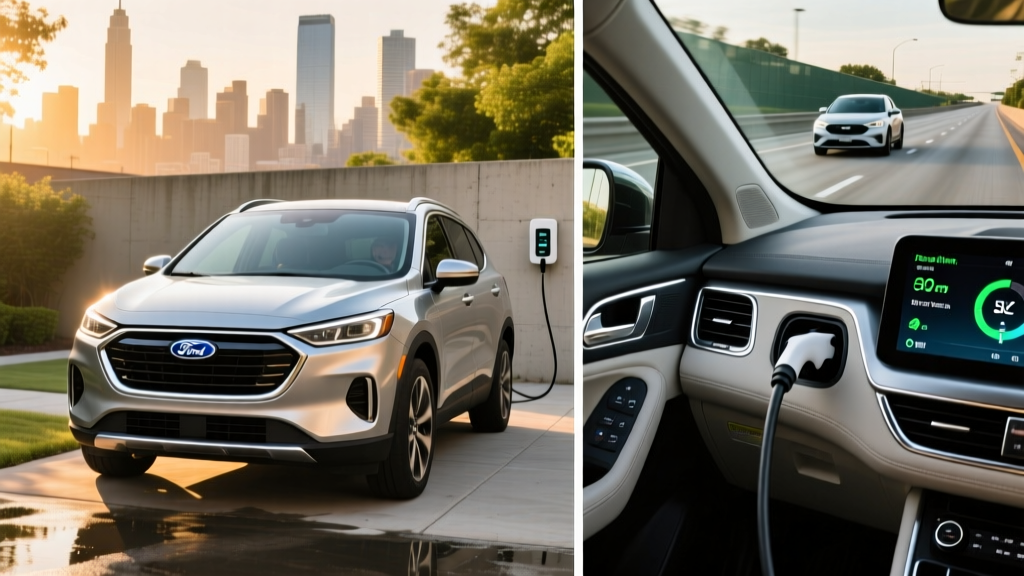
Quick Verdict: The Ford Escape PHEV Bridges Daily Electric and Weekend Gas
The 2026 Ford Escape Plug-In Hybrid targets buyers who want electric commuting without range anxiety on longer trips. With an EPA-rated 37 miles of electric-only range and a total combined range exceeding 520 miles, it eliminates the charging-desert worry that still plagues full EVs. The powertrain pairs a 2.5-liter Atkinson-cycle four-cylinder with a 131-hp electric motor for a combined 210 horsepower, routed through an eCVT. Base pricing starts at $41,500 (including destination), and it qualifies for the $3,750 federal tax credit under IRS §30D rules — though eligibility hinges on your adjusted gross income and point-of-sale transfer timing.
| Spec | 2026 Ford Escape PHEV |
|---|---|
| EPA Electric-Only Range | 37 miles |
| EPA MPGe (EV mode) | 105 MPGe combined |
| EPA MPG (hybrid mode) | 40 combined (42 city / 37 highway) |
| Battery Capacity | 14.4 kWh usable (NMC lithium-ion) |
| Combined Horsepower | 210 hp |
| 0-60 mph | ~8.0 seconds (estimated) |
| Level 1 Charge Time (120V) | ~10-11 hours (0-100%) |
| Level 2 Charge Time (240V) | ~3.5 hours (0-100%) |
| DC Fast Charging | No |
| Total Combined Range | ~520+ miles |
| Base MSRP | $41,500 |
| Federal Tax Credit | $3,750 (§30D, subject to income caps) |
| Hybrid Battery Warranty | 8 years / 100,000 miles |
HEV vs PHEV: Why the Plug-In Escape Exists Alongside the Standard Hybrid
Ford sells the Escape in both conventional hybrid (HEV) and plug-in hybrid (PHEV) forms. The distinction matters for your wallet and your daily routine.
| Feature | Escape Hybrid (HEV) | Escape Plug-In Hybrid (PHEV) |
|---|---|---|
| Needs to plug in? | No — self-charging via regen | Yes — for electric-only range |
| Electric-only driving | Minimal (~1 mile at low speed) | 37 miles EPA |
| Battery size | ~1.1 kWh | 14.4 kWh usable |
| Combined MPG (gas mode) | 39 combined | 40 combined |
| MPGe (electric mode) | N/A | 105 MPGe |
| Starting MSRP | ~$34,500 | $41,500 |
| Federal tax credit | None | Up to $3,750 |
The HEV is ideal if you lack home charging access — it operates like a gas car but sips fuel thanks to regenerative braking and a small battery buffer. The PHEV demands a garage or driveway with a 120V outlet (minimum) or a 240V Level 2 charger to unlock its electric advantage. If your commute is under 35 miles round-trip and you can charge overnight, the PHEV effectively functions as an EV on weekdays and a hybrid on weekends.
Electric-Only Range and Total Range: What 37 EPA Miles Actually Means
The EPA rates the 2026 Escape PHEV at 37 miles of electric-only range. In real-world driving, expect 30-34 miles in mild weather at mixed city/highway speeds. Cold temperatures (below 35°F) reduce usable range to roughly 24-28 miles due to cabin heating draw and reduced battery efficiency. Highway driving at 70+ mph will also shorten electric range to around 28-30 miles because the electric motor works harder against aerodynamic drag.
- EPA sticker: 37 miles electric-only
- Mild weather, city/suburban: 32-35 miles
- Highway (70 mph): 28-30 miles
- Cold weather (below 35°F): 24-28 miles
- After battery depletion (hybrid mode): 42 city / 37 highway / 40 combined MPG
Once the battery depletes, the Escape PHEV operates as a conventional hybrid, returning an EPA-estimated 40 MPG combined. With its 11.1-gallon fuel tank, total combined range (electric + gas) exceeds 520 miles — more than enough for any road trip without charging stops.
Charging the Escape PHEV: Level 1, Level 2, and the No-DC-Fast-Charge Limitation
The Escape PHEV uses a J1772 connector for AC charging. Unlike full EVs, it lacks DC fast charging capability — a deliberate engineering choice. PHEV batteries are small enough that overnight AC charging suffices for most owners.
| Charging Level | Power | Time (0-100%) | Use Case |
|---|---|---|---|
| Level 1 (120V household) | ~1.4 kW | 10-11 hours | Overnight, no install needed |
| Level 2 (240V home/public) | ~3.3 kW (vehicle-limited) | ~3.5 hours | Faster overnight, midday top-up |
| DC Fast Charge | N/A | N/A | Not supported |
A critical detail: the Escape PHEV's onboard charger is limited to approximately 3.3 kW, meaning even if you plug into a 7.2 kW or 11.5 kW Level 2 station, the car will only accept ~3.3 kW. This is standard for PHEVs — the smaller battery doesn't justify a larger (heavier, costlier) onboard charger. For overnight use, this is irrelevant; the car will be full by morning whether you use Level 1 or Level 2.
Level 1 charging via a standard 120V household outlet is genuinely viable for the Escape PHEV. If you drive 30 miles daily and plug in each evening, a 10-hour overnight session adds roughly 14 kWh — enough for a full charge. A Level 2 home charger (typically $500-$1,200 installed, depending on electrical panel proximity) cuts this to 3.5 hours, which matters only if you need midday top-ups or have a shorter parking window.
Powertrain and Efficiency: 210 HP Through an eCVT
The Escape PHEV's powertrain combines a 2.5-liter Atkinson-cycle four-cylinder engine (producing roughly 161 hp on its own) with a 131-hp permanent-magnet electric motor integrated into the eCVT transaxle. Combined system output is 210 horsepower. The eCVT is not a traditional belt-and-cone CVT; it's a planetary gearset that seamlessly blends engine and motor output — Toyota pioneered this architecture, and Ford licenses a variant of it.
Acceleration is adequate rather than thrilling. Expect 0-60 mph in approximately 8.0 seconds. The electric motor provides instant torque from a stop, making the Escape PHEV feel punchy in city driving even though it's not a performance vehicle. At highway speeds, the engine and motor cooperate for confident merging, though the eCVT can drone under hard acceleration.
| Driving Mode | City | Highway | Combined |
|---|---|---|---|
| Electric-only (MPGe) | 114 MPGe | 96 MPGe | 105 MPGe |
| Hybrid (gas, after battery depletion) | 42 MPG | 37 MPG | 40 MPG |
The city MPG advantage in hybrid mode (42 vs 37 highway) is typical of hybrids: regenerative braking recaptures energy in stop-and-go traffic, and the engine shuts off at idle. On the highway, aerodynamic drag dominates, and the engine runs more continuously. Owners who do mostly city driving after battery depletion will see the highest gas-mode MPG.
Real-world fuel economy often matches or slightly exceeds the EPA city estimate for hybrid-mode driving, particularly in warm weather and moderate traffic. Highway gas-mode MPG may fall 2-3 MPG below the sticker at sustained 75+ mph speeds. Source: fueleconomy.gov.
Pricing, Tax Credits, and Total Cost of Ownership
The 2026 Ford Escape PHEV starts at $41,500 (including destination) for the base Select trim. The Premium trim adds features like a panoramic sunroof and upgraded interior materials for approximately $45,000-$47,000 depending on options.
The Escape PHEV qualifies for a $3,750 federal tax credit — not the full $7,500 — because its battery meets some but not all critical-mineral and battery-component sourcing requirements under current IRS §30D rules. Key eligibility caveats:
- Income caps: Modified AGI must not exceed $150,000 (single), $225,000 (head of household), or $300,000 (joint).
- MSRP cap: The vehicle MSRP must not exceed $80,000 for SUVs (the Escape clears this easily).
- Point-of-sale transfer: You can transfer the credit to the dealer at purchase, reducing your out-of-pocket cost immediately — but you must still meet income requirements at tax-filing time, or you'll owe the credit back.
- Battery sourcing: The $3,750 figure reflects partial compliance with critical-mineral and component sourcing thresholds. This amount is subject to change as Ford adjusts supply chains.
For buyers who qualify, the effective starting price drops to approximately $37,750 — narrowing the gap with the conventional Escape Hybrid. Over five years of ownership, the PHEV's fuel savings (assuming 12,000 miles/year, 70% electric-mode driving, and $3.50/gallon gas) can total $3,500-$5,000 compared to a gas-only compact SUV, though exact savings depend on your electricity rate and driving pattern.
Battery Warranty, Reliability, and Replacement Cost
PHEV battery degradation is generally modest. The Escape PHEV's 14.4 kWh NMC battery is engineered with a buffer — you never use the full gross capacity, which reduces stress on the cells. Based on data from similar Ford hybrid systems (including the Fusion Energi and earlier Escape PHEV generations), expect 5-10% capacity loss over the first 8 years under normal use. This means your 37-mile electric range might drop to 33-35 miles after several years — noticeable but not debilitating.
Out-of-warranty battery replacement cost is the common fear. For the Escape PHEV, a high-voltage battery replacement runs approximately $6,000-$8,000 including labor at a Ford dealer. However, PHEV batteries rarely fail catastrophically; individual module replacement (if available) can cost significantly less. The hybrid system's mechanical simplicity — no traditional transmission, no starter motor, regenerative braking reducing wear on friction brakes — often results in lower maintenance costs than gas-only vehicles over the same period.
Ford's hybrid reliability record has been solid since the second-generation Fusion Hybrid (2013+). The Escape PHEV powertrain shares architecture with Toyota's proven hybrid system under a licensing agreement, which adds confidence. Check NHTSA ratings and IIHS scores for the current model year's safety performance.
- 37-mile electric range covers most commutes gas-free
- 520+ mile total range eliminates road-trip charging anxiety
- Level 1 (120V) charging is genuinely sufficient — no expensive install required
- 40 MPG hybrid mode after battery depletion beats most gas SUVs
- $3,750 federal tax credit lowers effective price
- 8-year/100,000-mile battery warranty
- No DC fast charging limits on-the-go electric top-ups
- 3.3 kW onboard charger is slow for public Level 2 stations
- $7,000 price premium over the conventional Escape Hybrid
- Cold-weather electric range drops to ~25 miles
- Only $3,750 tax credit (not the full $7,500) due to sourcing rules
- Cargo space slightly reduced vs gas model due to battery placement
Who Should Buy the Escape PHEV — and Who Shouldn't
- Your daily commute is under 35 miles round-trip and you have home charging (even a 120V outlet)
- You want electric weekday driving but take road trips where charging infrastructure is sparse
- You're not ready for a full EV due to apartment living, street parking, or frequent long trips
- You want to reduce fuel costs without behavioral change — just plug in at night
- You have no access to any charging (apartment, street parking, no outlet)
- Your commute exceeds 50+ miles daily, making the electric range less impactful
- You want the lowest purchase price and don't mind using gas for all driving
- You have reliable Level 2 home charging and your daily driving is under 250 miles
- You want zero tailpipe emissions and the lowest per-mile fuel cost
- You qualify for the full $7,500 federal EV tax credit on a larger-battery vehicle
The Escape PHEV occupies a specific niche: the bridge vehicle for households transitioning toward electrification but not yet ready to commit to a full EV. Its value proposition depends entirely on your charging access and commute distance. If you can plug in nightly and drive under 35 miles daily, you'll use almost no gasoline on weekdays. If you can't plug in regularly, you're paying a $7,000 premium for a slightly more efficient hybrid — at which point the conventional Escape HEV makes more financial sense.
Frequently Asked Questions
How many MPG does the Ford Escape Plug-In Hybrid get?
In electric mode, it achieves 105 MPGe combined (114 city / 96 highway). Once the battery is depleted and it operates as a conventional hybrid, it returns 40 MPG combined (42 city / 37 highway). Real-world hybrid-mode MPG often matches or slightly exceeds the EPA city estimate in stop-and-go driving.
How far can the Escape PHEV go on electric only?
The EPA rates it at 37 miles electric-only. In real-world conditions, expect 30-35 miles in mild weather, 28-30 miles at highway speeds, and 24-28 miles in cold weather (below 35°F). After the battery depletes, the gas engine and hybrid system provide 520+ additional miles of range.
Does the Ford Escape PHEV qualify for a tax credit?
Yes — it qualifies for a $3,750 federal tax credit under IRS §30D, not the full $7,500, due to partial battery-sourcing compliance. Eligibility depends on your modified adjusted gross income (must not exceed $150K single / $300K joint) and the vehicle's MSRP (must be under $80K for SUVs). You can transfer the credit to the dealer at point of sale. Consult a tax professional for your specific situation.
Is the Escape PHEV reliable, and what does battery replacement cost?
Ford's hybrid systems have demonstrated strong reliability since the 2013 Fusion Hybrid era, and the PHEV architecture benefits from Toyota-licensed components. The high-voltage battery is warranted for 8 years / 100,000 miles against capacity loss below 70%. Out-of-warranty battery replacement costs approximately $6,000-$8,000, though catastrophic battery failure is rare — degradation is typically 5-10% over 8 years.
Do I need to install a Level 2 charger at home?
No. The Escape PHEV charges fully overnight (10-11 hours) on a standard 120V household outlet, which is sufficient for daily electric commuting. A Level 2 (240V) charger reduces charge time to ~3.5 hours and costs $500-$1,200 installed, but it's a convenience upgrade, not a requirement. The vehicle does not support DC fast charging.
Hybrid vs PHEV vs EV — which is right for me?
Choose a conventional hybrid (HEV) if you have zero charging access and want better MPG with no behavior change. Choose a PHEV like the Escape if you have home charging and a short commute but need gas-engine range for longer trips. Choose a full EV (BEV) if you have Level 2 home charging, drive under 250 miles daily, and want the lowest operating cost and zero tailpipe emissions.