The Toyota Hybrid Dominance: Separating Fact from Fiction
Toyota didn’t just enter the hybrid market; they essentially created it. With over two decades of continuous refinement, the Toyota Hybrid System (THS) remains the gold standard for electrified commuting. However, with widespread adoption comes a wave of misinformation. Buyers frequently fall victim to outdated myths regarding battery degradation, maintenance costs, and the real-world efficiency of Plug-in Hybrid Electric Vehicles (PHEVs) versus standard Hybrid Electric Vehicles (HEVs).
If you are shopping for the best Toyota hybrid models ranked by efficiency and reliability, you need to look past the forum rumors and internet hearsay. In this guide, we are busting the most common Toyota hybrid myths, ranking the top models on the market today, and highlighting the critical maintenance mistakes that can actually compromise your vehicle’s legendary longevity.
Myth #1: ‘All Hybrid Batteries Die at 100,000 Miles and Cost $10,000 to Replace’
This is perhaps the most persistent and damaging myth in the EV and hybrid space. Early 2000s hybrid owners did face premature battery failures, but battery chemistry and thermal management systems have evolved drastically. Today, Toyota’s nickel-metal hydride (NiMH) and lithium-ion (Li-ion) hybrid batteries are engineered to last the lifetime of the vehicle.
Furthermore, Toyota has updated its warranty coverage to reflect this confidence. According to the official Toyota warranty guidelines, all hybrid batteries on 2020 and newer models are covered for 10 years or 150,000 miles, whichever comes first. In reality, data from taxi fleets and high-mileage commuters shows that Toyota hybrid batteries routinely surpass 200,000 miles with minimal degradation, provided the vehicle’s cooling systems are maintained.
Myth #2: ‘A PHEV is Always More Efficient Than a Standard HEV’
Many buyers assume that upgrading to a Plug-in Hybrid (like the RAV4 Prime or Prius Prime) automatically guarantees better fuel economy and lower running costs. This is only true if you actually plug it in.
If you lack access to home or workplace charging, a PHEV becomes a liability. Once the electric range is depleted, you are simply driving a heavier vehicle with a smaller gas tank than its standard HEV counterpart. For example, a standard RAV4 Hybrid achieves an EPA-estimated 39 MPG combined. If you never charge a RAV4 Prime, its heavier curb weight can cause its gas-only MPG to drop slightly below the standard hybrid in certain highway driving scenarios. PHEVs are only the ‘best’ choice if your daily commute fits within their electric-only range (usually 25-44 miles) and you have reliable charging infrastructure.
The Ultimate Ranking: Best Toyota Hybrids for Efficiency & Reliability
Based on EPA data, long-term dependability studies, and real-world owner feedback, here is how the current Toyota hybrid lineup stacks up.
| Model | Powertrain | Combined MPG / MPGe | Battery Warranty | Reliability Rating |
|---|---|---|---|---|
| Toyota Prius | HEV | 57 MPG | 10yr / 150k mi | 5/5 |
| Toyota Prius Prime | PHEV | 52 MPG / 127 MPGe | 10yr / 150k mi | 5/5 |
| Toyota Camry Hybrid | HEV | 52 MPG | 10yr / 150k mi | 4.5/5 |
| Toyota Corolla Hybrid | HEV | 50 MPG | 10yr / 150k mi | 5/5 |
| Toyota RAV4 Hybrid | HEV | 39 MPG | 10yr / 150k mi | 4.5/5 |
1. Toyota Prius & Prius Prime (The Efficiency Kings)
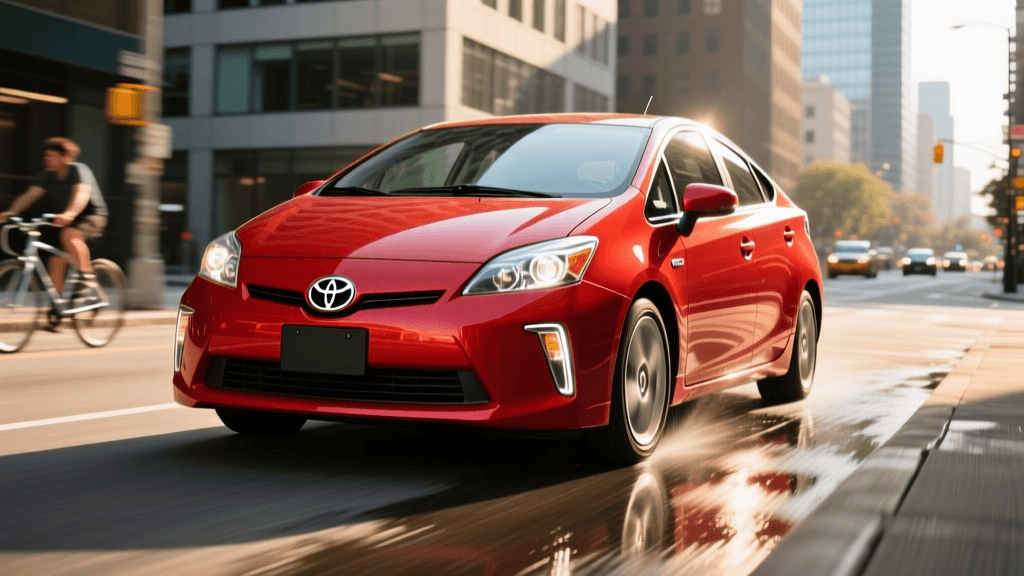
The completely redesigned Prius (featuring the 5th-generation hybrid system) is a masterclass in thermal efficiency. The standard HEV model achieves a staggering 57 MPG combined, making it the most fuel-efficient non-plug-in vehicle on the market. The Prius Prime offers up to 44 miles of EV range and 127 MPGe. Reliability is virtually bulletproof, as the Prius has served as the global benchmark for hybrid durability for over 25 years.
2. Toyota Camry Hybrid (The Midsize Sedan Sweet Spot)
Toyota has made the bold move to transition the Camry lineup to an exclusively hybrid powertrain for its latest generations. Achieving up to 52 MPG combined in FWD trims, the Camry Hybrid offers the space, comfort, and highway stability of a midsize sedan with the fuel consumption of a subcompact. It remains a top pick for rideshare drivers and high-mileage commuters due to its exceptional powertrain longevity.
3. Toyota Corolla Hybrid (The Budget Commuter)
For those who want maximum efficiency without the premium price tag of the Prius, the Corolla Hybrid is the answer. Sharing its core 1.8L hybrid powertrain with the Prius, it delivers an impressive 50 MPG combined. It is slightly less refined and slower than the new Prius, but its mechanical simplicity translates to rock-solid reliability and incredibly low cost of ownership.
4. Toyota RAV4 Hybrid & Prime (The SUV Benchmark)
The RAV4 Hybrid proves that you don’t need to sacrifice utility for efficiency. With standard All-Wheel Drive (AWD) and 39 MPG combined, it dominates the compact SUV segment. The RAV4 Prime adds 300 horsepower and 42 miles of EV range, making it one of the most desirable PHEVs on the market. Data from the J.D. Power Vehicle Dependability Study consistently places Toyota at or near the top of the mass-market segment, largely buoyed by the RAV4’s outstanding long-term performance.
Common Mistakes Toyota Hybrid Owners Make
While Toyota’s hybrid systems are incredibly robust, they are not maintenance-free. Many owners treat them exactly like traditional gas cars, leading to avoidable issues. Here are the most common mistakes to avoid:
Mistake 1: Neglecting the Inverter Coolant
The hybrid inverter converts DC power from the battery to AC power for the electric motors. It generates significant heat and has its own dedicated coolant loop. Many owners (and even some quick-lube technicians) forget to check or flush the inverter coolant. Over time, degraded coolant can lead to inverter failure, which is a costly repair. Always ensure the inverter coolant is inspected at every major service interval.
Mistake 2: Ignoring the 12-Volt Accessory Battery
A common point of confusion is why a hybrid with a massive 200+ volt traction battery can be ‘dead.’ Hybrids still rely on a standard 12V battery to power the computers, lights, and the relay that connects the main hybrid battery. If the 12V battery dies, the car will not start, even if the main hybrid battery is fully charged. Test your 12V battery annually after the 3-year mark to avoid being stranded.
Mistake 3: Poor Braking Habits (Riding the Pedal)
Regenerative braking is what makes hybrids so efficient. The U.S. Department of Energy’s Alternative Fuels Data Center notes that regenerative braking captures kinetic energy to recharge the battery. However, if you constantly ‘ride’ the brake pedal or brake aggressively at the last second, the system bypasses the regenerative motor and uses the traditional friction brake pads. This not only ruins your fuel economy but causes premature wear on the physical brake rotors and pads.
Mistake 4: Letting the Gas Tank Sit Empty or Stale
Because PHEVs and highly efficient HEVs use so little gas, owners often go months between fill-ups. Gasoline degrades over time, losing its combustibility and potentially clogging fuel injectors. Furthermore, Toyota’s fuel system is pressurized to prevent evaporative emissions. Running the tank down to the absolute dregs frequently can cause the fuel pump to overheat, as it relies on the surrounding gasoline for cooling. Try to keep the tank at least a quarter full and use a fuel stabilizer if you plan to leave the car sitting for extended periods.
Conclusion
Toyota’s hybrid lineup remains the safest, most reliable entry point into vehicle electrification. By understanding the reality of battery warranties, choosing the right powertrain (HEV vs. PHEV) for your specific lifestyle, and adhering to hybrid-specific maintenance routines, you can easily extract hundreds of thousands of trouble-free miles from your vehicle. Whether you choose the ultra-efficient Prius or the family-friendly RAV4 Hybrid, you are investing in proven, myth-defying technology.