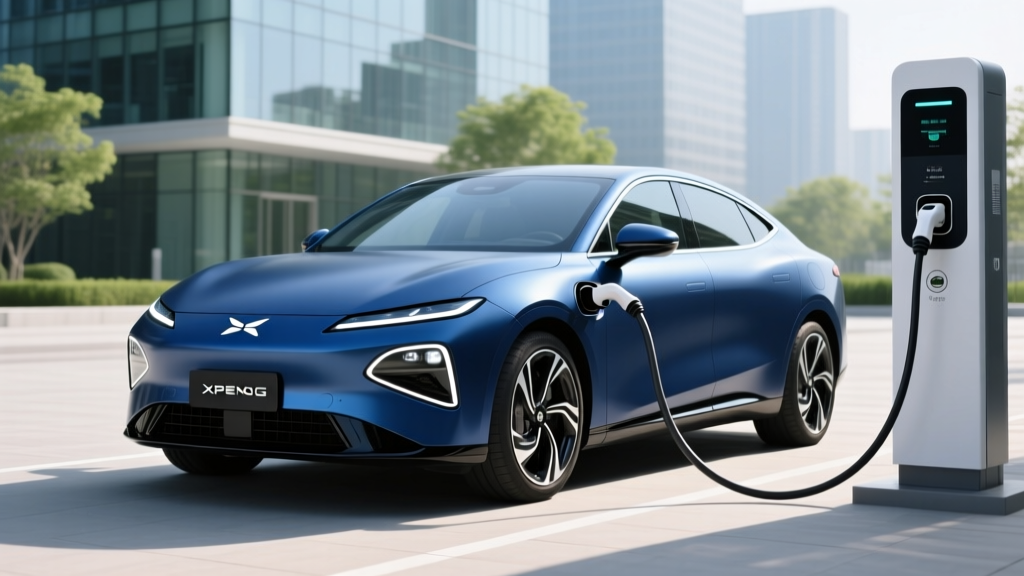
If you've been following the global EV market, the name XPeng has likely surfaced in conversations about China's rapidly maturing electric-vehicle industry. The XPeng G6 — a midsize electric crossover positioned against the Tesla Model Y and Hyundai Ioniq 5 — represents the brand's most internationally ambitious model. But for US-based buyers searching for an XPeng EV, the picture requires some important context: as of early 2026, XPeng has not officially launched retail sales in the United States, and its vehicles are not EPA-certified for the American market.
This review examines the XPeng G6 using the most current available specifications from XPeng's international markets (Europe, Australia, Southeast Asia), cross-referenced with independent testing data. We'll break down what this EV actually delivers in range, charging, tech, and value — and what US buyers need to know about availability, import feasibility, and comparable alternatives already on American roads.
XPeng G6 at a Glance: Core Specifications
The G6 rides on XPeng's SEPA 2.0 (Smart Electric Platform Architecture) with an 800-volt silicon carbide electrical architecture — a hardware decision that directly enables its standout charging performance. Two battery sizes and both rear-wheel-drive and all-wheel-drive configurations are offered globally.
| Spec | RWD Standard Range | RWD Long Range | AWD Performance |
|---|---|---|---|
| Battery (usable) | 66 kWh (LFP) | 87.5 kWh (NMC) | 87.5 kWh (NMC) |
| WLTP Range | ~267 mi (430 km) | ~354 mi (570 km) | ~336 mi (540 km) |
| Est. EPA-equivalent Range | ~225–240 mi | ~300–315 mi | ~280–295 mi |
| Power | 255 hp (190 kW) | 255 hp (190 kW) | 480 hp (358 kW) |
| 0–100 km/h (0–62 mph) | 6.6 sec | 6.6 sec | 3.9 sec |
| Drivetrain | RWD single motor | RWD single motor | AWD dual motor |
| Max DC Charge Rate | ~215 kW peak | ~280 kW peak | ~280 kW peak |
| 10–80% DC Charge | ~20 min | ~20 min | ~20 min |
| AC Level 2 Charge | 11 kW | 11 kW | 11 kW |
| Length / Width / Height | 186.8 in / 74.8 in / 65.4 in (4,753 / 1,920 / 1,650 mm) | ||
| Wheelbase | 111.0 in (2,890 mm) | ||
| Cargo (rear seats up) | ~20.1 cu ft (571 L) | ||
| Cargo (rear seats folded) | ~57.0 cu ft (1,610 L) | ||
Note: XPeng publishes WLTP range figures, which tend to run 10–15% higher than US EPA estimates. The "Est. EPA-equivalent" row is AutoEdgeView's projection based on typical WLTP-to-EPA conversion ratios observed in similar vehicles. These are not official EPA numbers.
Real-World Range: What WLTP Numbers Don't Tell You
WLTP sticker (Long Range RWD): 354 mi (570 km)
Estimated EPA-equivalent: ~300–315 mi
Real-world highway (70 mph, moderate temps): ~260–280 mi
Real-world cold weather (below 32°F / 0°C): ~220–250 mi
The G6 Long Range's 87.5 kWh NMC battery delivers genuinely competitive range on paper. In European independent testing by outlets including What Car? and Norwegian outlet NAF, the Long Range RWD variant has demonstrated highway consumption in the range of 18–20 kWh/100 km (roughly 3.0–3.3 mi/kWh) at sustained motorway speeds in mild conditions — translating to approximately 260–280 real-world highway miles on a full charge.
The Standard Range model's 66 kWh LFP (lithium iron phosphate) battery is a different calculus. LFP chemistry sacrifices some energy density — hence the smaller capacity in a similar physical pack size — but gains in cycle longevity and thermal stability. Owners can routinely charge LFP packs to 100% without the degradation concerns that NMC packs face at high states of charge. For a daily commuter covering 40–60 miles round trip, the Standard Range's ~225–240 estimated EPA-equivalent miles is more than sufficient, and the LFP chemistry means less long-term battery anxiety.
Cold-weather performance is where the G6, like most EVs without a dedicated heat pump standard across all trims in every market, loses meaningful range. Expect 20–30% range reduction in sustained sub-freezing conditions, consistent with industry norms. The AWD Performance variant compounds this with higher consumption from its dual-motor setup.
Charging Speed: The 800V Architecture Advantage
This is where the XPeng G6 makes its strongest technical argument. The 800V silicon carbide platform isn't just a marketing bullet — it enables sustained high-power DC charging that outperforms many competitors still running 400V architectures.
| Charging Method | Power / Rate | Time / Delivery |
|---|---|---|
| DC Fast Charge (peak) | Up to 280 kW (Long Range / AWD) | 10–80% in ~20 minutes |
| DC Fast Charge (Std Range) | Up to ~215 kW | 10–80% in ~20 minutes |
| DC Fast — miles added in 10 min | ~185 mi (300 km) WLTP-based | Long Range variant |
| Level 2 AC (home / public) | 11 kW (3-phase) / ~7 kW (single-phase US equivalent) | ~30–37 mi/hr (11 kW); ~20–24 mi/hr (7 kW) |
| Level 1 AC (120V household) | ~1.4–1.9 kW | ~4–6 mi/hr |
On a capable 350 kW charger (such as Ionity stalls in Europe or Electrify America's latest US stations), the Long Range G6 can accept up to 280 kW peak. XPeng's published charge curve shows the pack holding above 200 kW through approximately 50% state of charge before tapering — a characteristic advantage of 800V systems that reduces the gap between "peak" and "sustained" charge rates. The 10–80% time of approximately 20 minutes is competitive with the Hyundai Ioniq 5 (18 min at 240 kW) and significantly quicker than the Tesla Model Y Long Range (~27 min at 250 kW peak on V3 Superchargers).
For home charging, the G6 supports 11 kW on three-phase AC power (common in Europe and parts of Asia). In North America, where residential service is predominantly single-phase 240V, expect approximately 7–7.7 kW from a 32-amp Level 2 home charger — delivering roughly 22–25 miles of range per hour of charging. An overnight 8–10 hour session easily replenishes the battery from 20% to full.
Charging curve reality: The oft-advertised "280 kW" figure is a peak, not a sustained rate. In practice, the G6 — like all EVs — tapers charge speed as the battery fills, particularly above 80% SoC. That 10–80% time of ~20 minutes is the meaningful metric, and it's excellent. Charging from 80–100% will add another 15–20 minutes; plan accordingly on road trips and charge to 80% unless you need the final margin.
Performance and Driving Dynamics
The AWD Performance variant's 3.9-second 0–62 mph time places it in genuine sports-sedan territory — competitive with a Tesla Model Y Performance (3.5 sec) and comfortably quicker than a Hyundai Ioniq 5 AWD (5.2 sec). The RWD models at 6.6 seconds are adequate for daily driving and highway merging but won't win drag races.
XPeng tunes the G6's chassis with a rear-biased character on RWD trims, with multi-link rear suspension contributing to composed ride quality on varied surfaces. European reviewers have noted steering that is precise if somewhat numb — a common trait in electric crossovers prioritizing efficiency over engagement. The regenerative braking system offers adjustable intensity, though true one-pedal driving (coming to a complete stop via regen alone) is available only in the strongest setting and may not hold the vehicle indefinitely on inclines.
Interior, Tech, and Driver Assistance
The G6's cabin follows the minimalist template popularized by Tesla: a single 14.96-inch central touchscreen handles infotainment, climate, and vehicle settings, supplemented by a 10.2-inch digital instrument cluster. The infotainment runs XPeng's Xmart OS 4.0, which supports voice control (with a customizable AI avatar in some markets), over-the-air updates, and app integration.
XPeng XNGP (driver assistance): The G6 is equipped with XPeng's XNGP advanced driver-assistance system, which in China has demonstrated impressive urban navigation capabilities using lidar (on equipped trims) alongside cameras and radar. However, it is critical to understand the SAE automation level:
XNGP, like Tesla Autopilot, GM Super Cruise, and Ford BlueCruise, is a Level 2 system. The driver must remain engaged, hands on or near the wheel, and eyes on the road at all times. This is not autonomous driving. Only Level 4 services like Waymo operate without a human driver, and those are geofenced robotaxis, not consumer vehicles.
In international markets where XNGP is available, reviews describe confident highway lane-keeping, smooth adaptive cruise behavior, and capable automatic parking. The lidar-equipped variants (available in China, limited in other markets) provide enhanced object detection, particularly in low-visibility scenarios. However, the system's full urban navigation features are currently optimized for Chinese road infrastructure and may not translate seamlessly to other markets.
Notable interior drawbacks: Rear-seat headroom is adequate but not generous for passengers over 6 feet, owing to the sloping roofline. The cargo area at 20.1 cu ft (seats up) trails the Tesla Model Y's ~26 cu ft behind the second row. There is no front trunk (frunk), as the space is occupied by HVAC and power electronics — a packaging choice that costs the G6 a useful storage feature competitors offer.
Pricing, Availability, and Tax Credit Reality
Here is where US buyers face a hard truth: the XPeng G6 is not currently available for purchase in the United States. XPeng has focused its international expansion on Europe (Norway, Netherlands, Germany, Denmark), Australia, Thailand, and other Southeast Asian markets. The company has not announced a US launch timeline, and significant regulatory, homologation, and tariff barriers remain.
| Market | Trim | Local Price | Approx. USD Equivalent |
|---|---|---|---|
| United Kingdom | RWD Standard Range | ~£37,000 | ~$46,500 |
| United Kingdom | RWD Long Range | ~£42,000 | ~$52,800 |
| Australia | RWD Long Range | ~AUD $54,000 | ~$35,000 |
| Norway | AWD Performance | ~NOK 520,000 | ~$48,500 |
| China (domestic) | RWD Long Range | ~¥220,000 | ~$30,500 |
Pricing varies dramatically by market due to tariffs, local incentives, and homologation costs. The Chinese domestic price reflects the intense price competition in that market and is not indicative of what US pricing would be if the G6 were imported — tariffs on Chinese-manufactured vehicles (currently 100% under 2024–2026 US trade policy) would effectively double the cost.
Because the XPeng G6 is not sold in the US and is manufactured in China, it does not qualify for the IRS §30D federal EV tax credit. Even if it were available, current §30D rules include battery-sourcing and critical-mineral requirements that effectively exclude Chinese-manufactured battery packs, along with MSRP caps ($55,000 for sedans, $80,000 for SUVs/trucks) and buyer income limits ($150K single / $300K joint). Always verify current rules at IRS.gov.
How the G6 Compares: US-Available Alternatives
Since US buyers cannot purchase the G6, the practical question is: which available EVs deliver a similar package? Here's how the G6's specifications stack up against the competitors it was designed to challenge:
| Attribute | XPeng G6 LR RWD | Tesla Model Y LR AWD | Hyundai Ioniq 5 LR RWD |
|---|---|---|---|
| Est. EPA Range | ~300–315 mi* | 320 mi (EPA) | 303 mi (EPA) |
| Battery | 87.5 kWh NMC | ~75 kWh NMC | 77.4 kWh NMC |
| Max DC Charge | 280 kW | 250 kW | 240 kW |
| 10–80% DC Time | ~20 min | ~27 min | ~18 min |
| Architecture | 800V SiC | ~400V | 800V |
| 0–60 mph | 6.6 sec | 4.8 sec | 7.0 sec |
| Cargo (seats up) | 20.1 cu ft | 26.6 cu ft | 27.2 cu ft |
| US Availability | Not available | Yes | Yes |
| §30D Tax Credit | No | Partial (verify eligibility) | Partial (verify eligibility) |
| Base MSRP (US) | N/A | ~$44,990 | ~$42,600 |
*XPeng G6 range is an estimated EPA-equivalent, not an official EPA rating.
The comparison reveals the G6's genuine competitiveness on charging speed and range, but also its cargo-space deficit and — most critically — its unavailability in the US market. The Ioniq 5's 800V architecture delivers comparable charging performance with a robust US dealer and service network. The Model Y offers superior cargo volume and access to the Supercharger network, though its older electrical architecture means slower peak charging.
Pros, Cons, and Who Should Consider the G6
- 800V architecture enables 280 kW peak DC charging — among the fastest in its class
- 10–80% in ~20 minutes is genuinely road-trip-capable
- Competitive range (est. ~300+ mi EPA-equivalent for Long Range)
- LFP option on Standard Range offers superior cycle life and 100% daily charging
- Advanced XNGP driver assist with lidar (market-dependent)
- Strong value pricing in international markets
- Not available in the US — no sales, service, or parts network
- No federal or state tax credit eligibility for US buyers
- Cargo space (20.1 cu ft) trails key competitors significantly
- No frunk — missed utility opportunity
- WLTP-only range figures; no EPA certification
- XNGP urban features optimized for Chinese roads
- 100% US tariff on Chinese-manufactured vehicles makes import economically unviable
Who the XPeng G6 suits (in markets where it's sold): The G6 is ideal for daily commuters and weekend road-trippers who prioritize fast charging above all else. If your routine includes regular DC fast-charging stops — apartment dwellers without home charging, or drivers covering 200+ mile routes frequently — the 800V architecture's sustained charge speed is a tangible daily benefit. Families will find rear-seat space adequate but should note the cargo compromise versus a Model Y or Ioniq 5.
For US buyers: The G6 is a compelling "what if" — a well-engineered EV that demonstrates China's rapid closure of the quality gap with Korean and American competitors. But until XPeng establishes a US presence (or manufactures in a tariff-exempt facility), the practical alternatives are clear: the Hyundai Ioniq 5 for comparable 800V charging, the Tesla Model Y for cargo and charging-network access, or the Ford Mustang Mach-E for a more engaging drive with domestic dealer support.
Frequently Asked Questions
Can I buy an XPeng EV in the United States in 2026?
No. As of early 2026, XPeng does not sell vehicles in the US market. The company's international presence spans Europe, Australia, and Southeast Asia. No US launch date has been announced, and current 100% tariffs on Chinese-manufactured vehicles present a major economic barrier.
What is the real-world range of the XPeng G6?
The Long Range RWD variant achieves approximately 260–280 real-world highway miles in moderate temperatures, based on European independent testing. In cold weather (below freezing), expect roughly 220–250 miles. The published WLTP figure of 354 miles overstates real-world US-equivalent usage by approximately 15–20%.
How fast does the XPeng G6 charge?
On a capable 350 kW DC fast charger, the Long Range and AWD variants peak at 280 kW and charge from 10–80% in approximately 20 minutes. The Standard Range variant peaks around 215 kW with a similar 10–80% time due to its smaller battery. Home Level 2 charging at 11 kW (3-phase) or ~7 kW (US single-phase) adds 22–37 miles per hour depending on electrical supply.
Does the XPeng G6 qualify for the US federal EV tax credit?
No. The §30D federal tax credit requires the vehicle to be sold in the US, meet battery-sourcing and critical-mineral requirements (which effectively exclude Chinese-manufactured batteries), fall under MSRP caps, and the buyer must meet income limits. The G6 satisfies none of these criteria as it is not sold in the US. Verify current rules at IRS.gov.
Is the XPeng G6 worth waiting for vs. buying a Tesla Model Y or Ioniq 5 now?
For US buyers, waiting is not practical — there is no announced timeline for XPeng's US entry, and tariff barriers make near-term availability unlikely. The Hyundai Ioniq 5 offers comparable 800V charging speed and is available now with US dealer support and potential tax credit eligibility. The Tesla Model Y provides superior cargo space and Supercharger network access. Neither represents a compromise versus a G6 you cannot buy.
What battery chemistry does the XPeng G6 use?
The Standard Range variant uses a 66 kWh LFP (lithium iron phosphate) battery, which offers longer cycle life, better thermal stability, and the ability to charge to 100% routinely without degradation concerns. The Long Range and AWD Performance variants use an 87.5 kWh NMC (nickel manganese cobalt) battery for higher energy density and longer range.
Sources: XPeng international press specifications; European independent testing data; fueleconomy.gov for US competitor EPA figures; IRS §30D clean vehicle credit guidelines.