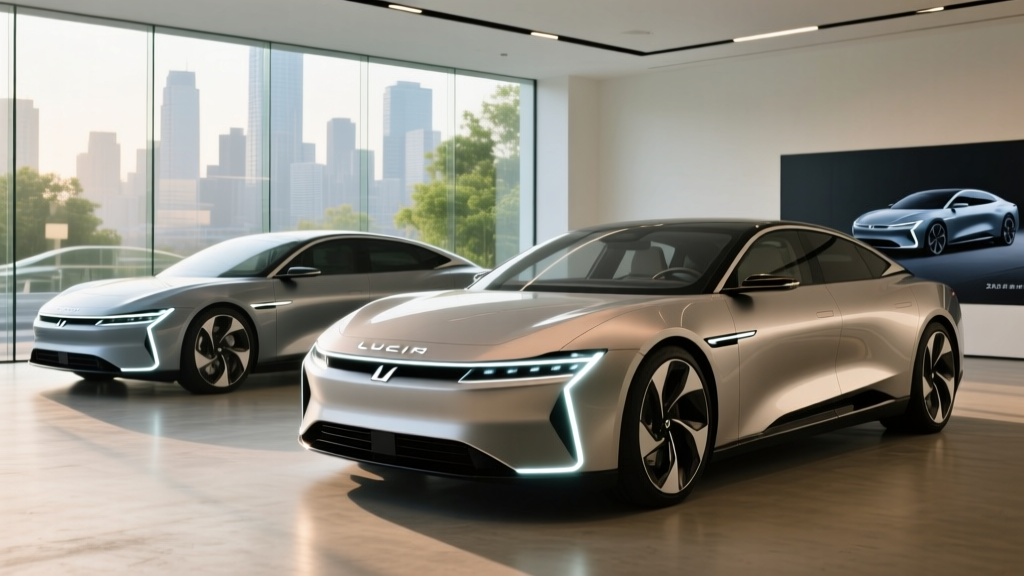
If you've searched "who makes the Lucid car" and landed here, you're not alone. Lucid Motors doesn't have the century-old brand recognition of Ford or the viral footprint of Tesla, yet it builds the most range-efficient luxury sedan on the US market. Let's answer the origin question, then get into the data that actually matters to buyers: EPA range, charging curves, real-world efficiency, and whether the 2026 Lucid Air justifies its six-figure starting price.
Who Makes the Lucid Car? The Company Behind the Air and Gravity
Lucid Group, Inc. (NASDAQ: LCID) is the automaker behind the Lucid Air sedan and the upcoming Gravity SUV. Founded in 2007 as Atieva, the company originally focused on EV battery and powertrain technology before pivoting to full vehicle manufacturing in 2016 and rebranding as Lucid Motors. Headquartered in Newark, California, Lucid operates a vertically integrated, purpose-built EV factory in Casa Grande, Arizona — branded AMP-1 (Advanced Manufacturing Plant 1).
Lucid's powertrain engineering pedigree runs deep. The company supplied battery systems to Formula E teams and designed its own compact drive units in-house, which is why the Air achieves class-leading efficiency (kWh per mile) despite its full-size luxury proportions. As of 2026, Saudi Arabia's Public Investment Fund (PIF) remains Lucid's majority shareholder, providing capital stability that several EV startups have lacked.
Lucid doesn't badge-engineer or rebadge. Every Air rolls off a dedicated EV platform with a proprietary 900-volt electrical architecture — the same voltage class used by the Porsche Taycan and Hyundai Ioniq 5, but executed with a focus on range rather than peak track performance.
2026 Lucid Air: Spec Table at a Glance
| Spec | Air Pure | Air Touring | Air Grand Touring | Air Sapphire |
|---|---|---|---|---|
| EPA Range | 419 mi | 425 mi | 516 mi | 427 mi |
| Battery (usable) | 88 kWh (NMC) | 92 kWh (NMC) | 112 kWh (NMC) | 118 kWh (NMC) |
| Drivetrain | RWD (single motor) | AWD (dual motor) | AWD (dual motor) | AWD (tri-motor) |
| Horsepower | 430 hp | 620 hp | 819 hp | 1,234 hp |
| 0–60 mph | 5.0 sec | 3.4 sec | 3.0 sec | 1.89 sec |
| MPGe (combined) | 146 MPGe | 131 MPGe | 131 MPGe | 105 MPGe |
| kWh/100 mi | 23 | 26 | 26 | 32 |
| Peak DC Charge | 220 kW | 250 kW | 300 kW | 300 kW |
| 10–80% DC Time | ~25 min | ~22 min | ~20 min | ~20 min |
| Level 2 Rate | 19.2 kW (~75 mi/hr) | 19.2 kW (~75 mi/hr) | 19.2 kW (~75 mi/hr) | 19.2 kW (~75 mi/hr) |
| Base MSRP | $69,900 | $77,900 | $125,600 | $249,000 |
Source: fueleconomy.gov and Lucid Motors official specifications, 2026 model year.
Real-World Range: What the EPA Number Doesn't Tell You
EPA Sticker: 516 miles (Grand Touring, 19" wheels)
Real-World Expectation: ~400–440 mi on mixed highway driving at 70–75 mph; ~350–380 mi in sub-freezing temperatures; ~460+ mi in city/regen-heavy commuting.
The Grand Touring's 516-mile EPA figure is legitimate — verified by EPA test data — but it's achieved under laboratory conditions that favor low-speed urban driving and moderate climate control use. On a 75-mph highway run in 85°F Arizona heat (with A/C drawing ~2 kW continuously), expect roughly 420–440 miles before the low-SoC warning. In 25°F winter conditions, lithium-ion internal resistance rises and cabin heating demands climb, reducing usable range by 15–25%. That drops the Grand Touring to roughly 380–400 miles real-world.
Still, those are numbers most competing luxury EVs can only dream of. The Air Pure's 419 EPA miles at a sub-$70K price point remains the efficiency benchmark for the segment.
Charging Speed: 900-Volt Architecture in Practice
| Charging Level | Power / Voltage | Miles Added per Hour | Notes |
|---|---|---|---|
| Level 1 (120V outlet) | ~1.4 kW | ~5 mi/hr | Emergency/trickle only |
| Level 2 (240V home) | 19.2 kW | ~75 mi/hr | Full overnight recharge in 6–12 hrs |
| DC Fast Charge | Up to 300 kW (Grand Touring/Sapphire) | ~300 mi in 20 min (10–80%) | Requires 350 kW-capable CCS/NACS station |
Lucid's 900-volt battery architecture enables sustained high-power DC charging that 400V competitors struggle to match. The Grand Touring and Sapphire peak at 300 kW on capable Electrify America or Tesla Supercharger (with NACS adapter) stalls. However, peak is not sustained: the charge curve tapers noticeably above 55% SoC, and drops sharply past 80% to protect battery longevity. A 10–80% session takes roughly 20 minutes; an 80–100% top-off can take another 25–30 minutes.
Home charging note: The Air's 19.2 kW onboard charger is among the fastest in any production EV. To exploit it, you'll need a hardwired Level 2 wall connector on a 100-amp circuit (80A continuous). Most homes require a panel upgrade or dedicated sub-panel for this — budget $1,500–$3,500 for the electrical work, plus the charger hardware itself.
Interior, Cargo, and Standout Tech
The Air's cabin leans minimalist-luxury, with a curved 34-inch glass canopy display (5K resolution) spanning the driver's instrument cluster and infotainment. A lower retractable "Pilot" touchscreen panel handles secondary controls. Wireless Apple CarPlay and Android Auto are standard, along with a 21-speaker Surreal Sound Pro audio system (Touring and above).
Passenger space: Rear-seat legroom measures 37.6 inches — generous for a sedan and competitive with the Mercedes EQS. Headroom is excellent thanks to the skateboard battery platform and absence of a transmission tunnel.
Cargo volume: The trunk offers 22.1 cubic feet (class-leading for a luxury sedan), plus a 3.5 cu-ft front trunk (frunk) under the hood. Total enclosed storage: ~25.6 cu ft.
DreamDrive Pro ADAS: Lucid's driver-assistance suite includes adaptive cruise control, lane centering, automatic emergency braking, and a LiDAR sensor (on Touring and above) for enhanced object detection. DreamDrive Pro is an SAE Level 2 system — the driver must remain attentive and keep hands on or near the wheel at all times. It is not self-driving. Competent for highway cruising, but it doesn't match the mapping depth of GM's Super Cruise or Ford's BlueCruise on supported roads.
Pricing, Tax Credits, and Ownership Costs
| Trim | Base MSRP | As-Tested (typical) | §30D Federal Credit Eligible? |
|---|---|---|---|
| Air Pure | $69,900 | $72,000–$75,000 | Potentially — see rules below |
| Air Touring | $77,900 | $82,000–$88,000 | Potentially — see rules below |
| Air Grand Touring | $125,600 | $130,000–$140,000 | No — exceeds MSRP cap |
| Air Sapphire | $249,000 | $249,000+ | No — exceeds MSRP cap |
Federal tax credit rules (IRS §30D, 2026): The up-to-$7,500 new EV tax credit applies only to sedans with an MSRP at or below $55,000. This immediately disqualifies the Grand Touring and Sapphire. The Pure and Touring trims may qualify, but eligibility hinges on three additional criteria:
- Buyer income caps: Modified AGI ≤ $150,000 (single), ≤ $225,000 (head of household), ≤ $300,000 (joint).
- Battery sourcing: A percentage of critical minerals and battery components must be sourced from the US or free-trade-agreement partners. These thresholds tighten annually. Verify current-year compliance on IRS.gov.
- Point-of-sale transfer: Eligible buyers can transfer the credit to the dealer at purchase for an immediate price reduction, rather than claiming it at tax time.
Always confirm eligibility with a tax professional before purchase. Incentive rules are subject to legislative change.
Pros, Cons, and Who Should Buy the Lucid Air
Pros
- Class-leading EPA range (516 mi Grand Touring)
- Best-in-segment efficiency (23 kWh/100 mi, Pure)
- 300 kW DC fast charging with 900V architecture
- 19.2 kW Level 2 onboard charger (fastest home-charge rate available)
- Spacious rear seat and 22+ cu-ft trunk
- Arizona-built with vertically integrated powertrain
Cons
- Limited service center network vs. Tesla or legacy luxury brands
- DreamDrive Pro ADAS lags Super Cruise/BlueCruise in hands-free coverage
- Grand Touring and Sapphire exceed $55K sedan MSRP cap — no federal credit
- Brand awareness and resale-value track record still developing
- 100-amp circuit required for max Level 2 charging — costly home install
Best for: High-mileage commuters, road-trip enthusiasts, and luxury sedan buyers who prioritize range and efficiency over badge prestige. The Air Pure at ~$70K is arguably the best value-per-mile-of-range EV on the market. The Grand Touring suits buyers who want 500+ miles of buffer and don't need the tax credit.
Look elsewhere if: You need hands-free highway driving (consider BMW i5 with Highway Assistant or Genesis Electrified G80), you want SUV cargo height (wait for the Lucid Gravity or consider the Tesla Model X), or you live far from a Lucid service center.
Lucid Air vs. Key Competitors
| Spec | Lucid Air GT | Tesla Model S LR | Mercedes EQS 450+ | BMW i5 eDrive40 |
|---|---|---|---|---|
| EPA Range | 516 mi | 402 mi | 390 mi | 295 mi |
| Efficiency (kWh/100mi) | 26 | 28 | 32 | 30 |
| Peak DC Charge | 300 kW | 250 kW | 200 kW | 205 kW |
| 0–60 mph | 3.0 sec | 3.1 sec | 5.9 sec | 5.7 sec |
| Base MSRP | $125,600 | $74,990 | $104,400 | $66,800 |
| Federal Credit? | No | No (sedan cap) | No | No |
The Air Grand Touring wins on range and charging speed by a wide margin. The Tesla Model S Long Range offers comparable performance at a lower price but with a less premium interior. The EQS and i5 trade range for brand cachet and dealer-network convenience.
Frequently Asked Questions
Is Lucid owned by Tesla or another major automaker?
No. Lucid Group, Inc. is an independent, publicly traded company (NASDAQ: LCID). Saudi Arabia's Public Investment Fund holds a majority stake, but Lucid operates autonomously with its own engineering, design, and manufacturing teams.
What is the real-world range of the Lucid Air?
The Grand Touring's EPA rating is 516 miles. Real-world highway driving at 70–75 mph yields roughly 420–440 miles. In freezing weather, expect 380–400 miles. The Pure trim (419 EPA) delivers around 340–360 miles highway.
How fast does the Lucid Air charge at home?
The Air's 19.2 kW onboard Level 2 charger adds roughly 75 miles of range per hour on a 240V/100A hardwired circuit. A full charge from near-empty takes about 6 hours (Pure) to 12 hours (Grand Touring). This is the fastest AC charging rate available in any production EV.
Does the Lucid Air qualify for the $7,500 federal EV tax credit?
Only the Pure and Touring trims potentially qualify, as the IRS §30D credit caps sedan MSRP at $55,000 — and even these trims' MSRPs exceed that threshold in most configurations. The Grand Touring and Sapphire are definitively ineligible. Always verify battery-sourcing compliance and buyer income limits on IRS.gov before purchasing.
Where are Lucid cars manufactured?
All Lucid Air sedans are built at AMP-1, Lucid's vertically integrated factory in Casa Grande, Arizona. The facility uses a purpose-built EV production line and houses battery pack assembly on-site.
What is the Lucid Air's battery warranty?
Lucid provides an 8-year / 100,000-mile battery and powertrain warranty covering defects and capacity degradation below 70% of original capacity. The basic vehicle warranty is 5 years / 60,000 miles.
Is the Lucid Air self-driving?
No. Lucid's DreamDrive Pro is an SAE Level 2 driver-assistance system. It can handle steering, acceleration, and braking on highways, but the driver must remain fully engaged and ready to take over at any moment. It is not autonomous.
For the latest Lucid Air pricing and specifications, consult Lucid Motors' official site. For federal tax credit rules, refer to IRS Publication on Clean Vehicle Credits.