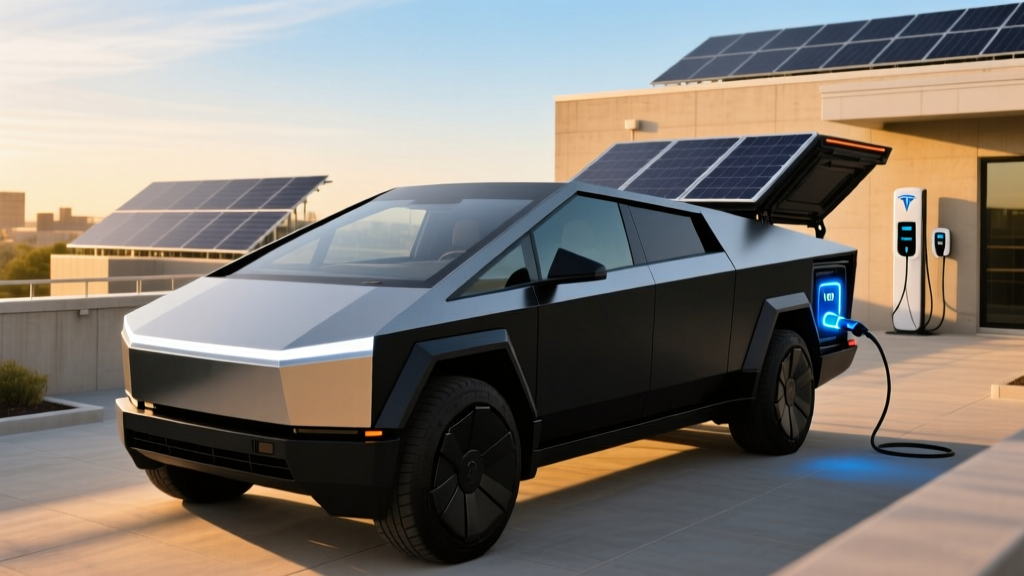
The Tesla Cybertruck isn't just a pickup — it's a rolling 123 kWh battery with outlets. While most EV reviews focus on range and 0-60 times, the Cybertruck's PowerShare system is arguably its most differentiated feature: bidirectional charging that lets you power tools at a job site, run appliances during an outage, or even back-feed your entire home. But how much power can it actually deliver, how does that affect range, and does the rest of the truck hold up as a daily driver? We break down every spec that matters.
Cybertruck PowerShare: What It Actually Does
PowerShare is Tesla's branding for the Cybertruck's bidirectional energy capabilities. It encompasses two distinct modes:
- Vehicle-to-Load (V2L): The truck's bed outlets (two 120V/20A NEMA 5-20 receptacles and one 240V/40A NEMA 14-50) deliver up to 9.6 kW of continuous power to external devices. You can plug in compressors, welders, circular saws, or a catering setup without a generator.
- Vehicle-to-Home (V2H): Paired with Tesla's PowerShare Gateway (a separate $2,000–$3,000 installed component), the Cybertruck can back-feed your home's electrical panel during an outage, supplying up to 9.6 kW — enough to run lights, refrigeration, HVAC (depending on load), and essential circuits for days.
This is not theoretical. Tesla began shipping V2H-capable Cybertrucks in late 2024, and by the 2026 model year, the hardware is standard on all trims. The Gateway installation requires a licensed electrician and a dedicated circuit integration, similar to how a standby generator or Powerwall connects.
• V2L (bed outlets): up to 9.6 kW continuous
• V2H (via Gateway): up to 9.6 kW to home panel
• 120V outlets: 2 × NEMA 5-20 (20A each)
• 240V outlet: 1 × NEMA 14-50 (40A)
• Estimated home backup duration: 3–5 days at moderate load (~2–3 kW average draw)
Range, Battery & Efficiency: The 123 kWh Reality
The Cybertruck uses a massive ~123 kWh usable battery pack. Tesla has not publicly disclosed cell chemistry for the production Cybertruck, but industry analysis and supply-chain reporting point to a high-nickel NMC (nickel-manganese-cobalt) configuration, consistent with Tesla's performance-oriented vehicles. The 4680-format cells are structurally integrated into the skateboard chassis.
Cybertruck AWD (Dual Motor): EPA 340 miles
Cybertruck Beast (Tri-Motor): EPA 320 miles
Real-world caveat: Expect 270–300 miles on the AWD at sustained 70–75 mph highway speeds in fair weather. In cold weather (below 32°F), range drops 20–30%, putting realistic winter highway range at roughly 220–250 miles. The Beast trim, with its higher curb weight and tri-motor drag, runs 10–15 miles fewer in equivalent conditions. The stainless-steel exoskeleton creates more aerodynamic drag than a curved body, which hurts efficiency at speed.
Efficiency lands at roughly 50–54 kWh/100 mi (combined), which translates to approximately 63–68 MPGe depending on trim. That's thirsty by EV standards — a Model Y averages 28 kWh/100 mi — but competitive with the Rivian R1T and Ford F-150 Lightning in the electric truck segment.
| Spec | AWD (Dual Motor) | Beast (Tri-Motor) |
|---|---|---|
| EPA Range | 340 mi | 320 mi |
| Battery (usable) | ~123 kWh | ~123 kWh |
| Chemistry | NMC (4680 cells) | NMC (4680 cells) |
| Horsepower | 600 hp | 845 hp |
| 0-60 mph | 4.1 sec | 2.6 sec |
| Drivetrain | Dual-motor AWD | Tri-motor AWD |
| Efficiency | ~50 kWh/100 mi | ~54 kWh/100 mi |
| Towing Capacity | 11,000 lbs | 11,000 lbs |
| Payload | 2,500 lbs | 2,500 lbs |
| Bed Length | 6 ft (72 in) | 6 ft (72 in) |
| Cargo Volume (bed) | ~67 cu ft | ~67 cu ft |
| Rear Legroom | ~38.5 in | ~38.5 in |
Source: Tesla Cybertruck specifications, fueleconomy.gov
Charging Speed: DC Fast, Level 2 & PowerShare Impact
The Cybertruck supports an 800-volt architecture, enabling DC fast-charge rates up to ~350 kW peak at compatible V4 Superchargers or third-party CCS/NACS stations. In practice, the charge curve peaks near 320–350 kW up to roughly 30% State of Charge (SoC), then tapers progressively. Tesla advertises up to 154 miles of range in 15 minutes under optimal conditions.
| Charging Level | Power (kW) | Speed / Time |
|---|---|---|
| Level 1 (120V household) | ~1.4 kW | ~3 mi/hr |
| Level 2 (240V / 48A Wall Connector) | 11.5 kW | ~25 mi/hr; full charge ~11 hr |
| Level 2 (240V / 80A) | 19.2 kW | ~42 mi/hr; full charge ~6.5 hr |
| DC Fast Charge (peak) | ~350 kW | 10–80% in ~25 min |
| DC Fast Charge (sustained avg 10–80%) | ~180–220 kW avg | ~154 mi in 15 min (optimal) |
Charging-curve reality check: Peak kW numbers are misleading if taken at face value. The Cybertruck sustains its highest charge rates only in the 10–40% SoC window. Above 60%, the rate drops significantly, and above 80% it slows to a trickle (under 50 kW) to protect the battery. For road trips, plan stops around the 10–80% window for the fastest turnaround.
Preconditioning matters. Navigate to a Supercharger using the truck's built-in navigation, and the thermal management system will warm or cool the battery to optimal temperature before you arrive. Without preconditioning — especially in cold weather — your peak charge rate may be cut in half for the first several minutes.
PowerShare drain math: Running a 2 kW continuous load (typical home essentials during an outage) for 24 hours consumes ~48 kWh — roughly 39% of the usable pack. That leaves you with ~190 miles of remaining range. If you're using PowerShare as a job-site generator at 5 kW for an 8-hour workday, you'll burn ~40 kWh and lose about 160 miles of range. Plan accordingly.
Pricing, Trims & Federal Tax Credit Eligibility
For the 2026 model year, Tesla offers the Cybertruck in two primary trims:
| Trim | Base MSRP | §30D Credit Eligible? | Effective Price* |
|---|---|---|---|
| AWD (Dual Motor) | $79,990 | Yes (up to $7,500) | ~$72,490 |
| Beast (Tri-Motor) | $99,990 | Yes (up to $7,500) | ~$92,490 |
*Effective price assumes full $7,500 federal tax credit. Actual credit depends on individual eligibility. Destination fee (~$1,995) not included.
Per IRS guidelines, you must meet ALL of the following:
✅ MSRP cap: Truck/SUV must be ≤ $80,000. The AWD trim qualifies; the Beast ($99,990) exceeds the cap and does NOT qualify.
✅ Income cap: Modified AGI ≤ $300,000 (joint), $225,000 (head of household), $150,000 (single).
✅ Battery sourcing: Critical minerals and battery components must meet phased-in domestic/free-trade-agreement thresholds (increasing annually through 2026).
✅ Point-of-sale transfer: You can transfer the credit to the dealer at purchase for an immediate price reduction, or claim it on your tax return.
✅ VIN registration: The vehicle must be registered for your own use in the U.S.
⚠️ The Beast trim's $99,990 MSRP exceeds the $80,000 truck cap — it does NOT qualify for the federal credit. Consult a tax professional for your specific situation.
Performance, Interior & Standout Technology
The dual-motor AWD Cybertruck produces 600 hp and hits 0-60 mph in 4.1 seconds — quick for a 6,600+ lb vehicle. The tri-motor Beast cranks out 845 hp with a 2.6-second 0-60, making it one of the fastest production pickups ever built. Both trims feature rear-axle steering (up to 10 degrees), which shrinks the turning circle to a surprisingly manageable ~40 feet despite the truck's 231-inch length.
Interior highlights:
- 18.5-inch center touchscreen running Tesla's latest software (horizontal orientation)
- 9.4-inch rear touchscreen for passengers
- Yoke steering wheel (conventional round wheel available as a no-cost option since late 2024)
- Front trunk (frunk) with ~7.1 cu ft of lockable storage
- 6-foot bed with powered retractable tonneau cover and ~67 cu ft volume
- Seats up to 6 (3-across front bench available; standard 2+3 configuration)
- HEPA air filtration with bioweapon defense mode
Driver assistance: The Cybertruck ships with Tesla's Basic Autopilot (adaptive cruise + lane centering). Enhanced Autopilot ($6,000) adds auto lane change, autosteer on city streets, and smart summon. Full Self-Driving (Supervised) at $8,000 adds traffic light/stop sign recognition and city street autosteer. All of these are SAE Level 2 systems — the driver must remain fully engaged and hands-on (or eyes-on, per Tesla's monitoring). This is not autonomous driving.
Notable drawbacks:
- The stainless-steel body panels show fingerprints and are difficult to repair; collision shops with Cybertruck certification remain limited
- Single-pane side windows create noticeable wind noise above 65 mph
- Rear visibility is compromised by the bed sail design; you'll rely heavily on the backup camera
- No Apple CarPlay or Android Auto — Tesla's ecosystem only
- The yoke steering, while improved with variable-ratio steering, still frustrates some drivers at low speeds and parking lots
- Insurance premiums run 30–50% higher than comparable F-150 Lightning or R1T policies due to repair costs
Cybertruck PowerShare vs. Competitors: Is It Worth It?
The Cybertruck's PowerShare is its most unique selling proposition in the electric truck space. Here's how bidirectional capability stacks up against key rivals:
| Feature | Cybertruck AWD | Ford F-150 Lightning | Rivian R1T (Gen 2) | Chevy Silverado EV |
|---|---|---|---|---|
| V2L (outlets) | 9.6 kW | 9.6 kW | ~7.2 kW (via bed) | Up to 10.2 kW |
| V2H (home backup) | Yes (w/ Gateway) | Yes (w/ Ford Charge Station Pro + home integration) | No (as of 2026) | Yes (w/ V2H enablement kit) |
| Battery (usable) | ~123 kWh | ~131 kWh (Ext. Range) | ~141 kWh (Max Pack) | ~200 kWh (4WT) |
| EPA Range | 340 mi | 320 mi | 420 mi | 492 mi |
| Starting MSRP | $79,990 | ~$59,995 | ~$75,900 | ~$57,900 (3WT) |
The bottom line: The F-150 Lightning offers comparable V2L/V2H capability at a significantly lower entry price, though with slightly less range. The Rivian R1T Gen 2 leads on range but lacks V2H. The Silverado EV 4WT offers the most range and the largest battery but sits at a premium price. The Cybertruck occupies a unique niche: polarizing design, strong PowerShare integration within Tesla's ecosystem (Gateway, Powerwall, solar), and performance numbers that embarrass sports cars.
Warranty & Long-Term Ownership
Tesla covers the Cybertruck with:
- Basic vehicle warranty: 4 years / 50,000 miles
- Battery & drive unit warranty: 8 years / 120,000 miles (whichever comes first), with a guaranteed minimum 70% battery capacity retention over the warranty period
- PowerShare hardware: Covered under the basic vehicle warranty (4yr/50k); the separately purchased PowerShare Gateway carries its own warranty (typically 10 years, consistent with Tesla Powerwall terms)
Given the 123 kWh pack size, a full out-of-warranty battery replacement would likely cost $15,000–$25,000 based on current Tesla service pricing per kWh, though the 4680 cell architecture and structural pack design could push labor costs higher. That said, Tesla's track record with battery degradation on NMC packs shows roughly 10–12% loss over 150,000 miles — well within the warranty threshold for most owners.
Who Should Buy the Cybertruck (And Who Shouldn't)
• You need reliable home backup power and want to eliminate a standalone generator
• You regularly power tools or equipment at remote job sites (V2L is excellent)
• You're already in the Tesla ecosystem (Superchargers, Powerwall, solar) and want seamless integration
• You value acceleration performance and tech-forward design over traditional truck aesthetics
• You tow up to 11,000 lbs and want instant electric torque for trailer launches
❌ Look elsewhere if:
• Budget is a primary concern — the F-150 Lightning and Silverado EV 3WT start $20,000+ lower
• You need maximum range — the Rivian R1T Max Pack (420 mi) or Silverado EV 4WT (492 mi) go farther
• You want a conventional truck look and easy body repairability
• You need Apple CarPlay/Android Auto
• You frequently drive in areas with limited Tesla Supercharger or NACS-compatible DC fast-charging access
Frequently Asked Questions
What is the real-world range of the Cybertruck?
The EPA rates the AWD at 340 miles and the Beast at 320 miles. In real-world highway driving at 70–75 mph, expect 270–300 miles for the AWD and 255–285 for the Beast. Cold weather (below freezing) can reduce range by 20–30%, dropping highway range to approximately 220–250 miles. Towing a 7,000+ lb trailer cuts range roughly in half.
How fast does the Cybertruck charge at home and on the road?
At home on a 48A Level 2 Tesla Wall Connector (11.5 kW), you'll add roughly 25 miles per hour, with a full 0–100% charge taking about 11 hours. On an 80A circuit, that improves to ~42 mi/hr. At a DC fast charger, the Cybertruck peaks at ~350 kW, achieving a 10–80% charge in approximately 25 minutes, though sustained average rates are closer to 180–220 kW.
Does the Cybertruck qualify for the $7,500 federal EV tax credit?
The AWD trim ($79,990 MSRP) qualifies — it's under the $80,000 truck/SUV cap set by IRS §30D. The Beast ($99,990) does NOT qualify because it exceeds the MSRP cap. All buyers must also meet income limits ($150K single / $300K joint) and the vehicle must satisfy battery-sourcing requirements. Always verify current rules at IRS.gov and consult a tax professional.
Can the Cybertruck really power my whole house?
Yes, with the PowerShare Gateway installed. At up to 9.6 kW continuous output, it can handle most household essentials — refrigerator, lights, outlets, Wi-Fi, and even a heat pump (depending on draw). With the 123 kWh battery, you can expect 3–5 days of backup at a moderate 2–3 kW average load. For comparison, a typical home uses 30–40 kWh per day.
How does PowerShare affect my driving range?
Every kWh you send to your home or tools is a kWh you can't drive. At a 2 kW continuous draw for 24 hours, you'll use ~48 kWh — about 39% of the battery, costing you roughly 130–140 miles of range. The truck's display shows real-time power draw and estimated remaining range while PowerShare is active, so you can manage your budget.
Is the Cybertruck worth buying over the F-150 Lightning?
It depends on your priorities. The Lightning starts ~$20,000 lower, offers a more conventional truck experience, has broader service-center availability, and also supports V2H (with Ford's Charge Station Pro). The Cybertruck wins on performance (especially the Beast), Tesla's Supercharger network, tighter ecosystem integration if you own Powerwall/solar, and the most distinctive design on the road. If price is paramount, the Lightning is the pragmatic choice. If you want maximum tech, speed, and Tesla integration, the Cybertruck earns its premium.