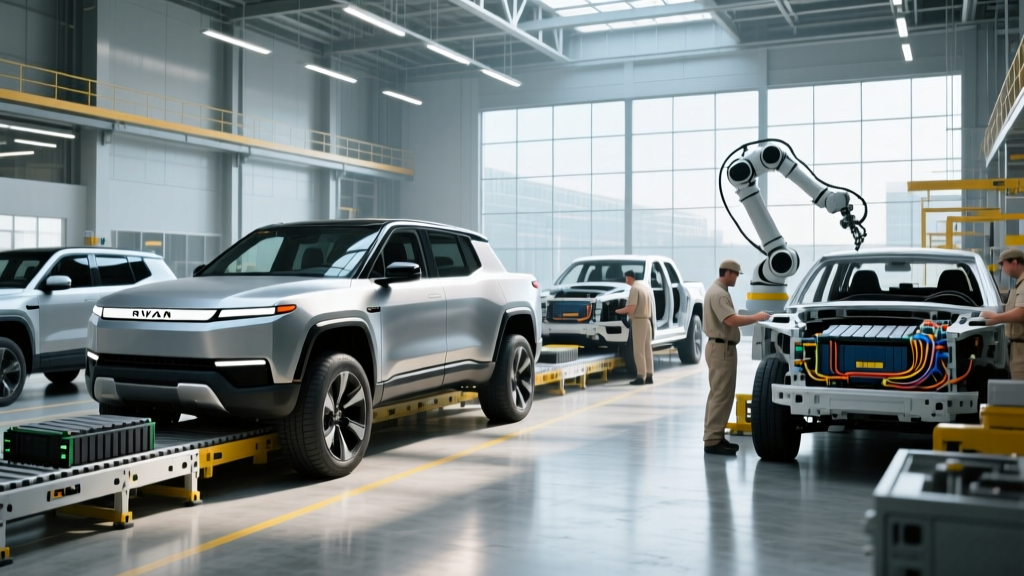
Rivian is often described as a California tech company, and its headquarters in Irvine would support that. But the answer to where Rivian made its vehicles has always pointed somewhere less glamorous and more industrial: Normal, Illinois. The former Mitsubishi Diamond-Star Motors plant has been the sole production home for every R1S, R1T, and Amazon EDV that has rolled off a Rivian line since 2021, and it remains the company's manufacturing anchor as the second-generation R1 fleet reaches full production in 2026.
Understanding where and how Rivians are built matters more than trivia. The Normal factory's union status, supply-chain footprint, and production cadence directly influence build quality, delivery timelines, and — critically for buyers — whether a given Rivian qualifies for the IRS §30D federal tax credit. Below, we break down the plant, then put the 2026 R1S and R1T under the spec microscope with real-world range, charging curves, and ownership math.
The Normal, Illinois Plant: From Mitsubishi to Rivian
Rivian purchased the 3.3-million-square-foot Normal assembly plant in 2017 for $16 million — a fraction of what a greenfield EV factory costs. The facility had been idle since Mitsubishi Motors shut it down in 2016, ending a 28-year run building Eclipse, Galant, and 3000GT models. Rivian retooled the body shop, paint shop, and general assembly lines for its skateboard-platform EVs and began production of the R1T pickup in September 2021, followed by the R1S SUV shortly after.
As of 2026, the Normal plant operates with a workforce of roughly 9,000 employees across three shifts, producing both the consumer R1 line and the Rivian EDV (Electric Delivery Van) for Amazon. The facility is not unionized (UAW has signaled interest but no representation vote has succeeded), and Illinois state and McLean County incentives have supported multiple expansion phases, including a $1.75 billion upgrade tied to second-generation R1 production.
Why this matters for buyers: domestic assembly is one of several requirements for the §30D new clean vehicle credit. Vehicles assembled in North America clear one hurdle; battery-component and critical-mineral sourcing rules add additional layers we unpack below.
2026 Rivian R1S and R1T: Core Specifications
The second-generation R1S and R1T launched for the 2025 model year with a revised skateboard platform, a new zoned electrical architecture, and a switch from Samsung SDI 2170 cells to large-format cylindrical cells (2170-format replacements and 46mm-format cells depending on pack). For 2026, Rivian continues to offer three battery sizes and three drive configurations.
| Spec | Standard Pack | Large Pack | Max Pack |
|---|---|---|---|
| Usable battery (kWh) | ~95 kWh | ~119 kWh | ~141 kWh |
| Chemistry | NMC (large-format cylindrical) | NMC | NMC |
| EPA range (R1S Dual-Motor AWD) | 270 mi | 352 mi | 410 mi |
| EPA range (R1T Dual-Motor AWD) | 270 mi | 352 mi | 420 mi |
| Peak DC fast charge | 200 kW | 220 kW | 220 kW |
| 10–80% DC time | ~28 min | ~30 min | ~36 min |
| Level 2 home charge (11.5 kW) | ~25 mi/hr | ~25 mi/hr | ~25 mi/hr |
| 0–60 mph (Dual-Motor) | 4.5 sec | 4.5 sec | 4.5 sec |
| 0–60 mph (Tri-Motor) | ~2.9 sec (Performance Tri-Motor, ~850 hp) | ||
| Efficiency (R1S Dual-Motor Large) | ~70 MPGe / 48 kWh/100 mi | ||
Real-World Range Reality Check
The EPA sticker on the R1S Max Pack reads 410 miles — among the longest of any production EV. Expect roughly 340–360 miles in sustained 75-mph highway driving at moderate temperatures, and closer to 280–300 miles in sub-freezing winter conditions with cabin heat on. The R1T Max, with its slightly lower curb weight and more aerodynamic bed cap option, can edge a few miles higher. Highway efficiency in these big, boxy trucks is their weak point; the NMC packs compensate with sheer capacity, not slipperiness.
Charging: Fast Enough for Road Trips, Slower Than Rivals
Rivian's peak DC fast-charge rate of 220 kW on the Large and Max packs is respectable but trails Hyundai/Kia's 800V architecture (which sustains 238 kW on the Ioniq 5 and 350 kW on the Ioniq 9) and Tesla's 250 kW V3 / 325 kW V4 Superchargers. The R1's charge curve is relatively flat through 50% SoC but tapers noticeably past 70%, which is why the 10–80% window stretches into the mid-30-minute range on the Max Pack.
| Level | Power | Miles Added per Hour | Notes |
|---|---|---|---|
| Level 1 (120V / 12A) | ~1.4 kW | ~3 mi/hr | Emergency/trickle only |
| Level 2 (240V / 48A) | 11.5 kW | ~25 mi/hr | Overnight full charge |
| DC Fast (Standard Pack) | 200 kW peak | — | 10–80% in ~28 min |
| DC Fast (Large / Max) | 220 kW peak | — | 10–80% in 30–36 min |
On the Rivian Adventure Network — the company's proprietary DC fast-charging network with 20-foot pull-through stalls designed for trucks and trailers — you'll typically see 180–210 kW sustained in the 10–60% window on a preconditioned Max Pack. That's enough for a 200-mile hop in about 25 minutes. For home charging, Rivian recommends a 48-amp hardwired Level 2 wall connector on a 60-amp circuit; budget $800–$1,500 for equipment plus electrician labor if your panel has capacity, or $2,500–$4,500 if a 200-amp service upgrade is required.
Pricing, Trims, and the §30D Tax Credit Question
Second-generation R1 pricing for 2026 positions Rivian squarely in the premium segment. The Adventure trim is the entry point, with Ascend and Ascend Tri-Motor trims stacking performance and luxury options.
| Model / Trim | Base MSRP | As-Tested (typical) | §30D Eligible? |
|---|---|---|---|
| R1S Dual-Motor Adventure (Large) | $79,900 | $84,500 | No — exceeds $80k SUV cap |
| R1S Dual-Motor Ascend (Max) | $94,500 | $102,000 | No — exceeds $80k SUV cap |
| R1T Dual-Motor Adventure (Large) | $71,700 | $76,500 | Potentially — under $80k truck cap* |
| R1T Tri-Motor Ascend (Max) | $99,000 | $108,000 | No — exceeds $80k truck cap |
*The IRS §30D credit for new clean vehicles caps MSRP at $80,000 for pickups and $80,000 for SUVs (SUVs reclassified per DOT). Buyer modified adjusted gross income must not exceed $300,000 (joint) / $225,000 (HOH) / $150,000 (single). Battery component and critical-mineral sourcing requirements apply separately and change annually. Always verify on IRS.gov §30D and confirm the specific VIN on the IRS Energy Credits Online portal before purchase. Point-of-sale transfer to the dealer is permitted if eligible.
In practice, the R1T Dual-Motor Adventure with the Large Pack is the only R1 variant that can land under the pickup MSRP cap, and only when ordered without expensive paint, wheels, or the camp kitchen option. Most R1S configurations and any Tri-Motor build exceed the ceiling. Buyers counting on the full $7,500 credit should structure their build carefully and confirm eligibility before signing.
Interior, Tech, and the Features That Define Ownership
The R1S offers three rows of seating for up to seven passengers, with 43.5 inches of front-row legroom, 38.2 inches in the second row, and a usable 28.5 inches in the third (best reserved for children). Cargo volume behind the third row is 10.4 cu ft; fold the second and third rows and the R1S opens up to 91.6 cu ft. The R1T's 4.5-foot bed includes a lockable tonneau, and the 11.0-cu-ft front trunk (frunk) is one of the largest in the EV segment — big enough for two carry-ons and a charging cable kit.
Tech highlights include a 15.6-inch center display running Rivian's in-house OS, a 12.3-inch digital cluster, standard wireless Apple CarPlay/Android Auto (added via OTA to second-gen vehicles), and an 18-speaker Rivian Elevate audio system on Ascend trims. The driver-assistance suite, branded Rivian Driver+, is an SAE Level 2 system — meaning it provides lane-centering and adaptive cruise but requires continuous driver supervision. It is not a Level 4 self-driving system; hands-off operation is not permitted or supported, despite marketing language around "highway assist."
Driver+ Is Not Self-Driving
Rivian Driver+ and Highway Assist are SAE Level 2 driver-assistance features. The driver must remain attentive, keep hands on or near the wheel, and be prepared to take over instantly. Rivian does not currently offer a Level 3 or Level 4 system. Do not treat any Rivian driver-assist feature as autonomous.
Who the Rivian R1 Is Actually For
The R1S and R1T occupy a narrow but defensible niche: premium, adventure-oriented, body-on-frame-equivalent EVs with genuine off-road capability (up to 14.9 inches of ground clearance in Max Ride Height), 7,700-lb towing capacity on the R1T, and the cargo flexibility that sedans and crossovers can't match. They are not the most efficient, fastest-charging, or cheapest vehicles in their price bracket. They are the best-built adventure EVs on the market, with OTA updates that have materially improved the vehicle since launch.
Pros
- Class-leading EPA range on Max Pack (410–420 mi)
- Genuine off-road chops with quad-motor torque vectoring on Tri-Motor
- Massive frunk and gear tunnel (R1T) unmatched by competitors
- Over-the-air updates continue to add features years post-delivery
- Domestic assembly supports §30D eligibility on qualifying trims
Cons
- Most trims exceed §30D MSRP caps
- DC fast-charge speed trails Hyundai/Kia 800V platforms
- Highway efficiency suffers from truck aerodynamics (~48 kWh/100 mi)
- Third row in R1S is tight for adults
- Insurance premiums run 15–25% above comparable ICE trucks
Rivian vs. the Competition: Is It Worth It?
Against the Tesla Cybertruck, the R1T is more refined, more traditionally truck-shaped, and significantly easier to park and daily-drive, though the Cybertruck undercuts it on price at the base AWD trim. Against the Ford F-150 Lightning, the R1T is more expensive but delivers roughly 100 more miles of range on the Max Pack and a more premium interior. The GMC Hummer EV and Cadillac Escalade IQ compete on size and presence but sacrifice efficiency and charging speed. For three-row electric SUV buyers, the R1S competes with the Kia EV9 (cheaper, shorter range), the Tesla Model X (longer-established Supercharger access, aging interior), and the Cadillac Escalade IQ (significantly pricier).
Efficiency data sourced from fueleconomy.gov; safety ratings available via NHTSA and IIHS as testing is completed for the refreshed platform.
Frequently Asked Questions
Where exactly are Rivian vehicles manufactured?
All Rivian R1S, R1T, and EDV (Amazon delivery van) vehicles are built at the company's factory in Normal, Illinois — a former Mitsubishi plant purchased in 2017 and retooled for EV production. Rivian's second Georgia plant has been announced but is not yet operational as of 2026.
What is the real-world highway range of the Rivian R1S?
Expect roughly 340–360 miles at sustained highway speeds (70–75 mph) in moderate temperatures on the Max Pack. In sub-freezing weather with cabin heat, plan for 280–300 miles. The EPA sticker reads 410 miles for the R1S Max; real-world results fall short by 12–25% depending on conditions.
Does the Rivian R1T qualify for the $7,500 federal tax credit?
Possibly — but only the R1T Dual-Motor Adventure with the Large Pack, configured under the $80,000 pickup MSRP cap, and only if the buyer meets income limits and the battery satisfies critical-mineral and component-sourcing rules for the model year. Confirm the VIN on the IRS portal before purchasing. Most R1 builds exceed the MSRP ceiling.
How fast does a Rivian charge on a DC fast charger?
Large and Max Packs peak at 220 kW, with a 10–80% session taking 30–36 minutes depending on pack size and preconditioning. Standard Pack peaks at 200 kW with a ~28-minute 10–80% time. Sustained rates are typically 180–210 kW through the 60% SoC mark.
Is Rivian Driver+ a self-driving system?
No. Rivian Driver+ is an SAE Level 2 driver-assistance system, similar in capability to Tesla Autopilot or Ford BlueCruise. It requires continuous driver supervision. Rivian does not currently offer Level 3 or Level 4 autonomous driving.
What is Rivian's battery and powertrain warranty?
Rivian provides an 8-year / 175,000-mile battery and drive-unit warranty on the R1S and R1T, with a capacity-retention threshold of 70% over that period. The bumper-to-bumper limited warranty is 5 years / 60,000 miles. These terms are competitive with Tesla and superior to most legacy automakers.