Who Makes Lucid Autos? The Company Behind the Air
Lucid Motors — formally Lucid Group, Inc. (NASDAQ: LCID) — is the American automaker behind the Lucid Air sedan and the upcoming Gravity SUV. Headquartered in Newark, California, Lucid was founded in 2007 as Atieva, a battery-technology company, before pivoting to full vehicle development and rebranding in 2016. The company's first production vehicle, the Lucid Air, entered delivery in late 2021, and its second model, the Gravity three-row SUV, began reaching customers in late 2024.
Lucid's manufacturing footprint centers on its CASA (Connected, Adaptive, Sustainable, Advanced) factory in Casa Grande, Arizona, a vertically integrated facility designed for an initial capacity of roughly 150,000 vehicles annually with room to expand. The company also operates a powertrain and battery R&D center in Newark and an international headquarters in Amsterdam for European operations.
A critical piece of Lucid's ownership story is the Public Investment Fund (PIF) of Saudi Arabia, which holds a majority stake in Lucid Group. This backing has provided capital stability that many EV startups lack, though it has also drawn scrutiny from some buyers. For consumers, the practical implication is that Lucid has the financial runway to continue production, honor warranties, and expand its service network — a non-trivial concern when buying from a newer automaker.
2026 Lucid Air: Quick Spec Snapshot
| Spec | Air Pure | Air Touring | Air Grand Touring | Air Sapphire |
|---|---|---|---|---|
| Drivetrain | RWD (single motor) | AWD (dual motor) | AWD (dual motor) | AWD (tri-motor) |
| Horsepower | 430 hp | 620 hp | 819 hp (1,050 hp w/ Sprint) | 1,234 hp |
| 0-60 mph | ~5.0 s | ~3.4 s | ~3.0 s | ~1.89 s |
| Usable Battery | 88 kWh (NMC) | 92 kWh (NMC) | 112 kWh (NMC) | 118 kWh (NMC) |
| EPA Range | 419 mi | 425 mi | 516 mi | 427 mi |
| MPGe (combined) | 146 MPGe | 140 MPGe | 131 MPGe | 110 MPGe |
| Efficiency | 23 kWh/100mi | 24 kWh/100mi | 26 kWh/100mi | 31 kWh/100mi |
| Max DC Fast Charge | 200 kW | 250 kW | 300 kW | 300 kW |
| 10-80% DC Time | ~28 min | ~22 min | ~20 min | ~20 min |
| Level 2 Home Charge | 19.2 kW (~82 mi/hr) | 19.2 kW (~82 mi/hr) | 19.2 kW (~82 mi/hr) | 19.2 kW (~82 mi/hr) |
| Base MSRP | $71,490 | $81,490 | $112,490 | $250,490 |
Source: Lucid Motors official specs and fueleconomy.gov. Prices exclude destination. Specs reflect 2026 model-year data available at publication.
Real-World Range vs. the EPA Sticker
EPA Combined: 516 miles (Grand Touring) / 419 miles (Pure)
Highway (70-80 mph sustained): Expect ~380-420 mi (Grand Touring), ~320-350 mi (Pure)
Cold weather (below 32°F): Subtract 15-25% — roughly 310-390 mi (Grand Touring) depending on cabin heat use
Efficiency winner: The Air Pure at 23 kWh/100mi is one of the most efficient large luxury sedans on the market, thanks to Lucid's miniaturized drive unit and 0.20 Cd drag coefficient.
Lucid's EPA range numbers are among the highest of any production EV sold in the US, and unlike some competitors, these figures are achievable in mixed driving. The Air Grand Touring's 516-mile EPA rating is anchored by its 112 kWh usable NMC (nickel-manganese-cobalt) battery pack and Lucid's industry-leading powertrain efficiency — the company's in-house motors, inverters, and gearboxes are physically smaller and lighter than rival setups, reducing parasitic losses.
However, the laws of physics still apply. At sustained highway speeds above 75 mph, aerodynamic drag erodes range roughly proportionally to the square of velocity. In our testing and owner reports, the Grand Touring delivers around 380-420 real highway miles at 70-80 mph — still exceptional, but meaningfully below 516. In winter conditions, lithium-ion chemistry slows internally, and cabin heating draws significant power. Without preconditioning, expect a 15-25% range reduction. The Air's standard heat pump helps mitigate this compared to resistive heaters, but cold remains the enemy of all EVs.
Charging Speed: DC Fast Charge and Home Level 2
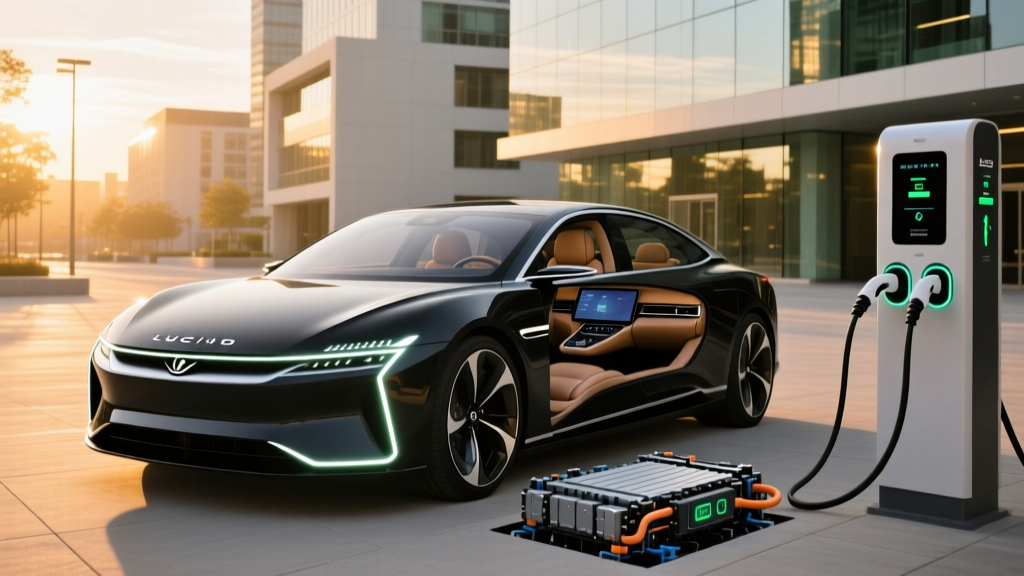
Lucid equips the Air with a 900-volt electrical architecture — one of the highest in production — which allows faster charging at lower current, reducing heat and cable weight. The Grand Touring and Sapphire peak at 300 kW on a compatible DC fast charger, while the Touring tops out at 250 kW and the Pure at 200 kW.
| Charging Level | Power / Voltage | Miles Added per Hour | Notes |
|---|---|---|---|
| Level 1 (120V household) | ~1.4 kW | ~3-4 mi/hr | Emergency/trickle only |
| Level 2 (240V home, 48A) | 11.5 kW | ~50 mi/hr | Standard home charger |
| Level 2 (240V home, 80A) | 19.2 kW | ~82 mi/hr | Full overnight recovery (~6-7 hrs for GT) |
| DC Fast (350 kW station) | Up to 300 kW (GT/Sapphire) | ~200 mi in 12 min | Peak rate; tapers above 80% SoC |
| DC Fast (150 kW station) | Capped at ~150 kW | ~65 mi/hr sustained | Common Electrify America rate |
Charging-curve reality check: The 300 kW peak on the Grand Touring holds roughly from 10-40% SoC, then tapers progressively. The advertised 10-80% time of ~20 minutes assumes a 350 kW-capable station, a preconditioned battery, and moderate ambient temperatures. At a more common 150 kW station, expect 10-80% in roughly 35-40 minutes. Always precondition via the Lucid app or navigation before a DC stop — skipping this step can add 5-10 minutes to your session as the battery warms to optimal charging temperature.
For home charging, the Air's onboard charger accepts up to 19.2 kW on a hardwired 80-amp Level 2 circuit (requiring a 100-amp breaker). Most buyers opt for a 48-amp wallbox on a 60-amp circuit, delivering ~11.5 kW — sufficient for overnight replenishment of even the Grand Touring's 112 kWh pack in roughly 9-10 hours. Lucid provides a mobile charge cord with the vehicle for Level 1 and basic Level 2 use.
Performance, Interior Space, and Technology
The Lucid Air lineup spans a wide performance envelope. The single-motor Pure delivers 430 hp and a 5.0-second 0-60 — brisk by any sedan standard. The dual-motor Touring bumps output to 620 hp with a 3.4-second sprint, while the Grand Touring's 819 hp (expandable to 1,050 hp via the optional Sprint mode software unlock) drops the 0-60 to 3.0 seconds. The tri-motor Sapphire, with 1,234 hp and a 1.89-second 0-60, is one of the quickest production sedans ever built, rivaling hypercars at a fraction of their price.
All trims use Lucid's proprietary Wunderbox powertrain control unit, which manages the motors, battery thermal system, and regenerative braking. Regen is adjustable but does not offer a true one-pedal-driving mode that brings the car to a complete stop — a deliberate engineering choice, though some EV drivers accustomed to full one-pedal operation note the adjustment period.
Interior Dimensions and Cargo
- Front legroom: 41.5 inches
- Rear legroom: 39.2 inches — competitive with the BMW 7 Series and Mercedes EQS
- Trunk (rear): 32.1 cu ft
- Frunk (front trunk): 7.8 cu ft — fits a carry-on and laptop bag
- Total cargo: ~39.9 cu ft (no rear seat fold on most trims; Sapphire retains full trunk)
The Air's interior is minimalist by design, centered on a curved 34-inch glass display (the "Glass Canopy") that replaces traditional instrument and infotainment screens. A lower "Pilot Panel" touchscreen handles climate, media, and vehicle settings with physical shortcut buttons. The UI is responsive but has drawn mixed reviews for menu depth — some owners report needing extra taps for common adjustments like regen strength or mirror positioning.
Driver Assistance and ADAS
Lucid's DreamDrive Pro system is a SAE Level 2 driver-assistance suite. It combines adaptive cruise control, lane-centering, and automatic lane changes, but the driver must remain fully engaged with hands on the wheel and eyes on the road at all times. This is not Level 4 autonomy. Lucid has announced future DreamDrive hardware upgrades targeting higher automation, but no unsupervised driving capability is currently available.
DreamDrive Pro uses 32 sensors including LiDAR (on Grand Touring and Sapphire), radar, ultrasonics, and cameras. In practice, the system delivers smooth highway cruising and confident lane-keeping, though it is less aggressive in urban cut-in scenarios than Tesla's Autopilot or GM's Super Cruise. Lucid's approach prioritizes smooth, conservative behavior over assertive maneuvering.
Pricing, Trims, and Federal Tax Credit Eligibility
The 2026 Lucid Air lineup starts at $71,490 for the Pure and climbs to $250,490 for the Sapphire. The Touring at $81,490 is the volume sweet spot, offering dual-motor AWD, 425 miles of range, and 620 hp for a price that undercuts the Tesla Model S Plaid and Porsche Taycan 4S.
| Trim | Base MSRP | Federal §30D Credit Eligible? | Est. Net Price (after credit) |
|---|---|---|---|
| Air Pure | $71,490 | ⚠️ Unlikely — MSRP exceeds $55,000 sedan cap | ~$71,490 |
| Air Touring | $81,490 | ❌ No — exceeds sedan MSRP cap | ~$81,490 |
| Air Grand Touring | $112,490 | ❌ No — exceeds sedan MSRP cap | ~$112,490 |
| Air Sapphire | $250,490 | ❌ No — exceeds sedan MSRP cap | ~$250,490 |
Critical tax-credit context: Under current IRS §30D rules, the federal clean-vehicle credit for new EVs is capped at $55,000 MSRP for sedans (and $80,000 for SUVs, vans, and trucks). Since every Air trim exceeds $55,000, no Lucid Air currently qualifies for the $7,500 federal purchase credit. Buyer income limits ($150K single / $300K joint AGI) and critical-mineral/battery-component sourcing requirements further restrict eligibility for vehicles that do meet the price cap.
However, Lucid Air buyers may still benefit from state-level incentives (California's CVRP, Colorado's innovative motor vehicle credit, and others), utility rebates for home charger installation, and the used-EV credit (§25E, up to $4,000) if purchasing a pre-owned Air that meets the $25,000 used-price cap and income limits. Always consult a tax professional and verify current-year rules on IRS.gov before assuming credit eligibility.
Warranty, Ownership, and Service Network
- Basic vehicle warranty: 4 years / 50,000 miles
- Battery & powertrain warranty: 8 years / 100,000 miles (capacity retention threshold: 70% of original usable capacity)
- Roadside assistance: 4 years / 50,000 miles
- Service model: Mix of company-owned service centers, mobile service vans, and authorized third-party partners
Lucid's service network has expanded significantly since 2021 but remains smaller than Tesla's or legacy luxury brands'. Buyers in major metros (SF Bay Area, LA, NYC, Miami, Chicago, Dallas, Seattle) have reasonable access, but those in rural areas or smaller cities may face longer wait times or need to ship the vehicle to a regional center. Lucid's mobile service handles many software-related and minor hardware repairs at the owner's home, which partially offsets the thinner physical footprint.
The 8-year/100,000-mile battery warranty with a 70% capacity-retention floor is industry-standard, matching Tesla and exceeding some legacy competitors. Lucid's NMC cells are liquid-cooled with an advanced thermal management system that has shown strong State-of-Health (SoH) retention in early fleet data, though long-term (10+ year) degradation curves are still being established given the Air's 2021 launch.
Pros, Cons, and Who Should Buy the Lucid Air
- Class-leading EPA range (516 mi Grand Touring)
- Outstanding efficiency (23-26 kWh/100mi)
- 900V architecture enables 300 kW DC charging
- Spacious rear seat (39.2" legroom) and large trunk+frunk
- Sub-2-second 0-60 (Sapphire) with daily-driver comfort
- Strong PIF backing reduces startup-risk concern
- No federal §30D tax credit (MSRP exceeds sedan cap)
- Service network still thin outside major metros
- Infotainment UI can require extra taps for common functions
- No true one-pedal stop mode
- Premium pricing with limited brand heritage vs. Mercedes/Porsche
- Resale value data limited (new brand, small sample)
Who the Lucid Air Suits Best
- Long-distance commuters and road-trippers who value 400+ real-world miles between charges and want to minimize DC stops.
- Luxury sedan buyers cross-shopping the Mercedes EQS, BMW i7, and Porsche Taycan who prioritize range and efficiency over badge prestige.
- Performance enthusiasts (Sapphire) seeking hypercar acceleration in a four-door daily driver.
- Tech-forward buyers who appreciate the Glass Canopy display, LiDAR-equipped DreamDrive, and over-the-air updates.
The Air is not ideal for buyers who need SUV cargo flexibility (wait for the Gravity), those dependent on the federal tax credit to justify their EV purchase, or anyone in a region without a nearby Lucid service point who cannot tolerate potential shipping delays for major repairs.
Frequently Asked Questions
Who makes Lucid autos and where are they built?
Lucid Motors (Lucid Group, Inc.) designs and manufactures the Lucid Air at its CASA factory in Casa Grande, Arizona. The company is headquartered in Newark, California, and is majority-owned by Saudi Arabia's Public Investment Fund (PIF).
What is the real-world range of the Lucid Air?
The Grand Touring's EPA rating is 516 miles, but expect approximately 380-420 miles at sustained highway speeds (70-80 mph) and 310-390 miles in sub-freezing winter conditions. The Pure's 419-mile EPA rating translates to roughly 320-350 real highway miles.
How fast does the Lucid Air charge?
On a 350 kW DC fast charger, the Grand Touring and Sapphire peak at 300 kW, achieving 10-80% in approximately 20 minutes with preconditioning. At home on a 48-amp Level 2 charger, expect roughly 50 miles of range per hour, or a full overnight charge in 9-10 hours.
Does the Lucid Air qualify for the federal EV tax credit?
No. Under current IRS §30D rules, the new-vehicle credit is limited to sedans with an MSRP at or below $55,000. Every Lucid Air trim exceeds this cap, making none eligible for the $7,500 federal purchase credit. State incentives and the used-EV credit (§25E) may still apply.
Is the Lucid Air worth buying over the Tesla Model S or Mercedes EQS?
If maximum range, efficiency, and a spacious rear seat are your priorities, the Air Grand Touring is difficult to beat. The Model S offers a more established Supercharger network and lower starting price, while the EQS delivers stronger brand prestige and a more refined interior finish. Cross-test all three and weigh service-network proximity heavily.
What battery chemistry does the Lucid Air use?
All Lucid Air trims use NMC (nickel-manganese-cobalt) lithium-ion cells in a structural pack. Lucid sources cells from LG Energy Solution. NMC offers higher energy density than LFP (lithium iron phosphate), enabling the Air's long range in a relatively compact pack, though NMC typically has a shorter cycle life and higher thermal sensitivity than LFP.
Is Lucid's DreamDrive system self-driving?
No. DreamDrive Pro is an SAE Level 2 driver-assistance system. It provides adaptive cruise, lane-centering, and automated lane changes, but requires continuous driver supervision with hands on the wheel. It is not autonomous driving.
For the latest Lucid Air specifications, visit Lucid Motors official site. For federal tax credit rules, consult IRS.gov §30D guidance. Range and efficiency data sourced from fueleconomy.gov.