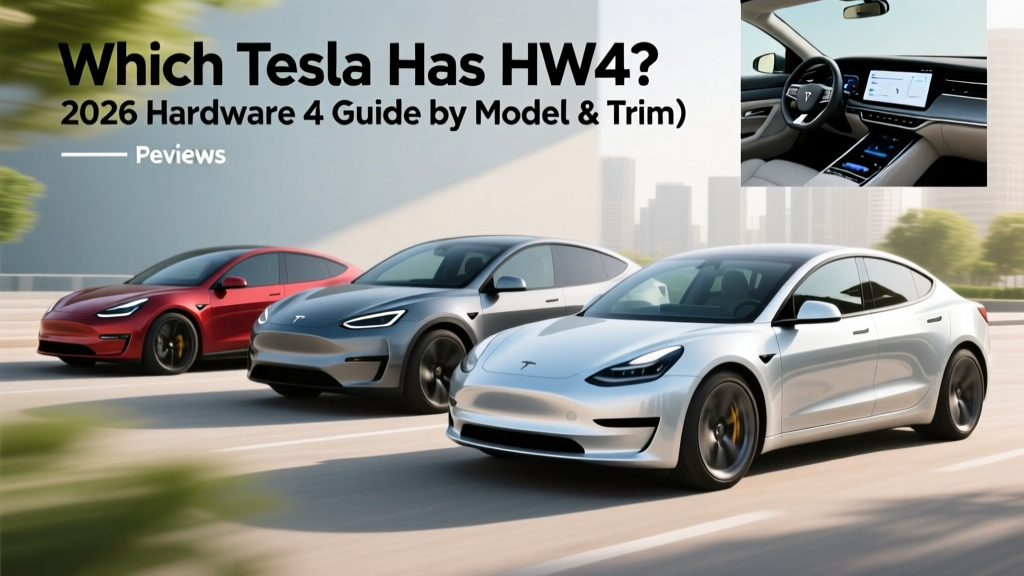
The Quick Answer: Which Tesla Models Have HW4?
If you're shopping for a Tesla and want the latest vision-based driver-assistance hardware, here's the direct answer: every new Tesla built since mid-2023 ships with Hardware 4 (HW4), also known as AI4. That includes the current Model 3 Highland refresh, the refreshed Model Y (Juniper), Model S, Model X, and Cybertruck. However, older inventory, used models, and pre-refresh vehicles may still carry Hardware 3 (HW3). The devil is in the build date and trim details.
This guide breaks down exactly which Tesla has HW4 by model, trim, and build period — and pairs that with the real-world range, charging, and pricing data you need to make a smart purchase in 2026.
HW4 vs HW3: What Actually Changed?
Before diving into model-by-model availability, it helps to understand what Hardware 4 brings to the table — and whether it's worth seeking out over a discounted HW3 vehicle.
| Feature | Hardware 3 (HW3) | Hardware 4 (HW4 / AI4) |
|---|---|---|
| Camera resolution | 1.2 megapixel | 5 megapixel |
| Camera count | 8 cameras | 7–8 cameras (varies by model) |
| Focal length / range | ~250m forward | ~424m forward (improved telephoto) |
| Neural net processor | ~2.5 billion params | ~5 billion+ params (est.) |
| Ultrasonic sensors (USS) | 12 sensors | Removed (Tesla Vision only) |
| Radar | Removed (post-2021) | Removed (Tesla Vision) |
The practical takeaway: HW4 sees farther, in higher resolution, with more processing headroom for Tesla's neural-network-based FSD (Supervised) stack. In real-world use, HW4 vehicles tend to handle complex intersections, construction zones, and low-light scenarios with fewer disengagements — though FSD remains a supervised Level 2 system, not a hands-off solution.
Tesla Model 3 (Highland Refresh): HW4 Standard
The refreshed Model 3 (internally called "Highland"), which began production in late 2023, ships exclusively with HW4. If you buy a new 2025 or 2026 Model 3, you are getting Hardware 4 regardless of trim.
EPA estimated: 363 miles. Real-world highway driving at 70–75 mph: expect ~290–310 miles. In freezing temperatures (below 32°F), range can drop to ~240–270 miles due to cabin heating and battery chemistry limitations. City driving with regen braking can match or slightly exceed the EPA sticker.
| Spec | Model 3 RWD | Model 3 Long Range AWD | Model 3 Performance |
|---|---|---|---|
| EPA Range | 363 mi (w/ 18" wheels est.) | 363 mi | 315 mi |
| Battery (usable) | ~60 kWh (LFP) | ~75 kWh (NMC) | ~75 kWh (NMC) |
| Drivetrain | RWD | Dual Motor AWD | Dual Motor AWD |
| Horsepower | ~271 hp | ~346 hp | ~510 hp |
| 0–60 mph | 5.8 sec | 4.2 sec | 2.9 sec |
| Efficiency | ~132 MPGe / 25 kWh/100mi | ~132 MPGe / 25 kWh/100mi | ~119 MPGe / 28 kWh/100mi |
| Max DC Fast Charge | ~170 kW | ~250 kW | ~250 kW |
| 10–80% DC Time | ~28 min | ~25 min | ~25 min |
| Level 2 Home Charge | 11.5 kW (~44 mi/hr) | 11.5 kW (~44 mi/hr) | 11.5 kW (~44 mi/hr) |
| Cargo Volume | 23 cu ft (rear trunk + frunk combined) | ||
| Rear Legroom | 35.2 in | ||
| Base MSRP (2025) | $38,990 | $44,990 | $52,990 |
LFP vs NMC note: The RWD Model 3 uses a lithium iron phosphate (LFP) battery, which is heavier and slightly less energy-dense but offers a longer cycle life and can be safely charged to 100% daily. The Long Range and Performance trims use nickel manganese cobalt (NMC) chemistry, which Tesla recommends charging to 80% for daily use to preserve longevity.
Tesla Model Y (Juniper Refresh): HW4 Across All Trims
The Model Y Juniper refresh, which rolled out for the 2025 model year, ships with HW4 on every trim. If you're buying a new Model Y in 2026, you're getting HW4. The pre-refresh Model Y (sold through early 2025) also carried HW4 from approximately mid-2023 onward, but always verify the build date.
The Model Y remains America's best-selling EV for good reason: crossover practicality, strong efficiency, and access to the Supercharger network. Here's what the numbers look like.
| Spec | Model Y Long Range AWD | Model Y Performance |
|---|---|---|
| EPA Range | 320 mi | 294 mi |
| Battery (usable) | ~75 kWh (NMC) | ~75 kWh (NMC) |
| Drivetrain | Dual Motor AWD | Dual Motor AWD |
| Horsepower | ~384 hp | ~456 hp |
| 0–60 mph | 4.8 sec | 3.5 sec |
| Efficiency | ~123 MPGe / 27 kWh/100mi | ~111 MPGe / 30 kWh/100mi |
| Max DC Fast Charge | ~250 kW | ~250 kW |
| 10–80% DC Time | ~25 min | ~25 min |
| Level 2 Home Charge | 11.5 kW (~37 mi/hr) | 11.5 kW (~37 mi/hr) |
| Cargo Volume | 76 cu ft (rear seats folded) + 4.1 cu ft frunk | |
| Rear Legroom | 41.6 in | |
| Base MSRP (2025) | $44,990 | $48,990 |
Sources: fueleconomy.gov — Tesla Model Y, Tesla Model Y design page.
Tesla Model S, Model X, and Cybertruck: HW4 Status
Model S and Model X: Both received HW4 starting with builds from approximately March 2023 onward. If you're ordering a new 2025 or 2026 Model S or Model X, HW4 is standard. However, Tesla's legacy inventory (new-old-stock from early 2023 or prior) may still carry HW3. Always confirm the hardware version in the vehicle's Software menu before purchase — it's listed under Controls → Software → Additional Vehicle Information.
Cybertruck: Every Cybertruck delivered since production began in late 2023 ships with HW4. There is no HW3 Cybertruck in existence. The Cybertruck's angular stainless-steel body and steer-by-wire system are paired with Tesla's latest vision hardware from day one.
| Model | HW4 Standard Since | EPA Range (top trim) | Base MSRP |
|---|---|---|---|
| Model S | ~March 2023 | 402 mi (LR) / 359 mi (Plaid) | $74,990 |
| Model X | ~March 2023 | 335 mi (LR) / 326 mi (Plaid) | $79,990 |
| Cybertruck | Nov 2023 (launch) | 340 mi (AWD) / 320 mi (Cyberbeast) | $79,990 |
Federal tax credit note: The Model S, Model X, and Cybertruck all exceed the IRS §30D MSRP cap ($55,000 for sedans; $80,000 for SUVs/trucks). The Model S sedan is priced above $55,000 and does not qualify. The Model X and Cybertruck, classified as SUVs/trucks, are right at or above the $80,000 cap depending on trim — check the specific configuration against current IRS §30D rules. The Model 3 and Model Y (under $55K/$80K caps) may qualify, subject to income and battery-sourcing requirements.
How to Verify HW4 on Any Tesla
Whether you're buying new, used, or from a third-party dealer, here's how to confirm the hardware generation:
- Software menu: Tap Controls → Software → Additional Vehicle Information. Look for "HW4" or "AI4" listed next to "Autopilot computer."
- Camera check: HW4 vehicles have noticeably larger, slightly different-shaped camera housings, particularly the front-facing camera above the rearview mirror. The turn-signal repeater cameras are also redesigned.
- Build date: Any Tesla built after approximately April 2023 is almost certainly HW4. The build date is on the driver's door jamb sticker.
- VIN decoder: Tesla's VIN doesn't directly encode HW version, but the 10th character indicates model year. 2024–2026 model years are reliably HW4.
Charging Deep Dive: What HW4 Owners Actually Experience
HW4 doesn't change charging speeds — that's determined by the battery pack and onboard charger. But since you're likely cross-shopping Tesla models, here's a consolidated charging reference:
| Charging Level | Power (kW) | Miles Added per Hour | Notes |
|---|---|---|---|
| Level 1 (120V household) | ~1.4 kW | 3–5 mi/hr | Emergency/overnight trickle only |
| Level 2 (240V, 48A Wall Connector) | 11.5 kW | 37–44 mi/hr | Full charge overnight (8–10 hrs) |
| DC Fast (V3 Supercharger) | Up to 250 kW | ~1,000 mi/hr (peak) | 10–80% in ~25 min; tapers above 80% |
| DC Fast (V4 Supercharger) | Up to 250–350 kW | ~1,000+ mi/hr (peak) | Vehicle-limited; most Teslas peak at 250 kW |
Charge curve reality: Tesla's 250 kW peak rate is sustained only between roughly 10–40% state of charge. Above 60%, the rate tapers significantly — you'll see ~100 kW at 70% and ~50 kW at 85%. This is why Tesla quotes 10–80% times rather than 0–100%. For road trips, plan your stops around the 10–80% sweet spot to minimize time at the charger.
Preconditioning matters: Navigate to a Supercharger using the car's built-in navigation, and the battery will automatically precondition (warm up) for optimal charge speed. If you arrive at a Supercharger without preconditioning — especially in cold weather — your peak charge rate could be cut in half until the battery warms up.
Pricing, Tax Credits, and Total Cost
Here's where the rubber meets the road for most buyers. Tesla's pricing has shifted frequently, so treat these as approximate starting points and verify at Tesla's inventory page.
| Model / Trim | Base MSRP | §30D Credit Eligible? | Effective Price (est.) |
|---|---|---|---|
| Model 3 RWD | $38,990 | Potentially (≤$55K MSRP cap ✓) | ~$31,490 (if eligible) |
| Model 3 Long Range AWD | $44,990 | Potentially (≤$55K MSRP cap ✓) | ~$37,490 (if eligible) |
| Model Y Long Range AWD | $44,990 | Potentially (≤$80K SUV cap ✓) | ~$37,490 (if eligible) |
| Model S Long Range | $74,990 | No (exceeds $55K sedan cap) | $74,990 |
| Model X Long Range | $79,990 | Borderline (≤$80K SUV cap) | $79,990 (options push over cap) |
| Cybertruck AWD | $79,990 | Borderline (≤$80K truck cap) | $79,990 (most configs exceed cap) |
- MSRP cap: ≤$55,000 for sedans (Model 3); ≤$80,000 for SUVs/trucks (Model Y, Model X, Cybertruck)
- Buyer income cap: AGI ≤$150,000 (single) / ≤$300,000 (joint filing)
- Battery sourcing: Critical minerals and battery components must meet phased-in domestic/F TA-sourced thresholds (check current IRS guidance)
- Point-of-sale transfer: Eligible buyers can apply the credit at purchase, reducing the out-of-pocket price immediately
- VIN registration: Dealer must register the sale with the IRS Energy Credits portal
Consult a tax professional for your specific situation. Rules change and vary by model year, battery supplier, and buyer income.
Who Should Buy a HW4 Tesla — And Who Shouldn't
Choose a HW4 Tesla if:
- You want the best available Tesla Vision hardware for FSD (Supervised) and active safety
- You plan to keep the vehicle 5+ years and want maximum future OTA capability
- You value access to the Supercharger network (now open to other brands, but Tesla vehicles still have the most seamless experience)
- You want a minimalist interior with over-the-air updates and no physical buttons
- Home Level 2 charging is available to you (a 240V/48A circuit adds ~44 miles per hour of charging)
Look elsewhere if:
- You want physical buttons, knobs, or a traditional instrument cluster
- You need Apple CarPlay or Android Auto (Tesla uses its own infotainment exclusively)
- You require proven Level 4 autonomy (no consumer vehicle offers this — Waymo is the only Level 4 option, and it's a ride-hail service)
- You frequently tow heavy loads (the Model Y tows up to 3,500 lbs; Cybertruck up to 11,000 lbs, but range drops dramatically under load)
- You live in an area with limited charging infrastructure and no home charging option
✅ Pros
- HW4 provides the most capable Tesla Vision system to date
- Class-leading efficiency (Model 3 LR: ~25 kWh/100mi)
- 250 kW DC fast charging, 10–80% in ~25 minutes
- Extensive Supercharger network with reliable plug-and-charge
- Over-the-air updates continuously improve the vehicle
- LFP battery on Model 3 RWD allows daily 100% charging
❌ Cons
- No Apple CarPlay / Android Auto support
- Minimalist interior polarizes — no stalks on refreshed Model 3/Y
- Removed ultrasonic sensors; Tesla Vision parking assist is still inconsistent
- FSD (Supervised) costs $8,000 extra or $99/mo and requires full attention
- Insurance premiums are above average for the segment
- Build quality variability — panel gaps still reported
Warranty Coverage
Tesla's warranty structure is straightforward but slightly below some competitors on basic coverage:
- Basic vehicle: 4 years / 50,000 miles
- Battery & drive unit (Model 3 RWD): 8 years / 100,000 miles
- Battery & drive unit (Model 3 LR, Model Y, Model S/X): 8 years / 120,000 miles
- Battery degradation guarantee: Tesla warrants that the battery will retain at least 70% of its original capacity during the warranty period
The 70% retention threshold is industry-standard but worth knowing. Real-world data from high-mileage Teslas suggests NMC packs typically retain 85–90% capacity at 100,000 miles, while LFP packs show even slower degradation due to their chemistry advantages.
Frequently Asked Questions
Can Tesla upgrade my HW3 car to HW4?
No. Tesla has not offered a retrofit program for HW3 to HW4. The camera wiring harness, mounting points, and compute module are physically different. If you want HW4, you need a vehicle that was built with it from the factory. Tesla previously offered free HW3 computer upgrades for FSD purchasers (from HW2.5 to HW3), but no such program exists for the HW3-to-HW4 transition.
Does HW4 make FSD significantly better?
HW4 provides higher-resolution camera input and more neural-network processing headroom, which gives Tesla's engineering team more data to work with. In practice, FSD (Supervised) on HW4 vehicles tends to handle edge cases — like faded lane markings, complex intersections, and glare — with fewer disengagements. However, FSD remains a Level 2 system requiring constant driver supervision, and its performance varies significantly by geography and road type.
Is a used HW3 Tesla still a good buy?
Absolutely. HW3 Teslas still receive Autopilot and FSD updates, and the core driving experience — range, performance, charging — is identical. The main trade-off is that HW4 may eventually receive exclusive FSD features that HW3 hardware can't support. If you're buying used and don't plan to subscribe to FSD, HW3 is perfectly capable and often available at a significant discount.
Does the Tesla Model 3 RWD with LFP battery have HW4?
Yes. Every new Model 3 built since the Highland refresh (late 2023 onward), including the base RWD trim with its LFP battery, ships with HW4. The LFP battery is a different chemistry choice, not a hardware generation change.
What about the next-generation Tesla (Robotaxi / Model 2)?
Tesla has announced a next-generation, lower-cost vehicle platform (sometimes called "Model 2" or associated with the Cybercab robotaxi concept). These vehicles are expected to ship with HW4 or a future HW5/AI5 iteration. However, as of 2026, the Cybercab remains in limited production for fleet use and is not available for consumer purchase. Any specs are preliminary.
How do I check if a specific Tesla has HW4 before buying?
On the vehicle's touchscreen, go to Controls → Software → Additional Vehicle Information. The "Autopilot computer" line will read either "Hardware 3" or "Hardware 4" (sometimes labeled "AI4"). If buying remotely, ask the seller or advisor for a screenshot of this screen. The build date on the driver's door jamb sticker is also a strong indicator — post-April 2023 builds are reliably HW4.
Sources: fueleconomy.gov, Tesla.com specifications, IRS §30D Clean Vehicle Credits, NHTSA.gov.