Where Are Teslas Built? The 2026 U.S. Manufacturing Map
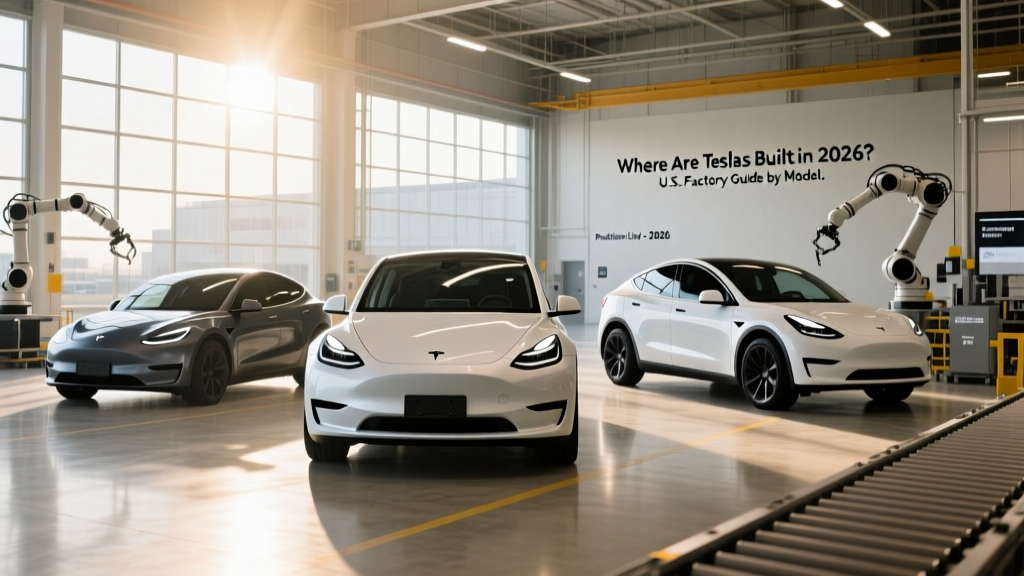
Tesla operates four vehicle assembly plants in the United States, each tied to specific models and battery chemistries. If you've ever wondered where are Teslas built before signing a purchase agreement, the answer matters more than trivia: factory origin can influence battery chemistry (LFP vs. NMC), delivery timelines, and — indirectly — eligibility for the §30D federal EV tax credit. Below is a model-by-model map of Tesla's U.S. production footprint as of the 2026 model year.
| Factory | Location | Models Produced | Opened |
|---|---|---|---|
| Fremont Factory | Fremont, California | Model S, Model X, Model 3, Model Y | 2010 (Tesla acquired) |
| Gigafactory Texas | Austin, Texas | Model Y, Cybertruck | 2022 |
| Gigafactory Nevada | Storey County, Nevada | Powertrain/battery components (not full vehicles) | 2016 |
| Gigafactory New York | Buffalo, New York | Supercharger components, Megapack (not vehicles) | 2017 |
Tesla also operates Gigafactory Berlin-Brandenburg (Germany) for European Model Y deliveries and Gigafactory Shanghai (China) for Asia-Pacific and some export markets. U.S. buyers, however, overwhelmingly receive vehicles from Fremont or Austin.
Model 3: Primarily Fremont, With Austin Ramping
The Tesla Model 3 remains Tesla's volume sedan and is produced predominantly at the Fremont Factory in California. The 2026 Model 3 (refreshed "Highland" architecture introduced for MY2024) is available in three trims.
| Spec | RWD | Long Range AWD | Performance AWD |
|---|---|---|---|
| EPA Range | 341 mi | 363 mi | 315 mi |
| Battery (usable) | ~57 kWh (LFP) | ~75 kWh (NMC) | ~75 kWh (NMC) |
| 0-60 mph | 5.8 sec | 4.2 sec | 2.9 sec |
| Horsepower | 271 hp | 346 hp | 510 hp |
| Drivetrain | RWD | Dual-motor AWD | Dual-motor AWD |
| Peak DC Charge | 170 kW | 250 kW | 250 kW |
| 10-80% DCFC | ~25 min | ~22 min | ~22 min |
| Level 2 Rate | 11.5 kW (~44 mi/hr) | 11.5 kW (~44 mi/hr) | 11.5 kW (~44 mi/hr) |
| MPGe (combined) | 142 MPGe | 132 MPGe | 119 MPGe |
| Base MSRP | $38,990 | $47,740 | $54,990 |
Real-World Range Note: The EPA 341-mile figure on the RWD assumes mixed driving. Expect ~280–300 miles on sustained 75-mph highway runs, and ~240–260 miles in sub-30°F winter conditions. The LFP battery in the RWD tolerates frequent 100% charges better than NMC, which partly offsets its smaller usable capacity.
Model Y: Austin and Fremont — Which One Will You Get?
The Model Y is Tesla's best-selling vehicle globally and the only model currently assembled at both Fremont and Gigafactory Texas. Your delivery origin depends on your zip code and configuration. Texas-built Model Ys use a rear mega-casting that reduces part count, though real-world owners report negligible differences in ride quality versus Fremont units.
| Spec | RWD | Long Range AWD | Performance AWD |
|---|---|---|---|
| EPA Range | 320 mi | 330 mi | 303 mi |
| Battery (usable) | ~57 kWh (LFP) | ~75 kWh (NMC) | ~75 kWh (NMC) |
| 0-60 mph | 6.6 sec | 4.8 sec | 3.5 sec |
| Horsepower | 295 hp | 384 hp | 456 hp |
| Peak DC Charge | 170 kW | 250 kW | 250 kW |
| 10-80% DCFC | ~25 min | ~22 min | ~22 min |
| MPGe (combined) | 137 MPGe | 125 MPGe | 119 MPGe |
| Base MSRP | $44,990 | $49,990 | $53,990 |
Cargo volume: 30.2 cu ft behind the second row, 76.2 cu ft with the second row folded. Legroom is 41.8 in. front / 37.4 in. rear — adequate for two adults and two children, tight for three across on long trips.
Cybertruck: Exclusively Gigafactory Texas
The Cybertruck is built only at Gigafactory Texas in Austin. The stainless-steel exoskeleton and 48-volt electrical architecture require dedicated tooling that exists nowhere else in Tesla's network. As of the 2026 model year, three trims are in production:
- AWD (dual-motor): 340 mi EPA, ~$79,990 MSRP, 600 hp, 0-60 in 3.9 sec.
- Cyberbeast (tri-motor): 320 mi EPA, ~$99,990 MSRP, 845 hp, 0-60 in 2.6 sec.
Battery chemistry is NMC with an estimated ~123 kWh usable pack. Peak DC fast-charge rate is 350 kW at Supercharger V4 stalls, with 10-80% in roughly 18 minutes under ideal thermal preconditioning. The Cybertruck's 800-volt-class architecture is what enables that sustained charge curve — most competing trucks (Rivian R1T, Ford F-150 Lightning) taper more aggressively above 80% SoC.
Model S and Model X: Fremont Only
Both the Model S sedan and Model X SUV are produced exclusively at Fremont. Volume is low — Tesla no longer breaks out S/X sales separately — but the flagship trims remain in production.
| Spec | Model S LR | Model S Plaid | Model X LR | Model X Plaid |
|---|---|---|---|---|
| EPA Range | 402 mi | 359 mi | 335 mi | 311 mi |
| Battery (usable) | ~95 kWh (NMC) | ~95 kWh (NMC) | ~95 kWh (NMC) | ~95 kWh (NMC) |
| 0-60 mph | 3.1 sec | 1.99 sec | 3.8 sec | 2.5 sec |
| Peak DC Charge | 250 kW | 250 kW | 250 kW | 250 kW |
| 10-80% DCFC | ~25 min | ~25 min | ~27 min | ~27 min |
| Base MSRP | $79,990 | $94,990 | $84,990 | $99,990 |
Because both exceed the §30D MSRP cap of $80,000 for sedans ($80k for SUVs), the Model S is ineligible for the federal credit in every trim; the Model X Long Range barely qualifies at MSRP but options push it over. Always verify current eligibility on IRS.gov.
Federal Tax Credit: Does Factory Origin Matter?
The short answer: indirectly, yes. The §30D New Clean Vehicle Credit is governed by MSRP caps, buyer AGI limits, and critical-mineral/battery-component sourcing rules — not the physical ZIP code of the assembly plant. However, because LFP battery cells used in Tesla's RWD trims are currently sourced from CATL (China), those trims have historically failed the battery-component prong of §30D. The Long Range and Performance trims with NMC packs from Panasonic (Nevada-made cells) have more consistently qualified.
| Model | MSRP Cap | AGI Limit (single) | Credit Potential |
|---|---|---|---|
| Model 3 LR / Perf. | $55,000 (sedan) | $150,000 | Up to $7,500 (verify sourcing) |
| Model Y LR / Perf. | $80,000 (SUV) | $300,000 (joint) | Up to $7,500 (verify sourcing) |
| Cybertruck | $80,000 (truck) | $300,000 (joint) | Often $0–$3,750 (sourcing) |
| Model S / X | Exceeds cap | — | Not eligible |
The point-of-sale transfer option lets dealers apply the credit as a down-payment reduction at purchase, but you are liable for repayment if your AGI exceeds the cap at tax time. Consult a tax professional — rules change annually.
Tech, Driver Assists, and What Tesla Doesn't Do
Every 2026 Tesla ships with Basic Autopilot (SAE Level 2 lane-centering and adaptive cruise). Full Self-Driving (Supervised) remains a paid add-on (~$8,000 or $99/mo subscription) and is still Level 2 — meaning the driver must monitor the road at all times. Tesla has not received regulatory approval for Level 3 or Level 4 operation anywhere in the U.S.
Autonomy Reality Check: "Full Self-Driving" is a marketing name, not an engineering classification. You are the driver. Eyes on the road, hands detectable on the wheel. Waymo and Zoox operate true Level 4 robotaxis in limited metro areas — Tesla does not.
Standard tech across the 2026 lineup includes a 15.4-inch center touchscreen (17-inch in S/X), native NACS charge port (the industry standard since 2024), over-the-air updates, and Tesla Vision (camera-only ADAS — no radar or ultrasonic sensors).
Pros, Cons, and Who Should Buy
Pros
- Supercharger network: 20,000+ U.S. stalls, best-in-class uptime
- Class-leading efficiency (kWh/100 mi) across most trims
- Over-the-air updates add features post-purchase
- LFP chemistry on RWD trims tolerates daily 100% charges
Cons
- Phantom braking complaints persist on Tesla Vision
- Panel gaps and paint quality inconsistent vs. legacy OEMs
- No Apple CarPlay / Android Auto
- Service-center wait times in rural markets
Best for: Tech-comfortable commuters and road-trippers who value Supercharger access and efficiency over luxury fit-and-finish. Families wanting three-row seating should cross-shop the Rivian R1S or Kia EV9.
FAQ
Are any Teslas built outside the U.S.?
Yes. Gigafactory Shanghai (China) serves Asia-Pacific and some export markets; Gigafactory Berlin (Germany) builds Model Y for Europe. U.S.-spec retail vehicles come from Fremont or Austin.
Does the build factory affect my tax credit?
Not directly. §30D eligibility depends on MSRP, buyer income, and battery/critical-mineral sourcing — but sourcing often correlates with which factory produced your pack.
How do I find out where my specific Tesla was built?
Check the VIN: a VIN starting with "5YJ" indicates Fremont; "7G2" indicates Gigafactory Texas. The door-jamb label also lists the assembly plant.
What is the battery warranty?
Tesla covers the battery and drive unit for 8 years / 120,000 miles on Long Range and Performance trims (whichever comes first), with a minimum 70% capacity retention threshold. RWD trims are 8 years / 100,000 miles.
Sources: EPA Fuel Economy, IRS §30D guidance, Tesla.com spec sheets.