Why the 2016 Tesla Model S Interior Still Matters in 2026
The 2016 Tesla Model S was a watershed moment for electric sedans. It was the year Tesla introduced the 100 kWh battery option, pushed the EPA range past 300 miles for the first time in a production car, and refined a minimalist cabin that either defined premium EV design or polarized luxury buyers—depending on who you ask. Nearly a decade later, the 2016 Model S remains one of the most-searched used EVs on the market, and for good reason: depreciated prices have brought it into territory where it competes with new compact EVs on cost while offering full-size luxury sedan space and Supercharger access.
But a used 2016 Model S is not a simple purchase. The interior materials, technology stack, battery health, and charging hardware all reflect 2016 engineering—not 2026. This review examines the 2016 Tesla Model S interior in detail, pairs it with the hard specs a used-EV buyer needs (range, charging, battery degradation, warranty status), and delivers a verdict on whether this car still earns its keep.
2016 Tesla Model S Interior: Materials, Layout, and Livability
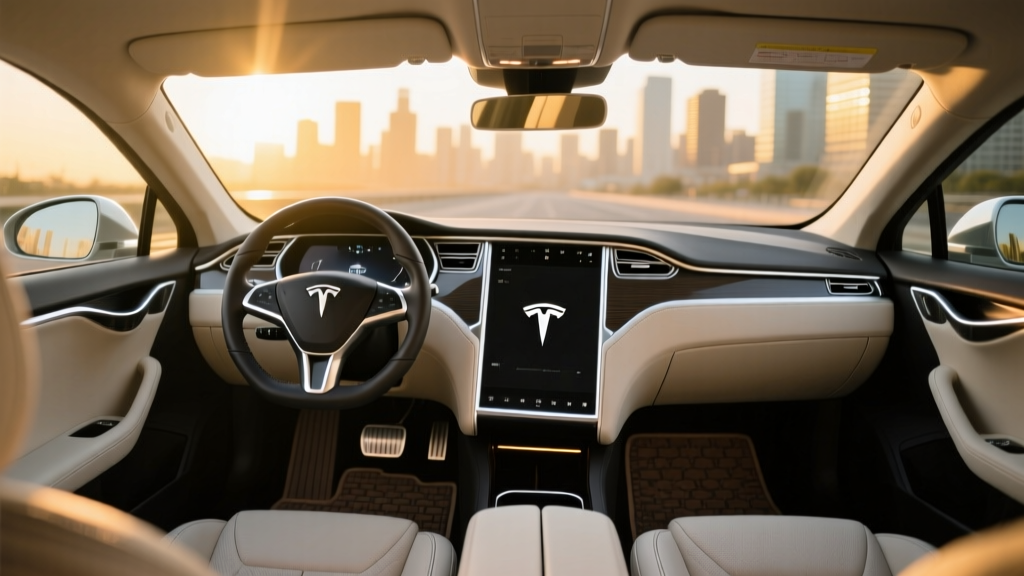
The 2016 Model S interior was Tesla's first serious attempt at luxury-grade fit and finish, though "luxury" here means something different from a Mercedes S-Class or BMW 7 Series. The dashboard is dominated by a 17-inch portrait touchscreen that handles nearly every vehicle function—climate, media, navigation, vehicle settings, and even the glovebox release. There is no traditional instrument cluster; a small digital display behind the steering wheel shows speed, range, and navigation prompts.
Materials and Build Quality
The 2016 Model S offered two interior tiers. The standard interior used synthetic leather (Tesla called it "vegan leather" in later years, though 2016 models used a leatherette material) on seats and door panels, with a soft-touch dashboard and aluminum or wood trim accents. The optional Next Generation seats (introduced mid-2016) added improved bolstering, adjustable thigh support, and slightly higher-grade upholstery.
Real-world owner feedback consistently notes that the 2016 interior materials fall short of German luxury rivals. The dashboard top is hard plastic in some areas. Panel gaps—particularly around the center console and door cards—vary noticeably from car to car. Rattles and squeaks are common in higher-mileage examples, especially around the panoramic roof mechanism and the touchscreen mount.
Seating and Passenger Space
The 2016 Model S seats five adults (or optionally six or seven with the rear-facing third-row child seat, a rare option). Front-seat comfort is good on longer drives, particularly with the Next Generation seat option. Rear legroom measures 35.4 inches, which is adequate but not generous for a car in this size class—blame the floor-mounted battery pack raising the floor height.
| Measurement | Specification |
|---|---|
| Front headroom | 38.8 in |
| Front legroom | 42.7 in |
| Rear headroom | 35.3 in |
| Rear legroom | 35.4 in |
| Front shoulder room | 57.7 in |
| Rear shoulder room | 54.7 in |
| Cargo volume (rear seats up) | 26.3 cu ft |
| Cargo volume (rear seats folded) | 58.1 cu ft |
| Frunk (front trunk) | 5.3 cu ft |
Infotainment and Technology
The 17-inch touchscreen runs Tesla's proprietary software, which in 2016 was several versions behind the current interface. Most 2016 Model S units received over-the-air (OTA) software updates through at least 2022, though Tesla has progressively limited feature availability on older hardware. The 2016 Model S uses the MCU1 (Media Control Unit) hardware, which features an NVIDIA Tegra processor. This unit is noticeably slower than the MCU2 (Intel Atom, introduced 2018) and the current Ryzen-based MCU3.
MCU1 limitations in 2026 include: sluggish map rendering, no support for Tesla's latest visualization features, limited app availability, and no Netflix/YouTube streaming (those require MCU2 or later). Navigation, Bluetooth audio, and basic vehicle controls function fine. Many owners have opted for the MCU2 retrofit (approximately $1,500–$2,500 at a Tesla Service Center) to unlock modern infotainment performance.
Notably, the 2016 Model S does not support Apple CarPlay or Android Auto—a limitation shared by all Tesla vehicles to date.
Range, Battery, and Efficiency: What to Expect from a 2016 Model S
The 2016 Model S was available in three main battery configurations: the 60 kWh, 75 kWh, and 90 kWh, with the 100 kWh arriving late in the model year. The most common and desirable used examples are the 75D (dual-motor AWD, 75 kWh) and the 90D.
| Variant | EPA Range (Original) | Real-World Range in 2026 (Est.) |
|---|---|---|
| Model S 60 (RWD) | 210 mi | ~150–170 mi (with degradation) |
| Model S 75D (AWD) | 259 mi | ~195–220 mi (with degradation) |
| Model S 90D (AWD) | 294 mi | ~220–250 mi (with degradation) |
| Model S P100D (AWD) | 315 mi | ~245–275 mi (with degradation) |
Real-world range accounts for typical 8-year battery degradation (10–18% depending on charging history), highway-speed driving, and moderate climate use. Cold weather can reduce range by an additional 15–30%.
Battery Chemistry and Degradation
The 2016 Model S uses NMC (nickel-manganese-cobalt) lithium-ion cells in a Panasonic-supplied pack. NMC offers high energy density but is more susceptible to calendar and cycle degradation than the LFP (lithium iron phosphate) chemistry used in some newer Tesla models. Based on aggregated owner data from Tesla forums and third-party analyses, a typical 2016 Model S battery at 80,000–120,000 miles retains approximately 82–90% of its original capacity. Units that were frequently DC fast-charged or regularly held at 100% state of charge show higher degradation.
Tesla's battery warranty for the 2016 Model S was 8 years/unlimited miles (for the 60 and 75 kWh packs) or 8 years/unlimited miles (for the 90 and 100 kWh packs), with a capacity retention threshold of 70%. As of 2026, most 2016 Model S vehicles are at or just past the end of this warranty window—a critical factor for used buyers.
| Spec | Model S 75D | Model S 90D | Model S P100D |
|---|---|---|---|
| Battery (usable) | ~75 kWh (NMC) | ~90 kWh (NMC) | ~100 kWh (NMC) |
| EPA Range (new) | 259 mi | 294 mi | 315 mi |
| Drivetrain | Dual-Motor AWD | Dual-Motor AWD | Dual-Motor AWD |
| Horsepower | ~328 hp | ~417 hp | ~670 hp |
| 0–60 mph | 5.2 sec | 4.2 sec | 2.5 sec |
| Efficiency (MPGe) | 104 MPGe | 101 MPGe | 98 MPGe |
| kWh/100 mi | 32 kWh | 33 kWh | 34 kWh |
Charging Speed: DC Fast Charging and Home Level 2
The 2016 Model S uses Tesla's proprietary connector (now being adopted industry-wide as NACS) and charges exclusively on the Tesla Supercharger network or with adapters. This is a significant advantage in 2026, as the Supercharger network remains the most reliable public DC fast-charging infrastructure in the U.S.
| Charging Method | Power / Rate | Time or Miles Added |
|---|---|---|
| Level 1 (120V household) | ~1.4 kW | ~3–4 miles per hour |
| Level 2 (240V, 48A) | ~11.5 kW | ~29–34 miles per hour |
| Level 2 (240V, 72A – dual charger option) | ~17.3 kW | ~44–50 miles per hour |
| DC Fast Charge (V2 Supercharger) | Peak ~120 kW | 10–80% in ~40–50 min |
| DC Fast Charge (V3 Supercharger) | Peak ~120 kW (hardware-limited) | 10–80% in ~40–50 min |
Charging curve reality: The 2016 Model S cannot take advantage of V3 Supercharger 250 kW peak rates. Its onboard charging hardware caps at roughly 120 kW, and sustained rates taper significantly above 60% state of charge. Expect the 10–80% session to take 40–50 minutes under typical conditions—slow by 2026 standards, where newer EVs achieve 10–80% in 18–25 minutes.
For home charging, the 2016 Model S with the optional dual onboard chargers can accept up to 72A (17.3 kW) on a hardwired Level 2 circuit, which is exceptionally fast for home charging and can fully replenish even the 100 kWh pack overnight. Most units, however, have the standard 48A single charger (11.5 kW), which adds roughly 30 miles per hour—sufficient for daily needs but requires 8–10 hours for a full charge on the larger packs.
Driver Assistance and Safety: Autopilot in the 2016 Model S
The 2016 Model S straddled a critical hardware transition. Cars built before October 2016 use Hardware 1 (HW1), which includes a single forward-facing camera, radar, and 12 ultrasonic sensors. HW1 supports basic Autopilot features: traffic-aware cruise control and lane-keeping assist. Cars built from October 2016 onward received Hardware 2 (HW2), with additional cameras intended for future full-self-driving capability—though Tesla's software rollout for HW2 took years and never reached parity with later hardware.
The 2016 Model S Autopilot (HW1 or HW2) is a Level 2 driver-assistance system per SAE J3016. It requires continuous driver supervision, hands-on or hands-near-wheel engagement, and does not constitute self-driving. The driver is legally and operationally responsible for the vehicle at all times.
- Does not stop for traffic lights or stop signs automatically
- Does not navigate highway interchanges without driver confirmation (HW1)
- Does not function reliably in construction zones or faded lane markings
- Does not support FSD (Supervised) features available on HW3/HW4 vehicles
- HW1 units cannot receive Autosteer updates beyond basic functionality
For safety ratings, the 2016 Model S earned a 5-star overall rating from NHTSA, with 5 stars in frontal crash, side crash, and rollover categories. The NHTSA vehicle page confirms these results. The IIHS did not fully test the 2016 Model S, as Tesla did not submit the vehicle for their evaluation protocol at the time.
Pricing, Tax Credits, and Total Cost of Ownership
As a used vehicle in 2026, the 2016 Tesla Model S is no longer eligible for the new-vehicle federal tax credit (§30D). However, it may qualify for the used clean vehicle credit (§25E), which provides up to $4,000 or 30% of the sale price (whichever is less), subject to income caps and dealer reporting requirements.
- Sale price must be $25,000 or less (for the 2016 Model S, most examples qualify)
- Buyer AGI must not exceed $75,000 (single), $112,500 (head of household), or $150,000 (joint)
- Vehicle must be purchased from a licensed dealer (private-party sales excluded)
- Vehicle must have at least 25,000 miles on the odometer at time of sale
- Credit is 30% of sale price, capped at $4,000
- Credit is non-refundable and claimed on IRS Form 8936
Source: IRS Used Clean Vehicle Credit. Rules are subject to change; consult a tax professional.
Used Market Pricing (2026 Estimates)
| Variant | Typical Mileage | Estimated Used Price | After Potential §25E Credit |
|---|---|---|---|
| Model S 60 (RWD) | 90,000–130,000 | $14,000–$18,000 | $10,000–$14,000 |
| Model S 75D (AWD) | 80,000–120,000 | $17,000–$22,000 | $13,000–$18,000 |
| Model S 90D (AWD) | 70,000–110,000 | $19,000–$25,000 | $15,000–$21,000 |
| Model S P100D (AWD) | 60,000–100,000 | $28,000–$38,000 | $24,000–$34,000 |
Ownership Costs to Budget For
Beyond purchase price, 2016 Model S ownership carries specific financial considerations:
- Out-of-warranty battery replacement: $12,000–$20,000 if the pack fails post-warranty (refurbished packs are less expensive)
- Drive unit (motor) replacement: $5,000–$8,000 per unit; some 2016 examples have required multiple drive unit swaps
- MCU1 failure or upgrade: $1,500–$2,500 for MCU2 retrofit
- Insurance: Typically 20–40% higher than comparable gas sedans due to repair costs
- Air suspension: Failure of air struts is common past 80,000 miles; replacement is $1,500–$2,500 per corner
2016 Model S vs. 2026 Alternatives: Is It Worth It?
The 2016 Model S competes in the used market against newer, smaller EVs and against its own successors. Here is how it stacks up against realistic alternatives at similar price points:
| Attribute | 2016 Model S 75D (Used ~$19K) | 2024 Tesla Model 3 LR (Used ~$27K) | 2024 Hyundai Ioniq 6 SEL (Used ~$28K) |
|---|---|---|---|
| EPA Range | 259 mi (new) / ~210 mi real | 341 mi | 361 mi |
| Charging 10–80% | ~45 min (120 kW peak) | ~25 min (250 kW peak) | ~18 min (235 kW peak) |
| Interior Tech | MCU1, slow screen, no CarPlay | MCU3/Ryzen, fast, modern UI | Dual 12" screens, CarPlay/AA |
| Cargo Space | 26.3 + 5.3 cu ft (hatch + frunk) | 23 cu ft (trunk) | 12.3 cu ft (trunk) |
| Warranty Remaining | None or minimal | Partial factory | Partial factory |
| Safety Tech | Basic Autopilot, no AEB standard | FSD-capable HW3, AEB standard | Highway Driving Assist, AEB |
- You need hatchback cargo versatility and full-size sedan rear-seat space
- You value Supercharger network access and NACS compatibility
- You want a luxury-badge EV at a compact-EV price and accept higher maintenance risk
- You primarily drive in moderate climates where range degradation is less punishing
- You want a warranty, modern charging speed, and current safety tech
- You need CarPlay/Android Auto or the latest infotainment performance
- Your daily commute exceeds 150 miles round-trip and you cannot charge at home
- You want predictable ownership costs without out-of-warranty repair risk
Pros and Cons: The Honest Verdict
- Hatchback cargo layout (26.3 cu ft + 5.3 cu ft frunk) is exceptionally practical
- Supercharger network access and NACS connector (industry-standard going forward)
- Strong straight-line performance even in base 75D trim (5.2 sec 0–60)
- Air suspension provides adjustable ride height and comfortable highway cruising
- Over-the-air updates kept the car current for years post-purchase
- Dual-motor AWD provides confident all-weather traction
- MCU1 infotainment is slow, limited, and lacks modern features (no streaming, no CarPlay)
- 120 kW DC fast-charge peak is slow by 2026 standards (45 min 10–80%)
- Battery and drive unit repairs are expensive out of warranty ($12K–$20K battery)
- Interior materials and build quality fall short of luxury-badge expectations
- HW1 Autopilot is functionally obsolete; no path to modern FSD features
- Air suspension, door handles, and panoramic roof are known failure points
- No federal new-vehicle tax credit; used credit capped at $4,000 with strict limits
Frequently Asked Questions
What is the real-world range of a 2016 Tesla Model S in 2026?
Expect roughly 195–220 miles from a 75D and 220–250 miles from a 90D in mixed driving with typical battery degradation. Highway driving at 75+ mph will reduce this by 10–15%, and cold weather (below 32°F) can cut range by an additional 15–30%. Always check the specific vehicle's battery health (displayed as rated range at 100% charge) before purchasing.
How fast does the 2016 Model S charge at home and on the road?
On a standard Level 2 home charger (48A/240V), the 2016 Model S adds roughly 29–34 miles of range per hour, fully charging overnight. Units with the optional dual charger accept 72A (17.3 kW) for faster home replenishment. On DC fast chargers (Superchargers), the 2016 Model S peaks at approximately 120 kW, requiring 40–50 minutes for a 10–80% charge—considerably slower than modern EVs.
Does the 2016 Tesla Model S qualify for any federal tax credit?
Not the new-vehicle §30D credit. However, if purchased from a licensed dealer for $25,000 or less, and the buyer meets income caps ($75K single / $150K joint), the used clean vehicle credit (§25E) may provide up to $4,000. Verify eligibility with a tax professional, as rules and dealer reporting requirements apply.
Is the 2016 Model S battery still under warranty?
Tesla's original battery warranty for the 2016 Model S was 8 years/unlimited miles with a 70% capacity retention threshold. As of 2026, all 2016 Model S vehicles are at or past the 8-year mark, meaning most are out of battery warranty unless an extension was purchased or a warranty replacement was previously performed. Always verify warranty status through Tesla using the VIN.
Should I upgrade the MCU1 to MCU2 in a 2016 Model S?
If you plan to keep the car long-term, the MCU2 retrofit (~$1,500–$2,500) significantly improves infotainment responsiveness, enables streaming apps, and provides a more modern navigation experience. However, it does not add HW3 Autopilot capability or CarPlay/Android Auto support. Weigh the cost against the vehicle's remaining value.
How does the 2016 Model S interior compare to a modern Tesla?
The 2016 Model S interior feels dated compared to the refreshed 2021+ Model S (which features a horizontal touchscreen, yoke steering option, rear-seat entertainment screen, and significantly improved materials). Against the current Model 3 Highland interior, the 2016 Model S offers more space and cargo versatility but noticeably older technology and lower material quality in key touchpoints.
What are the most common problems with a 2016 Tesla Model S?
Based on owner reports and service data, the most common issues include: air suspension failure (struts and compressor), MCU1 screen delamination or failure, drive unit (motor) whine or bearing failure, 12V battery drain, door handle mechanism failure, and panoramic roof rattles or leaks. Budget $2,000–$4,000 annually for unexpected repairs once the vehicle exceeds 80,000 miles.
Sources: fueleconomy.gov – 2016 Tesla Model S, NHTSA 2016 Tesla Model S Safety Ratings, IRS Used Clean Vehicle Credit (§25E).