The Short Answer
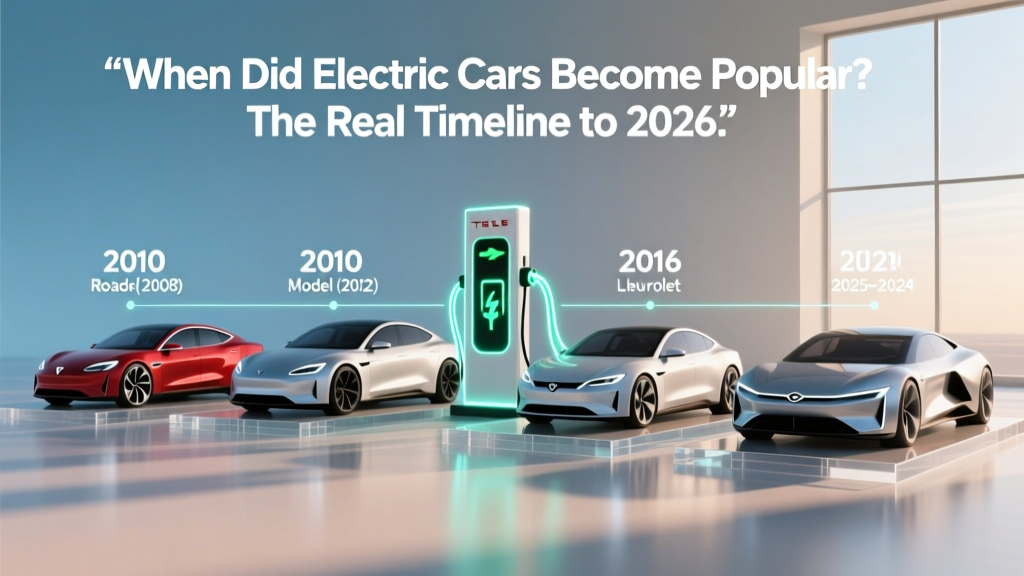
Electric cars became popular in two distinct waves. The first wave began in 2010–2012 with the Nissan Leaf and Chevrolet Volt, proving that mass-produced EVs were viable. The second, mainstream wave started around 2018–2020, driven by the Tesla Model 3's mass production, expanding public charging networks, and falling battery costs. By 2023, EVs crossed 7% of new U.S. car sales; by 2025, that figure exceeded 10%. In 2026, EVs are no longer niche — they're a standard consideration for most new-car buyers, with dozens of models under $45,000 and DC fast charging widely available along major highways.
The Early Spark: 2010–2015
Before 2010, electric cars were either niche compliance vehicles or low-speed neighborhood runabouts. That changed in December 2010 when Nissan delivered the first U.S.-spec Leaf — a dedicated battery-electric hatchback with a 24 kWh battery and an EPA-estimated 73 miles of range. It was a revelation: a real car, at a real price (about $32,780 before incentives), with zero tailpipe emissions.
That same year, Chevrolet launched the Volt, a plug-in hybrid (PHEV) offering ~35 miles of electric-only range before a gas engine kicked in. Together, the Leaf and Volt proved that electrified vehicles could be daily drivers, not just science projects.
But "popular" is relative. From 2011 through 2015, combined U.S. EV and PHEV sales rarely exceeded 1% of the new-car market. Early adopters faced real obstacles:
- Range: Most EVs offered 70–100 miles EPA — fine for commuting, stressful for road trips.
- Charging: Public DC fast chargers were scarce. CHAdeMO was the dominant standard; CCS didn't launch in the U.S. until 2014.
- Cost: Battery packs ran $500–$1,000+ per kWh, keeping EV prices high relative to gas equivalents.
Tesla's Inflection: 2012–2019
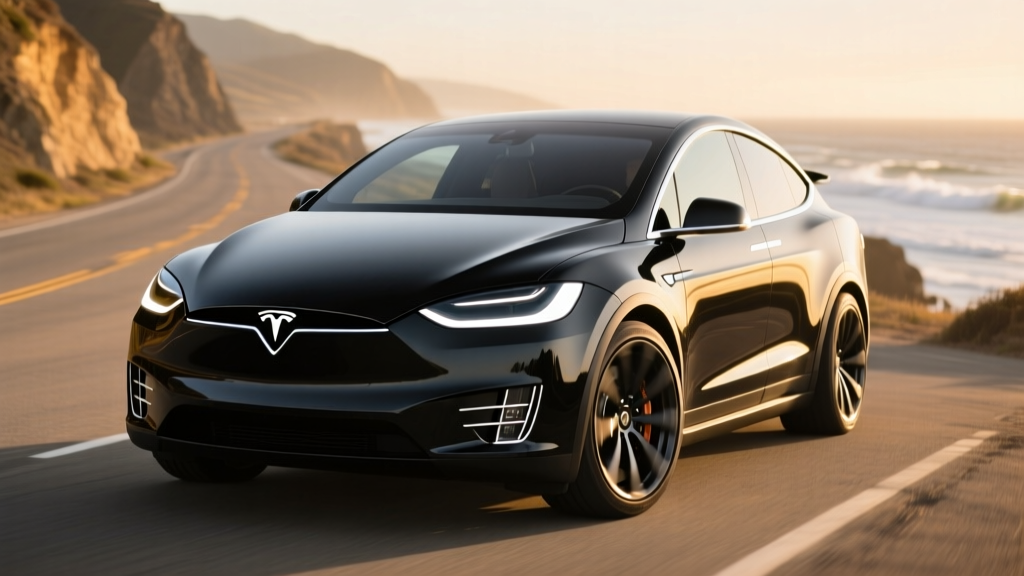
Tesla's Model S (2012) proved that an EV could be a luxury performance sedan with 265 miles of EPA range. But the real popularity catalyst was the Model 3. Announced in 2016 with a promised $35,000 price, it drew over 400,000 reservations in weeks. Volume deliveries began in 2018, and by 2019 the Model 3 was the best-selling premium sedan in the U.S. — gas or electric.
The Model 3's significance wasn't just sales volume. It forced legacy automakers to take EVs seriously. It also built the Supercharger network, which by 2019 had over 1,500 U.S. stations, making cross-country EV travel practical for the first time.
During this period, battery costs fell sharply. According to BloombergNEF data, average lithium-ion pack prices dropped from roughly $1,100/kWh in 2010 to under $140/kWh by 2023 — a decline that directly enabled more affordable, longer-range EVs.
The Mainstream Tipping Point: 2020–2026
Several converging forces pushed EVs from early-adopter territory into the mainstream between 2020 and 2026:
- More models: Ford Mustang Mach-E (2021), Hyundai Ioniq 5 (2022), Chevrolet Equinox EV (2024), and dozens more gave buyers real choices across body styles and price points.
- Range normalization: By 2025, 250+ miles of EPA range became standard for mainstream EVs. The Ioniq 5 delivers up to 318 miles EPA; the Equinox EV reaches 319 miles.
- Charging infrastructure: The 2022–2024 industry-wide adoption of the NACS (North American Charging Standard) connector meant nearly every automaker gained access to Tesla's Supercharger network by 2025, dramatically expanding reliable DC fast charging.
- Federal incentives: The Inflation Reduction Act (2022) restructured the §30D federal tax credit, offering up to $7,500 for qualifying new EVs — and critically, beginning in 2024, allowing point-of-sale transfer so buyers could apply the credit as an immediate price reduction.
U.S. EV sales crossed the 1 million annual mark in 2023 and continued climbing. By early 2026, EVs represent over 10% of new vehicle sales nationally, with states like California exceeding 25%.
EV vs. Gas vs. Hybrid: What the Numbers Actually Show in 2026
Popularity means nothing if the math doesn't work. Here's how a mainstream EV stacks up against comparable gas and hybrid vehicles in 2026, using the Hyundai Ioniq 5 (EV), Toyota RAV4 Hybrid, and Toyota RAV4 (gas) as representative examples:
| Metric | Hyundai Ioniq 5 SE (EV) | Toyota RAV4 Hybrid | Toyota RAV4 LE (Gas) |
|---|---|---|---|
| Base MSRP | $42,600 | $33,425 | $30,425 |
| Potential §30D Credit | Up to $7,500* | $0 | $0 |
| Effective Price After Credit | ~$35,100 | $33,425 | $30,425 |
| EPA Efficiency | 114 MPGe (26 kWh/100 mi) | 39 MPG combined | 30 MPG combined |
| EPA Range / Tank Range | 318 mi (EPA) | ~461 mi (14.5-gal tank) | ~435 mi (14.5-gal tank) |
| Fuel/Energy Cost per Mile† | ~$0.043 (home charging) | ~$0.087 | ~$0.113 |
| 5-Year Fuel/Energy Cost (75k mi) | ~$3,225 | ~$6,525 | ~$8,475 |
| Scheduled Maintenance (5 yr est.) | ~$1,200 | ~$2,800 | ~$3,200 |
*§30D credit eligibility depends on MSRP caps, buyer income limits, battery component sourcing, and critical-mineral requirements. Verify current rules at IRS.gov. †Based on $0.165/kWh national average electricity and $3.40/gallon regular unleaded.
The EV's higher sticker price narrows substantially after the federal credit, and its per-mile energy and maintenance savings compound quickly. Over five years and 75,000 miles, the Ioniq 5 saves roughly $3,300 in energy and $1,600 in maintenance versus the gas RAV4 — offsetting much of the remaining price gap.
The Real Costs of EV Ownership in 2026
Popularity doesn't mean "right for everyone." Here's an honest cost breakdown for a typical new EV buyer in 2026:
| Cost Category | EV (Typical) | Gas Car (Typical) | Notes |
|---|---|---|---|
| Purchase Price (before credit) | $38,000–$55,000 | $28,000–$42,000 | EVs still carry a premium, though narrowing |
| §30D Federal Tax Credit | $0–$7,500 | $0 | Subject to income, MSRP, and sourcing rules |
| Home Level 2 Charger Install | $800–$2,500 | $0 | Depends on panel capacity and run length; licensed electrician required |
| Annual Energy/Fuel (15k mi) | $645 (home) | $1,700 (gas) | Public DC fast charging costs ~2–3× home rate |
| Annual Insurance | $1,800–$2,600 | $1,400–$2,000 | EV premiums run 15–30% higher on average |
| Maintenance (annual avg.) | $200–$350 | $550–$750 | No oil changes, fewer brake replacements (regen braking) |
| Battery Replacement (if out of warranty) | $8,000–$18,000 | $3,000–$6,000 (transmission) | Rare; most EVs retain 85–92% battery capacity at 150k miles |
| Battery/Powertrain Warranty | 8 yr / 100,000 mi (federal mandate) | 5 yr / 60,000 mi (typical powertrain) | EV battery warranties are substantially longer |
The total cost of ownership (TCO) favors EVs for buyers who can charge at home and drive 12,000+ miles annually. But if you rely entirely on public DC fast charging — at $0.35–$0.55/kWh at networks like Electrify America or EVgo — your per-mile cost can approach or exceed that of a fuel-efficient hybrid.
Common Misconceptions — Fact-Checked
| Myth | Fact |
|---|---|
| "EVs have worse range than gas cars." | Most 2026 EVs deliver 250–350 miles EPA. Real-world highway driving reduces this ~10–15%; cold weather (below 25°F) can cut range 20–30%. A gas car's range also drops in aggressive driving, but EVs are more sensitive to temperature and speed. |
| "You can't take an EV on a road trip." | With NACS access to 6,000+ Superchargers and growing CCS networks, highway charging is widely available. A 300-mile EV charging from 10–80% at a 250 kW station adds ~200 miles in 18–22 minutes. Plan stops, and it works. |
| "EV batteries need replacing every few years." | Data from Recurrent Auto and OEM warranty claims show most NMC and LFP packs retain 85–92% of original capacity at 150,000 miles. The 8-year/100,000-mile federal warranty covers defects and excessive degradation (typically below 70% capacity). |
| "EVs are worse for the environment because of battery mining." | Lifecycle analyses from Argonne National Laboratory and the ICCT consistently show that even accounting for battery manufacturing, EVs produce 50–70% fewer lifetime greenhouse-gas emissions than comparable gas cars on the average U.S. grid — and the grid gets cleaner every year. |
| "Everyone qualifies for the $7,500 tax credit." | The §30D credit has strict rules: buyer AGI caps ($150k single / $300k joint), vehicle MSRP caps ($55k sedans / $80k SUVs/trucks), and battery sourcing requirements that disqualify some models. Always verify at IRS.gov before purchasing. |
What First-Time EV Buyers Need to Know in 2026
If you're entering the EV market for the first time, here's the practical knowledge that separates smooth ownership from frustration:
Home Charging Is the Make-or-Break Factor
Over 80% of EV charging happens at home. A Level 2 (240V) home charger adds 25–44 miles of range per hour of charging (at 7.7–11.5 kW), easily replenishing a full day's driving overnight. Installation costs $800–$2,500 depending on your electrical panel's capacity and the distance from panel to charger location. If your home has a 200-amp panel with spare capacity, expect the lower end. Older homes with 100-amp service may need a panel upgrade ($1,500–$3,500) — get a licensed electrician's assessment before committing.
If you cannot install home charging (apartment, street parking, HOA restrictions), an EV is still viable but less convenient. You'll rely on public Level 2 and DC fast charging, which costs more and requires planning. A PHEV may be a better bridge in this scenario.
Understand kW vs. kWh
This is the single most common confusion for new EV buyers:
- kWh (kilowatt-hours) = energy capacity. Think of it as your "tank size." A 77.4 kWh battery holds that much energy.
- kW (kilowatts) = power rate. Think of it as your "pump speed." A 250 kW DC fast charger delivers energy at that peak rate.
A 77.4 kWh battery charging at a sustained 150 kW would theoretically fill in ~31 minutes. In practice, charging follows a curve — it peaks at low state-of-charge (SoC) and tapers significantly above 80%. That's why manufacturers quote 10–80% charge times, not 0–100%.
Real-World Range vs. EPA Sticker
EPA range estimates are useful but optimistic for certain conditions. Expect:
- City/suburban driving: Close to or slightly above EPA (regenerative braking recaptures energy at low speeds).
- Sustained highway (70–80 mph): 10–20% below EPA, depending on temperature and elevation.
- Cold weather (below 25°F): 20–30% below EPA, due to battery chemistry and cabin heating demands. A heat pump (standard on many 2026 models) reduces but doesn't eliminate this loss.
Decision Framework: Is an EV Right for You in 2026?
Choose a full EV (BEV) if:
- You can install a Level 2 charger at home or have reliable workplace charging.
- Your daily driving is under 200 miles round-trip (covers ~95% of U.S. commutes).
- You take road trips 1–4 times per year and can plan 20-minute charging stops.
- You want the lowest per-mile operating cost and minimal maintenance.
- You qualify for the §30D credit, narrowing the upfront price gap.
Choose a plug-in hybrid (PHEV) if:
- You lack reliable home or workplace charging.
- You frequently drive 300+ miles in a single day through areas with sparse charging.
- You want electric-only commuting (25–45 miles) with gas flexibility for longer trips.
- Your budget is tighter — PHEVs typically start $5,000–$10,000 below comparable BEVs.
Stick with a gas or conventional hybrid (HEV) if:
- You live in a region with minimal public charging infrastructure (rural areas, charging deserts).
- You regularly tow heavy loads (towing reduces EV range by 40–60%).
- Your annual mileage is very low (under 6,000 miles), making fuel savings negligible against the EV price premium.
The Bottom Line: Popular Enough to Be Practical
Electric cars became popular not because of a single moment, but because of a steady convergence of longer range, lower battery costs, expanding charging networks, and real purchase incentives. In 2026, EVs are a proven, data-backed option for most drivers — not a leap of faith. The question is no longer "do EVs work?" but "does an EV work for my specific driving pattern, home setup, and budget?" Run your own numbers using the tables above, and the answer will be clear.
When did Tesla make electric cars popular?
Tesla's Model S (2012) proved EVs could be desirable luxury vehicles, but the Model 3 (volume deliveries starting 2018) was the true popularizer — it became the best-selling premium car in the U.S. and demonstrated that EVs could be produced at scale. Tesla's Supercharger network also solved the road-trip problem years before competitors.
Why did EVs take so long to become popular?
Three barriers: battery cost (over $1,000/kWh in 2010 vs. ~$130/kWh by 2024), limited range (73 miles in the 2011 Leaf vs. 300+ miles today), and sparse charging infrastructure. All three improved dramatically between 2015 and 2025, removing the primary obstacles to adoption.
Are EVs more popular than gas cars in 2026?
Not yet by total sales volume. EVs represent roughly 10–12% of new U.S. vehicle sales in 2026, with conventional gas, hybrid, and PHEV vehicles making up the remainder. However, EVs are the fastest-growing segment, and they dominate in states with strong incentives and charging infrastructure (California, Washington, Oregon, Colorado).
What was the first popular electric car?
The Nissan Leaf (2010) was the first mass-produced, widely available battery-electric vehicle, selling over 500,000 units globally by 2020. The Tesla Model 3 surpassed it in cultural impact and U.S. sales volume starting in 2018.
Do EVs hold their resale value?
EV depreciation has been steeper than gas cars, partly due to rapid technology improvements and price cuts on new models. Expect 40–55% value retention after 3 years for mainstream EVs, versus 50–65% for comparable gas vehicles. However, lower operating costs can offset this for owners who keep the vehicle 5+ years.