The Quick Verdict: Supercar SUV Meets Family Hauler
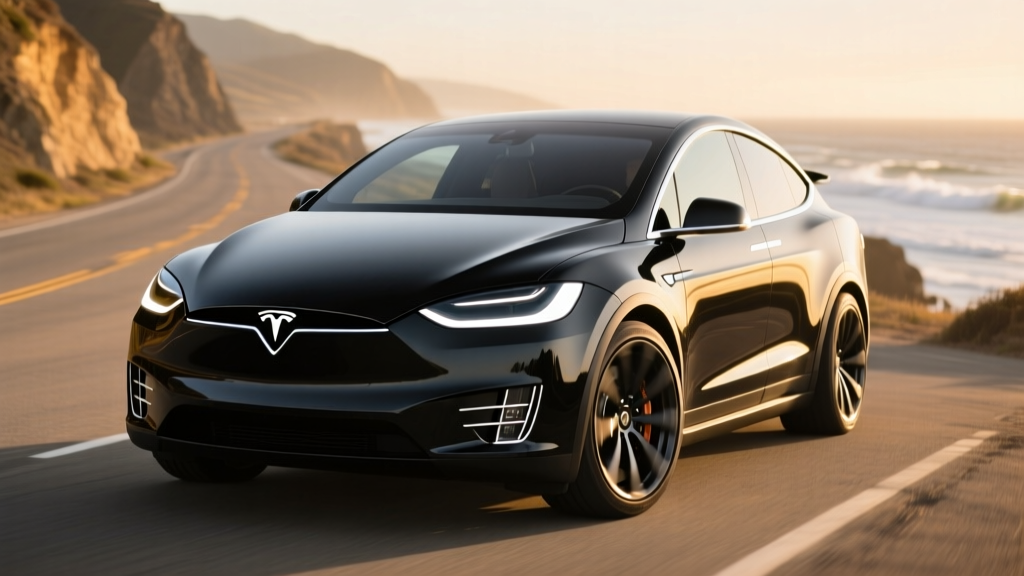
If you search for the Tesla Model X Plaid top speed, the headline number is 163 mph — a figure that places this three-row electric SUV in hypercar territory. But speed is only part of the story. The 2025 Tesla Model X Plaid pairs a 1,020-horsepower tri-motor all-wheel-drive powertrain with a 311-mile EPA range, Supercharger network access, and enough cargo space for a family road trip. At $114,990 before incentives, it is an unapologetically premium machine that trades some ride refinement for straight-line dominance.
This review covers everything a prospective buyer needs: real-world range versus the EPA sticker, DC fast-charging behavior and the notorious 80% taper, home charging math, federal tax credit eligibility under current IRS §30D rules, and how the Plaid stacks up against the Lucid Gravity, Rivian R1T, and BMW iX M70.
Performance: 0-60, Horsepower, and the 163 MPH Ceiling
The Model X Plaid uses Tesla's tri-motor architecture — one permanent-magnet motor up front and two induction motors in the rear — to deliver 1,020 horsepower and an estimated 1,050 lb-ft of torque. The result is a manufacturer-claimed 0-60 mph time of 2.5 seconds, making it one of the quickest production SUVs ever built.
The Tesla Model X Plaid top speed is electronically limited to 163 mph (262 km/h). That ceiling is imposed partly by the SUV's aerodynamic profile (a 0.24 Cd is excellent for an SUV but still generates more drag than a sedan) and partly by tire temperature management at sustained high velocities. For context, the standard dual-motor Model X Long Range tops out at 155 mph.
| Spec | Model X Plaid | Model X Long Range |
|---|---|---|
| Drivetrain | Tri-Motor AWD | Dual-Motor AWD |
| Horsepower | 1,020 hp | 670 hp |
| 0-60 mph | 2.5 sec | 3.8 sec |
| Top Speed | 163 mph | 155 mph |
| EPA Range | 311 mi | 335 mi |
Track use reveals the Plaid's thermal management is robust: Tesla's heat-pump-based battery cooling system can sustain repeated hard launches without the dramatic power derating that plagued early dual-motor Teslas. However, sustained 160+ mph runs will still heat-soak the pack, and the car will progressively limit power to protect the cells. This is physics, not a flaw — every high-output EV behaves similarly under extreme load.
Range and Efficiency: EPA vs. Reality
The EPA rates the Model X Plaid at 311 miles on a full charge (with 20-inch wheels; stepping to 22-inch Turbine wheels drops this to approximately 295 miles). Efficiency comes in at 98 MPGe combined, or roughly 34 kWh per 100 miles, according to fueleconomy.gov.
Real-World Range Expectations
EPA Sticker: 311 miles (20" wheels)
Highway (70-75 mph, moderate temps): ~255-275 miles — the boxy SUV shape and 5,000+ lb curb weight punish efficiency at sustained speed.
City / Suburban mixed: ~285-305 miles — regenerative braking recovers energy effectively in stop-and-go driving.
Cold weather (below 32°F): ~215-250 miles — expect a 20-30% reduction due to cabin heating demand and reduced battery chemistry efficiency, even with the standard heat pump.
The battery pack is a ~100 kWh (usable) lithium-ion unit using an NMC (nickel-manganese-cobalt) chemistry optimized for energy density and high C-rate discharge. Tesla does not publish exact kWh figures, but teardown data and EPA test-cycle analysis consistently point to approximately 95-100 kWh of usable capacity. Unlike the standard-range Model 3 and Model Y variants that use LFP (lithium iron phosphate) chemistry, the Plaid's NMC pack prioritizes power delivery over cycle-life longevity — a sensible trade-off for a performance vehicle.
For daily driving, Tesla recommends charging NMC packs to 80-90% for longevity, which gives you roughly 250-280 real-world miles of usable range before needing to plug in. Reserve 100% charges for road trips.
Charging Speed: Supercharger Peaks, Home Levels, and the 80% Taper
Charging speed is where many EV buyers get surprised, and the Model X Plaid is no exception. The peak DC fast-charge rate is 250 kW on a V3 Supercharger, but that peak only holds for a narrow state-of-charge window (roughly 10-30% SoC) before tapering significantly.
| Charging Level | Power / Rate | Miles Added | Notes |
|---|---|---|---|
| Level 1 (120V household) | ~1.4 kW | ~3-4 mi/hr | Emergency trickle only |
| Level 2 (240V, 48A Wall Connector) | 11.5 kW | ~34 mi/hr | Full charge in ~9 hours |
| DC Fast (V3 Supercharger, peak) | 250 kW | ~175 mi in 15 min | Peak rate, 10-30% SoC |
| DC Fast (10-80% average) | ~130 kW avg | ~30-35 minutes | Significant taper above 50% |
Preconditioning matters. If you navigate to a Supercharger in the Tesla app or in-car navigation, the battery management system will warm or cool the pack to the optimal temperature for fast charging. Skipping this step — for example, pulling into a charger without routing through navigation — can add 5-10 minutes to your session and reduce peak power by 30-50 kW, especially in cold weather.
At home, the Tesla Wall Connector on a 60-amp circuit (48 amps continuous) delivers up to 11.5 kW. With a ~100 kWh usable pack, a full charge from near-empty takes roughly 9 hours. Most owners charge overnight and wake up to a full battery every morning, which is the single biggest ownership convenience advantage EVs have over gas vehicles.
The Model X uses the NACS (North American Charging Standard) connector natively. This gives you access to the entire Tesla Supercharger network — over 25,000 stalls in North America — without an adapter, and increasingly to non-Tesla chargers as the industry standardizes on NACS through 2025-2026.
Pricing, Tax Credits, and Total Cost
The 2025 Tesla Model X Plaid starts at $114,990 (including destination fee). Options that push the as-tested price higher include:
- 22-inch Turbine wheels: +$5,500 (reduces range to ~295 mi)
- Full Self-Driving (Supervised): +$8,000
- Premium interior colors (e.g., Cream, Black and White): +$2,000
- Six-seat interior with center console: +$6,500 (replaces standard 7-seat)
A fully optioned Model X Plaid can approach $137,000.
| Item | Amount |
|---|---|
| Base MSRP (Model X Plaid) | $114,990 |
| Federal §30D Tax Credit | $0 (exceeds MSRP cap) |
| Estimated Out-the-Door (base) | ~$114,990 + taxes/fees |
Federal Tax Credit Eligibility
Under current IRS §30D rules, the Model X Plaid does not qualify for the $7,500 federal EV tax credit. The reason is straightforward: §30D imposes an MSRP cap of $80,000 for SUVs, vans, and pickup trucks (and $55,000 for sedans). At $114,990, the Plaid exceeds this cap by a wide margin. Even the Model X Long Range, at approximately $94,990, is ineligible.
Additionally, §30D has buyer income limits ($300,000 joint / $150,000 single for new vehicles) and battery critical-mineral and component sourcing requirements that shift annually. Always verify current eligibility on irs.gov or consult a tax professional before purchase. Some states offer their own rebates or tax credits that may partially offset the cost — check your local DMV or energy office.
Interior, Cargo, and Technology
The Model X interior balances minimalism with genuine utility. The standard seven-seat layout (2-3-2) offers adequate third-row space for children, while the optional six-seat configuration (2-2-2) replaces the second-row bench with individual captain's chairs and a center console — a more comfortable setup for four or five passengers.
Cargo volume:
- Behind third row: ~15 cu ft
- Third row folded: ~42 cu ft
- All rear rows folded: ~75 cu ft
- Front trunk (frunk): ~6.6 cu ft
The falcon-wing rear doors are the Model X's signature feature. They open upward with articulating hinges, allowing stand-up access to the second and third rows in tight parking spaces. They are genuinely useful for loading child seats, though they operate more slowly than conventional doors and can be problematic in low-clearance garages (ultrasonic sensors detect overhead obstructions and adjust the opening arc).
Tech highlights:
- 17-inch center touchscreen with 22-speaker audio system
- Second-row 8-inch touchscreen for rear passengers (climate, media, gaming)
- HEPA air filtration with Bioweapon Defense Mode
- Over-the-air software updates adding features post-purchase
- Tesla Vision-based Autopilot standard; Full Self-Driving (Supervised) optional
Driver-Assist Clarification
Tesla's Autopilot and Full Self-Driving (Supervised) are SAE Level 2 driver-assistance systems. The driver must remain fully attentive, keep hands on the wheel, and be prepared to take over at any moment. These systems do not make the vehicle self-driving. Only Level 4 services like Waymo operate without a human driver — and those are limited to specific geofenced areas.
Warranty, Reliability, and Ownership Costs
Tesla covers the Model X with the following warranty structure:
- Basic vehicle: 4 years / 50,000 miles
- Battery and drive unit: 8 years / 150,000 miles (whichever comes first), with a minimum 70% capacity retention guarantee over the warranty period
The 8-year/150,000-mile battery warranty is competitive and reflects Tesla's confidence in its NMC pack longevity. Independent fleet data from high-mileage Model S/X vehicles suggests typical degradation of 10-15% over the first 100,000 miles, with the curve flattening significantly afterward. A full pack replacement out of warranty currently costs approximately $15,000-$22,000 depending on the service center and pack revision — a figure worth factoring into long-term ownership projections.
Insurance premiums for the Model X Plaid are among the highest in the EV segment due to the vehicle's price, performance, and Tesla's historical repair-cost data. Expect annual premiums in the $3,500-$5,500 range depending on your state, driving record, and coverage level. Tesla offers its own insurance product in many states that uses real-time driving behavior (via the Tesla app) to calculate premiums, which can be 10-20% cheaper for careful drivers.
Pros, Cons, and the Competition
Pros
- 2.5-second 0-60 mph — among the quickest SUVs on the planet
- 311-mile EPA range is solid for a 5,000+ lb performance SUV
- Access to the Supercharger network (25,000+ stalls, highest reliability in the industry)
- Falcon-wing doors offer genuine loading convenience
- Continual OTA updates keep the vehicle current
- Class-leading cargo versatility with frunk + fold-flat rows
Cons
- $114,990 base price; no federal tax credit due to MSRP cap
- 250 kW peak charging is outpaced by Hyundai/Kia's 350 kW E-GMP platform and Porsche's 800V architecture
- Panel gaps and interior fit/finish still trail BMW, Mercedes, and Lucid at this price point
- Falcon-wing doors are slower and more complex than conventional doors
- Ride quality on 22-inch wheels is firm — noticeable on rough pavement
- Third row is best suited for children, not adults on long trips
Key Competitors
Lucid Gravity (Touring/Grand Touring): Starting around $94,900, the Gravity offers up to 440 miles of EPA range (Grand Touring), more refined ride quality, and a more luxurious interior. It cannot match the Plaid's acceleration, but it is the more polished luxury family SUV.
BMW iX M70: At ~$111,500, the iX M70 delivers 610 hp, a 0-60 of 3.6 seconds, and roughly 290 miles of range. The BMW wins on interior quality and ride comfort but loses on range, charging network access, and raw acceleration.
Rivian R1S (Tri-Motor): The three-motor R1S produces 850 hp, offers genuine off-road capability, and starts around $99,900. It sacrifices highway range (~316 miles on the Max pack) and charges slower than the Tesla, but it is the more adventurous family vehicle.
Who Should Buy the Model X Plaid?
Choose the Model X Plaid If:
- You want supercar-level acceleration in a three-row SUV and are willing to pay a premium for it
- You rely on the Supercharger network for frequent road trips
- You value OTA software updates and Tesla's tech ecosystem
- Your daily commute is under 200 miles round-trip (home charging covers it effortlessly)
Look Elsewhere If:
- You prioritize interior luxury and ride refinement — the Lucid Gravity or BMW iX do this better
- You need a federal tax credit to justify the purchase — the Model X exceeds the §30D MSRP cap
- You regularly carry adults in the third row — the Rivian R1S offers more space
- You want the fastest possible DC charging — Hyundai/Kia's E-GMP platform and Porsche's 800V system charge faster
Frequently Asked Questions
What is the real-world range of the Tesla Model X Plaid?
The EPA rates it at 311 miles, but expect 255-275 miles on the highway at 70-75 mph in moderate temperatures, and as low as 215-250 miles in freezing conditions. City driving with regenerative braking can get you close to the EPA number.
How fast does the Model X Plaid charge at home and on the road?
At home on a Level 2 Tesla Wall Connector (11.5 kW), you gain roughly 34 miles per hour — a full overnight charge. On a V3 Supercharger, the peak rate is 250 kW, adding up to 175 miles in 15 minutes, but a realistic 10-80% session takes 30-35 minutes due to charge-curve tapering above 50% SoC.
Does the Model X Plaid qualify for the federal EV tax credit?
No. Under IRS §30D rules, SUVs must have an MSRP at or below $80,000 to qualify. The Model X Plaid starts at $114,990, making it ineligible regardless of buyer income or battery sourcing. Always verify current rules at irs.gov.
Is the Model X Plaid worth it versus the Lucid Gravity or BMW iX?
If raw acceleration and Supercharger access are your top priorities, yes. If you value ride quality, interior materials, and a more traditional luxury experience, the Lucid Gravity or BMW iX M70 are more refined alternatives at similar or lower prices.
What is the battery warranty on the Model X Plaid?
Tesla covers the battery and drive unit for 8 years or 150,000 miles, whichever comes first, guaranteeing at least 70% capacity retention over that period. Out-of-warranty replacement currently costs approximately $15,000-$22,000.
Can the Model X Plaid tow?
Yes. The Model X is rated to tow up to 5,000 pounds when properly equipped. However, towing will reduce range significantly — expect a 30-50% reduction depending on trailer weight and aerodynamics.