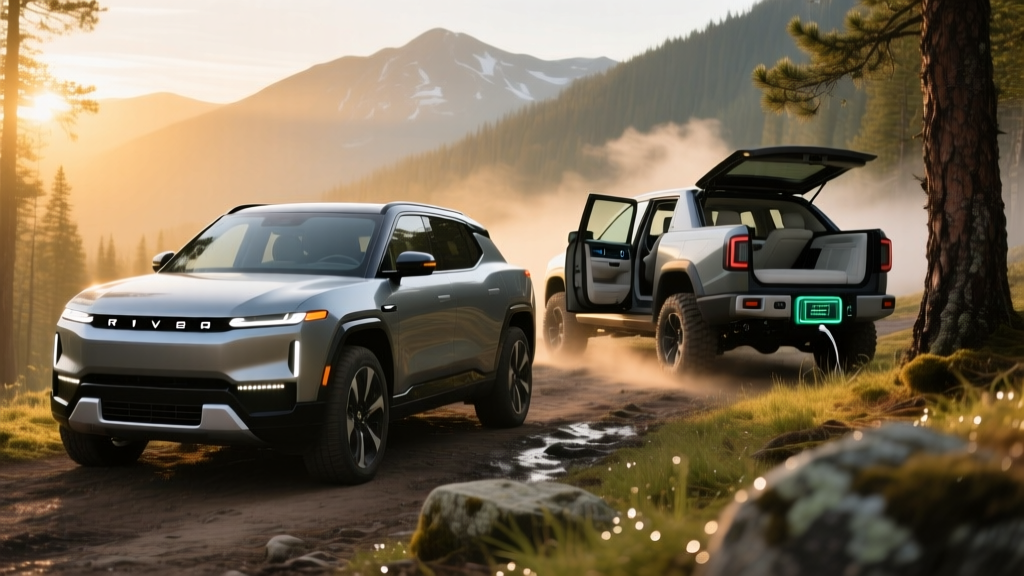
If you've been researching electric trucks and SUVs, you've likely asked: what is a Rivian vehicle, and how does it stack up against Tesla, Ford, and Chevrolet? Rivian Automotive, founded in 2009 and based in Irvine, California, builds two consumer vehicles on a shared "skateboard" platform: the R1S three-row SUV and the R1T pickup truck. Both received a major Generation 2 (Gen 2) update for the 2025 model year that carried into 2026, bringing new battery chemistries, faster charging, NACS ports, and revised pricing.
This guide covers everything a prospective buyer needs — EPA range, real-world efficiency, charging speeds, battery chemistry, pricing after tax credits, and whether a Rivian is the right electrified vehicle for your garage.
Rivian at a Glance: R1S and R1T Core Specs
Both the R1S and R1T share the same underlying architecture, battery options, and powertrain configurations. Below is a consolidated spec table for the 2026 model year Dual-Motor and Tri-Motor variants on the Standard and Max battery packs.
| Spec | R1S Dual-Motor (Standard) | R1S Tri-Motor (Max) | R1T Dual-Motor (Standard) | R1T Tri-Motor (Max) |
|---|---|---|---|---|
| EPA Range | ~270 mi | ~410 mi | ~270 mi | ~420 mi |
| Battery (usable, est.) | ~95 kWh (LFP) | ~141 kWh (NMC) | ~95 kWh (LFP) | ~141 kWh (NMC) |
| Drivetrain | Dual-Motor AWD | Tri-Motor AWD | Dual-Motor AWD | Tri-Motor AWD |
| Horsepower | 533 hp | 850+ hp | 533 hp | 850+ hp |
| 0–60 mph | ~4.5 sec | ~3.0 sec | ~4.5 sec | ~3.0 sec |
| Max DC Fast Charge | ~200 kW | ~220 kW | ~200 kW | ~220 kW |
| 10–80% DC Time | ~28 min | ~42 min | ~28 min | ~42 min |
| Level 2 Home Rate | 11.5 kW (~30 mi/hr) | 11.5 kW (~30 mi/hr) | 11.5 kW (~30 mi/hr) | 11.5 kW (~30 mi/hr) |
| Towing Capacity | 7,700 lb | 7,700 lb | 11,000 lb | 11,000 lb |
| Base MSRP (est.) | $75,900 | $99,900 | $69,900 | $93,900 |
Note: Specs reflect Gen 2 configurations announced for the 2025 model year and carried into 2026. Final EPA certification numbers for 2026 may vary slightly by trim. Always verify at fueleconomy.gov.
Real-World Range: What the EPA Sticker Doesn't Tell You
EPA Estimated: ~270 miles
Real-World Highway (70–75 mph): ~220–240 miles
Real-World Cold Weather (below 32°F): ~180–210 miles
Towing (5,000+ lb trailer): ~120–150 miles
Rivian's large, boxy shapes create substantial aerodynamic drag, which is the biggest range killer at highway speeds. In real-world testing by owners and independent reviewers, the Dual-Motor Standard pack typically delivers 220–240 miles at sustained highway speeds of 70–75 mph — roughly 10–15% below the EPA sticker.
Cold weather compounds this. Lithium-ion batteries lose efficiency in freezing temperatures, and cabin heating draws significant energy. Expect a 20–30% range reduction in sub-freezing conditions, bringing the Standard pack down to roughly 180–210 miles. Rivian does include a heat pump on Gen 2 vehicles, which mitigates some of this loss compared to resistive heating, but physics still wins in extreme cold.
The Max pack (141 kWh NMC) fares better in absolute terms — you'll still see 330–360 real-world highway miles — but the percentage loss is similar. If you regularly tow, plan for range to roughly halve. The R1T's 11,000-lb towing capacity is impressive, but pulling a 7,000-lb travel trailer at highway speed will limit you to 120–150 miles between charges. This is a reality for all electric trucks, not unique to Rivian.
Battery Chemistry: LFP vs. NMC in the Rivian Lineup
With the Gen 2 update, Rivian introduced an LFP (lithium iron phosphate) Standard battery pack alongside the carryover NMC (nickel manganese cobalt) Max pack. Understanding the difference matters for long-term ownership.
| Attribute | Standard Pack (LFP) | Max Pack (NMC) |
|---|---|---|
| Usable Capacity | ~95 kWh | ~141 kWh |
| Energy Density | Lower (heavier per kWh) | Higher (lighter per kWh) |
| Cycle Life | 3,000+ cycles (excellent) | 1,500–2,000 cycles |
| Daily Charging to 100% | Recommended — LFP prefers full charges | Charge to 80–90% daily; 100% for trips |
| Cold-Weather Performance | Slightly worse in extreme cold | Better low-temp efficiency |
| Cost | Lower — enables lower vehicle MSRP | Higher — premium pack |
| Best For | Daily commuting, city/suburban driving | Road trips, towing, range-maximizing buyers |
Key takeaway: If most of your driving is within 150 miles of home and you can charge nightly, the LFP Standard pack offers superior longevity and a lower purchase price. If you road-trip frequently, tow, or live in a cold climate, the NMC Max pack is the pragmatic choice. LFP batteries also use no cobalt or nickel, which simplifies critical-mineral sourcing — relevant for tax credit eligibility discussed below.
Charging Speed: DC Fast Charging and Home Level 2
Gen 2 Rivians switched to the NACS (North American Charging Standard) connector, the Tesla-designed plug now adopted industry-wide. This gives Rivian owners native access to Tesla Superchargers — one of the most reliable DC fast-charging networks in the U.S. — without an adapter.
| Charging Level | Power / Rate | Time / Range Added |
|---|---|---|
| Level 1 (120V household) | ~1.4 kW | ~3–4 miles per hour |
| Level 2 (240V home, 48A) | 11.5 kW | ~30 miles per hour; full charge in ~9–13 hours |
| DC Fast Charge (Standard LFP) | Peak ~200 kW | 10–80% in ~28 minutes |
| DC Fast Charge (Max NMC) | Peak ~220 kW | 10–80% in ~42 minutes |
A critical nuance: the "peak" kW number is not sustained. Rivian's charge curve, like all EVs, tapers significantly above 80% State of Charge (SoC) to protect battery health. On the Max pack, you might see 220 kW briefly between 10–30% SoC, then a step-down to ~150 kW through 60%, and further tapering above 80%. The 10–80% time of ~42 minutes reflects this realistic curve, not a sustained 220 kW sprint.
For home charging, a 48-amp Level 2 wall connector on a 60-amp circuit delivers 11.5 kW, adding roughly 30 miles of range per hour. Most owners plug in overnight and wake to a full battery every morning. Installation typically requires a 240V / 60A dedicated circuit; if your electrical panel is at capacity, a panel upgrade (200A service) may add $1,500–$3,000 to the installation cost. Always consult a licensed electrician for final specifications.
Preconditioning matters. Rivian's navigation system will precondition the battery when you route to a DC fast charger — warming it to optimal temperature for faster charging. If you drive to a charger without preconditioning (especially in cold weather), your initial charge rate will be substantially slower until the battery warms up.
Performance, Cargo Space, and Everyday Practicality
Even the "base" Dual-Motor Rivian produces 533 horsepower and hits 60 mph in roughly 4.5 seconds — quicker than most V8-powered trucks and SUVs from the gas era. The Tri-Motor variant pushes past 850 hp with a ~3.0-second 0–60 time, placing it in supercar territory despite its 6,000+ lb curb weight.
Rivian's quad-motor configuration (one motor per wheel, available on Tri-Motor with an additional front motor in some configurations) enables precise torque vectoring, which translates to genuinely capable off-road performance. The R1T and R1S feature an adjustable air suspension that can raise ground clearance to over 14 inches for trails or lower for highway efficiency.
Cargo and Passenger Dimensions
R1T (Pickup):
- Bed length: 4.5 feet (54 inches) — shorter than a traditional full-size truck bed
- Gear Tunnel: 11.7 cu ft of lockable, pass-through storage between the cab and bed — a signature Rivian feature
- Frunk (front trunk): 11.1 cu ft
- Seating: 5 passengers, 2 rows
- Rear legroom: ~38.5 inches
R1S (SUV):
- Cargo behind 3rd row: ~10.5 cu ft
- Cargo behind 2nd row (3rd row folded): ~46 cu ft
- Cargo behind 1st row (all rear seats folded): ~92 cu ft
- Frunk: 11.1 cu ft
- Seating: 7 passengers, 3 rows
- Third-row legroom: ~30 inches (tight for adults on long trips)
The R1T's Gear Tunnel is genuinely innovative — perfect for stowing camping gear, golf bags, or groceries out of sight. However, the 4.5-foot bed is shorter than competitors like the Ford F-150 Lightning (5.5 ft standard bed), which matters if you regularly haul plywood or long materials.
Pricing, Trims, and Federal Tax Credit Eligibility
| Model / Config | Base MSRP (est.) | Federal §30D Credit | Effective Price (est.) |
|---|---|---|---|
| R1T Dual-Motor Standard | $69,900 | Up to $7,500* | ~$62,400 |
| R1T Tri-Motor Max | $93,900 | $0 (above MSRP cap) | $93,900 |
| R1S Dual-Motor Standard | $75,900 | Up to $7,500* | ~$68,400 |
| R1S Tri-Motor Max | $99,900 | $0 (above MSRP cap) | $99,900 |
*Federal tax credit eligibility depends on multiple factors. See checklist below.
IRS §30D Federal EV Tax Credit — Eligibility Checklist
Rivian vehicles may qualify for up to $7,500 under the IRS §30D Clean Vehicle Credit, but only if every criterion below is met:
- MSRP Cap: Vans, SUVs, and pickup trucks must have an MSRP at or below $80,000. This means the R1T Dual-Motor Standard (~$69,900) and R1S Dual-Motor Standard (~$75,900) can qualify, but Tri-Motor Max variants (above $80K) cannot.
- Buyer Income Cap: Modified adjusted gross income (MAGI) must not exceed $300,000 (joint filers), $225,000 (head of household), or $150,000 (individual).
- Battery Sourcing: The battery's critical minerals and components must meet phased-in domestic-sourcing thresholds. Rivian's LFP cells have historically been sourced from international suppliers, which may reduce the credit to $3,750 or eliminate it entirely depending on the model year's sourcing rules. Verify current eligibility on the IRS website or with a tax professional.
- Point-of-Sale Transfer: As of 2024, the credit can be transferred to the dealer at purchase, reducing your out-of-pocket cost immediately rather than waiting for a tax refund.
- Final Assembly: Must occur in North America. Rivian manufactures in Normal, Illinois — this requirement is satisfied.
Bottom line: Only the Standard-pack Dual-Motor R1T and R1S, priced under $80K and purchased by buyers within income limits, are potential candidates for the full credit. Always confirm eligibility at purchase time — rules change, and battery-sourcing compliance can shift between model years.
Driver Assistance, Tech, and Ownership Experience
Rivian's Driver+ system is an SAE Level 2 driver-assistance feature. It provides adaptive cruise control and lane-centering on highways, but the driver must remain fully engaged — hands on or near the wheel, eyes on the road. This is not self-driving (Level 4/5). Rivian uses an interior camera to monitor driver attention.
Rivian's infotainment system runs on a custom 15.6-inch center display with a clean, tile-based interface. Notable tech features include:
- Over-the-air (OTA) updates: Rivian regularly pushes software updates that add features, improve efficiency, and refine the driving experience — similar to Tesla's OTA model.
- Camp Mode: Maintains climate control and powers accessories while parked — ideal for overlanding and car camping.
- Powered tonneau cover (R1T): Electric retractable bed cover, integrated with the Gear Tunnel.
- Vehicular Wi-Fi hotspot and integrated navigation with charger routing and preconditioning.
- Adventure Network: Rivian's proprietary charging network at adventure-oriented destinations (national parks, trailheads) — a niche but brand-aligned perk.
Notable drawbacks:
- No Apple CarPlay or Android Auto — Rivian uses its own native system exclusively. This is a dealbreaker for some buyers who prefer phone-mirroring.
- Third-row space in the R1S is tight for adults; best suited for children on longer trips.
- Service center network is still expanding. Depending on your region, the nearest Rivian Service Center may be 100+ miles away, though mobile service vans cover many metro areas.
- Insurance premiums tend to be higher than average for the segment, reflecting repair costs and parts availability for a low-volume manufacturer.
Warranty Coverage
Rivian provides competitive warranty coverage for the EV segment:
- Battery & Powertrain: 8 years / 175,000 miles (whichever comes first), with a capacity retention threshold of 70% — meaning Rivian warrants the battery will retain at least 70% of its original capacity during the warranty period.
- Limited Vehicle Warranty: 5 years / 60,000 miles bumper-to-bumper.
- Roadside Assistance: 5 years / 60,000 miles, including towing to the nearest service center.
The 175,000-mile battery warranty is above the industry standard of 100,000 miles (used by most competitors), which is a meaningful confidence signal for high-mileage drivers and those planning long-term ownership.
Who Should Buy a Rivian — and Who Shouldn't?
- You need a capable electric truck (R1T) or three-row SUV (R1S) with genuine off-road chops
- You value adventure-oriented design (Gear Tunnel, Camp Mode, air suspension)
- You want NACS native charging with Supercharger access
- You can charge at home and mostly drive within 200 miles of your garage
- You're willing to pay a premium for build quality and design
- You need Apple CarPlay / Android Auto
- You regularly tow long distances (range drops dramatically — consider a PHEV or diesel for heavy towing)
- Budget is a primary concern (the Ford F-150 Lightning and Chevrolet Silverado EV start significantly lower)
- You need a full-size 6.5+ foot truck bed (the R1T's 4.5-foot bed is compact)
- You live far from a Rivian service center and have no mobile-service coverage
Rivian vs. Key Competitors: Quick Comparison
| Attribute | Rivian R1T (Dual-Motor) | Ford F-150 Lightning (Ext. Range) | Tesla Cybertruck (AWD) |
|---|---|---|---|
| EPA Range | ~270 mi | ~320 mi | ~340 mi |
| Base MSRP | ~$69,900 | ~$59,995 | ~$79,990 |
| Bed Length | 4.5 ft | 5.5 ft | 6.0 ft |
| Towing | 11,000 lb | 10,000 lb | 11,000 lb |
| 0–60 mph | ~4.5 sec | ~4.0 sec | ~4.1 sec |
| Unique Feature | Gear Tunnel | Pro Power Onboard / Mega Frunk | Stainless Exoskeleton / Vault |
| Connector | NACS | NACS (2025+) | NACS |
The R1T trades outright range and bed length for premium materials, off-road capability, and innovative storage. The F-150 Lightning is the value and practicality pick. The Cybertruck offers polarizing design and strong range at a higher starting price. Your priorities determine the winner.
Frequently Asked Questions
What is the real-world range of a Rivian R1T or R1S?
Expect roughly 220–240 highway miles from the Standard (LFP) pack and 330–360 highway miles from the Max (NMC) pack. Cold weather reduces these figures by 20–30%. Towing cuts range roughly in half regardless of pack size.
How fast does a Rivian charge at home and on the road?
At home on a 240V Level 2 charger (11.5 kW), a Rivian adds about 30 miles of range per hour — a full overnight charge from empty. On a DC fast charger, the Standard pack reaches 10–80% in about 28 minutes at a peak of ~200 kW. The Max pack takes roughly 42 minutes at ~220 kW peak.
Does Rivian qualify for the $7,500 federal EV tax credit?
Only certain configurations qualify. The Dual-Motor Standard variants priced under $80,000 MSRP may be eligible, subject to buyer income caps ($300K joint / $150K individual) and battery-sourcing requirements. Tri-Motor Max variants exceed the $80K MSRP cap and do not qualify. Always verify current rules at IRS.gov before purchasing.
Is a Rivian worth buying over a Ford F-150 Lightning or Tesla Cybertruck?
It depends on your priorities. Rivian wins on off-road capability, premium interior quality, and innovative storage (Gear Tunnel). Ford wins on price, bed length, and dealer-service accessibility. Tesla wins on range and Supercharger infrastructure maturity. If adventure capability and build quality are paramount, Rivian justifies its premium.
Does Rivian support Apple CarPlay or Android Auto?
No. Rivian uses its own proprietary infotainment system exclusively. There is no phone-mirroring support. If CarPlay or Android Auto is essential to your daily driving experience, this is a significant limitation to consider.
How long will a Rivian battery last?
Rivian warrants its battery pack for 8 years / 175,000 miles with a minimum 70% capacity retention. The LFP Standard pack is rated for 3,000+ charge cycles, which translates to roughly 300,000+ miles of driving before reaching 70–80% capacity — well beyond the warranty period for most owners. NMC Max packs have a lower cycle-life rating (~1,500–2,000 cycles) but still represent 200,000+ miles in typical use.